
The Boom of Food Delivery Apps in Thailand: Market Analysis
13 min readTable of Contents
- How Did COVID-19 Accelerate Online Food Delivery in Thailand?
- Which Food Delivery App is Most Popular in Thailand?
- Who Are the Key Players in Thailand’s Food Delivery Market?
- What Is the Size of the Food Delivery Market in Thailand?
- How Much Do Food Delivery Apps Charge in Thailand
- How Has Thai Consumer Behavior Shifted Toward Food Delivery?
- Which Generation Uses Food Delivery Apps Most in Thailand?
- What Are the Biggest Challenges for Food Delivery Companies in Thailand?
- What’s Next for the Food Delivery Market in Thailand?
- Conclusion: A Feast of Opportunities
- References
The Boom of Food Delivery Apps in Thailand: Market Analysis
Thailand’s food delivery market is booming — with GrabFood, LINE MAN, and Robinhood leading the charge. As of 2025, the online food delivery sector claims a significant share of Thailand’s urban food consumption, driven by convenience, mobile adoption, and changing consumer habits.
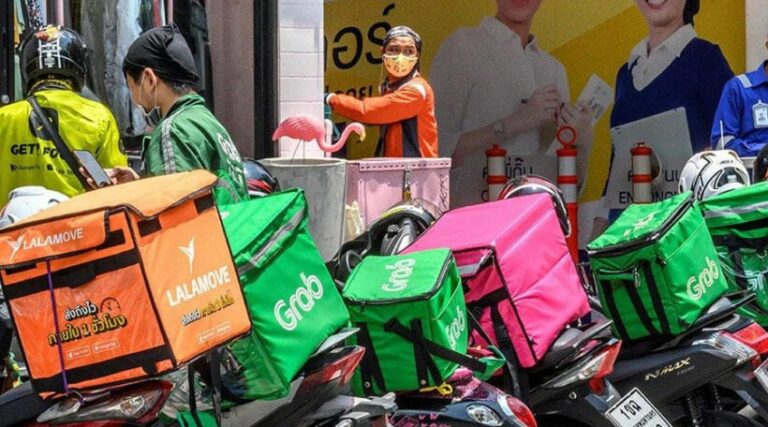
Today, we’re diving into one of the hottest topics in Thailand’s digital landscape: the explosive growth of food delivery apps. If you’ve been in Thailand recently, you’ve probably noticed the streets buzzing with motorbikes sporting colorful delivery boxes. The food delivery Thailand market has transformed from a convenience into an essential service, fundamentally changing how consumers access meals across the country.
How Did COVID-19 Accelerate Online Food Delivery in Thailand?
The Land of Smiles has wholeheartedly embraced the food delivery app revolution, with the Thailand food delivery market experiencing unprecedented growth across urban and suburban areas.
What’s Driving This Trend?
- Urbanization: With more Thais living in cities, the fast-paced urban lifestyle has created a perfect environment for food delivery apps in Thailand to thrive.
- Digital Savviness: Thailand boasts one of the highest internet and smartphone penetration rates in Southeast Asia. This tech-savvy population was primed and ready for the food delivery app in Thailand boom. Customer journey process has changed significantly because of that.
- Traffic Woes: Let’s face it, Bangkok’s traffic is legendary (and not in a good way). Online food delivery Thailand services offer a convenient solution to avoid the gridlock.
- Changing Work Culture: Long work hours and the rise of remote work have made food delivery Thailand an attractive option for busy professionals.
- COVID-19 Impact: The pandemic accelerated the adoption of food delivery services, turning them from a convenience into a necessity for many, driving significant Thailand food delivery growth.
Which Food Delivery App is Most Popular in Thailand?
Let’s examine the key players dominating the food delivery market Thailand landscape:
Grab Food Thailand
Originally a ride-hailing service, Grab Food Thailand has become a major player in the food delivery market. Their extensive network of drivers and user-friendly app has made them a go-to choice for many Thais seeking reliable food delivery Thailand services.
LINE MAN Thailand
Leveraging the popularity of the LINE messaging app in Thailand, LINE MAN Thailand offers food delivery, grocery delivery, and parcel delivery services. The platform has successfully integrated social messaging with food ordering, making it one of the leading food delivery apps in Thailand.
Robinhood Food Delivery Thailand
A relatively new player, Robinhood food delivery Thailand has been making waves with its zero-commission model for restaurants and fair pay for riders. This innovative approach has positioned Robinhood as a disruptive force in the Thailand food delivery market.
Foodpanda Thailand
With its distinctive pink branding, Foodpanda Thailand carved out a significant market share and was particularly successful in expanding beyond Bangkok into other Thai cities. However, their popularity declined due to fierce competition, ongoing financial losses, and strategic withdrawal by its parent company, culminating in the complete shutdown of Foodpanda Thailand services in May 2025.
Emerging New Markets
AirAsia Food: After acquiring Gojek’s Thailand operations, AirAsia launched AirAsia Food, focusing initially on select Bangkok districts. The platform is currently web-based and expanding its reach, offering free delivery within certain distances during its rollout.
Get (now rebranded as Gojek/GoFood): Initially entering as “Get” and now operating under the Gojek brand, this Indonesian-backed app is expanding its footprint in Thailand. Gojek offers a wide range of services, including food delivery, and is positioning itself as a major competitor among food delivery apps in Thailand.
Who Are the Key Players in Thailand’s Food Delivery Market?
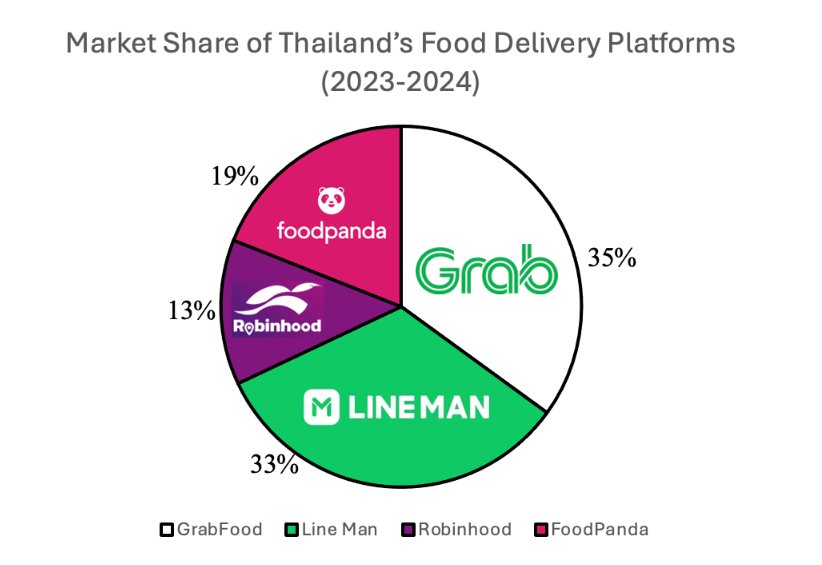
According to Rakuten Insight Survey, market analysis, the food delivery market share Thailand shows a competitive distribution among major platforms:
- GrabFood leads at 35% of market share
- LINE MAN follows closely with 33%
- Foodpanda maintained 19% before its exit in 2025
- Robinhood holds 13% with its unique zero-commission model
The market remains dynamic, with user preferences and market shares shifting as platforms innovate and expand. However, with Foodpanda’s exit from the Thailand food delivery market, the competitive landscape has consolidated among the remaining major players.
What Is the Size of the Food Delivery Market in Thailand?
The food delivery market in Thailand has seen exponential growth in recent years, with impressive Thai food delivery statistics:
- 2019: Market size reached approximately 35 billion baht
- 2020: This figure jumped to over 68 billion baht, largely due to pandemic impact
- 2025 Projections from Statista and Rakuten Insight suggest: The market could exceed 100 billion baht
This remarkable Thailand food delivery growth represents one of the most significant digital transformation success stories in Southeast Asia’s food service industry.
How Much Do Food Delivery Apps Charge in Thailand
Understanding the economics behind food delivery apps in Thailand reveals important insights into platform sustainability and restaurant partnerships:
Cost Structure Comparison: Thailand’s Major Food Delivery Apps
Platform | Commission Fee (to Restaurants) | Delivery Fee (to Consumer) | Platform Promo Cut | Driver Payment Structure |
GrabFood | 15%–30% | Variable (avg. ~20 baht) | Yes, from commission | Delivery fee + platform incentives |
LINE MAN | 25%–30% | Variable | Yes, from commission | Delivery fee + possible incentives |
Foodpanda | 30%–35% | Variable | Yes, from commission | Delivery fee + possible incentives |
Robinhood | 0% | Competitive, variable | No commission from vendor | Delivery fee only |
-
Key Insights
- Major platforms (GrabFood, LINE MAN, Foodpanda) charged high commission rates (up to 35%), which became a point of contention for small restaurants
- Robinhood’s zero-commission model was unique among major apps, aiming to support small businesses
- Delivery fees are generally paid by consumers and vary by platform, distance, and demand
- These economics significantly impact the food delivery Thailand ecosystem
How Has Thai Consumer Behavior Shifted Toward Food Delivery?
Understanding food delivery user behavior Thailand is crucial for anyone looking to enter or excel in this market. Key insights include:
- Convenience is King: Thai consumers value the ease and convenience of the best food delivery app in Thailand, often prioritizing it over cost.
- Diverse Culinary Choices: From street food to high-end restaurants, Thais appreciate the wide variety of options available on these apps.
- Promotions and Discounts: Thai consumers are deal-savvy and often make decisions based on promotional offers.
- Speed of Delivery: In the fast-paced urban environment, delivery time is a crucial factor in app selection.
- User Experience: A smooth, intuitive app interface can make or break a service’s popularity.
- Local Flavors: While international chains are popular, there’s a strong preference for local and authentic Thai cuisine.
Which Generation Uses Food Delivery Apps Most in Thailand?
Analyzing food delivery user behavior Thailand across different generations reveals distinct patterns:
Consumer Behavior by Age Group
Generation | Most Popular Apps | Usage Share (%) | Delivery Frequency per Week | Key Behavioural Traits |
Gen X | GrabFood, LINE MAN | 27% (lowest) | Lower than Gen Y/Z | Prefers convenience, orders less frequently, often compares prices/promotions, values reliability. |
Gen Y (Millennial) | GrabFood, LINE MAN | 40–58% (highest) | Moderate to high | Largest user group, uses multiple apps, compares deals, values variety and promotions. |
Gen Z | GrabFood, LINE MAN | 30% | Highest (multiple/week) | Smaller user base but highest order frequency, prioritizes convenience and app experience. |
Detailed Generational Analysis:
Gen X (born 1965–1980)
- Represents the smallest share of food delivery app Thailand users (27%)
- Orders less frequently than younger generations
- Prefers reliable platforms like Grab Food Thailand and LINE MAN Thailand
- Tends to compare prices and seek promotions before ordering
Gen Y (Millennials, born 1981–1996)
- The largest user group, making up 40–58% of users in the Thailand food delivery market
- Uses food delivery services moderately to frequently (several times a week)
- Often uses multiple apps to compare prices and promotions
- Values variety, convenience, and special offers
Gen Z (born 1997–2012)
- Makes up about 30% of users, but has the highest order frequency
- Many are students or young professionals driving Thailand food delivery trend
- Orders multiple times per week, with notable daily usage
- Highly values convenience, app usability, and fast delivery
- Represents a key growth segment for platforms
These Thai food delivery statistics support behavioral segmentation insights crucial for market research and platform development strategies.
What Are the Biggest Challenges for Food Delivery Companies in Thailand?
Like any rapidly growing sector, the food delivery market Thailand faces both challenges and exciting opportunities:
Challenges:
- Intense Competition: With multiple Thailand food delivery competitors vying for market share, standing out becomes increasingly difficult
- Thin Profit Margins: The race to offer the best deals and lowest delivery fees can impact profitability
- Regulatory Hurdles: As the market grows, increased scrutiny and potential regulation from authorities becomes likely
- Restaurant Partnerships: Balancing partner restaurant needs with platform profitability remains an ongoing challenge
- Rider Welfare: Ensuring fair treatment and safety for delivery riders is crucial for long-term sustainability
Opportunities:
- Market Expansion: Significant room for growth exists, especially in smaller cities and rural areas
- Technology Integration: AI and machine learning can improve efficiency and user experience
- Diversification: Expanding into grocery delivery or other services opens new revenue streams
- Sustainability Initiatives: With growing environmental awareness, eco-friendly packaging and delivery methods could differentiate platforms
- Cloud Kitchens: The rise of delivery-only restaurants presents new partnership opportunities
What’s Next for the Food Delivery Market in Thailand?
Several Thailand food delivery trend developments will shape the market’s future:
- Consolidation: Expect mergers and acquisitions as companies strive for market dominance in the Thailand food delivery market
- Hyper-Localization: More focus on local cuisines and neighborhood-specific offerings
- Tech Innovations: From drone deliveries to AR menu browsing, technology will continue driving digital transformation food delivery
- Health and Wellness Focus: As health consciousness grows, apps may prioritize healthy eating options and nutritional information
- Subscription Models: Rise of subscription models for food delivery offering benefits like free delivery or exclusive discounts, potentially integrated with AI-driven order prediction to enhance customer loyalty
Conclusion: A Feast of Opportunities
The food delivery app Thailand market represents more than just a trend – it’s a fundamental shift in how people interact with food and technology. For businesses, it presents a smorgasbord of opportunities, from tech startups to restaurant owners looking to expand their reach.
Success in the Thailand food delivery market requires deep understanding of Thai consumer behavior, technological innovation, and adaptability to rapid change. Whether you’re conducting market research, launching a startup, or operating a restaurant, staying informed about this dynamic sector proves both enlightening and profitable.
The digital transformation food delivery has brought to Thailand demonstrates the country’s readiness to embrace technology solutions that improve daily life. As the market continues evolving, those who understand local preferences while leveraging global innovations will find the most success.
For comprehensive insights into the food delivery market Thailand and consumer behavior analysis, market research becomes essential for making informed business decisions in this competitive landscape.
Frequently Asked Questions
What is the most popular food delivery app in Thailand?
GrabFood leads with 35% market share, followed by LINE MAN at 33%. Robinhood holds 13% with its zero-commission model.
How big is the food delivery market in Thailand?
The market reached 68 billion baht in 2020 and is projected to exceed 100 billion baht by 2025, up from 35 billion baht in 2019.
Which generation uses food delivery apps most in Thailand?
Millennials represent 40-58% of users (largest group), while Gen Z has the highest order frequency despite being 30% of users.
What commission fees do food delivery apps charge in Thailand?
Most platforms charge restaurants 15-35% commission. GrabFood charges 15-30%, LINE MAN 25-30%, while Robinhood charges 0%.
How did COVID-19 impact food delivery growth in Thailand?
The pandemic nearly doubled the market from 35 billion baht (2019) to 68 billion baht (2020), transforming delivery from convenience to necessity.
What's the future of Thailand's food delivery market?
Expect market consolidation, AI-driven order prediction, ghost kitchens expansion, and subscription models for enhanced customer loyalty.
References
- Rakuten Insight. “New survey: Food Delivery Apps in Thailand.” https://insight.rakuten.com/food-delivery-apps-in-thailand/
- Heaven is Hua Hin. “New Thai Delivery Apps Offer Low-Fee Alternative to Big Tech.” https://huahin.locality.guide/2025/05/22/new-thai-delivery-apps-offer-low-fee-alternative-to-big-tech/
- Grab. “#AskGrab: Where does the merchant commission go?” https://www.grab.com/th/en/blog/askgrab-merchant-commission/
- UTCC AEC Strategy Center. “Thailand Panel Mulls Online Food Delivery Fee Revamp.” https://aec.utcc.ac.th/thailand-panel-mulls-online-food-delivery-fee-revamp/
- Bangkok Post. “Panel mulls online food delivery fee revamp.” https://www.bangkokpost.com/business/general/2127895/panel-mulls-online-food-delivery-fee-revamp
- IT Business. “คนไทยใช้ Food Delivery น้อยลง ไม่สู้ราคาแพง.” https://today.line.me/th/v3/article/BERG5Lj
- Ubon Ratchathani Rajabhat University. “Factors on Marketing Mix from the Point of View of Consumers.” https://so04.tci-thaijo.org/index.php/ubruij/article/download/258476/175060
- Start.IO. “Food Deliveries App Users in Thailand.” https://www.start.io/audience/food-deliveries-app-users-in-thailand
- Statista. “Most popular food delivery apps in Thailand as of April 2023.” https://www.statista.com/statistics/1279851/thailand-most-used-food-delivery-apps/
- Editorialage. “20 Best Food Delivery Apps in Thailand.” https://editorialge.com/best-food-delivery-apps-in-thailand/
- Timeout. “Here are all the promotions from food delivery platforms this month.” https://www.timeout.com/bangkok/shopping/delivery-app-promos-this-month
If you wish to quote any information from this article, please kindly cite the source along with the link to the original article to respect copyright. |
 |
Iconic Research Thailand Your trusted partner in market research and consulting across Thailand and Southeast Asia. Headquartered in Bangkok, we provide research-driven insights across the Philippines, Malaysia, Indonesia, Singapore, Laos, and Vietnam. We help businesses navigate Thailand's market complexities through consumer insights, market entry strategy, and trend foresight. Contact us if you have any queries! (+66)888 954 954 |
Contact us
We always looking for new and exciting opportunities. Let’s connect.
Related posts
 AI Thailand: The Opportunity Is Real, But So Is the Complexity
Thailand’s AI market is projected to reach 114 billion baht by 2030, yet most Thai consumers remain cautious. Understanding who they are – and what they actually need from AI – is the difference between a product that lands and one that doesn’t.
13 min read Thailand 4.0 in 2026: An Investor’s Blueprint for the Innovation Economy
Thailand 4.0 has reached a defining year in 2026 – transitioning from policy vision to operational reality with AI integration, EV manufacturing, and digital infrastructure driving the innovation economy.
9 min read Unlocking the “Why” Behind Thai Culture: Introducing PhumPanya
Thai culture can feel like a puzzle. At PhumPanya, we believe the key to understanding Thai language and culture is in the words themselves. Explore our free database of Thai words, their roots, and the cultural logic hidden inside the language.
3 min read