

Thailand’s Eastern Economic Corridor (EEC) is Southeast Asia’s leading industrial investment zone, offering streamlined BOI incentives, Thailand FastPass approvals, and strategic opportunities in digital infrastructure, EV manufacturing, and green technology across Chonburi, Rayong, and Chachoengsao provinces.
Table of Contents
- The Global Context: Why Thailand, Why Now?
- The S-Curve Specialization: Where Capital is Flowing
- Regional Comparison: Chonburi vs. Rayong vs. Chachoengsao
- EEC Infrastructure Projects: 2026 Status Update
- The “Ground Truth” Gap: Why Market Research is Your Insurance
- Navigating the EEC with Strategic Intelligence
- References
Thailand’s industrial landscape is undergoing its most significant structural shift since the 1980s. The Eastern Economic Corridor (EEC) has evolved from an ambitious infrastructure project into a sophisticated ecosystem of specialized high-tech clusters. For foreign investors, EEC Thailand represents more than tax incentives—it’s the frontline of a national transition toward advanced green manufacturing and digital sovereignty [1, 3].
However, the “Gold Rush” culminating in record-breaking investment applications totaling $60.23 billion in 2025 has created a crowded and complex environment [2]. Success in the EEC Thai zones in 2026 no longer depends on merely showing up. It requires deep understanding of which industrial clusters are nearing saturation and which offer untapped high-yield potential [2, 3].
The Global Context: Why Thailand, Why Now?
The surge in EEC investment isn’t happening in a vacuum. By 2026, the global “China-Plus-One” strategy has matured. Investors are no longer seeking “anywhere but China”—they want “Trusted Hubs” with stable energy, clear digital laws, and neutral geopolitical positioning [1].
With recent US-Thailand joint statements on reciprocal trade and 17 FTAs currently in effect, Thailand has positioned the EEC as Southeast Asia’s primary “safe harbor” for electronics and automotive supply chains. The corridor’s strategic location, combined with government policy clarity, makes it the region’s most compelling industrial destination [3].
The S-Curve Specialization: Where Capital is Flowing
In 2026, the Thai government has sharpened its focus on “Advanced Green Manufacturing” and “Modern Industries” as primary GDP growth engines [3]. Capital is concentrating into three specific “S-Curve” pillars within EEC Thailand.
Digital Infrastructure and AI Hubs
The digital sector leads 2026 investment, attracting nearly $24 billion in applications [2]. Global tech giants are establishing hyperscale data centers to serve ASEAN’s exploding AI demand. The EEC is now marketed as “ASEAN’s Digital Hub,” supported by a dedicated Digital Infrastructure Development Plan (2024–2027) targeting 100% 5G coverage and low-latency applications like autonomous vehicles [4].
For investors, this means opportunities in cloud infrastructure, edge computing facilities, and AI training centers—all benefiting from streamlined BOI approvals and energy infrastructure prioritization.
EV Hub 2.0: The Heart of the Vehicle
While Thailand has long been the “Detroit of the East,” the 2026 roadmap focuses on EV Hub 2.0. The emphasis has shifted from simple vehicle assembly to high-density battery manufacturing—specifically cell, module, and pack production [2].
Major players must now source high-value components domestically to qualify for the most lucrative BOI schemes. This requirement is transforming the EEC Thai industrial landscape into a complete value chain for next-generation mobility, creating opportunities for parts manufacturers and materials suppliers [2].
Green Manufacturing and the BCG Model
The Bio-Circular-Green (BCG) model is no longer aspirational—it’s mandatory for new projects. The World Bank notes that Thailand’s “green goods” exports already account for nearly 10% of total exports [3].
In the EEC, this manifests as a surge in “Smart Industrial Estates” prioritizing energy-efficient cooling, solar integration, and circular waste management. Investors pursuing green credentials find the EEC Thailand framework provides both regulatory support and market access advantages [3].
Regional Comparison: Chonburi vs. Rayong vs. Chachoengsao
Choosing the right province within EEC Thailand is a strategic decision affecting logistics, talent access, and operational overhead.
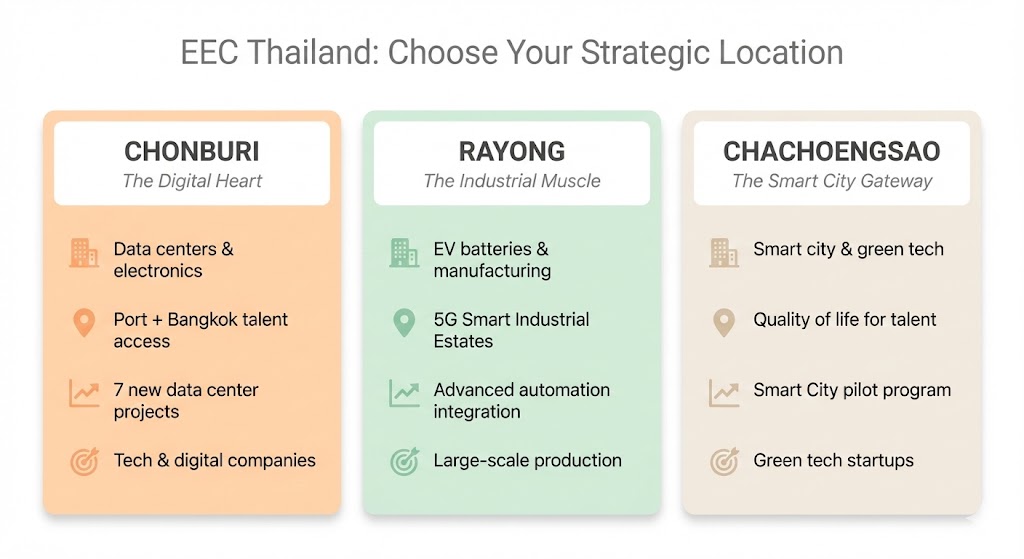
Chonburi: The “Digital Heart”
Adjacent to Laem Chabang Port, Chonburi has become the preferred site for data centers and smart electronics. In early 2026 alone, seven major data center projects were approved here [2]. The province offers superior digital connectivity and proximity to Bangkok’s talent pool.
Rayong: The “Industrial Muscle”
Rayong is the core of heavy industry and EV battery production. It hosts the most advanced “Smart Industrial Estates” integrating 5G-enabled automation and edge computing [4]. For manufacturers requiring large-scale production facilities and established industrial support services, Rayong remains the logical choice.
Chachoengsao: The “Smart City Gateway”
Often overlooked, Chachoengsao is evolving into a livable hub for high-skilled workforce. It serves as pilot area for the Chachoengsao Smart City project, focusing on green value chains and intelligent farm management to support Bangkok’s expansion [4].
EEC Infrastructure Projects: 2026 Status Update
While the EEC offers significant opportunities, investors should understand current infrastructure project timelines. As of February 2026, several flagship projects face implementation delays requiring adjusted expectations for connectivity and logistics readiness.
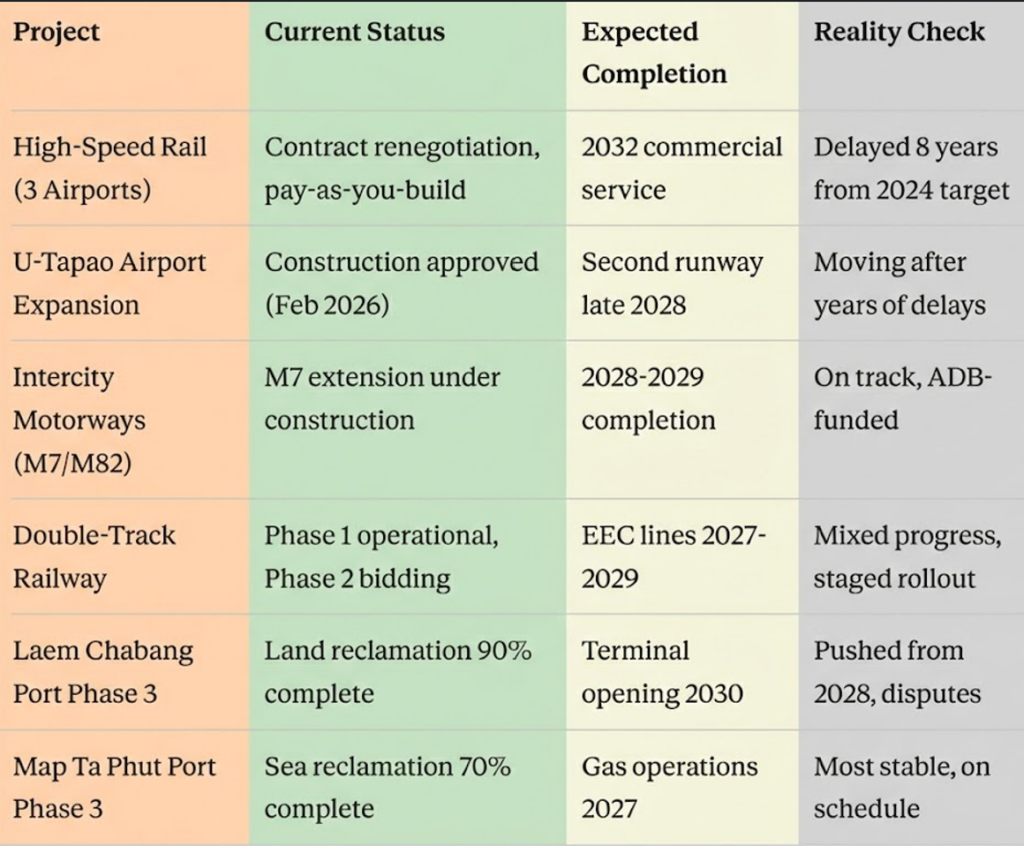
Understanding these infrastructure timelines is critical for operational planning. While delays affect connectivity, they also create opportunities for investors who can navigate interim logistics challenges that deter less-informed competitors.
The “Ground Truth” Gap: Why Market Research is Your Insurance
The Board of Investment (BOI) introduced the “Thailand FastPass” system to cut red tape by 20–50% for strategic projects exceeding 1 billion THB [2, 5]. But while the government provides permits, market research provides “ground truth.”
Investors in 2026 face three critical risks that official brochures won’t solve:
The Skilled Labor Squeeze: Despite government programs aiming to reskill 100,000 individuals, demand for specialized AI and green energy engineers far outstrips supply [5]. Labor mapping ensures your facility can actually be staffed before you break ground.
Energy and Utility Reliability: The surge in data centers has placed unprecedented pressure on the national grid. Industry outlooks identify “energy adequacy” as a vital 2026 risk factor [2]. Feasibility studies audit specific local utility capacity, ensuring your “FastPass” permit actually results in a powered factory.
Stakeholder and “NIMBY” Dynamics: In 2026, local communities are increasingly vocal about environmental impacts. Even with BOI approval, projects can stall for months facing local district opposition. Stakeholder mapping identifies power structures in local communities, allowing you to secure a “Social License to Operate” [5].
Navigating the EEC with Strategic Intelligence
The EEC Thai roadmap for 2026 presents immense opportunity alongside heightened complexity. The Thai government’s “Quick Big Win” policies have opened doors for massive capital inflows, but the economic climate requires investors to be more rigorous than ever [3, 5].
At Iconic Research, we believe data is the ultimate risk-mitigation tool. The EEC provides the roadmap, but successful entry requires a compass. Before you break ground in Chonburi or Rayong, ensure your strategy is validated by local expertise that goes beyond government brochures.
Frequently Asked Questions
What is the EEC Thailand?
Thailand's flagship industrial zone offering BOI incentives, fast-track approvals, and infrastructure for high-tech manufacturing across three provinces.
Which EEC province is best for my industry?
Chonburi for data centers, Rayong for heavy manufacturing and EV production, Chachoengsao for smart city opportunities.
What are the main EEC investment sectors in 2026?
Digital infrastructure/AI hubs, EV battery manufacturing, and Bio-Circular-Green mandatory green manufacturing.
What is the Thailand FastPass system?
BOI program cutting approval timelines 20-50% for strategic projects exceeding 1 billion THB.
What risks should investors research in the EEC?
Skilled labor shortages, energy grid constraints, and local community opposition requiring feasibility validation.
References
[1] Royal Thai Embassy. “Thailand’s Eastern Economic Corridor (EEC) Factsheet.” https://washingtondc.thaiembassy.org/en/page/eastern-economic-corridor-eec?menu=641d7fb54f13e1579a67e3b5
[2] Board of Investment (BOI). “BOI Accelerates Thailand FastPass to Unlock Strategic Investment.” https://www.boi.go.th/index.php?page=press_releases_detail&topic_id=134676&_mod&language=en
[3] World Bank. “Thailand Economic Monitor February 2026: Advanced Green Manufacturing for Growth.” https://www.worldbank.org/en/country/thailand/publication/thailand-economic-monitor-february-2026-advanced-green-manufacturing-for-growth
[4] Thailand.go.th. “EEC approves digital infrastructure plan to position Thailand as ASEAN’s Digital Hub.” https://www.thailand.go.th/issue-focus-detail/eec-approves-digital-infrastructure-plan-to-position-thailand-as-aseans-digital-hub
[5] The Legal Co. “Thailand Targets 2026 as Investment-Driven Growth Year with Fast-Track Initiatives.” https://thelegal.co.th/2025/11/25/thailand-targets-2026-as-investment-driven-growth-year-with-fast-track-initiatives-to-unlock-300-billion-baht-in-private-projects/
If you wish to quote any information from this article, please kindly cite the source along with the link to the original article to respect copyright. |
 |
Iconic Research Thailand Your trusted partner in market research and consulting across Thailand and Southeast Asia. Headquartered in Bangkok, we provide research-driven insights across the Philippines, Malaysia, Indonesia, Singapore, Laos, and Vietnam. We help businesses navigate Thailand's market complexities through consumer insights, market entry strategy, and trend foresight. Contact us if you have any queries! (+66)888 954 954 |
Contact us
We always looking for new and exciting opportunities. Let’s connect.
Related posts
 AI Thailand: The Opportunity Is Real, But So Is the Complexity
Thailand’s AI market is projected to reach 114 billion baht by 2030, yet most Thai consumers remain cautious. Understanding who they are – and what they actually need from AI – is the difference between a product that lands and one that doesn’t.
13 min read Thailand 4.0 in 2026: An Investor’s Blueprint for the Innovation Economy
Thailand 4.0 has reached a defining year in 2026 – transitioning from policy vision to operational reality with AI integration, EV manufacturing, and digital infrastructure driving the innovation economy.
9 min read Unlocking the “Why” Behind Thai Culture: Introducing PhumPanya
Thai culture can feel like a puzzle. At PhumPanya, we believe the key to understanding Thai language and culture is in the words themselves. Explore our free database of Thai words, their roots, and the cultural logic hidden inside the language.
3 min read