

AI Thailand: The Opportunity Is Real, But So Is the Complexity
15 min readAI Thailand refers to the growing ecosystem of artificial intelligence technology, investment, and adoption across Thailand’s economy – spanning financial services, retail, manufacturing, healthcare, and government. Driven by the National AI Strategy (2022-2027) and Thailand 4.0, it covers everything from Thai language AI models and chatbots to enterprise automation and consumer-facing GenAI tools. Understanding how Thai consumers and businesses actually engage with AI – not just how much is being invested – is what separates successful deployments from costly ones.
Table of Contents
- The Question That Silenced the Room
- The Numbers – What’s Real and What Needs Context
- Who the Thai AI Consumer Actually Is
- Fear, Trust, and What Thai Consumers Are Actually Asking For
- Why AI Doesn’t Simply Transplant into Thailand
- Where AI Actually Meets Thai Consumers
- Which AI Tools Are Thais Actually Using?
- The AI Ecosystem in Thailand: Who Is Actually Building Here
- PDPA, the AI Bill, and Why the Regulatory Window Matters Now
- What This Means in Practice
- References
The Question That Silenced the Room
In mid-2025, senior executives at SCBX – one of Thailand’s largest financial groups – posed a question during a leadership meeting: “Do customers perceive us as an AI-first organization the way we view ourselves?” The most honest answer was: we simply didn’t know. After three years of building GenAI into operations and reinventing internal workflows, the transformation had remained largely invisible to the people it was supposed to serve. [1]
That moment of organizational honesty is a useful starting point for anyone tracking AI Thailand’s development. The market is growing fast, investment is arriving from all directions, and the government has set serious targets. But there is a consistent gap between what companies think they’re delivering and what consumers are actually experiencing – and that gap has real commercial consequences.
The Numbers – What’s Real and What Needs Context
The headline figure you’ll see most often is 3 trillion baht. According to a 2024 survey by the Digital Economy Promotion Agency (depa) and the IMC Institute, Thailand’s digital economy reached 2.496 trillion baht that year – a 23.35% increase – and is forecast to hit 3 trillion baht by 2027. [2] That’s a compelling number, but it covers the entire digital economy: hardware exports, software, digital services, and content. Hardware alone accounted for 1.85 trillion baht of 2024’s figure, growing at 26.62%, driven largely by smart device exports and global demand.
The AI-specific market tells a different story – still impressive, but more precise. Thailand’s GenAI market was estimated at US$180 million in 2024, growing at 46.5% annually and projected to reach US$1.77 billion by 2030. DEPA’s own Thailand Digital Technology Foresight 2035 report puts the total AI market at 114 billion baht by 2030. [3] That’s the number worth planning around.
The investment signals are real. NVIDIA, AWS, and Microsoft have all made commitments in Thailand. AWS opened its first infrastructure region in-country in early 2025. For any AI company in Thailand – whether a global platform or a regional developer – the infrastructure foundations are now in place. The government’s National AI Strategy (2022-2027) – the backbone of the broader Thailand 4.0 economic vision and its digital transformation Thailand agenda – targets 30,000 trained AI professionals, 100 R&D prototypes, and business and social impact of at least 48 billion baht from AI technology Thailand-wide by 2027. [3] The policy scaffolding is in place. The harder question is whether the consumer side has been understood with the same rigour.
Who the Thai AI Consumer Actually Is
The SCBX report surveyed 1,004 Thai consumers nationwide – conducted by Ipsos and Vitamins – and produced the most detailed picture of Thai consumer behaviour in the AI era available. [1] The findings don’t describe a population afraid of technology. They describe a population that is already surrounded by it, just not always aware of it.
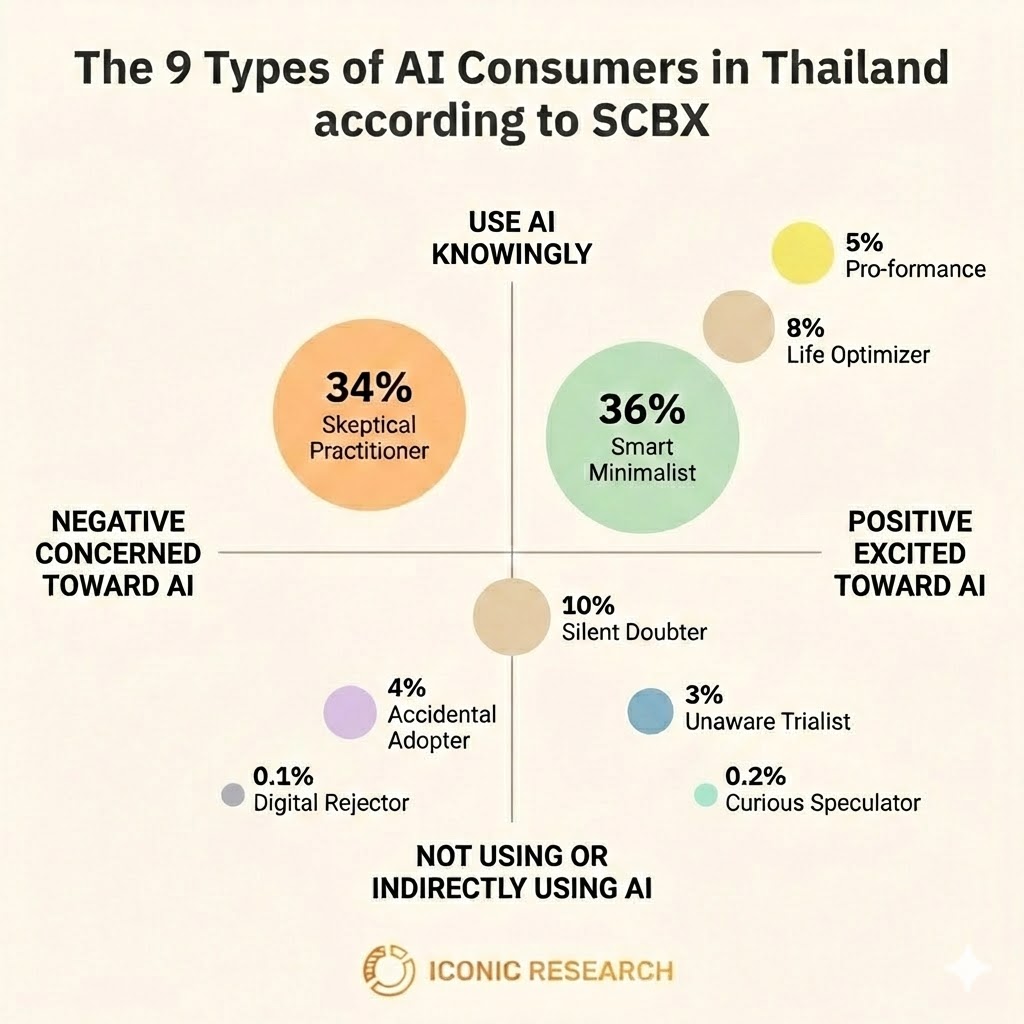
Over 90% of Thai consumers are familiar with the term “AI” and 80% are already using AI-powered tools – often without realising it. TikTok’s recommendation algorithm. Google’s search ranking. Bank fraud detection. These are all AI working in the background. Thai consumers have absorbed passive AI into daily life almost completely. The tension arises when AI becomes visible and interactive – when people are asked to trust a system they cannot see the reasoning behind.
The report identifies nine consumer segments, but two dominate. Smart Minimalists (36%) use AI for practical, low-risk tasks – translation, text summarisation, grammar checking – and manually verify results. They want simplicity and security above everything else. Skeptical Practitioners (34%) are active, frequent users who remain genuinely wary. They use AI regularly but haven’t been fully convinced to trust it. Together, these two groups make up 70% of Thailand’s consumer population. [1]
The implication is direct. The majority of Thai consumers are already in your market. The differences between them are not about access or awareness – they’re about trust and depth of usage. Any business launching AI-powered products or services without knowing which segment its customers belong to is making decisions without a map.
Fear, Trust, and What Thai Consumers Are Actually Asking For
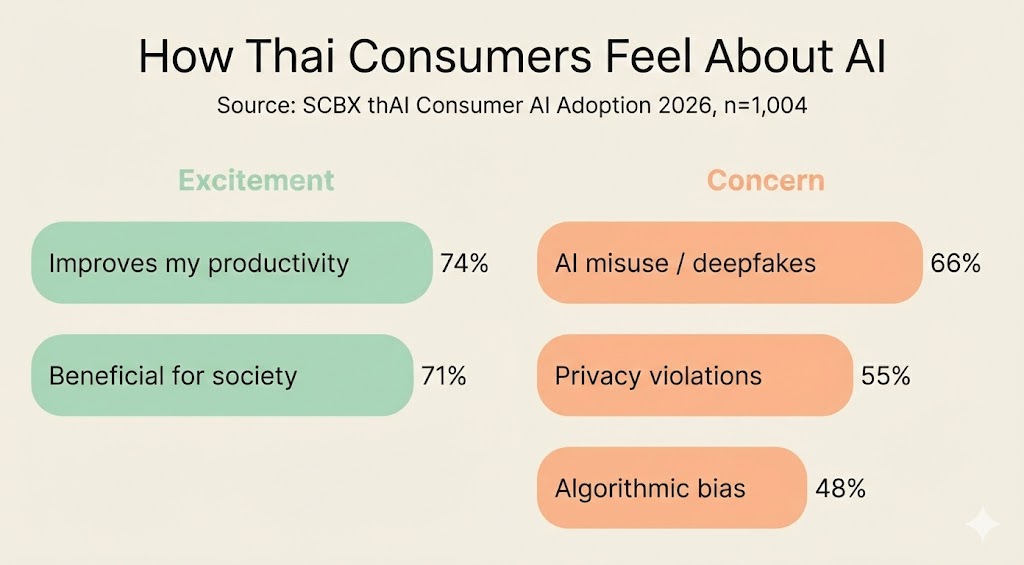
The emotional profile of Thai AI consumers is more nuanced than a simple adoption curve. 74% believe AI improves their productivity. 71% see it as beneficial for society. Yet 66% fear AI being misused for deepfakes and misinformation, 55% are worried about privacy violations, and 48% are concerned about algorithmic bias. [1] These numbers coexist because they describe different things: belief in AI’s potential, and scepticism about how it will actually be used by the organisations deploying it.
The single most important finding in the report is this: 79% of Thai consumers say human validation is essential when reviewing AI results. This isn’t technophobia. It’s a clear design brief. Thai consumers don’t expect AI to be perfect – they expect it to be transparent, explainable, and to have a human available when things get complicated. The SCBX report frames this as a “Human-in-the-Loop” principle, noting that this approach achieves significantly higher consumer acceptance in Thailand. [1]
The report’s conclusion carries real strategic weight: “AI adoption among Thai consumers is not driven by technology, but by trust.” Organisations can deploy the most technically sophisticated artificial intelligence in Thailand and still lose consumer confidence if they haven’t designed for transparency and human fallback. Getting that design right requires knowing your users – which segments they fall into, what their specific anxieties are, and what “simple and safe” actually means to them in practice.
Why AI Doesn’t Simply Transplant into Thailand
Consumer psychology is one layer of complexity. Language and culture are another. Thai is genuinely difficult terrain for AI systems trained primarily on English-language data. The language is tonal – a single syllable can carry five different meanings depending on pitch – has no spaces between words, and shows significant variation across regional dialects. Of the roughly 69 million Thai speakers, only about 20 million have Central Thai as their first language. [4]
Popular large language models are trained on data where Thai represents less than 0.5% of the total corpus. Thai NLP – natural language processing built specifically for the Thai language – is more expensive and less accurate than equivalent work for Latin-script languages, meaning higher costs and lower performance for developers building Thai language AI applications. [4] This is why Thailand’s research community has been developing its own models – Typhoon, OpenThaiGPT, Pathumma – specifically trained on Thai-language data and cultural context.
The SCBX report picks up this thread from the consumer side. Its third design principle for Thai AI deployment is what it calls “Meaningful Simplicity” – enabling systems to communicate in natural human language, understand various dialects, and integrate services seamlessly. [1] For businesses entering the Thai market with AI products, localisation is not a post-launch consideration. It’s a precondition for relevance.
Where AI Actually Meets Thai Consumers
Platform behaviour in Thailand doesn’t follow Western assumptions. The SCBX data shows that 35% of Thai consumers already interact with bank chatbots in Thailand via LINE Official Accounts. [1] Customer service, commerce, and financial inquiries happen on LINE, Facebook Messenger, and Instagram – not on dedicated apps or web portals. Any AI customer service deployment that ignores this is being built for an audience that isn’t there.
This connects to a broader pattern in Thailand consumer behavior. Thai consumers are comfortable with AI in familiar, convenient channels. They switch to human contact the moment complexity arises or trust is required. [5] Designing AI into the Thai customer experience means designing for that transition – making it effortless to move from bot to human and back – not trying to eliminate it.
Which AI Tools Are Thais Actually Using?
Web traffic data from Statcounter (December 2025) gives us the clearest country-level picture available. ChatGPT commands 74% of AI chatbot traffic in Thailand — higher than its global average — followed by Google Gemini at 16%, Perplexity at 7%, Microsoft Copilot at 2%, and Claude under 1%. DeepSeek, despite its global moment earlier in 2025, doesn’t register. [6]
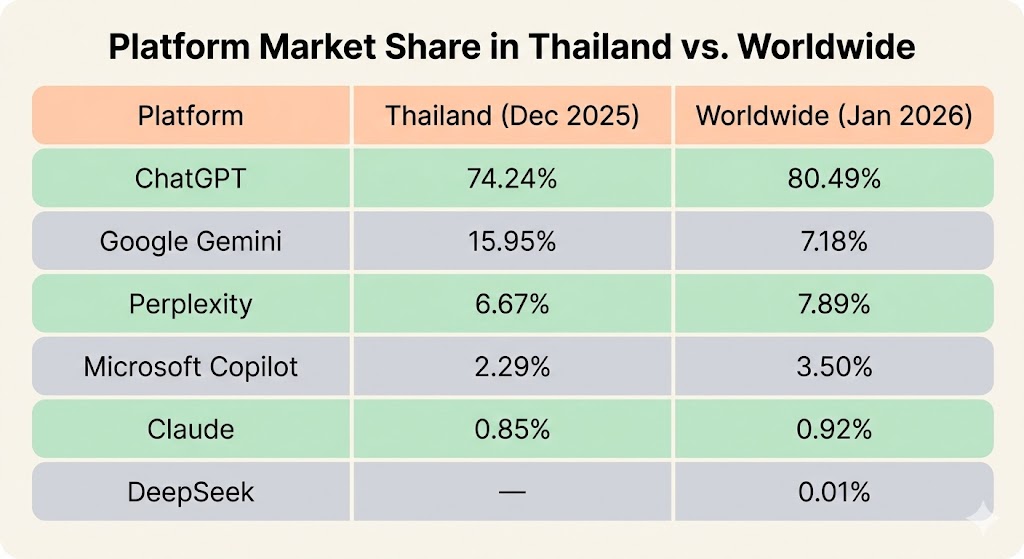
A few things stand out. ChatGPT’s grip on Thailand is stronger than in most markets, suggesting the brand became synonymous with “AI” here before alternatives had a chance to compete. Perplexity’s 7% share is above its global average and hints at a segment of more research-oriented, higher-education users in the Thai adopter base. Claude’s sub-1% share reflects its global positioning as a developer and enterprise tool rather than a consumer product.
One important caveat: Statcounter tracks website visits, not satisfaction, retention, or actual task completion. These numbers tell us where Thais go first — not whether they found what they were looking for when they got there. That distinction matters for any brand building AI-powered products for the Thai market: reach and trust are not the same thing, and in a market where 79% of consumers still want a human to verify AI outputs, winning the traffic battle is only the beginning.
The AI Ecosystem in Thailand: Who Is Actually Building Here
Understanding which AI tools Thai consumers use is one side of the picture. The other is who is building the infrastructure and models that will define the market over the next five years.
At the infrastructure level, the commitments are significant. AWS opened its first Thai data center region in early 2025, providing the in-country cloud infrastructure that enterprises and AI developers previously had to route through Singapore. Microsoft has made investment commitments tied to AI training and cloud expansion. NVIDIA has established a presence in Thailand through partnerships with local universities and the EEC’s digital cluster — its chips underpin the data center growth that Chonburi and Rayong are currently absorbing.
At the model level, the story is more distinctly Thai. Because standard large language models perform poorly on Thai-language tasks — a consequence of Thai representing less than 0.5% of most training data — a local model ecosystem has developed.
- Typhoon, developed by SCB’s OPSTA, is the most prominent Thai-language LLM.
- OpenThaiGPT is an open-source initiative building on the LLaMA architecture with Thai-language fine-tuning.
- Pathumma, developed by NSTDA, focuses on public sector and research applications.
These are not hobbyist projects — they are the foundation of any AI application that needs to work in Thai at genuine accuracy levels.
For any AI company in Thailand considering local deployment, partnerships, or product development, the ecosystem has two layers: the global infrastructure providers who have now committed physically to Thailand, and the Thai-language model builders whose work is the prerequisite for consumer-facing AI that actually functions as intended.
PDPA, the AI Bill, and Why the Regulatory Window Matters Now
Thailand’s AI regulatory environment is still forming, which creates both uncertainty and opportunity. The PDPA – Thailand’s Personal Data Protection Act – has been fully enforced since 2022, and 2025 saw active enforcement including the country’s first major administrative fines. For any company deploying AI that touches personal data, PDPA Thailand compliance is no longer optional or aspirational: it’s a live enforcement reality. An AI Bill is in draft, with provisions that include a local representation requirement for foreign AI service providers and regulatory sandboxes for AI testing. [3] Companies investing in consumer understanding now – before binding regulation arrives – will be better positioned for compliance and better insulated from the reputational risk of getting it wrong publicly.
What This Means in Practice
The picture that emerges is consistent across every source. Thailand’s AI market is large and growing. Consumer adoption is already widespread in passive form. But the gap between deployment and genuine consumer trust is significant, and it won’t close on its own.
For AI companies entering Thailand – whether global platforms, regional developers, or any AI company in Thailand looking to scale – due diligence means understanding which consumer segments your product will serve, how those segments relate to AI trust and anxiety, what the language and cultural requirements actually are, and who the relevant stakeholders are as regulation takes shape.
For Thai businesses implementing AI, the priority is honest evaluation before the next investment. The question SCBX asked itself in 2025 – do our customers actually experience us as AI-first? – is one every organisation should be asking before launch, not after.
Ready to move from insight to action? Whether you’re validating a product or testing how Thai users respond to your AI interface, we can help. Explore our Concept Testing & Pre-Validation and User Centered Design Research services, or get in touch.
“For Thai consumers, the best technology may not be the smartest – but the one that understands humans best.” [1]
Frequently Asked Questions
How big is the AI market in Thailand?
Thailand's specific AI market is projected to reach 114 billion baht by 2030, within a broader digital economy forecast to hit 3 trillion baht by 2027.
Do Thai consumers trust AI?
Adoption is high but trust is conditional. 66% fear AI misuse and 79% say human validation is essential - meaning transparency and human fallback are non-negotiable in any Thai AI deployment.
What is the PDPA and does it affect AI in Thailand?
The Personal Data Protection Act has been fully enforced since 2022 with active fines from 2025. Any AI system processing personal data of Thai users must comply, including foreign providers.
Why do AI products need localisation for Thailand?
Thai represents less than 0.5% of most AI training data. The language is tonal, unspaced, and dialectally varied - making standard models less accurate and more expensive to run than for Latin-script languages.
Which platforms do Thai consumers use for AI-powered services?
LINE is the dominant channel - 35% of Thai consumers already interact with bank chatbots via LINE Official Accounts, ahead of dedicated apps or web portals.
References
[1] SCBX. “thAI Consumer AI Adoption 2026.” https://www.scbx.com/en/scbx-exclusive/thai-consumer-ai-adoption/
[2] Nation Thailand / depa + IMC Institute. “AI to drive Thailand’s digital economy to 3 trillion baht by 2027.” https://www.nationthailand.com/business/tech/40055363
[3] Bangkok Post. “Thailand stands on precipice of major AI boom.” https://www.bangkokpost.com/business/general/2925276/thailand-stands-on-precipice-of-major-ai-boom
[4] Carnegie Endowment for International Peace. “Speaking in Code: Contextualizing Large Language Models in Southeast Asia.” https://carnegieendowment.org/research/2025/01/speaking-in-code-contextualizing-large-language-models-in-southeast-asia
[5] OurGreenfish. “Customer Service Channels 2025 in Thailand: Phone, Email, or AI?” https://blog.ourgreenfish.com/the-business-mind/customer-service-channels-2025-in-thailand-phone-email-or-ai
[6] Statcounter Global Stats. “AI Chatbot Market Share Thailand — December 2025.” https://gs.statcounter.com/ai-chatbot-market-share/all/thailand
If you wish to quote any information from this article, please kindly cite the source along with the link to the original article to respect copyright. |
 |
Iconic Research Thailand Your trusted partner in market research and consulting across Thailand and Southeast Asia. Headquartered in Bangkok, we provide research-driven insights across the Philippines, Malaysia, Indonesia, Singapore, Laos, and Vietnam. We help businesses navigate Thailand's market complexities through consumer insights, market entry strategy, and trend foresight. Contact us if you have any queries! (+66)888 954 954 |
Contact us
We always looking for new and exciting opportunities. Let’s connect.
Related posts
 Growth Strategy: The Expansion Decisions That Need Evidence
Growth strategy is the set of decisions about where a company expands next. Only 25% of companies grow sustainably — the difference is evidence, not ambition.
9 min read Brand Strategy: The Decisions That Should Be Built on Evidence
Brand strategy is the set of decisions that determine how a brand competes. Those decisions only pay off when they’re built on consumer evidence — not a workshop.
11 min read Key Opinion Leader: What Thai Brands Should Research Before, During, and After a KOL Campaign
Platform metrics mislead brands choosing and measuring KOLs in Thailand. A research-first look at what to verify before, during, and after a campaign.
10 min read