
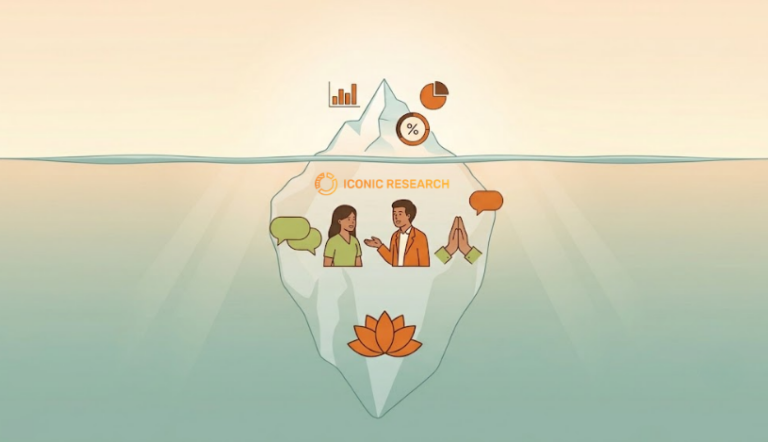
Consumer Insights: What the Data Doesn’t Tell You About Thai Consumers
9 min readConsumer insights are actionable interpretations of research data that explain why consumers behave as they do — not just what they purchase, but the motivations, cultural expectations, and unmet needs behind their choices. They go beyond market research, which records what is happening, to explain the reasons driving it. Consumer insights are produced through qualitative research, quantitative surveys, and social listening, and are the foundation for product, positioning, and communication decisions.
Table of Contents
- Consumer Insights vs Market Research
- Why Consumer Insights in Thailand Are Different
- How to Collect Consumer Insights in Thailand
- Consumer Insight Analysis — Turning Data into Decisions
- Consumer Insights in Practice — Thai Case Studies
- References
Consumer insights are the interpretation of why Thai consumers behave as they do — not just what they purchase, but the motivations, tensions, and cultural expectations that drive those choices. The problem is not a shortage of consumer data in Thailand — it is a shortage of genuine insight. Most organisations operating in Thailand have access to surveys, sales data, and social media metrics. What they lack is an accurate interpretation of what that data means in a market where standard research instruments systematically produce misleading results. This article explains the distinction, the methodology, and what genuine consumer insight research requires in Thailand.
Consumer Insights vs Market Research
Market research gathers data — market size, demographics, purchase frequency, category trends. Consumer insights interpret that data to explain the motivations, barriers, and cultural expectations behind observed behaviour [1]. Market research answers what. Consumer insights answer why.
The two approaches are not competing — they are sequential. Market research defines the landscape. Consumer insight research interprets the story within it [1]. In Thailand, the interpretation step is where most international brands underinvest, because they assume the data they collect reflects actual consumer preferences. In many cases, it does not.
Why Consumer Insights in Thailand Are Different
Thailand is not a difficult market to collect data from — it is a market where collected data frequently misrepresents reality. Three structural reasons:
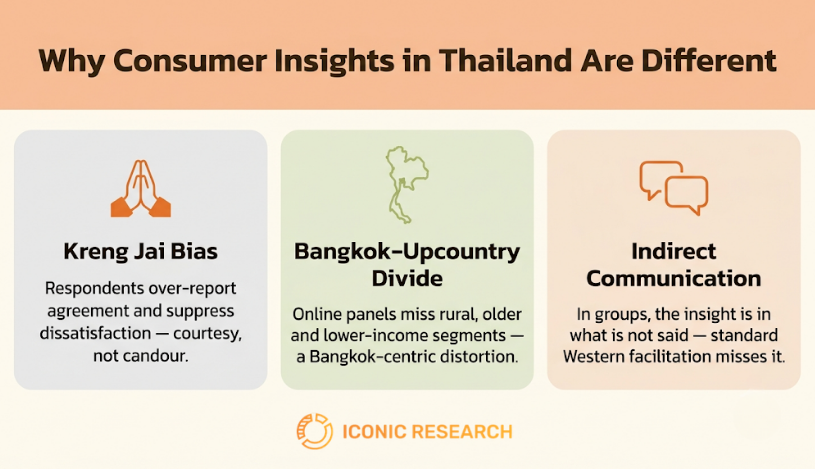
Acquiescence bias and kreng jai. Thai respondents systematically over-report agreement and under-report dissatisfaction in survey contexts [2][4]. This is not dishonesty — it is a culturally embedded norm of avoiding conflict and protecting the feelings of others, documented in research as kreng jai [2]. In a brand awareness survey, this means aided recognition scores are inflated — respondents affirm familiarity with brands they have not encountered. In a product satisfaction study, it means negative sentiment is suppressed. Instruments without built-in controls — decoy items, forced-choice formats, consistency checks — produce consumer behavior insights that reflect courtesy rather than genuine preference [4].
The Bangkok–upcountry divide. Online panels — the default data collection instrument for many global agencies — structurally underrepresent rural populations, older demographics, and lower-income segments [3]. In a market where regional variation in consumption patterns is significant and well-documented, panel-based consumer insight research produces a Bangkok-centric picture that misrepresents national consumer behaviour [3][6]. Offline CAPI fieldwork reaching provincial respondents produces materially different findings in category after category.
Indirect communication in qualitative settings. In focus groups and interviews, Thai participants will not readily contradict a moderator, express strong negative opinions about a product, or challenge a framing they find uncomfortable [2]. A moderator without genuine cultural knowledge and adapted probe techniques will surface comfortable consensus rather than authentic consumer tensions. The insight is in what is not said as much as what is — and standard Western facilitation protocols are not designed to surface it.
How to Collect Consumer Insights in Thailand
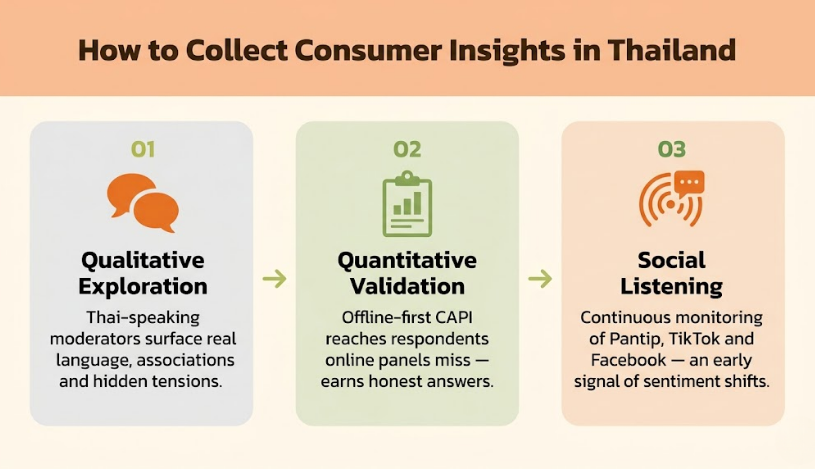
Stage 1 — Qualitative exploration. Consumer insight research in Thailand begins with qualitative methods — focus groups or in-depth interviews with target consumers, conducted by Thai-speaking moderators with genuine cultural knowledge. This stage surfaces the language consumers use about the category, the associations they hold about competing brands, and the tensions between stated preference and observed behaviour that structured surveys cannot detect. Qualitative research at this stage is not optional — it is the layer where Thai-specific cultural dynamics are captured before they get averaged out in quantitative data.
Stage 2 — Quantitative validation. Once qualitative exploration has identified the key associations, motivations, and barriers, quantitative research establishes their scale and distribution across the target population. In Thailand, offline-first data collection — CAPI conducted by trained interviewers — reaches respondents that online panels miss and produces more reliable responses because the interview context provides social cover for honest answers.
Stage 3 — Social listening as a continuous signal. Social listening monitors brand and category conversations in unsolicited consumer language — on Pantip, TikTok, Facebook communities, and review platforms — providing a leading indicator of sentiment shifts before they appear in structured tracking data.
Consumer Insight Analysis — Turning Data into Decisions
Data collection is not the hard part. The hard part is consumer insight analysis — interpreting findings in a way that produces a clear strategic recommendation, not a report of what respondents said.
Three principles for analysis that produces actionable insight.
First, distinguish between what consumers say and what they do. In Thailand, stated preferences in research contexts frequently diverge from observed purchase behaviour — the insight lies in the gap, not in the stated preference alone.
Second, segment by behaviour, not just demographics. Bangkok and upcountry consumers in the same age and income bracket frequently hold materially different brand associations and category relationships. National averages obscure these differences.
Third, connect findings to a specific business decision. A consumer insight that cannot be linked to a product, pricing, channel, or communication choice is not an insight — it is an observation. The value of consumer insight research is in the decision it enables, not the data it produces.
The output of consumer insight analysis is a research-backed customer persona — a profile that reflects what Thai consumers actually do, not what they say in a survey.
Consumer Insights in Practice — Thai Case Studies
EV market entry. A global automotive brand used consumer insight research to understand Thai consumer attitudes toward electric vehicles before market entry. Qualitative research revealed that purchase barriers were not primarily price or range anxiety — they were after-sales service trust and the perceived risk of owning a vehicle without an established repair network. The insight redirected investment from product specification communication to service network communication. See the full case study.
Medical nutrition localisation. A global medical nutrition company needed to understand patient experiences with oral nutritional supplements across Thailand’s healthcare system. A weeklong diary study combined with in-depth interviews across 32 patients and 12 healthcare professionals revealed gaps between prescribed consumption and actual patient behaviour that product specifications had not captured — producing specific product improvement recommendations grounded in real usage conditions. See the medical nutrition research case study.
Gen Z digital platform behaviour. A global media and entertainment company needed to understand how Thai Gen Z audiences chose between competing digital platforms — and what emotional triggers drove engagement during “Me Time.” Qualitative research including in-depth interviews and focus groups in Bangkok and regional cities revealed that platform choice was driven by emotional context and daily routine, not feature comparison. The insight redirected the client’s positioning from product attributes to emotional territory. See the digital consumer behaviour case study.
Consumer insights in Thailand are not difficult to collect — they are difficult to collect accurately. The gap between what Thai consumers say in a standard survey context and what they actually think, feel, and do is the central methodological challenge. Organisations that close that gap through culturally calibrated research make decisions with confidence. Those that do not are optimising against misleading data.
Frequently Asked Questions
What are consumer insights?
Actionable interpretations of data that explain the motivations, barriers, and cultural expectations behind consumer behaviour — the why behind the what of market research [1].
How are consumer insights different from market research?
Market research gathers data; consumer insights interpret it. Research answers what consumers do; insights explain why they do it.
Why is consumer insight research different in Thailand?
Acquiescence bias and kreng jai systematically distort survey responses [2][4]. Regional variation between Bangkok and upcountry markets means national-level data without fieldwork breakdown frequently misrepresents consumer reality [3].
What methods are used to collect consumer insights in Thailand?
Qualitative exploration first — focus groups and in-depth interviews with culturally calibrated moderation — followed by quantitative validation through offline CAPI fieldwork, supplemented by social listening.
What should I look for in consumer insights companies?
Local fieldwork capability, Thai-language moderation, offline data collection methodology, and regional recruitment networks across Bangkok and provincial Thailand. Consumer insights companies without these capabilities produce Bangkok-centric data that underrepresents the full market.
References
[1] Quantilope (2025). Consumer Insights: How To Use Them, Benefits, and Use Cases. https://www.quantilope.com/resources/glossary-how-to-gather-consumer-insights
[2] Andrews, T.G. & Chompusri, N. (2013). Understanding organizational practice adoption at the Thai subsidiary corporation: antecedents and consequences of kreng jai. Management International Review, 53(1), 61–82. https://link.springer.com/article/10.1007/s11575-012-0163-y
[3] Punpukdee, A. (2023). Considering consumer behavior in Thailand’s traditional and digital markets. Journal of Contemporary Issues and Thought, 13(1), 25–34. https://doi.org/10.37134/jcit.vol13.1.3.2023
[4] Chen, C., Lee, S.Y. & Stevenson, H.W. (1995). Response style and cross-cultural comparisons of rating scales among East Asian and North American students. Psychological Science, 6(3), 170–175. https://doi.org/10.1111/j.1467-9280.1995.tb00327.x
[5] Cadence Research (2024). Cultural biases and respondent tendencies in international market research. https://cadencecr.com/cultural-biases-and-respondent-tendencies-in-international-market-research/
[6] Iconic Research (2024). Consumer Behavior in Thailand: Digital Trends and Market Research. https://iconicthai.com/understanding-the-thai-consumer-insights-and-trends/
If you wish to quote any information from this article, please kindly cite the source along with the link to the original article to respect copyright. |
 |
Iconic Research Thailand Your trusted partner in market research and consulting across Thailand and Southeast Asia. Headquartered in Bangkok, we provide research-driven insights across the Philippines, Malaysia, Indonesia, Singapore, Laos, and Vietnam. We help businesses navigate Thailand's market complexities through consumer insights, market entry strategy, and trend foresight. Contact us if you have any queries! (+66)888 954 954 |
Contact us
We always looking for new and exciting opportunities. Let’s connect.
Related posts
 Growth Strategy: The Expansion Decisions That Need Evidence
Growth strategy is the set of decisions about where a company expands next. Only 25% of companies grow sustainably — the difference is evidence, not ambition.
9 min read Brand Strategy: The Decisions That Should Be Built on Evidence
Brand strategy is the set of decisions that determine how a brand competes. Those decisions only pay off when they’re built on consumer evidence — not a workshop.
11 min read Key Opinion Leader: What Thai Brands Should Research Before, During, and After a KOL Campaign
Platform metrics mislead brands choosing and measuring KOLs in Thailand. A research-first look at what to verify before, during, and after a campaign.
10 min read