

Brand awareness is the degree to which a target audience recognises or recalls a brand. It is measured across three levels — top-of-mind awareness, unaided recall, and aided recognition — each representing a different depth of mental availability. Brand awareness research quantifies where a brand sits in the consumer’s mind relative to competitors, and tracks whether that position is strengthening or eroding over time.
Table of Contents
- Brand Awareness Pyramid
- Brand Awareness Metrics and KPIs
- How to Measure Brand Awareness
- Brand Awareness Funnel
- Low Brand Awareness — Diagnosis Before Treatment
- References
Brand awareness is one of the most frequently cited marketing objectives and one of the most poorly measured. Most organisations either do not measure it at all, or measure it with instruments that produce numbers they cannot trust or act on. This article explains what the levels of brand awareness mean, how to measure each level correctly, what the key metrics are, and why measurement in Thailand requires specific methodological adjustments.
Brand Awareness Pyramid
The brand awareness pyramid is a diagnostic framework — not just a definitional one [1]. It maps four levels of consumer familiarity, each representing deeper mental availability and each requiring a different research instrument to measure.
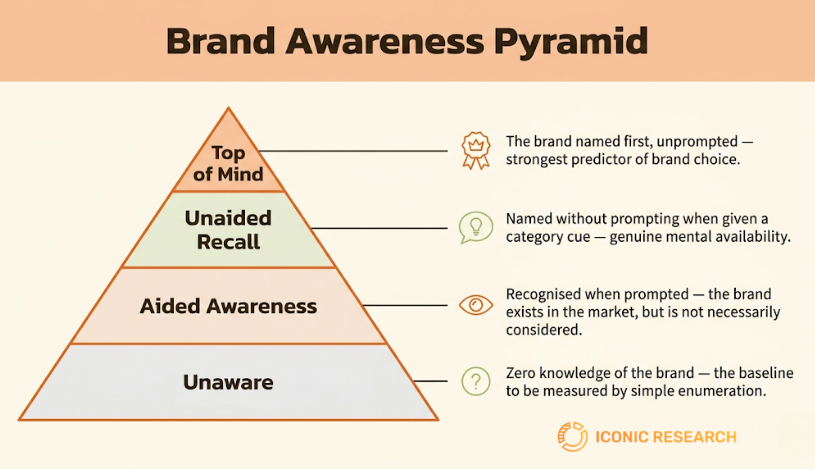
Unaware — the baseline. The consumer has no knowledge of the brand’s existence. The research task is simple enumeration: what percentage of the target market sits at zero awareness.
Aided brand awareness (recognition) — the consumer recognises the brand when prompted. Aided brand awareness is measured by showing or naming the brand and asking whether the respondent is familiar with it. High aided awareness means the brand exists in the market. It does not mean the brand is being considered [1].
Unaided awareness (recall) — the consumer names the brand without prompting when given a category cue. Unaided recall is a significantly stronger indicator of purchase consideration than aided recognition — it reflects whether the brand has earned genuine mental availability [2].
Top of mind brand awareness — the brand named first, unprompted, in a category. Top of mind is the strongest form of brand awareness and the strongest predictor of brand choice in low-involvement categories. In high-involvement categories it still correlates strongly with consideration set inclusion [2].
The diagnostic insight: a brand with high aided but low unaided awareness has a penetration problem, not a reach problem. It exists in the market but has not earned mental availability. The strategic response is different from a brand with low awareness across all levels — and the research instrument must distinguish between the two.
Brand Awareness Metrics and KPIs
Brand awareness KPI a marketing director needs to defend spend or demonstrate progress is not a single number — it is a set of four metrics tracked consistently over time [3].
Aided awareness score — percentage of the target market that recognises the brand when prompted. Baseline metric. Useful for new market entry and launch tracking.
Unaided recall score — percentage of the target market that names the brand unprompted in category. Primary brand awareness metric for established brands. Movement in unaided recall is the most meaningful indicator of brand-building effectiveness.
Top of mind score — percentage of the target market naming the brand first. The brand awareness KPI most directly correlated with market share in mature categories.
Share of mind — the brand’s unaided recall score relative to total mentions across all brands in the category. Normalises the metric across markets with different category penetration levels.
Brand awareness metrics are only meaningful in comparison — against competitors at a point in time, or against the brand’s own prior measurement. A brand awareness tracking programme measures at consistent intervals — quarterly for most categories, monthly in contested markets — using consistent methodology so that movement is real and not methodological noise.
How to Measure Brand Awareness
Brand awareness survey design is the primary measurement instrument [3]. Key design rules: unaided questions must always precede aided questions in the brand awareness questionnaire — once a respondent has seen a brand name, aided recall contaminates unaided measurement. The brand awareness survey should be administered to a representative sample of the target market, not existing customers — measuring awareness among people who already buy the brand produces meaningless data. For most Thai market tracking studies, a minimum of 200 respondents per wave per target segment is required to detect meaningful movement between waves.
The Thai measurement problem. Brand awareness surveys in Thailand systematically over-report. Yea-saying bias — the tendency of respondents to affirm recognition of brands they have not encountered — is documented across East Asian research contexts [4]. A respondent who wishes to appear knowledgeable will claim aided awareness of brands they cannot actually recall. Standard survey instruments without proper controls produce inflated aided awareness scores that cannot be benchmarked meaningfully. Iconic Research designs brand awareness surveys with built-in controls — including decoy brands and consistency checks — that correct for this bias and produce numbers that reflect genuine market penetration. See quantitative research for sampling and instrument methodology.
Social listening as a supplementary signal. Social listening measures brand mentions in unsolicited consumer conversations — Pantip, TikTok, Facebook, and review platforms. It does not measure brand awareness directly. But share of voice in social conversation is a leading indicator of awareness trends, surfacing problems in specific consumer segments or regional markets before they appear in survey data. The same measurement discipline applies to campaign channels: isolating the awareness uplift from a KOL campaign requires pre/post brand tracking, not platform engagement data.
Brand Awareness Funnel
Brand awareness is the entry point — no consumer can consider, prefer, or purchase a brand they are not aware of. The brand awareness funnel moves from awareness through consideration, preference, and purchase. Each stage requires different research to measure [3].
Low brand awareness is frequently misdiagnosed. A brand with strong aided awareness but low consideration has a positioning or relevance problem, not an awareness problem. Spending to increase awareness when the real gap is in consideration is the most common and most expensive brand research mistake. Correct measurement of the full funnel — not just the awareness level — prevents this misallocation. Whether the gap is awareness, consideration, or positioning, the fix is a brand strategy decision, not more spend.
Low Brand Awareness — Diagnosis Before Treatment
Low brand awareness has three distinct causes, each requiring a different research response.
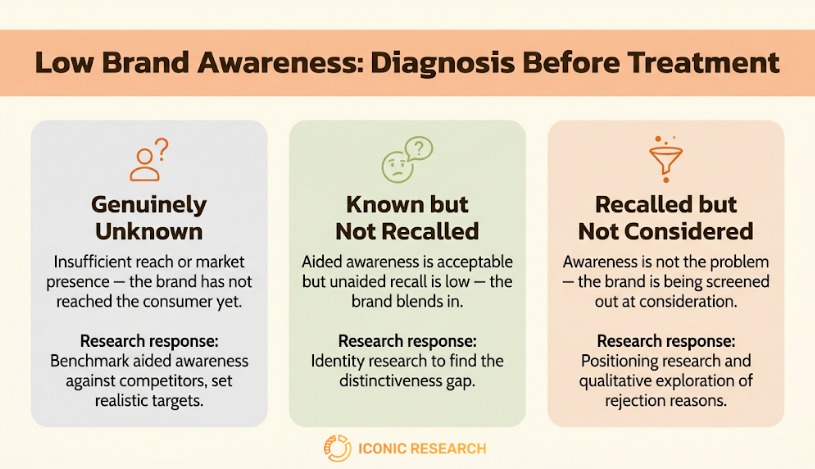
The brand is genuinely unknown — insufficient reach or market presence. Research response: benchmark aided awareness against competitors to establish the gap, then set realistic targets based on investment levels and category norms.
The brand is known but not recalled — aided awareness is acceptable but unaided recall is low. Research response: brand identity research to understand whether the brand has a distinctive enough identity to earn mental availability. A brand that looks like its competitors in the consideration set will not be retrieved independently of them.
The brand is recalled but not considered — awareness is not the problem. Research response: brand strategy consulting to identify the positioning gap, and qualitative exploration to understand why the brand is being screened out at the consideration stage.
A brand awareness agency that recommends awareness spend without first diagnosing which of these three problems the brand faces is solving the wrong problem. Iconic Research begins every brand awareness engagement with measurement — establishing where the brand sits in the pyramid and why — before making any recommendation on how to move it.
Frequently Asked Questions
What is brand awareness?
The degree to which a target audience recognises or recalls a brand, measured across three levels: top-of-mind awareness, unaided recall, and aided recognition. Each level represents a different depth of mental availability.
What is the brand awareness pyramid?
A diagnostic framework mapping four levels of consumer familiarity — unaware, recognition, recall, and top of mind. Used to identify where a brand sits in the awareness hierarchy and what research is needed to move it.
What is the difference between aided and unaided brand awareness?
Aided brand awareness measures recognition when the brand is shown or named. Unaided awareness measures whether the consumer can recall the brand without prompting. Unaided recall is the stronger indicator of purchase consideration.
What are the key brand awareness KPIs?
Aided awareness score, unaided recall score, top-of-mind score, and share of mind. All four are only meaningful when tracked over time with consistent methodology.
How do you measure brand awareness in Thailand?
Through brand awareness surveys with unaided questions preceding aided questions, administered to a representative target market sample. Surveys in Thailand require controls for yea-saying bias — decoy brands and consistency checks — to produce numbers reflecting genuine awareness.
References
[1] Aaker, D.A. (1996). Building Strong Brands. Free Press, New York.
[2] Romaniuk, J. & Sharp, B. (2004). Conceptualising and measuring brand salience. Marketing Theory, 4(4), 327–342. https://doi.org/10.1177/1470593104047643
[3] Keller, K.L. (2013). Strategic Brand Management (4th ed.). Pearson, Harlow.
[4] Chen, C., Lee, S.Y. & Stevenson, H.W. (1995). Response style and cross-cultural comparisons of rating scales among East Asian and North American students. Psychological Science, 6(3), 170–175. https://doi.org/10.1111/j.1467-9280.1995.tb00327.x
[5] Iconic Research. Brand Strategy Consulting. https://iconicthai.com/services/brand-strategy-consulting/
If you wish to quote any information from this article, please kindly cite the source along with the link to the original article to respect copyright. |
 |
Iconic Research Thailand Your trusted partner in market research and consulting across Thailand and Southeast Asia. Headquartered in Bangkok, we provide research-driven insights across the Philippines, Malaysia, Indonesia, Singapore, Laos, and Vietnam. We help businesses navigate Thailand's market complexities through consumer insights, market entry strategy, and trend foresight. Contact us if you have any queries! (+66)888 954 954 |
Contact us
We always looking for new and exciting opportunities. Let’s connect.
Related posts
 Growth Strategy: The Expansion Decisions That Need Evidence
Growth strategy is the set of decisions about where a company expands next. Only 25% of companies grow sustainably — the difference is evidence, not ambition.
9 min read Brand Strategy: The Decisions That Should Be Built on Evidence
Brand strategy is the set of decisions that determine how a brand competes. Those decisions only pay off when they’re built on consumer evidence — not a workshop.
11 min read Key Opinion Leader: What Thai Brands Should Research Before, During, and After a KOL Campaign
Platform metrics mislead brands choosing and measuring KOLs in Thailand. A research-first look at what to verify before, during, and after a campaign.
10 min read