

Brand identity is the complete set of elements a brand deliberately creates to project a specific image — visual, verbal, cultural, and behavioural. It encompasses logo, colour, typography, tone of voice, cultural values, and the relationship a brand offers its consumers. Brand identity is what the brand intends to stand for; brand image is what consumers actually perceive. The gap between the two is what brand identity research measures.
Table of Contents
- What Is Brand Identity?
- Brand Identity Prism
- Branding vs Identity — Why the Distinction Matters for Research
- How Iconic Research Audits Brand Identity
- References
Most brand failures in new markets are not product failures — they are brand identity failures. The brand’s intended identity did not translate into the consumer’s perception. This article explains what brand identity is, how to audit it using the Kapferer Brand Identity Prism, and why researching brand identity in Thailand requires methods and cultural knowledge that standard frameworks do not account for.
What Is Brand Identity?
Brand identity is the complete set of elements a brand deliberately creates to project a specific image — visual, verbal, cultural, and behavioural [1]. It is what the brand intends to stand for. Brand image, by contrast, is what consumers actually perceive. The gap between intended identity and perceived image is exactly what brand identity research measures — and closing that gap is the commercial case for commissioning it.
Addressing branding vs identity directly: branding is the act of building and communicating identity. Brand identity is the substance being communicated. Confusing the two leads organisations to invest heavily in campaign execution while their underlying identity remains unclear or inconsistent. A brand can achieve high recall while simultaneously reinforcing the wrong associations — because the executions are being evaluated while the identity underneath them is never audited. Measuring whether the intended identity is producing recall at all is the first step — which is where brand awareness research begins.
Brand identity extends beyond logo and colour palette. It encompasses tone of voice, cultural values, the relationship a brand offers consumers, and the self-image it enables in the people who use it. Brand identity packaging is one visible expression of identity — but the identity itself exists independently of any single execution. Changing the packaging without understanding the identity it is meant to express produces packaging that is visually refreshed and strategically incoherent.
Brand Identity Prism
Brand Identity Prism, developed by Jean-Noël Kapferer, is the most useful analytical framework for auditing brand identity [1]. It defines brand identity through six facets — and crucially, it separates what the brand projects from what consumers internalise. This makes it a research framework as much as a brand planning tool.
The infographic below applies the prism to KOI Thé — a brand operating in Thailand’s competitive premium bubble tea category — illustrating how each facet translates from framework to market reality.
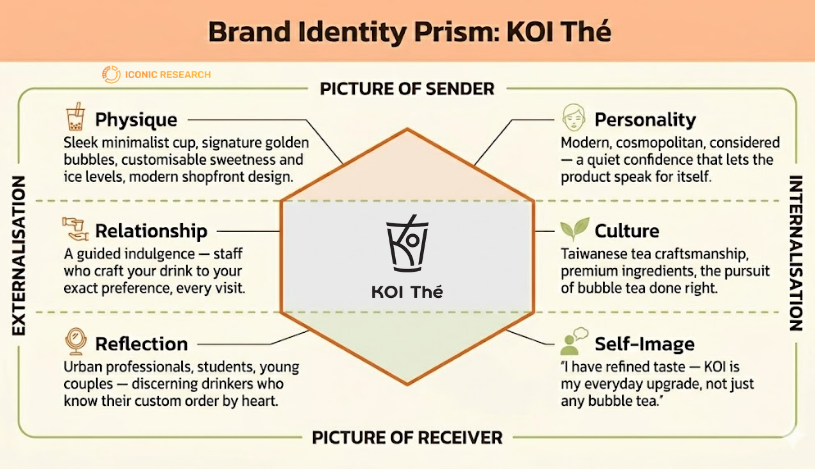
Physique is the tangible, visual dimension of the brand: logo, colours, packaging, product form. In Thailand, colour associations carry cultural weight that differs from Western defaults — gold signals prestige more powerfully, and packaging hierarchy signals product tier in ways that vary by region. Brand identity research at the physique level uses quantitative surveys and concept testing to verify visual elements are landing with intended meaning [2].
Personality refers to the human character traits associated with the brand — an intended characteristic, not a consumer projection [2]. In Thailand, the formal or informal register of brand voice carries social meaning that international brands routinely miscalibrate. Brand personality research uses qualitative research to surface how the intended personality is actually being read.
Culture is the set of values and principles from which the brand draws its authority — and the facet where Thai market research is most consequential and most often skipped. Thai cultural dispositions toward avoiding conflict systematically distort standard survey and focus group data on brand values [3]. Skilled qualitative moderators design probe techniques that surface authentic associations rather than socially comfortable ones.
Relationship is the mode of exchange the brand offers consumers: service, authority, friendship, aspiration. Brand-consumer relationships in Thailand tend toward a more paternalistic dynamic than Western frameworks anticipate — consumers expect brands they trust to guide them [3]. Relationship facet research uses in-depth interviews to understand how consumers experience the brand’s relational stance.
Reflection is the customer the brand depicts in its communication — not the target audience, but the consumer image the brand holds up as a mirror. In Thailand, Bangkok and upcountry consumers have substantially different aspirational reference points [4]. Research at this level uses quantitative research to verify the brand’s depicted consumer matches the self-image of its actual target. Verifying that the brand’s depicted consumer matches the actual target requires a research-backed customer persona — not an assumption about who the audience is.
Self-image is what consumers tell themselves about who they are when they use the brand. Social desirability bias is pronounced in Thai research — consumers will not readily admit that a brand signals status, even when this is the primary purchase driver [3]. Projective techniques in qualitative research — brand personification, visual association — surface self-image associations that direct questioning cannot.
Branding vs Identity — Why the Distinction Matters for Research
Branding is the execution — campaigns, communications, activations. Brand identity is the underlying substance those executions are meant to convey. The common failure: organisations measure the success of branding executions — recall, reach, engagement — without measuring whether the underlying identity is landing as intended.
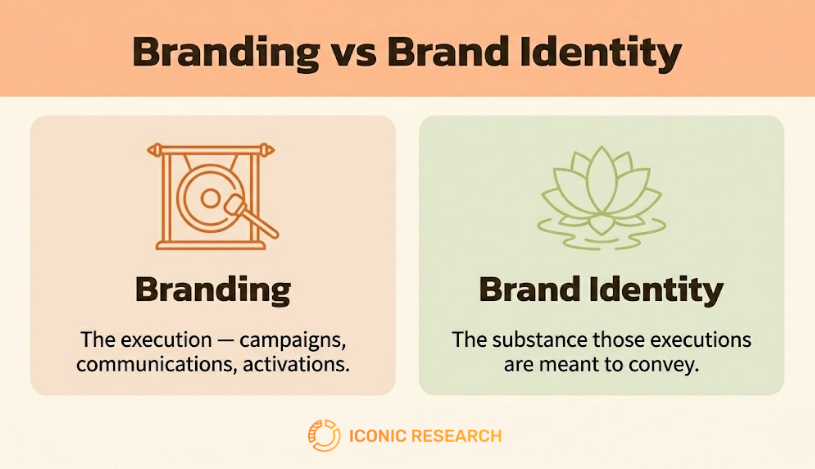
Research branding decisions without first establishing what your brand identity means to consumers is measuring the wrong variable entirely. A campaign can achieve high recall while simultaneously reinforcing associations that damage long-term positioning. Understanding whether that positioning gap exists — and how large it is — requires brand positioning research. Identity must be established and periodically audited as the foundation for evaluating all brand communication — not assumed to be stable between campaigns. Identity is the expression of a brand’s position, downstream of the brand strategy decisions that set it — not a substitute for them.
How Iconic Research Audits Brand Identity
Brand identity research almost always begins with qualitative exploration. Focus groups or in-depth interviews with target consumers surface the associations, language, and cultural meanings the brand currently holds — before any assumptions are tested quantitatively. In Thailand, this phase is where the culture and personality facets of the prism are most rigorously examined. A moderator with genuine Thai cultural knowledge is the difference between useful data and comfortable affirmation [3].
Once qualitative exploration has identified the key associations and potential gaps, quantitative research establishes baselines and enables tracking over time. Iconic Research’s brand strategy consulting is built on tracking surveys that measure awareness, association strength, and preference against competitors [5]. Conjoint analysis quantifies the value consumers place on specific brand attributes — including the premium they will pay for a brand that delivers on its intended identity.
Social listening provides continuous monitoring of brand associations in unsolicited consumer language — surfacing identity gaps before they appear in structured tracking studies. In Thailand, this means monitoring consumer forums, social media comment threads, and community platforms where brand associations form and shift independently of what the brand communicates.
Frequently Asked Questions
What is brand identity?
The complete set of elements a brand deliberately creates to project a specific image — visual, verbal, cultural, and behavioural. Distinct from brand image, which is what consumers actually perceive.
What is Brand Identity Prism?
A framework that analyses brand identity through six facets: physique, personality, culture, relationship, reflection, and self-image. It functions as both a brand planning tool and an audit framework.
How do you research brand identity?
Through qualitative research to surface associations and gaps, quantitative research to measure and benchmark over time, and social listening to monitor uncontrolled brand associations in consumer conversations.
Why is brand identity research different in Thailand?
Thai cultural dynamics mean standard survey instruments and Western focus group protocols systematically produce unreliable data. Research design must be adapted to surface genuine associations rather than socially acceptable responses.
What is brand identity packaging?
The physical manifestation of brand identity on product packaging — colour, typography, structural form, and material. In Thailand, packaging signals product tier in ways that vary by category and consumer segment.
References
[1] Kapferer, J.N. (2008). The New Strategic Brand Management (4th ed.). Kogan Page, London.
[2] Azoulay, A. & Kapferer, J.N. (2003). Do brand personality scales really measure brand personality? Journal of Brand Management, 11(2), 143–155. https://doi.org/10.1057/palgrave.bm.2540162
[3] Tiwsakul, R. & Hackley, C. (2012). Postmodern paradoxes in Thai-Asian consumer identity. Journal of Business Research, 65(4), 490–496. https://doi.org/10.1016/j.jbusres.2011.02.002
[4] Iconic Research. Understanding Thai Consumer Behaviour. https://iconicthai.com/understanding-the-thai-consumer-insights-and-trends/
[5] Iconic Research. Brand Strategy Consulting. https://iconicthai.com/services/brand-strategy-consulting/
If you wish to quote any information from this article, please kindly cite the source along with the link to the original article to respect copyright. |
 |
Iconic Research Thailand Your trusted partner in market research and consulting across Thailand and Southeast Asia. Headquartered in Bangkok, we provide research-driven insights across the Philippines, Malaysia, Indonesia, Singapore, Laos, and Vietnam. We help businesses navigate Thailand's market complexities through consumer insights, market entry strategy, and trend foresight. Contact us if you have any queries! (+66)888 954 954 |
Contact us
We always looking for new and exciting opportunities. Let’s connect.
Related posts
 Growth Strategy: The Expansion Decisions That Need Evidence
Growth strategy is the set of decisions about where a company expands next. Only 25% of companies grow sustainably — the difference is evidence, not ambition.
9 min read Brand Strategy: The Decisions That Should Be Built on Evidence
Brand strategy is the set of decisions that determine how a brand competes. Those decisions only pay off when they’re built on consumer evidence — not a workshop.
11 min read Key Opinion Leader: What Thai Brands Should Research Before, During, and After a KOL Campaign
Platform metrics mislead brands choosing and measuring KOLs in Thailand. A research-first look at what to verify before, during, and after a campaign.
10 min read