

Conjoint analysis is a quantitative research method used for pricing decisions, product configuration, and feature prioritisation. It solves a problem that direct questioning cannot: consumers routinely misreport what they want and consistently underestimate their own price sensitivity. When you ask someone whether a feature matters to them, they say yes. Conjoint analysis bypasses this by forcing real trade-off decisions — the same way actual purchase decisions are made.
Table of Contents
- What Is Conjoint Analysis?
- What Conjoint Analysis Tells You
- Conjoint Analysis in Practice — An Iconic Research Case Study
- Choice-Based Conjoint Analysis vs. Other Methods
- How a Conjoint Study Is Designed
- When to Commission Conjoint Analysis
- Conjoint Analysis for the Thai and ASEAN Market
- References
What Is Conjoint Analysis?
Conjoint analysis presents respondents with complete product or service concepts — combinations of attributes and levels — and asks them to choose, rank, or rate between packages [1]. Because they are evaluating whole concepts rather than isolated features, the analysis can reverse-engineer how much weight they give each attribute. The core principle: people reveal preferences through trade-offs, not through direct questions.
Choice-based conjoint analysis (CBC) is now the dominant form [2]. Respondents choose between product concepts exactly as they would in a real purchase decision — not by rating features in isolation, but by selecting the overall package they would actually buy. This mirrors real market behaviour more closely than any direct questioning method and is the design Iconic Research applies as standard for pricing and product configuration studies.
What Conjoint Analysis Tells You
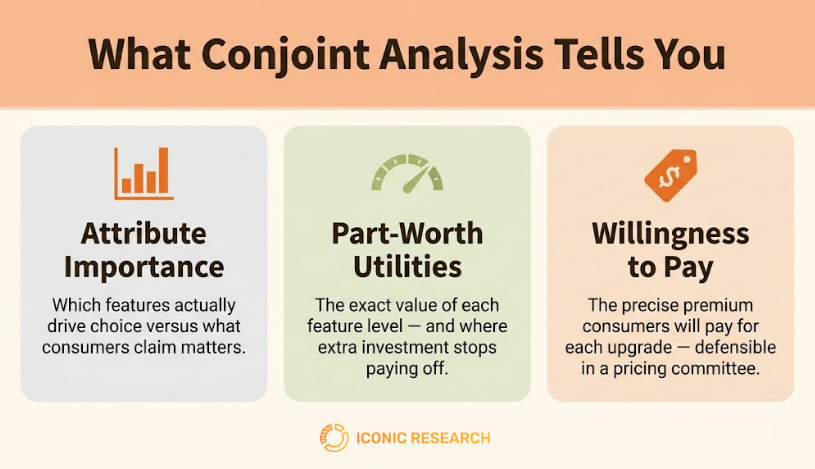
The output of a conjoint study is not a ranked list of features. It is three specific, actionable numbers:
Relative attribute importance. Which features actually drive choice versus which ones consumers claim matter. In most categories, the rank order of stated importance and revealed importance differs substantially. Conjoint analysis quantifies the gap — and the gap is where pricing strategy is won or lost.
Part-worth utilities. The precise value assigned to each level within an attribute. Not “warranty matters” but “a 3-year warranty increases purchase probability by 12 percentage points relative to a 1-year warranty, and extending to 5 years adds only 4 more.” These numbers tell a product director exactly where additional investment in a feature stops paying off.
Willingness to pay. When price is included as an attribute — which it should be for conjoint analysis pricing applications — the model quantifies the exact premium consumers will pay for each feature upgrade. Not a range. A number. One that can be defended in a pricing committee or a board presentation.
Conjoint Analysis in Practice — An Iconic Research Case Study
When Thailand’s EV market entered its Trust War phase — aggressive price competition, deep anxiety about long-term ownership costs — a premium EV challenger brand faced a specific problem: their technologically advanced product was being evaluated alongside mass-market competitors despite superior engineering. Specifications alone could not justify the price premium.
Iconic Research designed a choice-based conjoint study as the core of a broader EV market research case study [4]. Respondents chose between product concepts combining certified residual value guarantees, extended warranties, advanced soundproofing, and driver assistance systems — all anchored to specific price points. The finding inverted the client’s assumptions: the most powerful lever was not technology or warranty length — it was a credible guarantee of future resale value. The client repositioned entirely and converted high-net-worth buyers away from established European luxury competitors.
The conjoint study ran alongside a competitor experience audit across Japanese and European luxury dealer networks and interviews with car brokers and insurance underwriters. The conjoint produced the numbers. The qualitative work explained why.
Choice-Based Conjoint Analysis vs. Other Methods
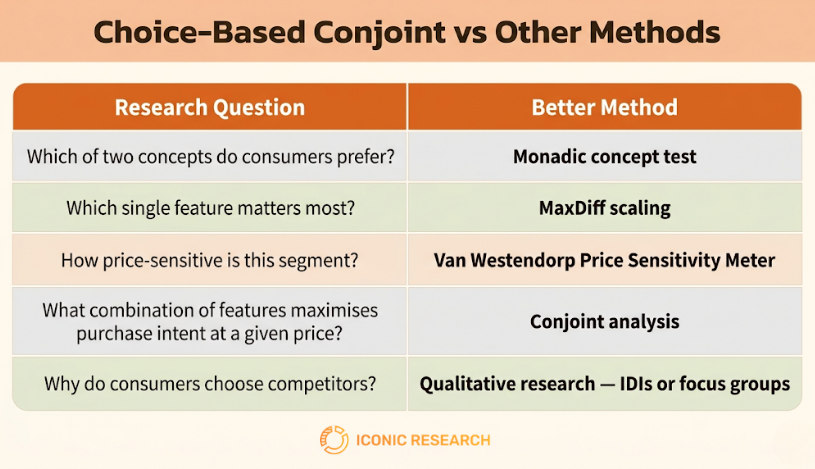
Conjoint analysis earns its cost when the product has multiple configurable attributes, price is a variable, and the decision has commercial stakes. It is the right tool when you need to simulate market scenarios — to test what happens to predicted share if you add a feature, raise a price, or reposition against a specific competitor. It is overkill for simple go/no-go concept screening, where a monadic test is faster and cheaper.
How a Conjoint Study Is Designed
Define attributes and levels. With the client, Iconic Research identifies four to six attributes that genuinely drive purchase decisions in the category. Each attribute needs two to four levels. Too many attributes produces cognitive overload and unreliable responses. Too few produces insufficient discrimination between products. Attribute selection is where research experience matters most — wrong attributes invalidate the entire study regardless of sample size or modelling sophistication.
Design the choice sets. Using experimental design principles, Iconic constructs the combinations each respondent evaluates. Typically eight to twelve choice tasks per respondent — enough to capture preference patterns without fatiguing the sample. The design ensures all attribute combinations are tested without requiring every respondent to evaluate every possible combination.
Field the survey. Minimum sample sizes depend on the number of attributes and the number of market segments requiring separate analysis. For segmented quantitative research in Thailand, Iconic Research typically recommends 200 to 400 respondents as a minimum — higher for studies requiring distinct segment-level outputs. Data collection approach — online panel, recruited sample, or hybrid — is determined by the target respondent profile.
Model the data. Hierarchical Bayesian modelling is the standard for choice-based conjoint analysis [4]. It produces individual-level utility estimates, which enables segmentation — identifying not just the average preference but the distinct preference patterns across consumer groups that may require different product configurations.
Simulate market scenarios. The deliverable is not a table of utility scores. A market simulator built from the model lets the client test hypothetical product configurations against named competitors and read predicted market share responses. This is what makes conjoint analysis a strategic tool rather than a measurement exercise.
When to Commission Conjoint Analysis
If you can answer yes to two or more of the following, conjoint analysis is the right call:
- Are you setting or defending a price point for a new or repositioned product?
- Do you have more than three product attributes you are trying to prioritise?
- Are you designing different product tiers or bundles for different segments?
- Is your product competing in a crowded market where differentiation needs to be quantified, not assumed?
- Do you need to simulate competitor responses to your launch configuration?
Conjoint Analysis for the Thai and ASEAN Market
Thai consumer behaviour adds specific complexity that makes conjoint analysis particularly well-suited to this market. Brand trust and face dynamics — both giving and saving — influence perceived value in ways that do not appear in attribute lists and cannot be captured by direct questioning. Conjoint captures revealed preferences: what people actually choose when forced to make real trade-offs. This makes it more reliable in Thailand than direct questioning, where social desirability bias consistently inflates stated willingness to pay for premium attributes and suppresses honest responses about price sensitivity.
For companies running multi-market product launches across ASEAN, conjoint studies can be designed with consistent attribute structures across markets and modelled separately by country — producing directly comparable output on which attributes matter most in each market and where willingness to pay diverges. A feature that commands a premium in Singapore may be table stakes in Vietnam. Conjoint analysis quantifies the gap rather than leaving it to assumption.
Iconic Research has run conjoint studies across automotive, FMCG, healthcare, and financial services categories in Thailand [5]. The output — which attributes drive choice and at what price premium — feeds directly into brand positioning decisions, defining which dimensions of differentiation the brand can credibly own. The methodology scales from single-market product configuration studies to multi-country pricing architecture for regional launches.
Frequently Asked Questions
What is conjoint analysis?
A quantitative method that presents respondents with complete product concepts and asks them to choose between packages. By analysing those trade-off decisions, it reverse-engineers the weight each attribute carries in actual purchase choice.
What is choice-based conjoint analysis?
The dominant form of conjoint, where respondents choose between product concepts as they would in a real purchase situation. It mirrors market behaviour more closely than rating or ranking tasks, making it more predictive of actual outcomes.
What does conjoint analysis output look like?
Three numbers: relative attribute importance, part-worth utilities (the precise value of each feature level), and willingness to pay when price is included as an attribute. Each is directly actionable in a pricing or product configuration decision.
When should you use conjoint instead of a simpler method?
When your product has multiple configurable attributes, price is a variable, and the decision has commercial stakes. For simple go/no-go concept screening, a monadic test is faster. For single-feature prioritisation, MaxDiff is sufficient.
How many respondents does a conjoint study require?
For segmented analysis in Thailand, typically 200 to 400 respondents minimum. Studies requiring distinct segment-level outputs need larger samples.
Can conjoint be used across multiple ASEAN markets?
Yes — studies can be designed with consistent attribute structures across markets and modelled separately by country, producing directly comparable willingness-to-pay output across the cluster.
References
[1] Green, P.E. & Rao, V.R. (1971). Conjoint Measurement for Quantifying Judgemental Data. Journal of Marketing Research, 8(3), 355–363. https://www.jstor.org/stable/3149575
[2] Louviere, J.J. & Woodworth, G. (1983). Design and Analysis of Simulated Consumer Choice or Allocation Experiments. Journal of Marketing Research, 20(4), 350–367. https://www.jstor.org/stable/3151440
[3] Orme, B.K. (2019). Getting Started with Conjoint Analysis: Strategies for Product Design and Pricing Research (4th ed.). Research Publishers LLC / Sawtooth Software. https://sawtoothsoftware.com/resources/books/getting-started-with-conjoint-analysis
[4] Iconic Research. EV Market Entry in Thailand — Automotive Market Research Case Study. https://iconicthai.com/case-study/case-study-navigating-thailands-ev-market-a-comprehensive-research-approach/
[5] Sawtooth Software. Choice-Based Conjoint Analysis. https://sawtoothsoftware.com/conjoint-analysis/cbc
If you wish to quote any information from this article, please kindly cite the source along with the link to the original article to respect copyright. |
 |
Iconic Research Thailand Your trusted partner in market research and consulting across Thailand and Southeast Asia. Headquartered in Bangkok, we provide research-driven insights across the Philippines, Malaysia, Indonesia, Singapore, Laos, and Vietnam. We help businesses navigate Thailand's market complexities through consumer insights, market entry strategy, and trend foresight. Contact us if you have any queries! (+66)888 954 954 |
Contact us
We always looking for new and exciting opportunities. Let’s connect.
Related posts
 Growth Strategy: The Expansion Decisions That Need Evidence
Growth strategy is the set of decisions about where a company expands next. Only 25% of companies grow sustainably — the difference is evidence, not ambition.
9 min read Brand Strategy: The Decisions That Should Be Built on Evidence
Brand strategy is the set of decisions that determine how a brand competes. Those decisions only pay off when they’re built on consumer evidence — not a workshop.
11 min read Key Opinion Leader: What Thai Brands Should Research Before, During, and After a KOL Campaign
Platform metrics mislead brands choosing and measuring KOLs in Thailand. A research-first look at what to verify before, during, and after a campaign.
10 min read