

Market research methods — also called market research methodologies or market research techniques — are the systematic approaches businesses use to collect and analyse market data. Choosing the right method determines whether research answers the actual business question or produces data that cannot be acted on. In Thailand, method choice has an additional layer: execution realities — platform behaviour, cultural dynamics, and regional variance — affect which approaches yield reliable data and which do not.
Table of Contents
- Types of Market Research
- Qualitative Market Research Methods
- Quantitative Market Research Methods
- Primary vs Secondary Research Methods
- The Market Research Process — How to Do Market Research
- Choosing the Right Market Research Methodology for Thailand
- Conclusion
- References
Types of Market Research
Market research divides along three axes: primary versus secondary, qualitative versus quantitative, and exploratory versus descriptive versus causal. These are not mutually exclusive — a well-designed research programme typically combines types to answer different parts of the same question.
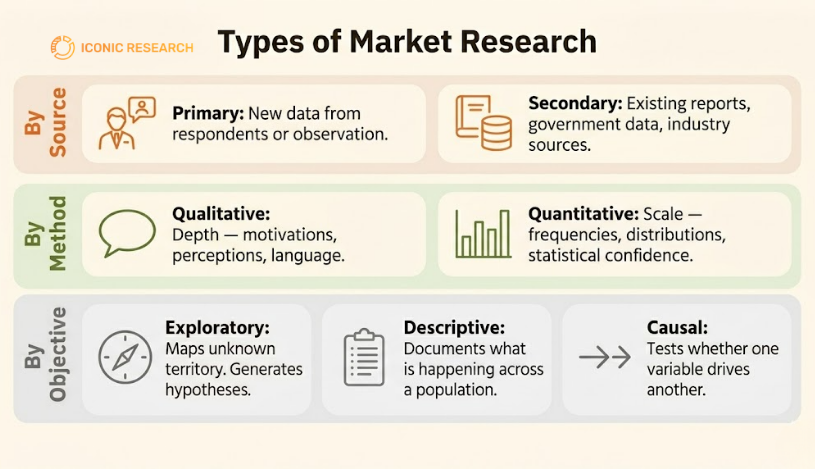
Primary and secondary research differ by source. Primary research generates new data directly from respondents or observation. Secondary research draws on existing data — published reports, government statistics, industry databases, and internal sales records. Most research programmes begin with secondary research to establish context before committing to primary data collection [5].
Qualitative and quantitative research differ by what they measure. Qualitative methods produce depth — motivations, perceptions, and language. Quantitative methods produce scale — frequencies, distributions, and statistical confidence. Neither is superior; they are answers to different questions. A qualitative study explains why consumers behave a certain way; a quantitative study tells you how many do [2].
Exploratory, descriptive, and causal research differ by objective. Exploratory research maps unfamiliar territory — it generates hypotheses rather than testing them. Descriptive research documents what is happening across a defined population. Causal research tests whether one variable drives another — typically through controlled experiments. Most commercial research in Thailand is exploratory or descriptive [1].
Qualitative Market Research Methods
Qualitative market research methods generate understanding rather than measurement. They are the right choice when the research objective is to understand how people think, feel, and make decisions — not to count how many.
Focus groups bring six to ten participants together to discuss a topic under a moderator’s guidance. They are effective for concept exploration, communications testing, and understanding group dynamics in decision-making. In Thailand, focus group methodology requires adaptation: kreng jai — the cultural disposition to avoid conflict — means participants may moderate their views in group settings. Skilled Thai moderators manage this through projective techniques and indirect questioning rather than direct opinion elicitation. See focus groups for methodology detail.
In-depth interviews are one-on-one conversations that generate rich individual perspective without the social pressure of a group setting. They are the preferred qualitative method for sensitive topics, high-involvement decisions, and B2B research where respondents are executives or specialists unlikely to participate in group settings. In Thailand, in-depth interviews often perform better than focus groups for topics that touch on status, financial decisions, or personal behaviour. See in-depth interviews for Thailand-specific methodology.
Ethnography and observation place researchers in the consumer’s natural environment — at home, in-store, or on mobile — to observe behaviour directly rather than relying on self-report. These methods are particularly valuable in Thailand for categories where stated and actual behaviour diverge: food preparation, retail browsing, and mobile commerce all show significant gaps between what consumers say they do and what observation records.
Quantitative Market Research Methods
Quantitative market research methods produce data that can be counted, aggregated, and tested for statistical significance. They answer questions of scale, frequency, and correlation across defined populations.
Surveys are the most widely used quantitative method. A well-designed market survey can measure brand awareness, purchase intent, customer satisfaction, and price sensitivity across large samples. Survey design — question structure, scale choice, and sequencing — directly affects data quality. In Thailand, survey mode matters: online panels skew urban and educated; face-to-face surveys reach provincial populations that online methods miss entirely.
CAPI (Computer-Assisted Personal Interviewing) and CATI (Computer-Assisted Telephone Interviewing) are interviewer-administered quantitative methods that improve data quality in markets where self-completion survey literacy is variable. CAPI is the standard for central location tests, exit interviews, and rural data collection in Thailand. See data collection methods for fieldwork methodology and sample design considerations.
Online panels offer speed and cost efficiency but carry coverage and quality risks in the Thai context. Panel composition in Thailand skews toward Bangkok and secondary cities; rural and lower-income segments are underrepresented. For research requiring nationally representative samples, online panels need supplementation with offline fieldwork [3].
Polls are short-form quantitative instruments — typically one to three questions — designed for fast directional data rather than statistically robust measurement. They are useful for tracking shifts in awareness or sentiment but insufficient as a standalone research method for strategic decisions.
Conjoint analysis is a quantitative method used when the research question involves trade-offs between product attributes and price — not just measuring preferences but quantifying exactly what consumers will pay for each feature. Where surveys measure stated preferences, conjoint reveals revealed ones by forcing real choice decisions. For product configuration, pricing architecture, and feature prioritisation, see conjoint analysis.
Primary vs Secondary Research Methods
Primary research generates data that does not exist until the study is conducted. It is designed to answer a specific business question with data collected directly from the target population. Primary research is more expensive and time-intensive than secondary research, but it produces findings that are specific, current, and proprietary.
Secondary research draws on data that already exists — published market reports, government statistics, academic studies, industry databases, and internal company data. It is faster and cheaper than primary research, and it provides essential context for study design. In Thailand, reliable secondary sources include ETDA for digital behaviour [3], the National Statistical Office for demographic data [4], and Bank of Thailand publications for economic indicators.
The practical rule: use secondary research to frame the question and scope the study, then use primary research to answer what secondary data cannot. A common error is commissioning primary research before exhausting available secondary sources — this wastes budget on questions that published data already answers.
The Market Research Process — How to Do Market Research
A structured market research process reduces the risk of generating data that cannot be acted on. Five stages apply regardless of method.
- Define the objective. The research question must be specific enough to determine method, sample, and success criteria. That specificity usually starts with knowing who you are researching — for guidance on how to define and validate your target audience before the research brief is written, see our target audience guide. “Understand our customers” is not a research objective. “Identify the three primary barriers to trial among Bangkok women aged 25–40 who have not purchased in the past six months” is.
- Design the study. Method selection follows from the objective. Qualitative methods for exploration and diagnosis; quantitative methods for measurement and validation. Sample design, instrument development, and fieldwork logistics are determined at this stage.
- Collect data. Fieldwork execution in Thailand requires local expertise — regional variance, language, platform behaviour, and respondent recruitment all affect data quality. Face-to-face fieldwork outside Bangkok requires established provincial networks.
- Analyse findings. Analysis translates raw data into findings. Quantitative data requires statistical processing; qualitative data requires thematic coding and interpretation. The quality of analysis determines whether findings are actionable or merely descriptive.
- Act on insights. Research that does not change a decision or inform a strategy has no return. Findings should be presented in terms of business implications, not research outputs — what should we do differently, and why [5].
Choosing the Right Market Research Methodology for Thailand
Method choice in Thailand is not only a question of research design — it is a question of cultural execution. Several dynamics affect which methodologies yield reliable data.
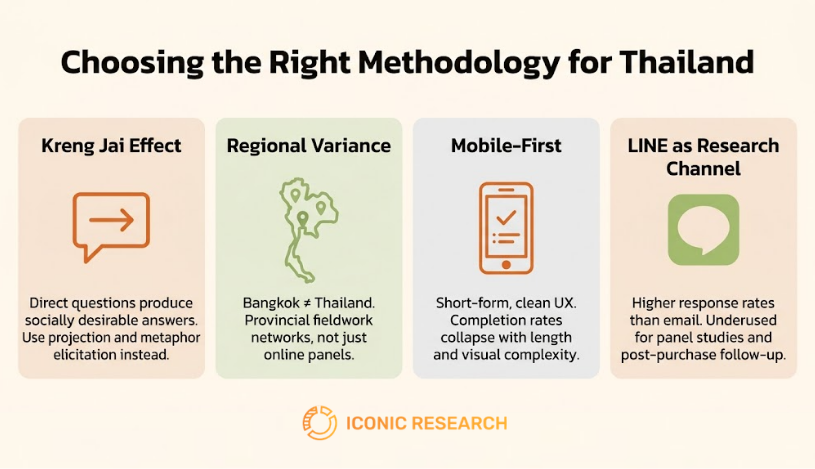
Kreng jai and indirect communication mean that direct questioning consistently produces socially desirable responses rather than honest ones. Qualitative methods that use projection, metaphor elicitation, and indirect questioning outperform direct survey instruments for sensitive or evaluative topics. Quantitative instruments need careful question framing to minimise acquiescence bias.
Regional variance is structural. Bangkok consumers differ from provincial consumers in media consumption, purchasing behaviour, income, and language. Research scoped only to Bangkok systematically misrepresents the national picture for most consumer categories. Methodology must account for this — which means fieldwork networks, not just online panel access.
Mobile-first behaviour shapes mode preference. Thai consumers are highly active on mobile, but mobile survey completion rates vary significantly by question length and visual complexity. Short-form instruments with clean UX consistently outperform long-form surveys in mobile environments.
LINE as a research channel is underused but effective for recruited panel studies and post-purchase follow-up research. Thai consumers respond to LINE-based research instruments at higher rates than email — a mode consideration that most global research frameworks do not account for.
Conclusion
Market research methods are not interchangeable. Each methodology is a tool suited to a specific type of question — and in Thailand, the right tool also needs to be the right fit for local execution realities. The companies that generate reliable insights here are the ones that match method to objective, design for the Thai context, and treat fieldwork quality as a research output in its own right.
Frequently Asked Questions
What are the main market research methods?
The main market research methods divide into qualitative and quantitative approaches. Qualitative methods — focus groups, in-depth interviews, ethnography — generate depth and understanding. Quantitative methods — surveys, CAPI, online panels — generate scale and statistical confidence. Both draw on either primary research (data collected directly from respondents) or secondary research (existing published data). Most robust research programmes combine methods across these categories.
What is the difference between qualitative and quantitative market research methods?
Qualitative market research methods explore why people think, feel, and behave as they do — they produce depth, nuance, and language. Quantitative market research methods measure how many, how often, and how strongly — they produce frequencies, percentages, and statistical relationships. Qualitative research is the right tool for diagnosis and exploration; quantitative research is the right tool for measurement and validation. The two are most powerful when used in sequence.
What is the market research process?
The market research process runs through five stages: define the objective, design the study, collect data, analyse findings, and act on insights. The first stage is the most commonly underinvested — a poorly defined objective produces research that answers the wrong question. In Thailand, the data collection stage requires particular attention to fieldwork execution, regional coverage, and cultural adaptation of instruments.
How do you choose between market research methodologies?
Method choice follows from the research objective. If the objective is to understand motivations, perceptions, or decision processes — use qualitative methods. If the objective is to measure awareness, preference, or behaviour across a population — use quantitative methods. Budget and timeline are secondary factors; the primary constraint is the question being asked. In Thailand, execution considerations — regional coverage, cultural dynamics, platform behaviour — also constrain method choice in ways that global research design frameworks do not anticipate.
What market research techniques work best in Thailand?
Face-to-face qualitative methods — particularly in-depth interviews — consistently produce higher data quality in Thailand than self-completion alternatives for complex or sensitive topics. For quantitative research, CAPI and face-to-face surveys outperform online-only panels for nationally representative samples. LINE-based instruments outperform email for recruited panel studies. Any method that relies on direct questioning without cultural adaptation for kreng jai and indirect communication norms will consistently underperform in the Thai market.
References
[1] Iconic Research (2025). Market Research Guide: Methods, Examples & Key Questions for Business Growth. https://iconicthai.com/market-research
[2] GreenBook (2023). Qualitative vs Quantitative Market Research: Why Not Both? https://www.greenbook.org/insights/research-methodologies/qualitative-vs-quantitative-market-research-why-not-both
[3] Electronic Transactions Development Agency (2024). Thailand Internet User Behavior Report. ETDA. https://www.etda.or.th/en/Our-Service/statistics-of-internet-users-in-thailand.html
[4] National Statistical Office of Thailand (2024). Statistical Yearbook Thailand. NSO. https://www.nso.go.th/sites/2014en/Pages/survey/Socio/Statistical_Yearbook_Thailand.aspx
[5] Qualtrics (2024). Types of Research Methods: A Guide. https://www.qualtrics.com/experience-management/research/types-of-research-methods/
If you wish to quote any information from this article, please kindly cite the source along with the link to the original article to respect copyright. |
 |
Iconic Research Thailand Your trusted partner in market research and consulting across Thailand and Southeast Asia. Headquartered in Bangkok, we provide research-driven insights across the Philippines, Malaysia, Indonesia, Singapore, Laos, and Vietnam. We help businesses navigate Thailand's market complexities through consumer insights, market entry strategy, and trend foresight. Contact us if you have any queries! (+66)888 954 954 |
Contact us
We always looking for new and exciting opportunities. Let’s connect.
Related posts
 Growth Strategy: The Expansion Decisions That Need Evidence
Growth strategy is the set of decisions about where a company expands next. Only 25% of companies grow sustainably — the difference is evidence, not ambition.
9 min read Brand Strategy: The Decisions That Should Be Built on Evidence
Brand strategy is the set of decisions that determine how a brand competes. Those decisions only pay off when they’re built on consumer evidence — not a workshop.
11 min read Key Opinion Leader: What Thai Brands Should Research Before, During, and After a KOL Campaign
Platform metrics mislead brands choosing and measuring KOLs in Thailand. A research-first look at what to verify before, during, and after a campaign.
10 min read