
Malaysia Market Research: The Multicultural Market That Rewards the Prepared
10 min readMalaysia market research begins with a paradox. Malaysia is Southeast Asia’s most accessible market on paper — English-speaking, digitally connected, with 97.7% internet penetration and GDP per capita the highest in non-Singapore ASEAN [3]. It is also structurally segmented in a way that most international market entries underestimate. Bumiputera, Chinese, and Indian communities each carry distinct consumer behaviours, brand relationships, and cultural purchase triggers. Research that treats Malaysia as a homogeneous market produces findings that represent none of these communities accurately.
Table of Contents
- Malaysia at a Glance
- The Malaysian Consumer
- What the Accessibility Assumption Gets Wrong
- Key Research Considerations for Malaysia
- Working with a Research Partner for Malaysia
- References
Malaysia is the market international businesses enter with the least anxiety in ASEAN — and sometimes the least preparation. English is widely spoken. Infrastructure rivals developed markets. The Malaysia market research brief appears straightforward. What international teams consistently miss is that accessibility is a surface condition. Underneath it is one of the most structurally segmented consumer landscapes in the region, where ethnic community, language, religion, and regional identity each shape purchase behaviour in ways that require deliberate research design to surface. For businesses evaluating Malaysia market trends and entry, the preparation gap between surface and structure is where most assumptions fail.
Malaysia at a Glance
Facts only [1][2][3]:
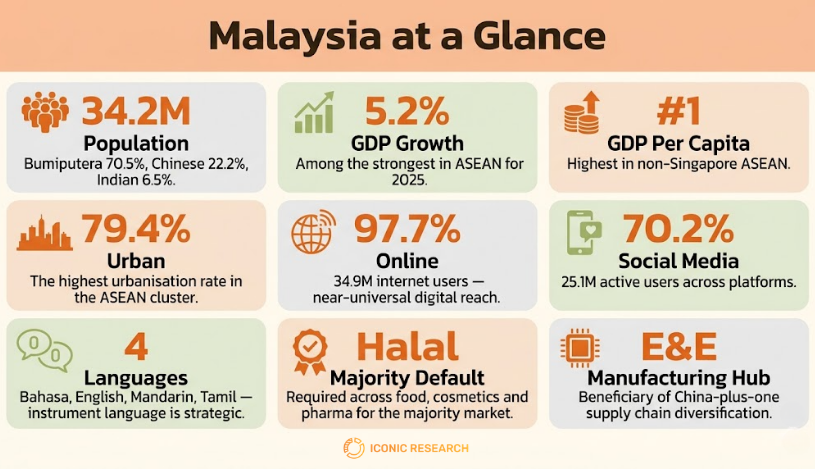
- Population: 34.2 million (2025). Ethnic composition: Bumiputera 70.5%, Chinese 22.2%, Indian 6.5% [1].
- GDP growth: 5.2% in 2025 — among the strongest in ASEAN [2].
- GDP per capita: highest in non-Singapore ASEAN.
- Urban-rural split: 79.4% urban — the highest urbanisation rate in the ASEAN cluster [3].
- Digital penetration: 34.9 million internet users, 97.7% of the population — near-universal [3]. 25.1 million social media users, 70.2% penetration.
- Languages: Bahasa Malaysia (official), English (widely spoken in business and urban settings), Mandarin, Tamil. Research instrument language is a strategic decision, not a logistics one.
- Religion: Islam (official, majority Bumiputera), Buddhism and Taoism (majority Chinese community), Hinduism (majority Indian community). Halal requirements apply across food, cosmetics, and pharmaceutical categories for the majority market.
- Malaysia manufacturing: significant electronics and electrical (E&E) sector — beneficiary of China plus one supply chain diversification [2].
- Key economic sectors: E&E manufacturing, services, financial services, tourism, palm oil and commodities, digital economy.
The Malaysian Consumer
Malaysia consumer trends cannot be read from aggregate data. The national average conceals three distinct consumer communities — each with different media habits, purchase triggers, brand loyalty patterns, and category sensitivities.
The Ethnic Segmentation Imperative
Bumiputera consumers — 70.5% of citizens — are the majority market and the most diverse within the designation. Peninsular Malay, Sabahan, and Sarawakian Bumiputera communities have distinct cultural identities and consumer preferences. The Chinese community — 22.2% — is economically influential beyond its population share and clusters heavily in urban centres, particularly Kuala Lumpur, Penang, and Johor Bahru. The Indian community — 6.5% — is further segmented by Tamil, Malayalam, and other South Indian identities with different media consumption patterns. Research that aggregates across these communities produces a composite consumer that does not exist.
The Malaysia Middle Class — Multiple Versions
Malaysia’s middle class is the most developed in non-Singapore ASEAN, but it is not one segment. Malaysia middle class aspirations, brand preferences, and purchase triggers differ significantly between Bumiputera and Chinese communities across virtually every consumer category studied. International brands that position to “the Malaysian middle class” without ethnic segment-specific research are positioning to nobody in particular.
Urban Malaysia vs East Malaysia
The Klang Valley dominates market research conducted in Malaysia. Penang and Johor Bahru are secondary research centres. Sabah and Sarawak — East Malaysia, across the South China Sea — are routinely excluded from research scopes despite representing a distinct consumer population with different income profiles, different ethnic compositions, and different brand penetration levels. For national consumer goods launches, East Malaysia exclusion is a volume error.
The Halal Economy
Malaysia has one of the world’s most sophisticated halal certification frameworks — administered by JAKIM. For the majority Bumiputera market, halal status is a category entry requirement across food, beverages, cosmetics, and pharmaceuticals — not a positioning choice. Research that does not assess halal purchase criteria for the Bumiputera segment is missing the primary purchase filter for 70% of the citizen market.
What the Accessibility Assumption Gets Wrong
The English Assumption
Business in Malaysia runs substantially in English. Consumer marketing does not. Bumiputera consumers are most effectively reached in Bahasa Malaysia. Chinese consumers by community segment in Mandarin, Cantonese, or Hokkien. Indian consumers in Tamil. Research conducted only in English reaches urban, English-dominant consumers — a real segment, but not a nationally representative one. Malaysia research panels skew heavily toward English-dominant urban demographics.
The Modern Trade Assumption
Malaysia has the highest modern trade penetration in non-Singapore ASEAN. For specific consumer goods categories and for East Malaysia, traditional trade channels remain significant. Research scoped only to modern trade retail audits produces an incomplete distribution picture.
The Malaysia Ecommerce Assumption
Malaysia ecommerce penetration is high and growing — Shopee and Lazada dominate, with TikTok Shop accelerating. But purchase behaviour varies significantly by ethnic segment, product category, and geography. Research that models ecommerce as a uniform channel across all segments overstates adoption in certain communities and understates it in others.
The Homogeneity Assumption
No other market in the ASEAN cluster has this problem at the same scale. Malaysia has geographic diversity, urban-rural income variation, and ethnic segmentation that cuts across geography and income simultaneously. A Bumiputera consumer and a Chinese consumer in Kuala Lumpur, at the same income level, in the same category, will frequently make different purchase decisions for different reasons. Segment-blind research produces segment-blind strategy.
Key Research Considerations for Malaysia
Ethnic Segment Sampling
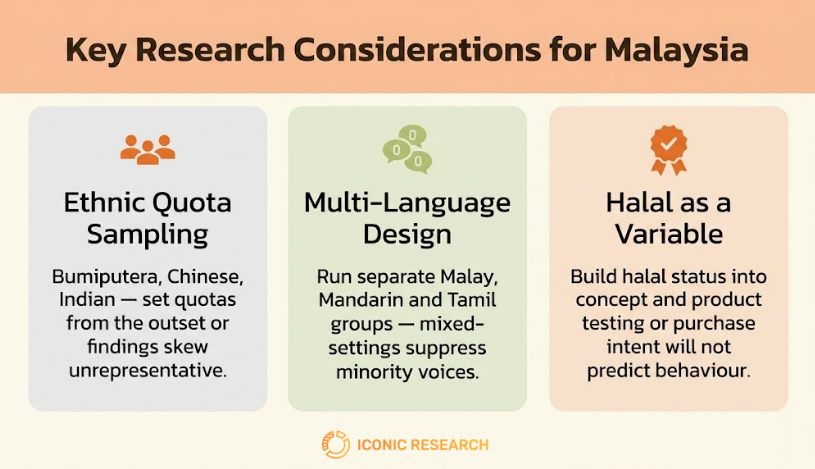
Every quantitative study in Malaysia requires deliberate ethnic quota sampling — Bumiputera, Chinese, and Indian at minimum, with Sabah/Sarawak Bumiputera considered separately for national studies. Default online panels skew toward urban, English-dominant, and disproportionately Chinese demographics. Quantitative research that does not set ethnic quotas produces ethnically unrepresentative findings.
Multi-Language Qualitative Design
Focus groups and in-depth interviews in Malaysia require deliberate language strategy. Malay-language groups for Bumiputera segments. Mandarin or dialect groups for Chinese segments. Tamil groups for Indian segments. Mixed-language groups produce dynamics where the dominant language speaker influences discussion direction — suppressing minority-language perspectives. Skilled qualitative research design treats each ethnic community segment as a separate research brief [5].
Halal Research Design
For food, beverage, cosmetics, and pharmaceutical categories, halal status must be incorporated into concept testing and product testing instruments. Failing to include halal certification status as a variable in concept testing for the Bumiputera market produces purchase intent scores that do not predict actual purchase behaviour.
Multi-Country Coordination
Malaysia is frequently part of a broader ASEAN research programme — particularly for FMCG, automotive, and consumer goods clients entering the region market by market.
In practice, this means projects like a four-market automotive feature development programme that included Malaysia — recruiting dealers and end users, managing bilingual fieldwork, and delivering unified findings across Malaysia, Philippines, Vietnam, and Thailand. See case study.
For clients building regional intelligence, Malaysia findings are most valuable when methodologically aligned with parallel studies in Indonesia, Vietnam, and the Philippines. That comparability is a design decision made at briefing — not something that can be retrofitted after fieldwork.
Working with a Research Partner for Malaysia
International businesses entering Malaysia need a Malaysia market research agency that understands ethnic segmentation as a structural research requirement, not a demographic footnote. The relevant questions: Can the agency execute qualitative research in Bahasa Malaysia, Mandarin, and Tamil? Do they set ethnic quotas in quantitative sampling by default? Do they have fieldwork capability in East Malaysia as well as the Klang Valley?
Iconic Research coordinates international market research programmes through established long-term fieldwork partnerships across Kuala Lumpur, Penang, Johor Bahru, and East Malaysia — designed from Bangkok, executed in-country with ethnic segment-specific moderation, and delivered as unified findings. See fieldwork and recruitment for how we structure in-country execution. For clients who have entered Thailand first and are expanding the ASEAN footprint, the research model is consistent — see market entry Thailand for the reference model.
Frequently Asked Questions
What does market research in Malaysia involve?
Ethnic segment-specific research across Bumiputera, Chinese, and Indian communities. Quantitative studies with deliberate ethnic quota sampling. Qualitative research in Bahasa Malaysia, Mandarin, and Tamil. Concept testing that incorporates halal status for majority-market categories.
How does ethnic segmentation affect Malaysia market research?
It is the defining structural feature of the Malaysian consumer market. Each community has different purchase triggers, brand relationships, and media habits. Research that aggregates across communities produces a composite that represents none of them.
What does doing business in Malaysia require from a research perspective?
Understanding which community segment you are entering — or whether your product requires presence across all three — and designing research that captures each segment's genuine preference rather than an averaged composite.
Does Iconic Research conduct fieldwork in Malaysia?
Yes — through established long-term partnerships across the Klang Valley, Penang, Johor Bahru, and East Malaysia, in Bahasa Malaysia, English, Mandarin, and Tamil, with Bangkok quality control. Malaysia fieldwork has run as part of multi-country ASEAN programmes including the four-market automotive study.
What sectors does Iconic Research cover in Malaysia?
FMCG, automotive, halal-category products, financial services, healthcare and pharmaceuticals, technology and digital products, and market entry for international brands navigating ethnic segmentation.
References
[1] Department of Statistics Malaysia (DOSM) (2025). Current Population Estimates, Malaysia, 2025. https://www.dosm.gov.my/portal-main/release-content/current-population-estimates-2025
[2] IMF (February 2026). Malaysia: 2026 Article IV Consultation. https://www.imf.org/en/news/articles/2026/02/26/pr-26065-malaysia-imf-executive-board-concludes-2026-article-iv-consultation
[3] We Are Social / Meltwater (2025). Digital 2025: Malaysia. https://datareportal.com/reports/digital-2025-malaysia
[4] World Bank (October 2025). Malaysia Economic Monitor — From Bytes to Benefits. https://www.worldbank.org/en/country/malaysia/publication/from-bytes-to-benefits-digital-transformation-as-a-catalyst-for-public-sector-productivity
[5] Iconic Research. Qualitative Market Research. https://iconicthai.com/services/qualitative-market-research/
If you wish to quote any information from this article, please kindly cite the source along with the link to the original article to respect copyright. |
 |
Iconic Research Thailand Your trusted partner in market research and consulting across Thailand and Southeast Asia. Headquartered in Bangkok, we provide research-driven insights across the Philippines, Malaysia, Indonesia, Singapore, Laos, and Vietnam. We help businesses navigate Thailand's market complexities through consumer insights, market entry strategy, and trend foresight. Contact us if you have any queries! (+66)888 954 954 |
Contact us
We always looking for new and exciting opportunities. Let’s connect.
Related posts
 Growth Strategy: The Expansion Decisions That Need Evidence
Growth strategy is the set of decisions about where a company expands next. Only 25% of companies grow sustainably — the difference is evidence, not ambition.
9 min read Brand Strategy: The Decisions That Should Be Built on Evidence
Brand strategy is the set of decisions that determine how a brand competes. Those decisions only pay off when they’re built on consumer evidence — not a workshop.
11 min read Key Opinion Leader: What Thai Brands Should Research Before, During, and After a KOL Campaign
Platform metrics mislead brands choosing and measuring KOLs in Thailand. A research-first look at what to verify before, during, and after a campaign.
10 min read