
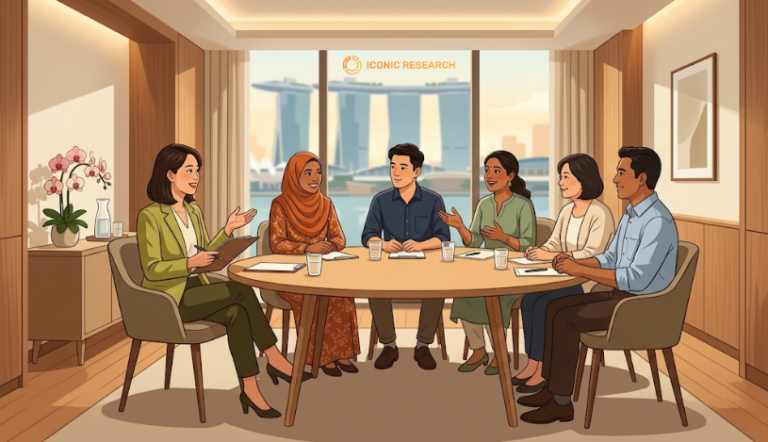
Focus group Singapore operates on two levels that most agencies address separately. The first is consumer research with Singapore’s multicultural population — Chinese, Malay, Indian, and expatriate communities whose shared English fluency conceals significant differences in purchase behaviour, cultural reference, and social research dynamics. The second is Singapore as the commissioning hub for ASEAN-wide qualitative research programmes — where the brief is written in Singapore but the focus groups run across Indonesia, Vietnam, Malaysia, the Philippines, and Thailand. Getting both right requires different things from a research partner.
Table of Contents
- What Focus Group Singapore Involves
- The Multicultural Design Challenge
- Singapore as the ASEAN Qualitative Research Hub
- Focus Group vs In-Depth Interview in Singapore
- Working with Iconic Research for Focus Groups in Singapore
- References
Singapore is the market where most ASEAN qualitative research briefs originate. Regional headquarters sit here. Regional marketing directors sign off here. And regional procurement evaluates vendors here. A focus group Singapore programme is rarely just about Singapore consumers — it is frequently the anchor leg of a multi-country qualitative programme, or the validation study for a product being considered across Southeast Asia. Understanding both use cases is the starting point for research design.
What Focus Group Singapore Involves
A focus group in Singapore is a moderated discussion with six to eight participants, selected to represent a defined consumer segment, exploring attitudes, motivations, and responses to stimuli — concepts, products, communications, or experiences. The format is qualitative: the goal is depth of understanding, not statistical projection. Focus groups are most valuable at the stages of research where you need to know why — why consumers prefer one option over another, why a concept resonates or fails, what language they use to describe a problem your product claims to solve.
In Singapore, the standard format runs ninety minutes to two hours, in English for most urban demographics, with specialist moderation for Chinese-language or Malay-language segments where required. Participants are recruited to a screener — demographic, behavioural, and category-usage criteria — that defines which Singapore consumer population the group represents. See fieldwork and recruitment for how recruitment is structured.
The Multicultural Design Challenge
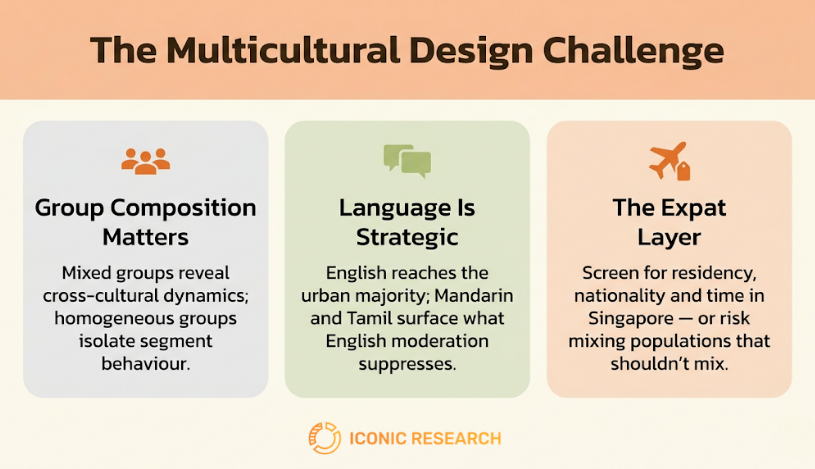
Singapore’s resident population — Chinese 73.9%, Malay 13.5%, Indian 9.0% [1] — shares English as a common language but does not share a common consumer reference frame. A mixed-ethnicity focus group run in English will produce English-language findings. It will not necessarily produce findings that reflect how each community actually thinks about the category in their own cultural frame.
Group composition matters. A focus group that mixes Chinese and Malay participants on a food or personal care category will produce dynamics shaped by halal sensitivity, dietary restriction awareness, and cross-cultural social deference that a homogeneous group would not. This is not a problem to be managed out — it is data about how the category works in a multicultural market. The research design question is whether you want to study cross-cultural dynamics or isolate ethnic segment behaviour. Both are valid. They require different group compositions.
Language is a strategic decision. English-only moderation reaches Singapore’s urban, educated, English-dominant demographic accurately. For Chinese-speaking segments — particularly older consumers or specific product categories where Mandarin, Cantonese, or Hokkien carries more cultural weight — English moderation produces socially acceptable responses rather than genuine ones [3]. The same applies to Tamil for Indian segments. Iconic Research commissions bilingual moderators for focus groups Singapore where category or demographic context requires it.
The expat layer. Singapore’s 1.91 million non-residents include expatriate professionals whose consumer behaviour, brand relationships, and purchase triggers differ significantly from Singapore citizens [1]. Screener design must specify residency status, nationality cluster, and length of time in Singapore — otherwise the recruited group mixes populations that should not be mixed.
Singapore as the ASEAN Qualitative Research Hub
For international businesses headquartered or regionally based in Singapore, the focus group brief often extends beyond Singapore. A brand manager in Singapore’s regional office may need qualitative research across Indonesia, Vietnam, Malaysia, the Philippines, and Thailand simultaneously — with findings that are methodologically comparable across all five markets and deliverable to a global headquarters on a unified timeline [2].
This is where the choice of research partner matters most. A Singapore-only agency executes the Singapore leg. It cannot coordinate the regional market research programme. A global network agency can coordinate but adds cost and layers at every market. The alternative — a Bangkok-based ASEAN regional market research coordinator with a long-term Singapore partner, in-country fieldwork networks across all five ASEAN markets, and a single point of accountability for the full programme — produces comparable findings across markets without the multi-agency complexity [5].
In practice, this means multi-country qualitative programmes coordinated simultaneously across ASEAN — including a five-country simultaneous FGD programme for a global automotive brand evaluating consumer perception across Southeast Asia see case study.
Focus Group vs In-Depth Interview in Singapore
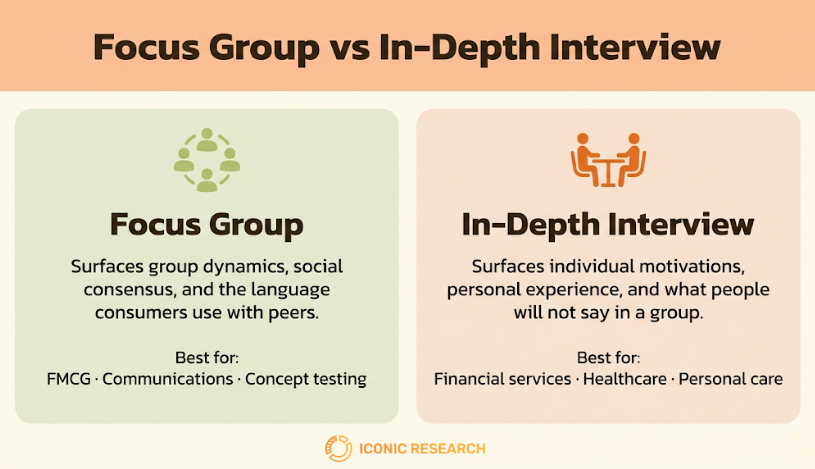
Focus groups and in-depth interviews serve different research questions. Focus groups surface group dynamics, social consensus, and the language consumers use when discussing a category with peers. In-depth interviews — or in-depth interview Singapore methodology — surface individual motivations, personal experience, and responses that respondents would not express in a group setting. This is particularly relevant in Singapore where face-saving dynamics may suppress candid group responses on sensitive categories [3].
For Singapore consumer research, the choice between focus group and IDI depends on category sensitivity, the need for group interaction data, and whether the research question is social or individual. Financial services, healthcare, and personal care categories frequently benefit from in-depth interview methodology over focus groups. FMCG, communications, and concept testing frequently benefit from focus group discussion Singapore dynamics.
Working with Iconic Research for Focus Groups in Singapore
Iconic Research coordinates focus groups Singapore programmes through a long-term local research partnership — experienced moderators, established recruitment networks, and fieldwork infrastructure across Singapore’s multicultural population. Research is designed to the brief, executed in-country, and delivered as findings that can stand alone or integrate into a broader ASEAN programme.
For regional qualitative research commissioned from Singapore, Iconic Research provides a single point of coordination across all ASEAN markets — unified methodology, local execution, Bangkok quality control. This is market research Singapore delivered as a regional capability, not a local service. See qualitative market research for the full service scope and Singapore market research for the market intelligence context.
Frequently Asked Questions
What is a focus group in Singapore?
A moderated group discussion — typically six to eight participants, ninety minutes to two hours — exploring consumer attitudes, motivations, and responses to products, concepts, or communications. Conducted in English for most urban demographics, with Mandarin, Malay, or Tamil moderation for specific segments.
What is a focus group discussion Singapore?
Focus group discussion (FGD) is the formal research term for the same methodology — a structured, moderated group session designed to elicit qualitative consumer insight. The terms focus group and FGD are used interchangeably in Singapore's market research community.
Can focus groups in Singapore cover ASEAN markets simultaneously?
Yes — Iconic Research coordinates multi-country focus group programmes across ASEAN from Bangkok, with Singapore execution through our established local partner. The same discussion guide runs across markets with local moderation adapted to each research environment.
How is a focus group different from an in-depth interview?
Focus groups capture group dynamics and social consensus. In-depth interviews surface individual motivations and responses that respondents may not express in a group setting. Both are qualitative — the choice depends on the research question and category sensitivity.
How many focus groups are needed for Singapore research?
A minimum of two groups per consumer segment is standard. For multicultural research covering two or three ethnic communities, expect four to six groups as a minimum. For ASEAN-wide programmes, the Singapore groups are typically two to three legs of a larger multi-country design.
References
[1] Singapore Department of Statistics (2025). Population Trends 2025. https://www.singstat.gov.sg/publication-resources/population-trends-2025
[2] We Are Social / Meltwater (2025). Digital 2025: Singapore. https://datareportal.com/reports/digital-2025-singapore
[3] Prolific (2025). What Is a Focus Group? Purpose, Process and Best Practices. https://www.prolific.com/resources/what-is-a-focus-group-a-guide-to-understanding-purpose-process-and-best-practice
[4] Iconic Research. Focus Group Discussion. https://iconicthai.com/focus-group-discussion/
[5] Iconic Research. Qualitative Market Research. https://iconicthai.com/services/qualitative-market-research/
If you wish to quote any information from this article, please kindly cite the source along with the link to the original article to respect copyright. |
 |
Iconic Research Thailand Your trusted partner in market research and consulting across Thailand and Southeast Asia. Headquartered in Bangkok, we provide research-driven insights across the Philippines, Malaysia, Indonesia, Singapore, Laos, and Vietnam. We help businesses navigate Thailand's market complexities through consumer insights, market entry strategy, and trend foresight. Contact us if you have any queries! (+66)888 954 954 |
Contact us
We always looking for new and exciting opportunities. Let’s connect.
Related posts
 Growth Strategy: The Expansion Decisions That Need Evidence
Growth strategy is the set of decisions about where a company expands next. Only 25% of companies grow sustainably — the difference is evidence, not ambition.
9 min read Brand Strategy: The Decisions That Should Be Built on Evidence
Brand strategy is the set of decisions that determine how a brand competes. Those decisions only pay off when they’re built on consumer evidence — not a workshop.
11 min read Key Opinion Leader: What Thai Brands Should Research Before, During, and After a KOL Campaign
Platform metrics mislead brands choosing and measuring KOLs in Thailand. A research-first look at what to verify before, during, and after a campaign.
10 min read