
Indonesia Market Research: What International Businesses Need to Know Before Entering
11 min readIndonesia market research begins with a market that most regional strategy decks underestimate. Indonesia is Southeast Asia’s largest economy and its most complex consumer market — 285 million people across 17,000 islands, speaking over 700 languages, with purchasing behaviour that varies sharply by island, religion, generation, and income tier. For international businesses, entering without primary research is not a calculated risk. It is an uninformed one.
Table of Contents
- Indonesia at a Glance
- The Indonesian Consumer
- What Western Assumptions Get Wrong
- Key Research Considerations for Indonesia
- The Indonesia Automotive Market
- Working with a Research Partner for Indonesia
- References
The scale is real — fourth largest population globally, largest economy in ASEAN, a middle class growing faster than any comparable market in the region [1]. What the deck rarely includes is how differently this market behaves from the frameworks used to analyse it. This article covers what indonesia market research involves at the market entry stage — what the market looks like, where international assumptions misfire, and what research is required before a brief is written.
Indonesia at a Glance
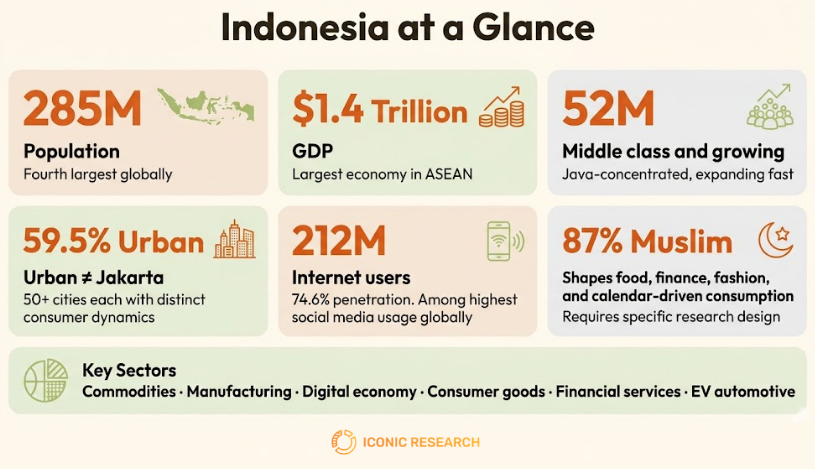
Facts only [1][2]:
- Population: 285 million. Fourth largest globally [3].
- GDP: approximately $1.4 trillion. Largest economy in ASEAN.
- Middle class: 52 million and growing — concentrated in Java but expanding to Sumatra and Sulawesi.
- Urban-rural split: 59.5% urban, rising. “Urban Indonesia” is not Jakarta — it is 50+ cities each with distinct consumer dynamics.
- Digital penetration: 212 million internet users, 74.6% of the population [3]. Among the highest social media usage rates globally.
- Religion: 87% Muslim. This shapes food, finance, fashion, and calendar-driven consumption patterns in ways that require specific research design.
- Key economic sectors: commodities, manufacturing, digital economy, consumer goods, financial services, infrastructure — including a growing indonesia automotive market as EV adoption accelerates across Java and Sumatra.
The Indonesian Consumer
Indonesia consumer behavior does not follow a single pattern across the archipelago. Understanding the variation is the starting point for any research brief.
Java vs the Archipelago
Jakarta and Java account for 57% of GDP but only 40% of population [1]. International businesses that research Jakarta and call it Indonesia have researched one city, not one country. Consumer behaviour, price sensitivity, brand familiarity, and channel preference differ significantly between Java, Sumatra, Kalimantan, and Eastern Indonesia. Research scoped to Jakarta produces Jakarta data.
Generational Dynamics
Indonesia has one of the youngest median ages in ASEAN — 30.4 years [3]. Gen Z and millennials are the primary consumption engine, heavily digital, brand-aware, and influenced by domestic KOLs more than global advertising. Campaigns built on global creative without local validation consistently underperform against domestically produced content at a fraction of the budget.
The Indonesia Middle Class
The 52 million middle class figure is widely cited and frequently misapplied [4]. Indonesia middle class income thresholds sit well below Western equivalents. Price sensitivity is acute even among aspirational consumers. Premium positioning that works in Singapore or Bangkok frequently fails in Jakarta at the same price point.
Religion and Purchasing
Halal certification is not a niche concern — it is a baseline requirement across food, cosmetics, pharmaceuticals, and financial products for the majority Muslim market. Ramadan is the single largest consumption event of the year, reshaping category behaviour, channel mix, and promotional timing in ways that require specific planning and research.
What Western Assumptions Get Wrong
Distribution Complexity
Indonesia’s modern trade penetration is lower than its smartphone penetration suggests. Traditional trade — warungs, wet markets, small independents — still accounts for the majority of FMCG volume outside major urban centres. A product that performs in Indomaret or Alfamart may not reach the consumer who buys from a warung in Surabaya. Research that covers only modern trade covers a fraction of the market.
Digital Behaviour vs Purchase Behaviour
Indonesia has extraordinary social media engagement [3]. This does not translate directly to e-commerce conversion. Social commerce — TikTok Shop, Instagram, WhatsApp group buying — is growing rapidly but category adoption varies. Research that equates digital engagement with purchase intent produces overoptimistic forecasts.
Brand Trust Dynamics
Indonesian consumers exhibit high brand loyalty once trust is established but significant scepticism toward unfamiliar foreign brands. The trust pathway runs through local influencers, peer recommendation, and trial — not advertising. Market entry strategies built on awareness spend without trust-building research tend to underperform.
Indonesia FMCG Market: Price Architecture
Sachet economics — small unit sizes at accessible price points — define indonesia FMCG market volume. International brands that enter at standard international pack sizes often find their volume ceiling is far lower than their TAM analysis suggested. Packaging and price point research is not optional. For brands at the new product development stage, this is the business analysis phase where pricing research determines whether the product is commercially viable at the pack size and price point the market will accept [5].
Key Research Considerations for Indonesia
Sampling Across the Archipelago
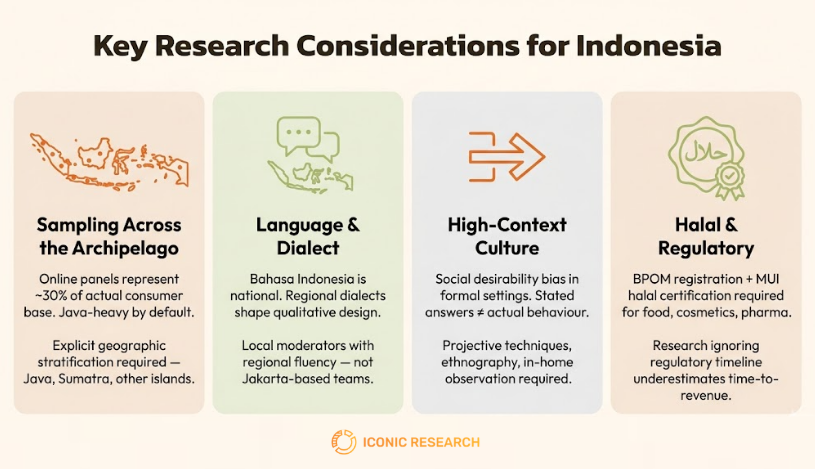
A nationally representative sample in Indonesia requires deliberate geographic stratification — Java, Sumatra, other islands at minimum. Online panels skew heavily toward Java and urban demographics. Research designs built on urban online panels produce findings that represent approximately 30% of the actual consumer base [2]. Quantitative research for Indonesia requires explicit sampling strategy across geographic zones — not defaulting to whatever the panel provides. Defining which audience segment is being researched before the sampling frame is built is the prerequisite; see target audience for the methodology.
Language and Dialect
Bahasa Indonesia is the national language but regional dialects influence research instrument design, particularly in qualitative research. Focus groups conducted in Jakarta with nationally mixed samples produce group dynamics that suppress regional candour. In-market qualitative research requires local moderators with regional fluency.
Qualitative in a High-Context Culture
Indonesian respondents exhibit social desirability bias in formal research settings — stating preferred or socially acceptable answers rather than actual behaviour. Skilled qualitative research design accounts for this through projective techniques, ethnographic observation, and in-home placement studies that observe behaviour rather than asking about it.
Halal and Regulatory Context
Products entering Indonesia require BPOM registration — food, cosmetics, pharmaceuticals — and halal certification from MUI. Research that does not account for the regulatory timeline and consumer awareness of certification status produces market entry forecasts that underestimate time-to-revenue.
Multi-Country Coordination
International businesses entering Indonesia as part of a broader ASEAN rollout face a coordination problem. Running parallel research programmes through separate local agencies in each market produces inconsistent methodologies, incomparable findings, and significant project management burden. Iconic Research operates as a Bangkok-based ASEAN research coordinator — single brief, consistent methodology, long-term fieldwork partnerships executing in-country across Indonesia, Vietnam, Thailand, Malaysia, and the Philippines. For clients entering multiple markets simultaneously, this is the operational model that produces comparable data and manageable timelines.
The Indonesia Automotive Market
Indonesia’s automotive market is the largest in ASEAN by volume and one of the most structurally complex to research. The indonesia automotive market is split between a dominant mass-market segment — where price and after-sales service network are the primary purchase drivers — and a rapidly growing EV segment where brand trust, charging infrastructure, and battery warranty are displacing price as the decisive variables.
Chinese EV brands have entered Indonesia aggressively, replicating the trust-building challenge they faced in Thailand. Consumer perception of Chinese-origin vehicles varies significantly by income tier, island, and demographic — assumptions imported from the Thai or Malaysian EV market do not transfer. Research that maps Indonesian consumer attitudes to brand origin, perceived quality, and service reliability is the prerequisite to any EV market entry or positioning decision here.
For multi-country automotive research across ASEAN — including Indonesia — see the case studies in the section below.
Working with a Research Partner for Indonesia
International businesses entering Indonesia need a research partner who understands both the brief and the market. The questions worth asking: Does the agency have fieldwork capability outside Java? Can they conduct qualitative research in Bahasa Indonesia with regional sensitivity? Do they understand the category dynamics in your specific sector — FMCG, healthcare, financial services, and technology each operate differently here?
Iconic Research coordinates indonesia market research and international market research programmes through established long-term fieldwork partnerships across Java and key provincial markets. We design research programmes from Bangkok, brief and quality-control local fieldwork partners in-country, and deliver unified findings that travel — whether the project covers Indonesia alone or runs in parallel across multiple ASEAN markets. See fieldwork and recruitment for how we structure in-country execution.
- In practice, this means projects like a four-market automotive feature development programme across the Philippines, Vietnam, Malaysia, and Thailand — recruiting dealers and end users, managing bilingual fieldwork in local languages, and delivering a unified experience journey map. See case study.
- Or a five-country simultaneous study for a global automotive brand evaluating consumer perception across ASEAN, with translation coordinated across multiple language pairs and a single coordination layer across all local teams. See case study.
The output is research built to the same methodological standard regardless of where the fieldwork happens. For clients who have entered Thailand first and are now expanding the footprint, see market entry Thailand for the reference model.
Frequently Asked Questions
What does market research in Indonesia involve?
At minimum: consumer landscape research to understand who is buying and why, segmentation to identify which audience is most accessible, concept or product testing to validate the offer, and distribution research to understand which channels reach the target segment. For regulated categories — food, cosmetics, healthcare — regulatory landscape research runs in parallel.
How is Indonesia different from other ASEAN markets to research?
Scale, diversity, and distribution complexity make Indonesia the most demanding research environment in ASEAN. Geographic stratification across the archipelago, language and dialect considerations in qualitative work, and the role of traditional trade in FMCG volume all require specific adaptation. A research design that works in Thailand or Vietnam does not transfer directly.
What does doing business in Indonesia require from a research perspective?
Doing business in indonesia requires understanding which part of the market you are actually entering — Java or the wider archipelago, modern trade or traditional trade, urban middle class or mass market — before the business case is built. Each of those choices has a different research brief and a different competitive landscape.
Does Iconic Research conduct fieldwork in Indonesia?
Yes. Iconic Research coordinates Indonesia fieldwork through established long-term partnerships across Java and key provincial markets — recruitment, moderation, and data collection in Bahasa Indonesia with quality control oversight from the Bangkok team. For clients running multi-country ASEAN programmes, Indonesia fieldwork runs in parallel with other markets under a single coordinated brief.
What sectors does Iconic Research cover in Indonesia?
FMCG, healthcare and pharmaceuticals, financial services, technology and digital products, consumer durables, automotive, and market entry for international brands. Each sector has different research requirements — regulatory context, channel dynamics, consumer decision-making patterns — and we scope accordingly.
References
[1] Badan Pusat Statistik (BPS) Indonesia (2024). Statistical Yearbook of Indonesia. https://www.bps.go.id
[2] World Bank (2025). Indonesia Economic Prospects, June 2025. https://www.worldbank.org/en/country/indonesia/publication/indonesia-economic-prospect
[3] We Are Social / Meltwater (2026). Digital 2026: Indonesia. https://datareportal.com/reports/digital-2026-indonesia
[4] World Bank Open Data. Indonesia Country Profile. https://data.worldbank.org/country/indonesia
[5] Iconic Research (2026). New Product Development. https://iconicthai.com/new-product-development/
If you wish to quote any information from this article, please kindly cite the source along with the link to the original article to respect copyright. |
 |
Iconic Research Thailand Your trusted partner in market research and consulting across Thailand and Southeast Asia. Headquartered in Bangkok, we provide research-driven insights across the Philippines, Malaysia, Indonesia, Singapore, Laos, and Vietnam. We help businesses navigate Thailand's market complexities through consumer insights, market entry strategy, and trend foresight. Contact us if you have any queries! (+66)888 954 954 |
Contact us
We always looking for new and exciting opportunities. Let’s connect.
Related posts
 Growth Strategy: The Expansion Decisions That Need Evidence
Growth strategy is the set of decisions about where a company expands next. Only 25% of companies grow sustainably — the difference is evidence, not ambition.
9 min read Brand Strategy: The Decisions That Should Be Built on Evidence
Brand strategy is the set of decisions that determine how a brand competes. Those decisions only pay off when they’re built on consumer evidence — not a workshop.
11 min read Key Opinion Leader: What Thai Brands Should Research Before, During, and After a KOL Campaign
Platform metrics mislead brands choosing and measuring KOLs in Thailand. A research-first look at what to verify before, during, and after a campaign.
10 min read