
New Product Development: The 7 Stages and the Research That Makes Them Work
10 min readNew product development is the structured process of taking a product from initial idea to commercial launch — covering ideation, validation, design, testing, and go-to-market execution. The standard framework runs across seven stages: idea generation, idea screening, concept development and testing, business analysis, product development, test marketing, and launch. In Thailand, where stated consumer preference diverges from purchase behaviour more sharply than in Western markets, research at each stage is not optional — it is what separates a validated launch from an expensive assumption.
Table of Contents
- What Is New Product Development?
- The 7 Stages of New Product Development
- Where Research Fits — and Where It Gets Cut
- New Product Development Research Methods
- New Product Development in Thailand
- References
Most new products fail [1]. Not because the idea was wrong or the engineering was poor — because the research that should have validated both was cut, compressed, or never commissioned. The 7-stage framework is widely understood and widely misapplied: treated as a project management checklist rather than a research-dependent process where each stage produces evidence the next stage depends on. When the research is removed, the checklist still gets completed. The product still launches. The failure just moves to where it costs most — at shelf, post-investment, post-commitment.
What Is New Product Development?
New product development is the complete process of taking a product from initial idea to commercial launch — encompassing ideation, validation, design, testing, and go-to-market execution. It applies to genuinely new products, to existing products entering new markets, and to significant reformulations of existing products [1].
It is distinct from product improvement, which optimises an existing product without fundamentally changing it, and from line extension, which applies an existing brand to an adjacent category or format. NPD involves validated unknowns at every stage — unknown consumer response, unknown market size, unknown competitive reaction. Research is not supplementary to the new product development process. It is the mechanism by which unknowns become knowable before they become expensive.
The 7 Stages of New Product Development
The stages are a framework, not a rigid sequence. In practice they overlap, loop back under commercial pressure, and compress when timelines tighten. What matters is that each stage produces a decision — and that each decision is supported by evidence.
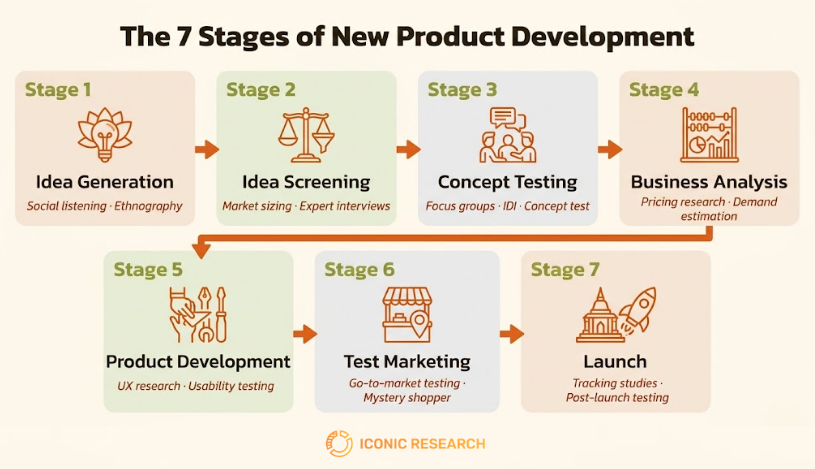
Stage 1 — Idea generation. The search for product opportunities across customer complaints, competitive gaps, emerging trends, and internal R&D. Research required: social listening to surface unprompted consumer language around the category, ethnographic observation to identify unmet needs, and desk research to map the competitive landscape.
Stage 2 — Idea screening. Filtering the idea pool against strategic fit, technical feasibility, and market size. Research required: initial market sizing to confirm the opportunity is large enough to justify development investment, and expert interviews to validate technical and regulatory assumptions early.
Stage 3 — Concept development and testing. Translating screened ideas into defined product concepts and exposing them to target consumers before any development begins. Research required: concept testing, focus groups, and in-depth interviews to measure purchase intent, preference against alternatives, and the language consumers use to describe the benefit. This is the highest-leverage research stage in the entire NPD process — the cost of iteration here is weeks, not months.
Stage 4 — Business analysis. Revenue projections, cost modelling, and break-even analysis that determine whether the concept is commercially viable. Research required: pricing research to establish willingness to pay, demand estimation to size the opportunity, and competitive benchmarking to set realistic share assumptions.
Stage 5 — Product development. Building the prototype or minimum viable product. Research required: UX research and usability testing to validate that the product experience matches the concept promise — identifying friction points before production commitments are made.
Stage 6 — Test marketing. Controlled release to a limited market to validate assumptions before full rollout. Research required: product and go-to-market testing with real consumers under real conditions, mystery shopper audits to assess retail execution, and structured data collection to distinguish genuine traction from launch novelty.
Stage 7 — Launch. Full commercial release. Research required: tracking studies to monitor brand health and consumer awareness, post-launch product testing to verify that the product performs in-market as it did in test conditions, and consumer feedback programmes to catch early signals before they become structural problems.
Where Research Fits — and Where It Gets Cut
Research is not a stage in the new product development process. It is the connective tissue between stages. Each stage produces a decision. Each decision is only as good as the evidence behind it.
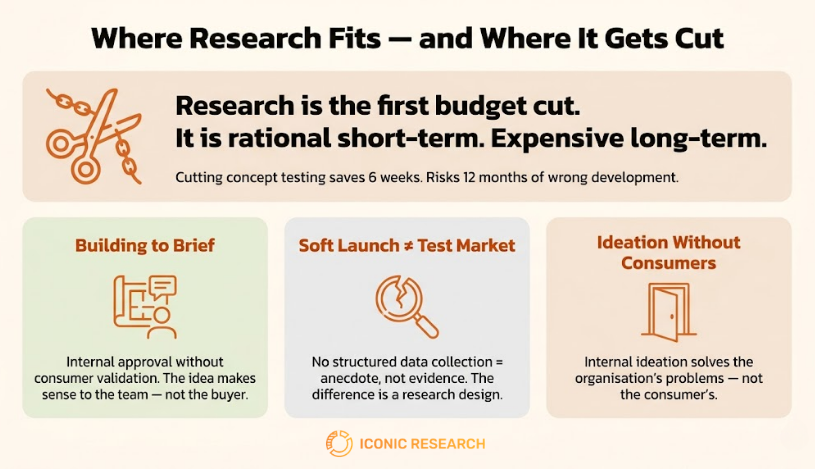
When timelines compress — and they always compress — research is the first budget cut. This is rational in the short term. It is expensive in the long term. Cutting concept testing saves six weeks and risks twelve months of development on an idea consumers will not buy. The failure does not appear at the research stage. It appears at launch, where the cost of being wrong is highest and the window for correction is narrowest [1].
Three failure patterns appear consistently in compressed NPD programmes:
Building to brief rather than to evidence. The concept goes straight from internal approval to development without external validation. The team has confirmed that the idea makes sense to them. They have not confirmed that it makes sense to the consumer.
Compressing test marketing into a soft launch. A limited regional release with no structured data collection produces anecdote rather than evidence. The difference between a soft launch and a test market is a research design.
Treating idea generation as an internal exercise. Consumer complaints, social media language, and ethnographic observation are the most productive sources of genuine product opportunities. Removing external input from ideation produces ideas that solve the organisation’s problems rather than the consumer’s.
New Product Development Research Methods
Qualitative research at ideation and concept stages surfaces the language, motivation, and unmet needs that inform what gets built. Focus groups and in-depth interviews reveal how consumers describe the category problem, what solutions they have already tried, and what would make them switch — before a single brief is written.
Concept testing is the structured exposure of product concepts to target consumers before development begins [3]. It tests purchase intent, preference against named alternatives, and willingness to pay. The most important function of concept testing is not confirming that a concept is good — it is identifying which version of the concept is best and why, so development builds the right product from the start. See concept testing for methodology detail.
Quantitative research at the business analysis stage converts qualitative hypotheses into projectable findings [2]. Survey-based segmentation sizes the opportunity, pricing research establishes the viable price range, and conjoint analysis identifies which product attributes drive purchase intent at scale. Quantitative research is where insight becomes a business case.
Product testing exposes the actual product — not the concept — to consumers under controlled or naturalistic conditions before full launch [4]. Blind tests, central location tests, and in-home placement studies all produce different data suited to different NPD questions. For methodology detail, see product and go-to-market testing.
Fieldwork and recruitment underpin every research stage. In Thailand, recruiting representative samples — by region, income bracket, and category usage — requires local fieldwork expertise that online panels cannot replicate. Fieldwork and recruitment is the operational infrastructure that determines whether the research finds the right people.
New Product Development in Thailand
Standard NPD frameworks were built on Western consumer behaviour and Western market data. Three specific dynamics make Thailand different.
Speed-to-market pressure compresses research timelines. In FMCG — food and beverage, personal care, household products — competitive windows are short and the pressure to move from concept to shelf is constant. The cost of that compression is concept-to-shelf failures that would have been caught at stage three. A concept that scores strongly in internal review and weakly in consumer concept testing has given the NPD team six weeks to change course. A product that reaches shelf without concept testing has given them nothing.
Stated preference diverges from purchase behaviour more sharply here. A Thai consumer who rates a concept highly in a focus group setting may not convert at shelf. The gap between stated and actual preference — driven partly by kreng jai social dynamics and partly by the Thai consumer’s genuine openness to novelty that does not extend to repeat purchase — means that attitudinal research needs to be paired with behavioural observation and go-to-market testing to produce reliable launch predictions [5].
Distribution and channel shape the product as much as the product itself. What performs in modern trade in Bangkok does not automatically work in traditional trade upcountry. The pack size, price point, and communication format that drives purchase in a 7-Eleven may be wrong for a wet market in Chiang Rai. New product development research that covers regional variation — not just Bangkok — is what separates a national launch from a Bangkok launch that never scales.
Frequently Asked Questions
What is the new product development process?
The sequence of stages — from idea generation through commercial launch — a company follows to bring a new product to market. Seven stages in the standard framework, though in practice they overlap and compress under commercial pressure.
What are the stages of new product development?
Idea generation, idea screening, concept development and testing, business analysis, product development, test marketing, and launch. Each stage produces a decision the next depends on.
What is a new product development strategy?
The decisions governing which markets to target, what innovation level to pursue, and how to balance speed against validation rigour. Research informs strategy at every point where assumptions about consumers, competitors, or market size are being made.
What does product development research involve?
Qualitative exploration at ideation, concept testing at the development stage, quantitative validation at business analysis, and product testing before launch. The method follows the question.
How do I find new product development companies in Thailand?
Look for agencies covering the research side — concept testing, consumer research, fieldwork — not just design or engineering. Research capability is what determines whether the product meets the market before launch rather than after.
References
[1] Evanschitzky, H. et al. (2021). How common is new product failure and when does it vary? Marketing Letters, 32. https://link.springer.com/article/10.1007/s11002-021-09555-x
[2] Product Development & Management Association (2012). PDMA Best Practices Study. PDMA. https://www.pdma.org/page/best_practices
[3] Iconic Research (2025). Concept Testing in Thailand. https://iconicthai.com/services/concept-testing/
[4] Iconic Research (2025). Go-to-Market Testing in Thailand. https://iconicthai.com/insights/go-to-market-testing/
[5] Smith, P.B. (2004). Acquiescent Response Bias as an Aspect of Cultural Communication Style. Journal of Cross-Cultural Psychology. https://journals.sagepub.com/doi/10.1177/0022022103260380
If you wish to quote any information from this article, please kindly cite the source along with the link to the original article to respect copyright. |
 |
Iconic Research Thailand Your trusted partner in market research and consulting across Thailand and Southeast Asia. Headquartered in Bangkok, we provide research-driven insights across the Philippines, Malaysia, Indonesia, Singapore, Laos, and Vietnam. We help businesses navigate Thailand's market complexities through consumer insights, market entry strategy, and trend foresight. Contact us if you have any queries! (+66)888 954 954 |
Contact us
We always looking for new and exciting opportunities. Let’s connect.
Related posts
 Growth Strategy: The Expansion Decisions That Need Evidence
Growth strategy is the set of decisions about where a company expands next. Only 25% of companies grow sustainably — the difference is evidence, not ambition.
9 min read Brand Strategy: The Decisions That Should Be Built on Evidence
Brand strategy is the set of decisions that determine how a brand competes. Those decisions only pay off when they’re built on consumer evidence — not a workshop.
11 min read Key Opinion Leader: What Thai Brands Should Research Before, During, and After a KOL Campaign
Platform metrics mislead brands choosing and measuring KOLs in Thailand. A research-first look at what to verify before, during, and after a campaign.
10 min read