
Product testing is the process of exposing a product to real consumers under controlled or natural conditions to evaluate performance, preference, acceptability, and purchase intent before or after launch. This article covers consumer product testing in a market research context — not laboratory, chemical, or safety certification testing. In Thailand, specific execution considerations affect which methods produce reliable data and which produce scores that look strong but misrepresent the market.
Table of Contents
- What Is Product Testing in Market Research?
- Types of Product Testing
- Product Testing Methods in Thailand — Execution Considerations
- When to Use Product Testing
- Product Testing in Thailand — Iconic Research
- References
What Is Product Testing in Market Research?
Product testing in market research is a form of consumer product evaluation: it measures how real consumers perceive, use, and respond to a product — not whether it meets a technical specification or passes a regulatory standard. Three questions it answers: does the product perform as expected, does it meet consumer expectations, and does it generate sufficient purchase intent to justify launch?
This distinguishes product testing from concept testing. Concept testing evaluates an idea before a physical product exists — it determines whether the proposition is compelling enough to develop. Product testing evaluates the physical product itself — it determines whether the product delivers on the concept’s promise. The two are sequential: concept testing precedes development; product testing follows it.
Product testing applies across the product lifecycle — pre-launch validation, variant selection during development, renovation assessment before an existing formula is changed, and post-launch tracking. Each stage requires a different instrument and a different research design.
Types of Product Testing
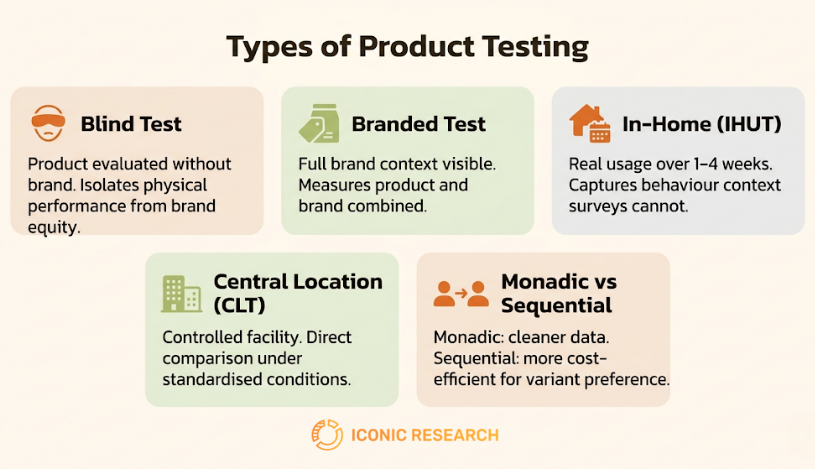
Blind product test — the product is evaluated without brand identification. Respondents assess taste, texture, scent, performance, or design without knowing which brand they are evaluating. This isolates the product’s physical performance from brand equity and packaging influence — producing a direct read on whether the product itself is competitive. Standard in FMCG, food and beverage, and personal care categories where brand halo effects are strong.
Branded product test — the product is evaluated with full brand context: packaging, name, and positioning visible. Measures the combined effect of product and brand on consumer perception. Used when the brand is integral to the proposition — luxury, premium, or heritage categories where the brand experience is part of the product experience.
In-home use test — also called a home usage test or home use test (IHUT) — the product is placed with consumers to use in their natural environment over a defined period, typically one to four weeks. In home product testing captures real usage behaviour, frequency, and satisfaction over time rather than a single point-in-time reaction in a controlled setting. Particularly valuable for food, household products, personal care, and any category where usage context affects performance perception — a cleaning product evaluated in a CLT produces different data from one used across a month of actual household cleaning.
Central location test (CLT), also called a hall test — consumers evaluate the product in a controlled facility. Enables direct product comparison between multiple variants or competitor products under standardised conditions. Standard methodology for FMCG, food and beverage, and automotive in Thailand. CLT facilities allow for sensory controls — lighting, temperature, serving conditions — that in-home or online methods cannot replicate [6]. For CLT logistics, venue sourcing, and respondent recruitment across Thailand, see fieldwork and recruitment.
The reason a central location test produces reliable comparative data is environmental control. Every consumer evaluates under identical conditions — the same temperature, lighting, serving method, and sequence — which removes the variability that makes in-home or online data noisy. When several variants are tested, the tasting sequence is rotated across respondents so no variant benefits from being sampled first or last; this order control is what makes comparative CLT data trustworthy rather than an artefact of position. The choice between CLT and IHUT follows from the research question: a hall test is right for controlled comparison and sensory precision — taste, first impressions, packaging response — while in-home testing is right for real-world usage measured over time, as the IHUT description above explains.
A well-designed CLT also isolates variables that would otherwise contaminate one another, by running in sequential stages. In the blind taste stage, products are evaluated unbranded, so flavour scores reflect genuine sensory response rather than packaging or brand halo. In the packaging-reveal stage, consumers see the packaging and state the price they would expect to pay from packaging alone — a packaging test within the CLT that measures how packaging shapes perceived value. In the price-acceptance stage, the planned price is revealed, and the gap between expected and planned price shows whether the product is underpriced, correctly priced, or facing a packaging-credibility gap. A related check, shelf testing, evaluates how the product stands out against competitors on a crowded shelf — a distinct read that pairs naturally with packaging testing. For a worked example, see our Central Location Test for a Thai snack brand, which used this staged design to separate taste, packaging, and pricing response.
Monadic vs sequential monadic design — a monadic test exposes each respondent to one product only. Sequential monadic exposes the same respondent to multiple products in sequence. Monadic testing produces cleaner, uncontaminated data — each respondent’s reaction is not influenced by prior exposure. Sequential monadic is more cost-efficient for variant testing where the research question is relative preference rather than absolute performance. The choice depends on what the data needs to support.
Product Testing Methods in Thailand — Execution Considerations
No methodology choice is neutral in Thailand. The same product test designed for a Western market will produce systematically different — and often unreliable — results if applied without adaptation.
Acquiescence bias is the primary instrument risk. Thai respondents consistently rate products higher than their actual preference warrants [5]. The cultural norm of kreng jai — the instinct to avoid causing discomfort — operates in product evaluation exactly as it does in satisfaction surveys. A product that scores 4.2 out of 5 in a Thai CLT does not mean the same thing as 4.2 in Germany. Blind test protocols, carefully structured rating scales, and forced-choice comparative questions all mitigate this — but only when the instrument is designed for it from the start, not adjusted after data collection reveals the problem.
Regional variance is structural. Bangkok consumers differ from provincial consumers in taste preference, usage behaviour, and price sensitivity in ways that materially affect product acceptance scores. A product test scoped only to Bangkok misrepresents the national picture for any product with national distribution ambitions. For FMCG and food and beverage categories, regional supplementation is not optional — it is the difference between a test that informs a national launch and one that validates Bangkok performance only.
In-home testing and LINE completion rates. Thai consumers respond to LINE-based check-in surveys during IHUT studies at significantly higher rates than email-based follow-up [4]. In-home product testing programmes designed around LINE check-ins — daily or weekly prompts through LINE Official Account — produce better data quality and higher completion rates than email diaries. This is a methodology consideration, not a minor operational detail. An IHUT that loses 40% of respondents to non-completion by week two has a sample integrity problem regardless of how strong the initial placement was.
Automotive product testing. Car clinic methodology in Thailand runs as two distinct phases: a static hall test for design, interior, and feature evaluation — consumers spend time with the vehicle in a controlled venue — and a dynamic drive test for performance, handling, and technology assessment on a defined route. These phases serve different research questions and require different facility and logistics arrangements. For automotive product evaluation methodology, see car clinic and automotive research.
When to Use Product Testing
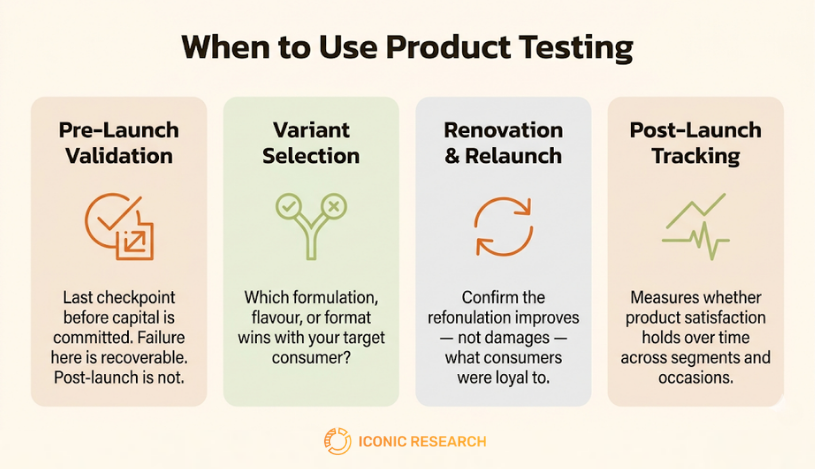
Pre-launch validation is the primary use case. A physical prototype or production sample is tested with the target consumer before full production commitment. This is the last checkpoint before capital is deployed at scale — a product that fails with consumers at this stage is recoverable; one that fails post-launch is not. Within the full new product development process, product testing sits at Stage 6 — after business analysis and prototype development, before commercial launch commitment.
Variant selection applies when two or more formulations, designs, flavours, or pack formats are under consideration. Sequential monadic or side-by-side comparison testing identifies which variant performs best with the target consumer, reducing the risk of launching the wrong version of a viable product.
Renovation and relaunches require product testing to confirm that a reformulation improves or maintains consumer acceptance before the existing formula is discontinued. This is a category where testing is often skipped under cost pressure — and where brands regularly discover that a renovation consumers did not request has damaged the product they were loyal to.
Post-launch tracking measures whether a live product is maintaining consumer satisfaction over time. This connects product testing to a broader customer satisfaction programme — tracking how product performance scores shift across consumer segments and purchase occasions as the product matures in market. For post-launch satisfaction measurement methodology, see our customer satisfaction guide.
Product Testing in Thailand — Iconic Research
Iconic Research designs and executes consumer product testing programmes across Thailand for FMCG, automotive, food and beverage, and healthcare clients. As a product testing company operating its own fieldwork and recruitment team, we run central location tests, in-home placement studies, and automotive car clinic programmes — with provincial coverage that online-only panels cannot replicate.
Our central location test for a Thai snack brand [1] is a worked example of the staged CLT design above. A Thai food manufacturer preparing to launch a new fried snack needed evidence on three questions before committing to a full launch: which of three flavour variants consumers actually preferred, how the product was perceived once packaged, and whether the planned retail price would hold.
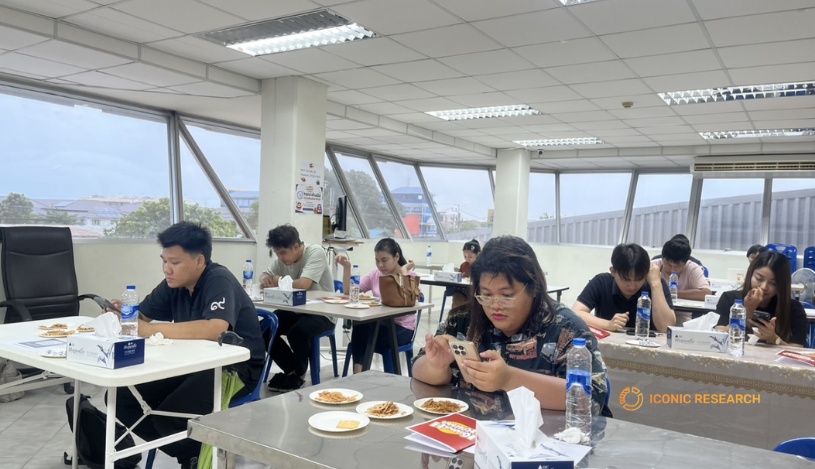
Iconic ran a single CLT built in three sequential stages with around 100 consumers, split across Gen Z, young adults, and parents and profiled by mindset rather than age alone. In the blind taste stage, the three variants were rated unbranded, so flavour scores reflected genuine sensory response; in the packaging-reveal stage, consumers stated the price they expected to pay from the packaging alone; in the price-acceptance stage, the planned price was revealed, and the gap between expected and planned price showed whether the product was underpriced, correctly priced, or facing a packaging-credibility gap. The staged sequence is what made the findings reliable — measuring taste blind before any packaging or brand cue could move the score, then capturing price expectation from packaging before the real price was shown, separated variables that a single combined test would have blurred. The result was a defensible read on product, packaging, and pricing before the cost of a full launch was committed.
Our toothpaste product testing [2] programme combined blind CLT evaluation across Bangkok consumer segments with in-home placement to validate performance across real usage occasions — a methodology that produced significantly different data from the initial CLT-only design. Our pickup truck market entry study [3] demonstrates gang survey methodology applied to automotive product evaluation in Thailand — respondents assembled at a central location to assess a new model’s design, features, and specifications before launch, with exterior design feedback directly informing model adjustments prior to market entry.
Frequently Asked Questions
What is product testing in market research?
Product testing in market research is the evaluation of a physical product with real consumers to measure performance, preference, and purchase intent. It differs from laboratory or chemical testing — the focus is consumer perception, not technical specification. It is conducted before launch to validate the product, during development to select between variants, and after launch to track satisfaction over time.
What is the difference between product testing and concept testing?
Concept testing evaluates an idea, proposition, or prototype before a physical product exists — it tests whether the concept is compelling enough to develop. Product testing evaluates the physical product itself — it tests whether the product delivers on the concept's promise. The two are sequential: concept testing precedes development; product testing follows it.
What is a blind product test?
A blind product test evaluates a product without brand identification. Respondents assess taste, texture, performance, or design without knowing which brand they are evaluating. This isolates the product's physical performance from brand equity and packaging influence — producing a cleaner read on whether the product itself is competitive against alternatives in the category.
What is in-home product testing?
In-home product testing (IHUT) places a product with consumers to use in their natural environment over a defined period — typically one to four weeks. It captures real usage behaviour, frequency of use, and satisfaction over time rather than a single point-in-time reaction in a controlled setting. IHUT is particularly valuable for food, personal care, household, and any product where usage context affects performance perception.
What is a central location test (CLT)?
A central location test, or hall test, is a product test run in a controlled facility where consumers evaluate a product under standardised conditions. It is the standard method for comparing multiple variants or testing against competitors, and is widely used for FMCG, food and beverage, and automotive product testing in Thailand. CLTs can be staged to separate taste, packaging, and pricing response.
How is product testing conducted in Thailand?
Product testing in Thailand requires adaptation for local execution. Acquiescence bias — the tendency of Thai respondents to rate products higher than their actual preference — must be designed out through blind test protocols and carefully structured rating instruments. Regional variance between Bangkok and provincial consumers is structural and must be accounted for in sample design. Central location tests in Thailand are typically conducted in Bangkok with provincial supplementation for studies requiring national representation. LINE-based check-in surveys are the standard for IHUT completion in Thailand, outperforming email-based diary methods on completion rate and data quality.
References
[1] Iconic Research. Snack Product Testing in Thailand — Central Location Test. https://iconicthai.com/case-study/snack-product-testing-clt-thailand/
[2] Iconic Research. Toothpaste Product Testing in Urban Thailand. https://iconicthai.com/case-study/case-study-toothpaste-product-testing-in-urban-thailand/
[3] Iconic Research. Pick-up Truck Market Entry Study in Thailand. https://iconicthai.com/case-study/thailand-pickup-truck-market/
[4] Electronic Transactions Development Agency (2024). Thailand Internet User Behavior Report. ETDA. https://www.etda.or.th/en/Our-Service/statistics-of-internet-users-in-thailand.html
[5] Smith, P.B. (2004). Acquiescent Response Bias as an Aspect of Cultural Communication Style. Journal of Cross-Cultural Psychology. https://journals.sagepub.com/doi/10.1177/0022022103260380
[6] Galloway Research Service (2026). What is Central Location Testing? A Complete Guide for Brands. https://www.gallowayresearch.com/insights/central-location-testing-guide
If you wish to quote any information from this article, please kindly cite the source along with the link to the original article to respect copyright. |
 |
Iconic Research Thailand Your trusted partner in market research and consulting across Thailand and Southeast Asia. Headquartered in Bangkok, we provide research-driven insights across the Philippines, Malaysia, Indonesia, Singapore, Laos, and Vietnam. We help businesses navigate Thailand's market complexities through consumer insights, market entry strategy, and trend foresight. Contact us if you have any queries! (+66)888 954 954 |
Contact us
We always looking for new and exciting opportunities. Let’s connect.
Related posts
 Growth Strategy: The Expansion Decisions That Need Evidence
Growth strategy is the set of decisions about where a company expands next. Only 25% of companies grow sustainably — the difference is evidence, not ambition.
9 min read Brand Strategy: The Decisions That Should Be Built on Evidence
Brand strategy is the set of decisions that determine how a brand competes. Those decisions only pay off when they’re built on consumer evidence — not a workshop.
11 min read Key Opinion Leader: What Thai Brands Should Research Before, During, and After a KOL Campaign
Platform metrics mislead brands choosing and measuring KOLs in Thailand. A research-first look at what to verify before, during, and after a campaign.
10 min read