

Customer Satisfaction Survey: How to Measure CSAT, NPS, and CES in Thailand
11 min readA customer satisfaction survey is only as useful as the methodology behind it — and in Thailand, the methodology assumptions that work in Western markets consistently produce misleading results. Acquiescence bias, channel behaviour, and the absence of Thai-market baselines all distort scores in ways that standard benchmarking tools do not account for. This article covers the three core customer experience measurement frameworks — CSAT, NPS, and CES — how to design a customer satisfaction survey that produces reliable data in Thailand, and what to do with the results once you have them.
Table of Contents
- What Is Customer Satisfaction?
- The Three Measurement Frameworks
- Why Standard Benchmarks Mislead in Thailand
- Designing a Customer Satisfaction Survey That Works
- What to Do With the Data
- Customer Satisfaction Research in Practice
- References
What Is Customer Satisfaction?
Customer satisfaction is the degree to which a product or service meets or exceeds customer expectations at each point of interaction. It is distinct from customer experience — which encompasses the full relationship across every touchpoint — and from customer loyalty, which is the behavioural outcome that sustained satisfaction produces over time. Satisfaction is the middle term: it reflects perception at a moment, and moments accumulate into the decisions to return, recommend, or leave.
The primary instrument for measuring it is CSAT — Customer Satisfaction Score — which quantifies satisfaction at a specific interaction and forms the foundation of most customer satisfaction programmes. The critical qualification is that the survey instrument, delivery method, and interpretation framework all determine whether those numbers reflect reality or produce a comfortable fiction.
The Three Measurement Frameworks
CSAT, NPS, and CES are the three instruments used to measure customer satisfaction and related dimensions of experience. They are not interchangeable. Each answers a different question — CSAT measures satisfaction at a specific interaction, NPS measures overall loyalty, and CES measures friction — and selecting the wrong instrument produces data that cannot support the decision it is meant to inform.
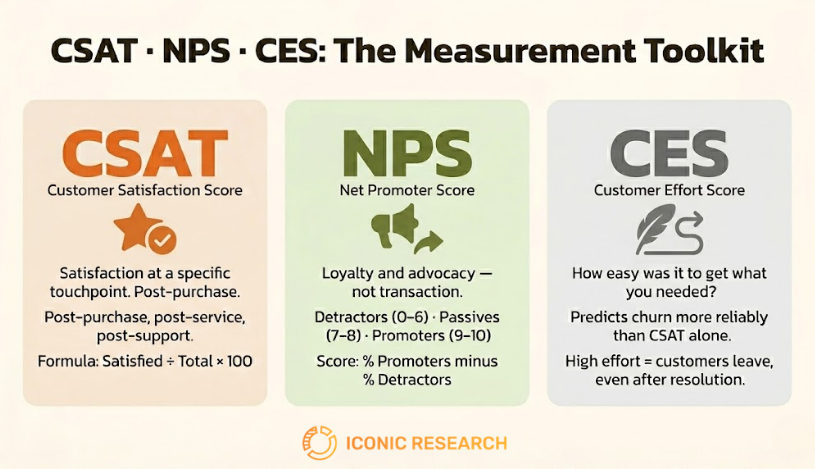
CSAT (Customer Satisfaction Score) measures satisfaction at a specific touchpoint immediately after an interaction. The formula: satisfied responses divided by total responses, multiplied by 100. CSAT is the right instrument for post-purchase, post-service, and post-support measurement — any moment where you need to know whether a specific interaction met expectations. It is not a relationship-level metric. Understanding how satisfaction and loyalty interact — and where they diverge — is the core question that customer loyalty research answers.
NPS (Net Promoter Score) measures loyalty and advocacy, not transactional satisfaction. The single question — how likely are you to recommend us? — separates Detractors (0–6), Passives (7–8), and Promoters (9–10). NPS reflects overall relationship sentiment, not moment-level experience. It is the right instrument for periodic relationship health measurement — quarterly or biannually — not post-transaction tracking.
CES (Customer Effort Score) measures how easy it was for the customer to accomplish what they needed, using a 7-point agreement scale. High effort — customers who had to work hard to resolve an issue — is the strongest churn predictor at service and support touchpoints, often more reliable than CSAT alone: customers leave even when the resolution was satisfactory if the process of getting there was painful.
These three instruments answer three different questions. The choice between them is determined by what decision the data needs to inform, not by what is easiest to collect.
The Importance-Satisfaction Gap
A fourth dimension — rarely included in standard programmes but consistently the most actionable output — is the gap between stated importance and current satisfaction. Measuring satisfaction alone tells you how customers feel. Measuring importance alongside satisfaction tells you where to act first. A feature rated high in importance but low in satisfaction is a higher-priority improvement target than a low-importance element with poor scores. In a multi-market study across Thailand, the Philippines, and Indonesia, Iconic Research applied a three-dimension framework — Feature Importance, Current Satisfaction, and Purchase Intent Considering Cost — across 25 product attributes simultaneously. The importance-satisfaction gap identified the highest-leverage improvement priorities that satisfaction scores alone would not have surfaced.
Why Standard Benchmarks Mislead in Thailand
This is the gap that most customer satisfaction programmes operating in Thailand do not close — and it is where scores that look acceptable produce decisions that are wrong.
Acquiescence bias is structural, not incidental. Thai respondents systematically score higher than their actual satisfaction level because openly expressing dissatisfaction with a service provider feels socially uncomfortable. The cultural norm of kreng jai — the instinct to avoid causing discomfort to others — operates in survey responses exactly as it operates in conversation [6]. A CSAT score of 4.2 out of 5 in Thailand does not mean the same thing as 4.2 out of 5 in Germany. The number looks the same. The underlying satisfaction it represents is different. This is a well-documented finding in cross-cultural research literature, and it has a direct implication: benchmarks must be established locally against consistent Thai-market measurement, not imported from global averages that were built on different response cultures.
Channel affects response patterns. LINE is the standard delivery channel in Thailand — response rates are higher, turnaround is faster, and the mobile-first format fits how Thai consumers communicate with brands. Email surveys skew toward older respondents and underrepresent younger urban segments. The methodology choice shapes who responds, how they respond, and what the data actually measures.
Industry context determines what a score means. A car brand running post-service CSAT surveys needs Thai automotive baselines — not global averages — to know whether a 78% CSAT is strong performance or an early warning sign. Sector-specific baselines, built from consistent measurement over time, convert a number into a decision.
Designing a Customer Satisfaction Survey That Works
Survey design determines data quality before a single response is collected. The decisions made at instrument level — length, question structure, timing, language — shape whether the results reflect genuine customer perception or the artefacts of a poorly designed measurement tool.
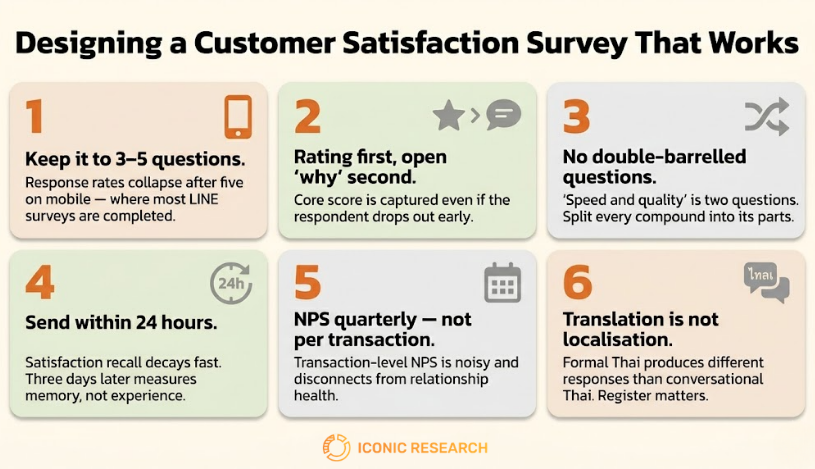
Keep the survey short. Three to five questions is the effective range for a post-interaction CSAT in a mobile-first environment. Response rates in Thailand collapse after five questions on mobile, which is where most LINE-delivered surveys are completed.
Lead with the rating question, then follow with one open-ended “why” question. The rating question produces the quantifiable score. The open-ended response is where the actionable insight lives — the specific reason a customer rated an interaction a 3 rather than a 5 is what tells you what to fix.
Send the survey within 24 hours of the interaction. Satisfaction recall decays quickly, particularly for routine service touchpoints. A survey sent three days after a service visit measures memory and mood as much as it measures the original experience.
For NPS, run it quarterly or biannually — not after every transaction. Transaction-level NPS conflates moment-level friction with overall relationship sentiment and produces data that is noisy and disconnected from the relationship health it is supposed to measure.
What to Do With the Data
Most organisations collect customer satisfaction data and do nothing actionable with it. The score goes into a report, the report goes into a folder, and the customers who flagged dissatisfaction hear nothing.
Segment before you interpret. An aggregate CSAT score tells you almost nothing. A CSAT score broken down by dealership, service advisor, product category, or customer segment tells you where to intervene and with what priority. The aggregate hides the variance that contains all the useful information.
Pair quantitative scores with qualitative depth. When CSAT drops at a specific touchpoint, a focused set of in-depth interviews or a mystery shopper audit will tell you why. The customer satisfaction survey identifies the problem; qualitative research diagnoses it.
Track over time, not just at a point in time. A single CSAT score is a snapshot. Trend data — the same metric, measured consistently, across the same segments and channels over multiple periods — builds the Thai-market baselines that make the numbers meaningful.
Customer Satisfaction Research in Practice
Measuring customer satisfaction in a complex, multi-stakeholder product context requires research design that standard post-transaction surveys cannot provide. A single-audience CSAT survey administered to end users misses the satisfaction gaps that exist at the dealer, the service centre, and among technical experts who understand where the product underperforms structurally.
In a recent Iconic Research study across Thailand, the Philippines, and Indonesia, four distinct stakeholder groups were researched simultaneously: current owners through structured focus groups; technical experts on competitive positioning; frontline dealers on buying factors and objections; and after-sales staff on recurring service issues. See the full B-MPV competitive feature evaluation case study.
The multi-stakeholder design produced a findings picture that no single-audience study could have generated — each group reported different satisfaction gaps on the same product. This is the model Iconic Research applies to satisfaction research in complex purchase categories — automotive, healthcare, financial services, and B2B — where the “customer” is never a single person and satisfaction is never a single number.
Frequently Asked Questions
What is the difference between CSAT, NPS, and CES?
CSAT measures satisfaction at a specific interaction. NPS measures overall relationship sentiment. CES measures friction. Each answers a different question — none is a substitute for the others.
What is a good CSAT score in Thailand?
There is no universal answer. Thai-market baselines are systematically higher than Western benchmarks due to acquiescence bias. Local baselines built from consistent measurement are more useful than global averages.
How many questions should a customer satisfaction survey have?
Three to five for a post-interaction CSAT. Response rates collapse beyond five questions on mobile in Thailand, where LINE is the primary delivery channel.
How do you design a customer satisfaction survey for Thailand?
Lead with the rating question, follow with one open-ended "why," and send within 24 hours. Run NPS quarterly, not after every transaction.
What does a good customer satisfaction programme look like?
Segment before interpreting, pair scores with qualitative follow-up to diagnose problems, and track consistently over time to build baselines that make the numbers meaningful.
References
[1] Reichheld, F.F. (2003). The One Number You Need to Grow. Harvard Business Review. https://hbr.org/2003/12/the-one-number-you-need-to-grow
[2] Dixon, M., Freeman, K. and Toman, N. (2010). Stop Trying to Delight Your Customers. Harvard Business Review. https://hbr.org/2010/07/stop-trying-to-delight-your-customers
[3] Smith, P.B. (2004). Acquiescent Response Bias as an Aspect of Cultural Communication Style. Journal of Cross-Cultural Psychology. https://journals.sagepub.com/doi/10.1177/0022022103260380
[4] Parasuraman, A., Zeithaml, V.A. and Berry, L.L. (1988). SERVQUAL: A Multiple-Item Scale for Measuring Consumer Perceptions of Service Quality. Journal of Retailing. https://www.sciencedirect.com/science/article/pii/S0022435988800125
[5] Electronic Transactions Development Agency (2024). Thailand Internet User Behavior Report. ETDA. https://www.etda.or.th/en/Our-Service/statistics-of-internet-users-in-thailand.html
[6] Iconic Research (2024). Consumer Behaviour in Thailand: Digital Trends and Market Insights. https://iconicthai.com/understanding-the-thai-consumer-insights-and-trends/
If you wish to quote any information from this article, please kindly cite the source along with the link to the original article to respect copyright. |
 |
Iconic Research Thailand Your trusted partner in market research and consulting across Thailand and Southeast Asia. Headquartered in Bangkok, we provide research-driven insights across the Philippines, Malaysia, Indonesia, Singapore, Laos, and Vietnam. We help businesses navigate Thailand's market complexities through consumer insights, market entry strategy, and trend foresight. Contact us if you have any queries! (+66)888 954 954 |
Contact us
We always looking for new and exciting opportunities. Let’s connect.
Related posts
 Growth Strategy: The Expansion Decisions That Need Evidence
Growth strategy is the set of decisions about where a company expands next. Only 25% of companies grow sustainably — the difference is evidence, not ambition.
9 min read Brand Strategy: The Decisions That Should Be Built on Evidence
Brand strategy is the set of decisions that determine how a brand competes. Those decisions only pay off when they’re built on consumer evidence — not a workshop.
11 min read Key Opinion Leader: What Thai Brands Should Research Before, During, and After a KOL Campaign
Platform metrics mislead brands choosing and measuring KOLs in Thailand. A research-first look at what to verify before, during, and after a campaign.
10 min read