

Customer experience is the sum of every interaction a customer has with a brand — across every channel, every touchpoint, and every stage of the relationship. It is not customer service. Customer service is one touchpoint. Customer experience is the entire relationship, from first awareness through to post-purchase advocacy and everything in between. In Thailand, that relationship runs through channels, cultural expectations, and trust dynamics that most global CX frameworks were not built to handle.
Table of Contents
- What Is Customer Experience?
- Why Customer Experience Strategy Matters
- The Components of Customer Experience
- Customer Experience in Thailand: What Global Frameworks Miss
- How to Measure Customer Experience
- Conclusion
- References
- Related Resources
What Is Customer Experience?
Customer experience (CX) is the cumulative perception a customer forms of a brand over time[1]. It is shaped by every interaction — a search result, a product page, an in-store conversation, a delivery, a complaint, a renewal. None of these interactions exist in isolation. They accumulate. What a customer thinks and feels about a brand at any given moment is the sum of every touchpoint they have encountered on the customer experience journey up to that point.
This distinguishes customer experience from two related concepts that are often conflated with it. Customer service is reactive and transactional — it describes what happens when a customer needs help, and it is one touchpoint among many. User experience describes the usability and design quality of a specific product or interface. Customer experience contains both and extends well beyond them.
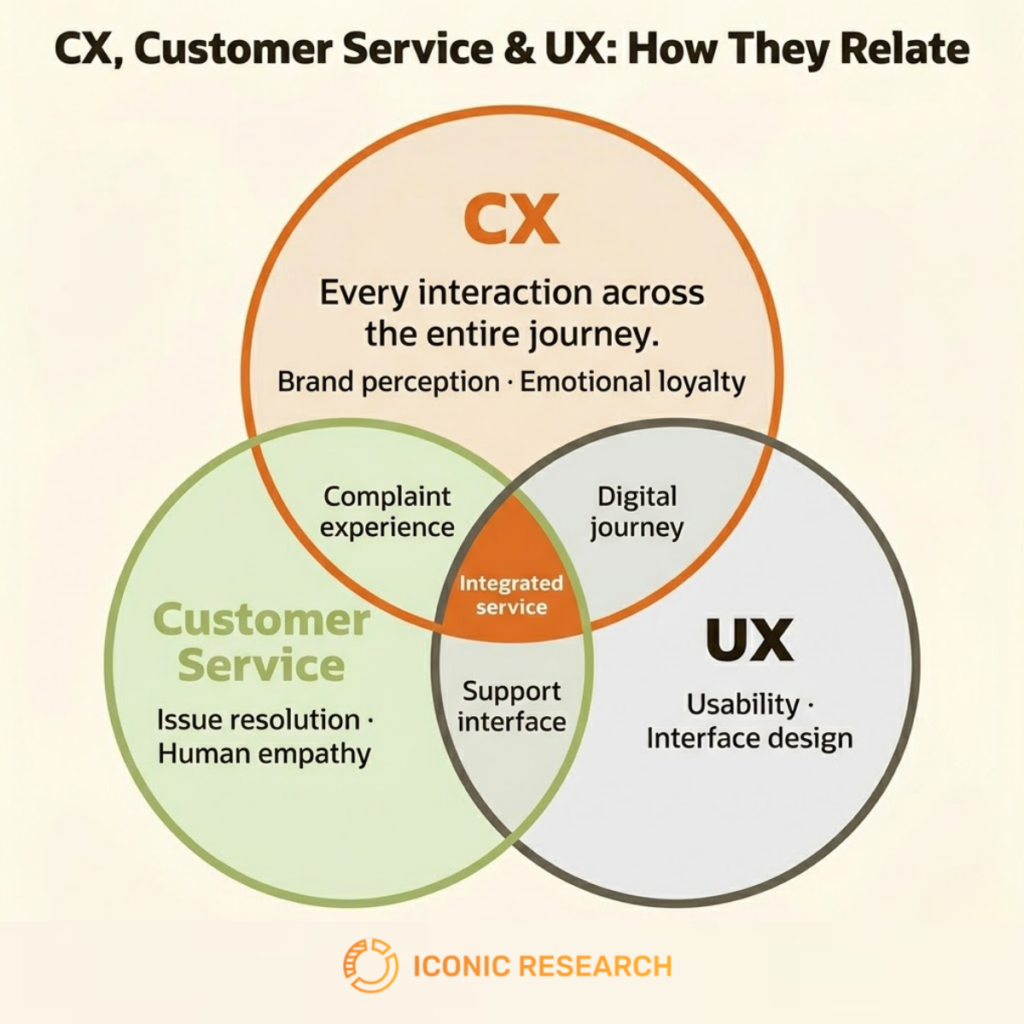
Customer experience management is the organisational discipline of deliberately designing, measuring, and improving that cumulative perception. It requires mapping the full journey, understanding what drives satisfaction and dissatisfaction at each stage, and building the internal systems to act on that understanding consistently.
Customer experience is the sum of every touchpoint a customer encounters across the relationship — from first discovery through post-purchase.
Why Customer Experience Strategy Matters
The commercial case for customer experience strategy is retention and revenue. Customers who have consistently positive experiences with a brand are more likely to repurchase, less likely to defect to competitors, more likely to increase their share of wallet, and more likely to recommend. The inverse is equally true — and in Thailand, the consequences of poor CX tend to surface quickly and publicly.
Thai consumers move fast when experience fails. Social commerce has compressed the distance between a poor experience and a public complaint. A delivery problem, an unacknowledged message, or a dismissive response from an in-store promoter can be shared on Pantip, TikTok, or a LINE group with thousands of members before a brand’s customer service team has been notified. Poor CX in Thailand does not stay private. The reputational risk is immediate, and the window for recovery is short.
This is why customer experience strategy — the deliberate, research-grounded approach to designing and managing CX — matters more than ever in the Thai market. Reactive service is insufficient. Brands that lead on CX here have mapped the journey, identified the friction points, and built the operational capacity to respond to them before they escalate.
The Components of Customer Experience
You cannot manage what you have not defined. Customer experience management begins with a clear framework of what CX is actually made of.
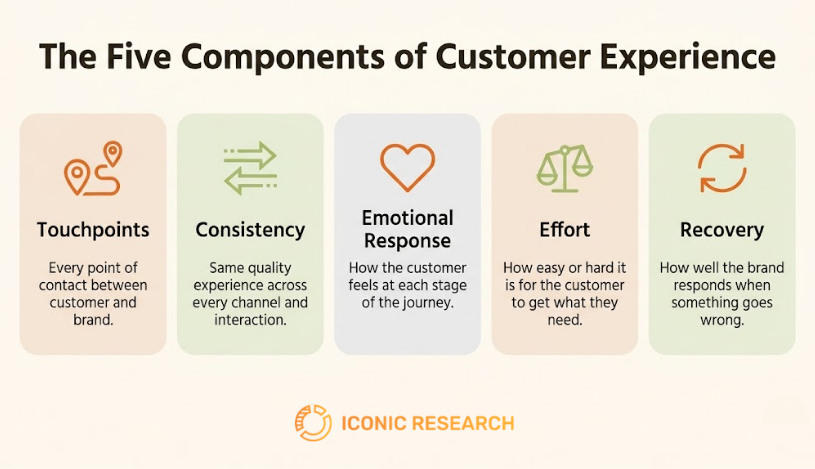
Touchpoints are every point of interaction between a customer and a brand — physical and digital, direct and indirect. A product listing on Shopee is a touchpoint. So is a conversation with a mall promoter, a LINE OA notification, and the experience of returning a faulty product. Touchpoints are the raw material of the customer experience journey. For a complete methodology on mapping them across the full journey, see Customer Journey [2].
Consistency is the degree to which experience quality is maintained across channels and over time. A brand that delivers an excellent in-store experience but fails on LINE fulfilment has a consistency problem, not a service problem. Customers do not separate the channels. They experience the brand.
Emotional response is how customers feel at each stage of the journey — not just what they do. Satisfaction is a cognitive assessment. Emotional response is what drives loyalty and advocacy. Research that captures only behaviour misses half the picture.
Effort measures how easy or difficult the brand makes it to complete a task. Effort is a powerful predictor of churn. Customers who have to work hard to get things done — repeat explanations, slow responses, unclear processes — defect even when the eventual outcome is positive.
Recovery is how a brand handles failure. Every brand fails at some point. The difference between a lost customer and a retained one often comes down to how quickly and empathetically the failure is acknowledged and resolved. Recovery is itself a CX event.
Customer Experience in Thailand: What Global Frameworks Miss
Global CX frameworks are built around email, call centres, and web-based interactions. In Thailand, these assumptions break down quickly.
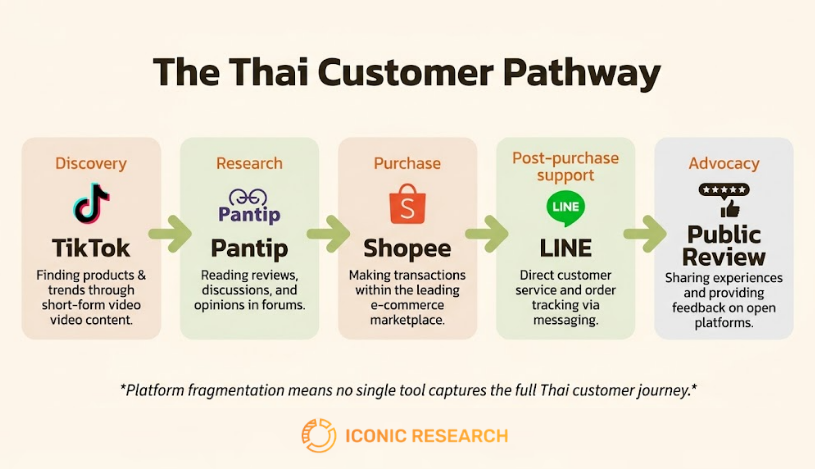
LINE is the primary post-purchase channel. Not email. Not SMS. Thai consumers expect to communicate with brands on LINE — for order updates, complaints, questions, and support. A brand managing CX through email automation is functionally invisible to a large share of its Thai customer base. LINE Official Account performance is a CX metric, not a marketing metric.
Speed expectations are compressed. Thai consumers expect responses within hours on LINE and social platforms. A response the following business day is not a response — it is an acknowledgement that the brand is not paying attention. Delayed responses are a CX failure regardless of resolution quality.
Face-saving shapes complaint handling. Thai consumers are less likely than Western consumers to complain directly and explicitly. When they do escalate — particularly to public channels like Pantip or TikTok — it often signals that private resolution has already failed. The escalation is a last resort, not a first step. Brands that understand this build private resolution pathways that are fast, accessible, and visibly attentive before complaints reach social media.
Trust signals function as CX touchpoints. KOL endorsements, peer reviews on Shopee and Pantip, and the credibility of in-store staff are not purely marketing phenomena. They shape the cumulative perception that constitutes customer experience. A poor interaction with a promoter in a shopping mall is a CX event. So is a negative review on a major e-commerce platform.
Digital customer experience is mobile-first and platform-fragmented. TikTok, Facebook, LINE, Shopee, and physical retail all feed into the same cumulative perception [5]. A customer may discover a product on TikTok, research it on Pantip, purchase it on Shopee, and contact the brand on LINE. The digital customer experience spans all of these surfaces simultaneously. Understanding where experience gaps exist across this landscape requires research that tracks behaviour across the full channel mix, not just within a single platform.
When social media complaints surface — and they will — early visibility matters. Social listening provides the monitoring infrastructure to catch brand mentions and sentiment shifts before they escalate.
How to Measure Customer Experience
Measurement is where customer experience management becomes operational. Three metrics form the standard toolkit.
CSAT (Customer Satisfaction Score) measures customer satisfaction at specific touchpoints. It is typically collected immediately after an interaction — a delivery, a service call, a purchase. CSAT answers the question: how satisfied was the customer with this specific experience?
NPS (Net Promoter Score) measures overall loyalty and likelihood to recommend [4]. It is a relationship-level metric rather than a transactional one. NPS answers the question: how does the customer feel about the brand overall?
CES (Customer Effort Score) measures how easy the brand makes it for customers to complete tasks [3]. It is particularly useful for identifying friction points in service and support processes. CES answers the question: how hard did the customer have to work?
Customer experience research measures what happens at each interaction. Customer loyalty research measures what that cumulative experience produces — genuine commitment or captive behaviour.
Each metric is a distinct instrument with a distinct use case — how to apply them correctly in Thailand, including the effect of acquiescence bias on score interpretation, is covered in our customer satisfaction measurement guide.
Each metric serves a different diagnostic purpose. The important qualification is this: metrics without research context are numbers without meaning. A CSAT score of 3.8 out of 5 tells you something is wrong. It does not tell you where, why, or what to do about it. Qualitative research — in-depth interviews, focus groups, customer diaries — provides the diagnostic layer that quantitative measurement alone cannot. Iconic Research’s qualitative and quantitative research methodologies are designed to work together for exactly this reason.
Conclusion
Customer experience strategy in Thailand requires local fluency, not just global CX frameworks applied to a Thai context. The brands that lead on CX here understand how trust is built, where complaints surface, and what frictionless actually looks like on LINE at 10pm. That understanding comes from research — not from dashboards built on assumptions imported from other markets.
Frequently Asked Questions
What is customer experience?
Customer experience is the cumulative perception a customer forms of a brand through every interaction across the full relationship — from first awareness through post-purchase. It encompasses every channel, every touchpoint, and every stage of the customer experience journey, not just moments of service or support.
What is the difference between customer experience and customer service?
Customer service is one touchpoint — the reactive response to a specific customer need or complaint. Customer experience is the entire relationship. It includes customer service but also encompasses discovery, purchase, delivery, product use, renewal, and advocacy. A brand can have excellent customer service and still deliver a poor overall customer experience if other touchpoints underperform.
What is customer experience management?
Customer experience management is the organisational discipline of deliberately designing, measuring, and improving the cumulative perception customers have of a brand. It involves mapping the customer experience journey, identifying friction points and emotional drivers, setting experience standards across channels, and building internal systems to measure and act on CX performance consistently.
How is customer experience measured?
The three primary customer experience metrics are CSAT (satisfaction at specific touchpoints), NPS (overall loyalty and advocacy likelihood), and CES (ease of completing tasks). Each measures a different dimension of experience. Effective customer experience strategy uses all three in combination, supplemented by qualitative research to interpret what the numbers actually mean and where to intervene.
Why is customer experience different in Thailand?
Several dynamics distinguish Thailand's CX landscape from global norms. LINE is the dominant post-purchase communication channel, not email or SMS. Response speed expectations are compressed — hours, not days. Face-saving cultural norms shape how complaints are raised and how escalation to public channels occurs. Trust signals such as peer reviews on Pantip and KOL endorsements function as CX touchpoints. And digital customer experience runs across a fragmented platform mix — TikTok, Facebook, LINE, Shopee, and physical retail — that feeds into the same cumulative customer perception.
References
[1] Meyer, C. and Schwager, A. (2007). Understanding Customer Experience. Harvard Business Review. https://hbr.org/2007/02/understanding-customer-experience
[2] Iconic Research (2025). Customer Journey in Thailand. https://iconicthai.com/customer-journey/
[3] Dixon, M., Freeman, K. and Toman, N. (2010). Stop Trying to Delight Your Customers. Harvard Business Review. https://hbr.org/2010/07/stop-trying-to-delight-your-customers
[4] Reichheld, F.F. (2003). The One Number You Need to Grow. Harvard Business Review. https://hbr.org/2003/12/the-one-number-you-need-to-grow
[5] Electronic Transactions Development Agency (2024). Thailand Internet User Behavior Report. ETDA. https://www.etda.or.th
Related Resources
- Customer Journey
- Social Listening Tools in Thailand
- Consumer Behaviour in Thailand
- TAM SAM SOM: Market Sizing Guide
If you wish to quote any information from this article, please kindly cite the source along with the link to the original article to respect copyright. |
 |
Iconic Research Thailand Your trusted partner in market research and consulting across Thailand and Southeast Asia. Headquartered in Bangkok, we provide research-driven insights across the Philippines, Malaysia, Indonesia, Singapore, Laos, and Vietnam. We help businesses navigate Thailand's market complexities through consumer insights, market entry strategy, and trend foresight. Contact us if you have any queries! (+66)888 954 954 |
Contact us
We always looking for new and exciting opportunities. Let’s connect.
Related posts
 Growth Strategy: The Expansion Decisions That Need Evidence
Growth strategy is the set of decisions about where a company expands next. Only 25% of companies grow sustainably — the difference is evidence, not ambition.
9 min read Brand Strategy: The Decisions That Should Be Built on Evidence
Brand strategy is the set of decisions that determine how a brand competes. Those decisions only pay off when they’re built on consumer evidence — not a workshop.
11 min read Key Opinion Leader: What Thai Brands Should Research Before, During, and After a KOL Campaign
Platform metrics mislead brands choosing and measuring KOLs in Thailand. A research-first look at what to verify before, during, and after a campaign.
10 min read