

Social listening tools are software platforms that monitor online conversations by tracking keywords, brand mentions, and hashtags across social media, forums, and web sources — processing the raw data through automated sentiment analysis and delivering the output via a reporting dashboard. They range from free trend discovery tools like Wisesight Trend to enterprise-grade platforms like Zocial Eye and Mandala Analytics built natively for Thai-language markets, through to global platforms such as Brandwatch and Talkwalker designed primarily for English-language environments.
Table of Contents
- How Social Listening Tools Work
- Global Social Listening Platforms — Capabilities and Thailand Fit
- Social Listening Tools for Thailand — Wisesight Trend, Zocial Eye, and Mandala
- Tool or Agency — A Practical Decision Framework
- References
Evaluating social listening tools is the right starting point — but the landscape is more fragmented than most comparison lists suggest. This article maps the options across three categories: global platforms, Thailand-specific tools, and free options. For readers still building a case for social listening as a methodology, the complete guide to social listening in Thailand [1] covers the foundations before the tool selection question arises.
How Social Listening Tools Work
A social listening tool connects to platform APIs, pulls in posts, comments, and mentions that match predefined keywords or brand names, runs them through automated sentiment scoring — positive, negative, or neutral — and delivers the output to a dashboard. What the subscriber is buying is keyword-matched mention tracking, automated sentiment classification, trend visualisation, and reporting exports.
What the tool does not do is interpret the data. When social media complaints surface — and they will — early visibility matters for the full customer experience. Social listening data is often the earliest signal of a CX failure in progress.
The dashboard presents volume and scores — it does not explain why volume spiked, whether the sentiment classification is accurate for the language and cultural context, or what the strategic implication is. In Thailand, that distinction matters more than in most markets.
Global Social Listening Platforms — Capabilities and Thailand Fit
The major global platforms — Brandwatch, Meltwater, Sprout Social, Talkwalker (via Hootsuite), and Sprinklr — share a common architecture: strong coverage of English-language Western platforms, AI-powered sentiment analysis, and enterprise-grade dashboards [2][3].
For Thailand work, they share a common limitation. Pantip — Thailand’s largest consumer discussion forum and a primary source of unfiltered Thai consumer opinion — is absent or undocumented across all five platforms reviewed. Thai-language sentiment accuracy is not benchmarked in any published documentation. Talkwalker is the exception worth noting: it documents Thai as one of 187 supported languages and offers image and logo recognition, making it the strongest global option for brands monitoring Thailand within a broader regional or global programme [3]. For Thailand-only briefs requiring Thai-language consumer intelligence, global tools need a trained analyst building the interpretive layer on top of the tool output — the tool alone will not do it.
Social Listening Tools for Thailand — Wisesight Trend, Zocial Eye, and Mandala
Wisesight Trend
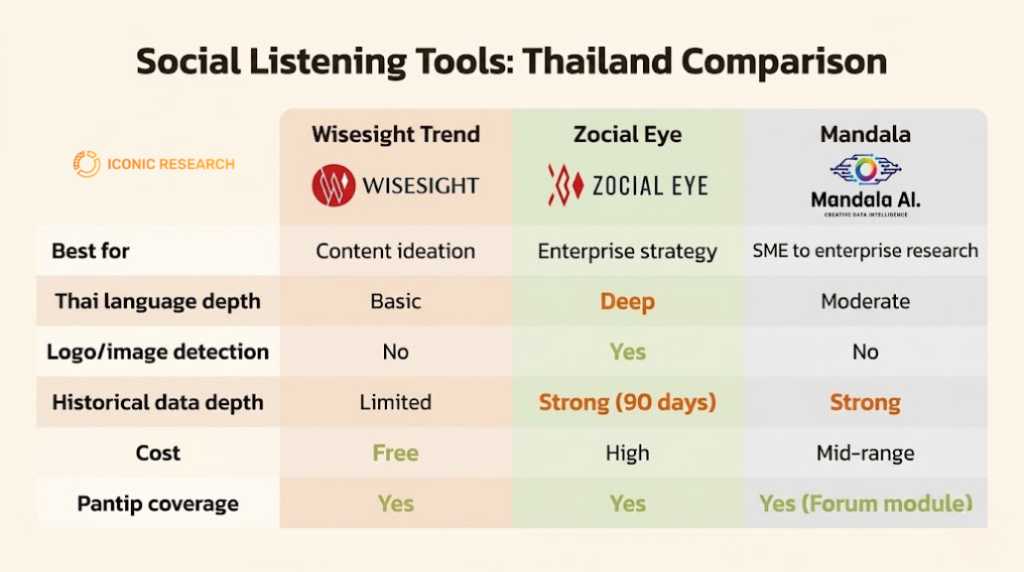
Wisesight Trend is the best quick-glance tool for staying relevant without digging into complex data. Its real-time categorisation of trends by industry — General, Lifestyle, Brand — makes it an excellent free resource for content creators who need instant inspiration for viral topics or hashtags across Facebook, Instagram, TikTok, Pantip, News, Blogs, and YouTube [4].
It falls short for serious strategic planning. It is a discovery tool, not an analytical one — it tells you what is trending now but provides no historical depth, no competitor audit capability, and no consumer behaviour analysis. It cannot tell you why something is trending or what it means for brand strategy.
Use it for content inspiration. Don’t use it to answer a strategic question.
Zocial Eye (by Wisesight)
Zocial Eye is the gold standard for Thai market intelligence, built specifically for large enterprises that need to navigate the nuances of Thai language and culture [4]. Its standout features are AI-driven logo detection and Intelligence Analytics — allowing brands to find mentions even when their name is not typed out, catching visual references that keyword-based tools systematically miss. It covers Facebook, Twitter/X, Instagram, Pantip, YouTube, TikTok, and major Thai news and blog sources, with up to 90 days of historical data. The Account Label feature filters verified brand and media accounts from organic consumer voices, reducing noise and improving the signal quality of genuine consumer-sourced mentions.
The downside is complexity and cost. Zocial Eye is a heavyweight system that requires a learning curve and a significant budget, making it disproportionate for smaller projects, single-campaign monitoring, or SME use cases.
The most powerful Thai-specific tool on the market — built for enterprise briefs with enterprise budgets.
Mandala Analytics
Mandala Analytics is the most flexible all-rounder, bridging the gap between SMEs and large corporations [5]. It excels in data visualisation and UX/UI — a clean, timeline-based view of keywords and sentiments that allows users to drill down to individual post level to verify the emotional context of a mention. Pantip is accessible through a dedicated Forum Listening module with direct click-through to original threads. It is highly adaptable across marketing goals, from long-term sentiment tracking to SEO and influencer mapping.
Where it falls short relative to Zocial Eye: it lacks advanced image and logo recognition, and its broad feature set can feel less specialised for briefs requiring deep hyper-local Thai cultural nuance.
The practical choice for brands that need real depth without Zocial Eye’s complexity or cost.
Free Social Listening Tools — What You Get and What You Give Up
Free tools have genuine legitimate uses — Google Alerts for tracking brand mentions in online press, Meta Business Suite for owned page performance, TikTok Creator Tools for owned account analytics, Hootsuite’s free tier for basic keyword monitoring on X and Reddit.
The Thailand-specific gap is consistent across all of them: none cover Pantip, none provide Thai-language sentiment processing, and none deliver the cross-platform view that Thailand’s fragmented platform mix requires. Free tools support tactical monitoring for global platforms. They cannot substitute for structured Thai-language social listening analytics.
What Social Listening Tools Cannot Do
Tools surface data. They do not interpret it. Four structural limitations matter for Thailand work specifically.
Unprompted social mentions capture sentiment at scale but do not replace structured measurement. For tracking satisfaction at specific touchpoints and building Thai-market baselines, see our guide to customer satisfaction measurement.
Automated sentiment models cannot distinguish indirect Thai expression, culturally shaped negativity, or polite deflection from genuine dissatisfaction — the cultural dynamics that shape this are covered in the complete guide to social listening in Thailand [1]. High-volume data contains bots, coordinated content, and irrelevant homonyms at equal weight to genuine consumer expression — separating signal from noise requires analytical judgment no dashboard automates. Social listening analytics tell you that sentiment dropped; they do not tell you whether a pricing decision, a competitor campaign, or a single viral thread caused it — causation requires a researcher. And tool dashboards are built around the data they collect, not around the strategic question the brand needs to answer — qualitative research and quantitative research are the disciplines designed to answer what social data raises but cannot resolve.
Tool or Agency — A Practical Decision Framework
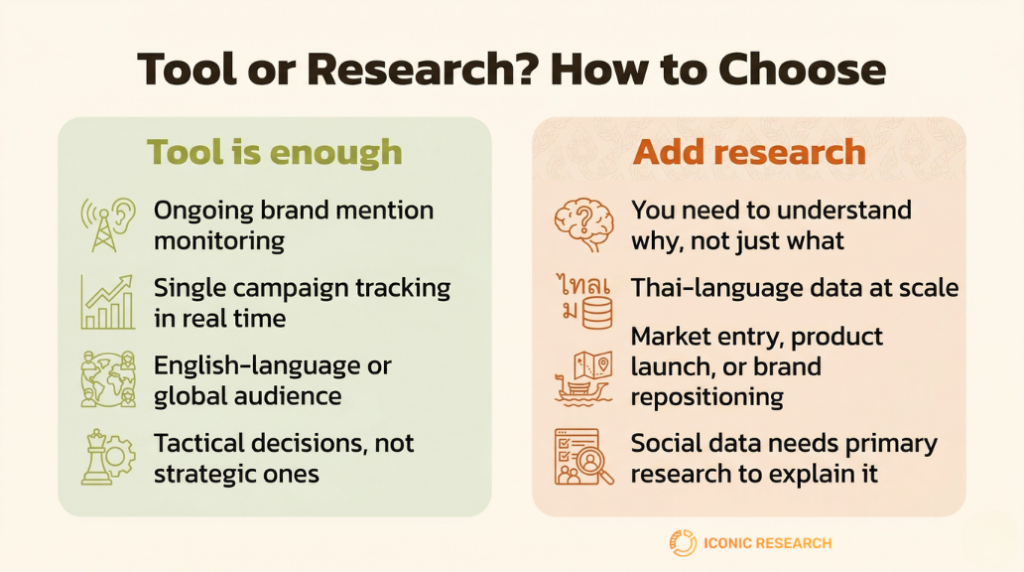
A tool subscription is sufficient when you need ongoing brand mention monitoring with an internal researcher who owns interpretation, you are tracking a single campaign in real time, your audience is primarily English-language or global, and the output informs tactical rather than strategic decisions.
Expert analysis adds value when the question requires understanding causation rather than volume, you need culturally accurate interpretation of Thai-language conversation at scale, the output informs a market entry, product launch, or brand repositioning decision, or you need social data integrated with primary research findings to explain what the data surfaces.
Frequently Asked Questions
What are the best social listening tools for Thailand?
Zocial Eye for enterprise, Mandala Analytics for mid-range, Wisesight Trend for free content discovery. Global tools work for English-language monitoring but need Thai analyst input for Thai-language sentiment work.
What is the difference between Wisesight Trend and Zocial Eye?
Wisesight Trend is free and built for real-time trend discovery. Zocial Eye is the enterprise platform — deeper data, AI logo detection, full analytics, significantly higher cost. Same company, different use cases.
Do any free tools cover Pantip?
No. Free tools cover global platforms and English-language web only. None provide Pantip coverage or Thai-language sentiment analysis.
Which tool is best for a mid-size brand entering Thailand?
Mandala Analytics — strong visualisation, Pantip access via Forum Listening, and usable without a specialist analyst. Zocial Eye is more powerful but disproportionate unless the brief is enterprise-scale.
When should social listening be combined with market research?
When the question behind the data requires a researcher to answer it. Consumer behaviour studies, brand perception research, and market entry validation need primary research methods — qualitative or quantitative — not a dashboard. Social listening data is often the starting point that defines the research question, not the answer to it.
References
[1] Iconic Research. “What is Social Listening? A Thailand Guide for Brands and Researchers.” https://iconicthai.com/social-listening/
[2] Brandwatch. Platform overview and coverage documentation. https://www.brandwatch.com
[3] Talkwalker by Hootsuite. Social listening platform documentation. https://www.talkwalker.com
[4] Wisesight. Wisesight Trend and Zocial Eye product pages. https://wisesight.com/zocialeye/
[5] Mandala AI. Mandala Analytics platform overview. https://www.mandalasystem.com/
If you wish to quote any information from this article, please kindly cite the source along with the link to the original article to respect copyright. |
 |
Iconic Research Thailand Your trusted partner in market research and consulting across Thailand and Southeast Asia. Headquartered in Bangkok, we provide research-driven insights across the Philippines, Malaysia, Indonesia, Singapore, Laos, and Vietnam. We help businesses navigate Thailand's market complexities through consumer insights, market entry strategy, and trend foresight. Contact us if you have any queries! (+66)888 954 954 |
Contact us
We always looking for new and exciting opportunities. Let’s connect.
Related posts
 Growth Strategy: The Expansion Decisions That Need Evidence
Growth strategy is the set of decisions about where a company expands next. Only 25% of companies grow sustainably — the difference is evidence, not ambition.
9 min read Brand Strategy: The Decisions That Should Be Built on Evidence
Brand strategy is the set of decisions that determine how a brand competes. Those decisions only pay off when they’re built on consumer evidence — not a workshop.
11 min read Key Opinion Leader: What Thai Brands Should Research Before, During, and After a KOL Campaign
Platform metrics mislead brands choosing and measuring KOLs in Thailand. A research-first look at what to verify before, during, and after a campaign.
10 min read