
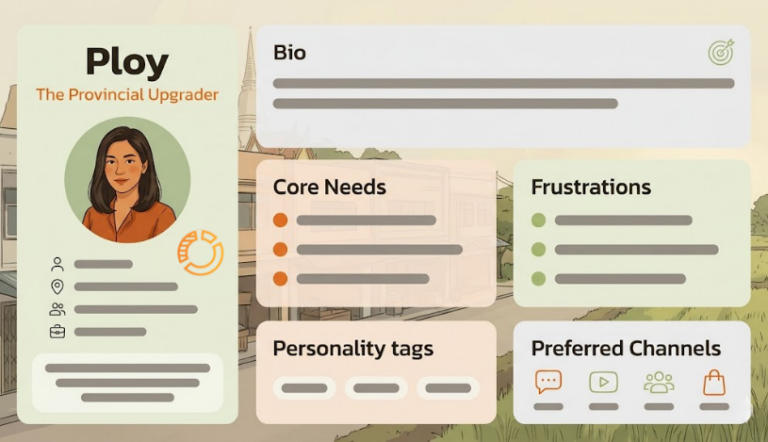
Customer persona is a research-based profile of a specific type of customer — their motivations, decision-making criteria, behaviours, and cultural expectations — built to guide product, marketing, and communication strategy. Unlike demographic profiles, customer personas explain why consumers behave as they do, not just who they are. In Thailand, research-backed personas frequently differ from assumption-based ones because Thai consumer motivations are systematically distorted by standard data collection instruments.
Table of Contents
- What Is a Customer Persona?
- Assumption-Based vs Research-Backed Customer Personas
- Customer Persona Template — Thai Market Edition
- How to Build a Research-Backed Customer Persona in Thailand
- Customer Persona Examples — Thailand
- Persona Marketing — From Persona to Strategy
- References
Most brands have customer personas. Most of them are wrong. Not because the people who built them were careless — but because they were built from the wrong inputs: sales team assumptions, Google Analytics demographics, internal workshops. In Thailand, the gap between an assumption-based persona and a research-backed one is wider than in most markets, because Thai consumers systematically present differently in research contexts than they behave in reality. This article explains the distinction, the methodology, and what three real research engagements found when they tested their assumptions against actual consumer data.
What Is a Customer Persona?
A customer persona is a composite profile of a specific customer type — built to represent a real segment of the market, not an average of all customers [1]. There are three types relevant to brand and marketing strategy:
A customer persona profiles the end user — how the product fits into their life, their motivations, lifestyle, and goals. It informs product design, UX, and post-purchase experience. A buyer persona profiles the purchase decision-maker — their evaluation criteria, buying triggers, decision-making process, and risk concerns. In most B2C categories, the buyer and customer are the same person and a single combined profile serves both purposes. In B2B procurement, healthcare, household durables, and gifting categories, they diverge — and treating them as one produces a persona that accurately represents neither. The marketing persona — sometimes called a marketing customer persona — is the buyer persona applied specifically to campaign targeting: channel preferences, messaging receptivity, and cultural reference points.
All three are only as accurate as the data used to build them. In Thailand, the buyer and customer roles diverge more than international marketing teams typically account for — family decision-making dynamics mean the person who researches and the person who pays and the person who uses are frequently three different profiles [4].
Assumption-Based vs Research-Backed Customer Personas
Most customer personas are built in workshops. The team lists what they believe about their customers — age, income, lifestyle, motivations — drawing on sales experience, anecdotal interactions, and internal data that reflects who is already buying, not who could be buying.
Research-backed personas begin with qualitative exploration: focus groups or in-depth interviews where consumers speak in their own language about the category, the brand, and their decision-making. This surfaces associations, tensions, and motivations that internal teams cannot see from inside the organisation. Quantitative research then validates which patterns are statistically representative and which are edge cases [2].
In Thailand, the gap between these two approaches is structural. Thai consumers in research contexts exhibit acquiescence bias — systematically agreeing with framings presented to them rather than expressing genuine dissent [3]. A workshop persona built from sales team beliefs will be reinforced by customer interviews conducted without proper probe techniques. The dissatisfaction, the real purchase barriers, and the alternative motivations only emerge with research instruments specifically designed to surface them.
Customer Persona Template — Thai Market Edition
A customer persona template provides structure. What fills it determines whether the result is a strategic tool or a fictional character. The two visuals below show the same persona built twice — once with evidence, once with assumptions.
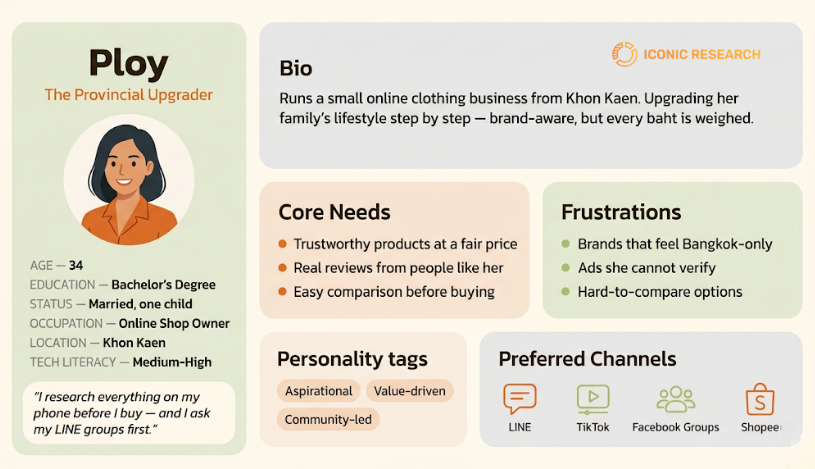
Here is what a research-backed Thai persona looks like — Ploy, the Provincial Upgrader, built from qualitative and quantitative consumer research, with the fields filled from evidence rather than assumption.
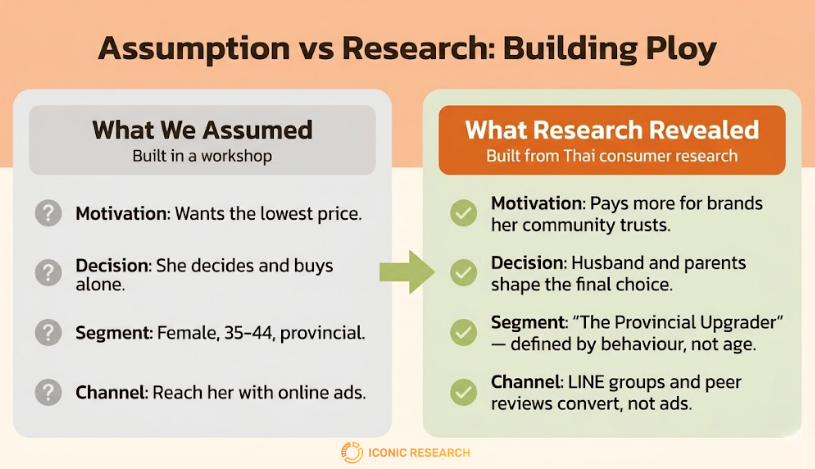
The difference is not theoretical. Built from workshop assumptions instead, the same Ploy would have looked very different — and pointed marketing at the wrong motivations, the wrong segment, the wrong decision-maker, and the wrong channels.
How to Build a Research-Backed Customer Persona in Thailand
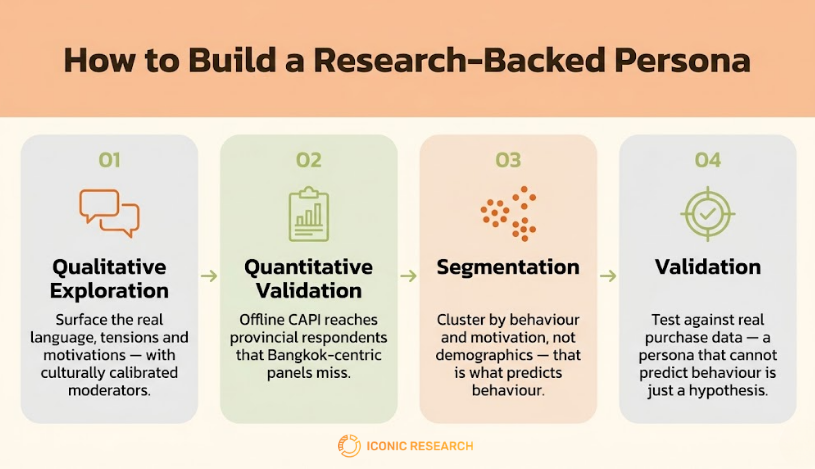
Stage 1 — Qualitative exploration. Begin with qualitative research — focus groups or in-depth interviews with target consumers. The goal is not to confirm what the team already believes — it is to surface how consumers actually talk about the category, what language they use, what tensions exist between stated preference and observed behaviour, and what associations they hold about competing brands. In Thailand, moderators must be culturally calibrated: direct questioning produces socially comfortable answers, not authentic consumer tensions.
Stage 2 — Quantitative validation. Once qualitative exploration has identified the key patterns, quantitative research establishes their scale and distribution across the target population. This step separates the representative persona from the interesting edge case. In Thailand, offline data collection — CAPI fieldwork reaching provincial respondents — produces materially different segment distributions than online panels, which are structurally Bangkok-centric [4].
Stage 3 — Segmentation. Cluster analysis groups consumers by behaviour and motivation, not just demographics. Two consumers with identical demographic profiles — age, income, location — frequently hold entirely different brand relationships and purchase drivers. Research-backed market segmentation produces personas that actually predict behaviour.
Stage 4 — Validation. Test the persona against actual purchase data before committing strategy to it. A persona that cannot predict observed behaviour is not a strategic tool — it is a hypothesis that needs revision [2].
Customer Persona Examples — Thailand
Pickup truck market entry. An automotive brand assumed Thai pickup truck purchase criteria were primarily functional — payload, fuel efficiency, price. Research across competitor brand user groups revealed that after-sales service trust was the decisive factor — the primary gate for considering an unfamiliar brand, not a secondary concern. Communication strategy was adjusted to address the trust gap before launch. See the full case study [5].
Real estate platform. A Thai property portal assumed its primary persona was the traditional family buyer — location and price dominant. Research uncovered a distinct second persona: younger professionals interested in co-living, with entirely different platform feature priorities — invisible in the platform’s existing analytics. See the full case study.
Digital messaging platform. A major platform assumed Thai users could be segmented by age and urban-rural split. Qualitative research across 12 focus groups revealed that behaviour-based segmentation — how users integrated messaging into daily life — produced different persona groups that crossed demographic boundaries entirely. See the full case study.
Persona Marketing — From Persona to Strategy
Persona marketing is the application of customer persona insights to specific marketing decisions — channel selection, message framing, timing, and format. The value of a research-backed persona over an assumption-based one is most visible here: the decisions it drives are different.
Channel selection in Thailand is persona-dependent in ways that demographic assumptions miss. LINE remains the primary conversion channel for older established consumers and provincial audiences. TikTok drives discovery for younger urban personas but rarely converts directly. In-store and community referral remain decisive for specific category and geographic personas that online-first brands systematically underestimate.
Message framing is equally persona-specific. Thai consumers across all segments are sensitive to messaging that feels presumptuous or inconsistent with their self-image. A persona built from research surfaces the exact language, reference points, and cultural signals that resonate — and those that cause silent rejection.
A customer persona is only as accurate as the data it was built from. In Thailand, where consumer research requires cultural calibration, proper probe techniques, and offline fieldwork to reach representative samples, assumption-based personas are not just imprecise — they actively misdirect marketing investment toward the wrong channels, the wrong messages, and sometimes the wrong consumer entirely.
Frequently Asked Questions
What is a customer persona?
A research-based profile of a specific customer type representing their motivations, decision criteria, and cultural expectations — built to guide product, marketing, and communication strategy. Distinct from a demographic profile because it explains why consumers behave as they do, not just who they are.
What is the difference between a customer persona and a buyer persona?
Customer persona covers consumer categories broadly. A buyer persona specifically profiles the B2B or considered-purchase decision-maker — role, evaluation criteria, risk concerns, and organisational influence.
Can I use a customer persona template?
A customer persona template provides structure but not insight — a completed template is only as accurate as the data used to fill it. A template filled with workshop assumptions produces a fictional character. Research fills it with evidence.
How many customer personas should a brand have?
Depends on the category and market complexity. In Thailand, brands frequently discover more distinct personas than expected — particularly between Bangkok and upcountry segments, and between stated and actual purchase drivers.
What is persona marketing?
The application of customer persona insights to specific marketing decisions — channel selection, message framing, timing, and format. In Thailand, research-backed persona marketing produces different channel and message decisions from assumption-based approaches.
References
[1] Revella, A. (2015). Buyer Personas: How to Gain Insight into your Customer’s Expectations, Align your Marketing Strategies, and Win More Business. Wiley. ISBN 978-1-118-96150-9.
[2] Salminen, J., Jansen, B.J., An, J., Kwak, H. & Jung, S. (2020). Persona transparency: Analyzing the impact of explanations on perceptions of data-driven personas. International Journal of Human-Computer Interaction, 36(8), 788–800. https://www.tandfonline.com/doi/full/10.1080/10447318.2019.1688946
[3] Chen, C., Lee, S.Y. & Stevenson, H.W. (1995). Response style and cross-cultural comparisons of rating scales among East Asian and North American students. Psychological Science, 6(3), 170–175. https://doi.org/10.1111/j.1467-9280.1995.tb00327.x
[4] Punpukdee, A. (2023). Considering consumer behavior in Thailand’s traditional and digital markets. Journal of Contemporary Issues and Thought, 13(1), 25–34. https://doi.org/10.37134/jcit.vol13.1.3.2023
[5] Iconic Research. Pick-up Truck Market Entry Study in Thailand. https://iconicthai.com/case-study/thailand-pickup-truck-market/
If you wish to quote any information from this article, please kindly cite the source along with the link to the original article to respect copyright. |
 |
Iconic Research Thailand Your trusted partner in market research and consulting across Thailand and Southeast Asia. Headquartered in Bangkok, we provide research-driven insights across the Philippines, Malaysia, Indonesia, Singapore, Laos, and Vietnam. We help businesses navigate Thailand's market complexities through consumer insights, market entry strategy, and trend foresight. Contact us if you have any queries! (+66)888 954 954 |
Contact us
We always looking for new and exciting opportunities. Let’s connect.
Related posts
 Growth Strategy: The Expansion Decisions That Need Evidence
Growth strategy is the set of decisions about where a company expands next. Only 25% of companies grow sustainably — the difference is evidence, not ambition.
9 min read Brand Strategy: The Decisions That Should Be Built on Evidence
Brand strategy is the set of decisions that determine how a brand competes. Those decisions only pay off when they’re built on consumer evidence — not a workshop.
11 min read Key Opinion Leader: What Thai Brands Should Research Before, During, and After a KOL Campaign
Platform metrics mislead brands choosing and measuring KOLs in Thailand. A research-first look at what to verify before, during, and after a campaign.
10 min read