

Brand positioning is the deliberate act of defining where a brand sits in the consumer’s mind relative to competitors — and research is how that position is measured, built, and defended. A brand positioning map plots consumer perceptions of competing brands across two or more attributes, revealing gaps, overlaps, and threatened territory. Brand positioning research tells you not just where your brand is, but whether it can stay there.
Table of Contents
- What Is Brand Positioning?
- Brand Positioning Map
- Brand Positioning in Thailand — The Chinese Disruptor Problem
- How to Research Brand Positioning
- Brand Repositioning — When the Position Needs to Change
- References
Brand positioning is not a strategy document exercise — it is a measurable market position that either exists in consumers’ minds or does not. The problem most brands have is not that they lack a positioning strategy — it is that they have never verified whether their intended position is actually held in the market. In Thailand, this gap between intended and actual positioning has become a commercial emergency for established brands facing aggressive Chinese competitor entry across electronics, automotive, FMCG, and lifestyle categories. This article explains how brand positioning research works, how to build a positioning map from data, and what repositioning requires when competitive pressure has eroded existing territory.
What Is Brand Positioning?
Brand positioning is the territory a brand occupies in the consumer’s mind relative to competitors, defined by the attributes consumers associate with it and the needs it is perceived to address [1]. It is not a tagline or a mission statement — it is a perception that exists independently of what the brand claims about itself. The gap between what a brand claims and what consumers actually perceive is exactly what brand positioning research measures.
Brand positioning differs from product positioning: product positioning defines where a specific product sits within a category by price tier, functional attributes, and target user. Brand positioning is broader — it defines the values and territory the brand as a whole occupies across its portfolio. Brand differentiation is the outcome of successful positioning — the degree to which consumers perceive the brand as meaningfully distinct from alternatives [1]. Positioning is the first of the core brand strategy decisions, and the one most often asserted rather than verified.
Brand Positioning Map
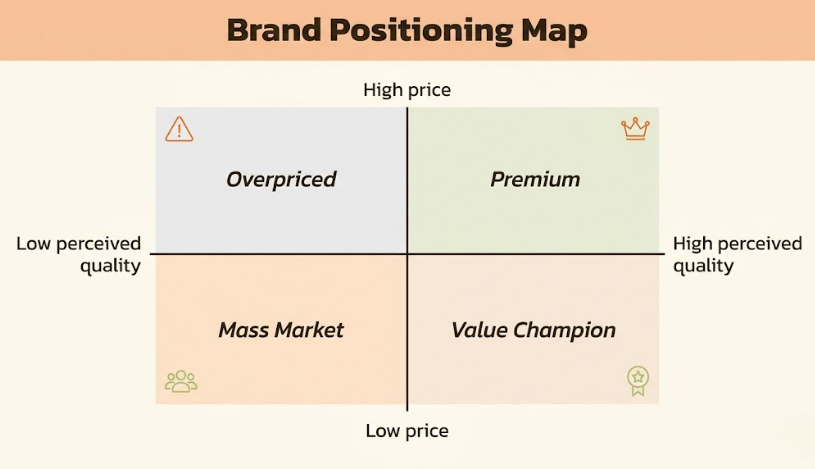
A brand positioning map — more precisely, a perceptual map — is a two-axis chart that plots competing brands as points in a space defined by two attributes. The horizontal and vertical axes each represent one attribute that matters to purchase decisions in the category: price vs perceived quality, prestige vs accessibility, innovation vs reliability. Each brand is plotted where consumers perceive it to sit on both axes simultaneously. The closer two brands appear on the chart, the more interchangeable consumers consider them. The further apart, the more distinct.
The four quadrants that emerge each carry strategic meaning — Premium (high price, high perceived quality), Value Champion (low price, high perceived quality), Mass Market (low price, low perceived quality), and Overpriced (high price, low perceived quality). Where a brand sits is not a management decision — it is a consumer verdict, produced by primary research.
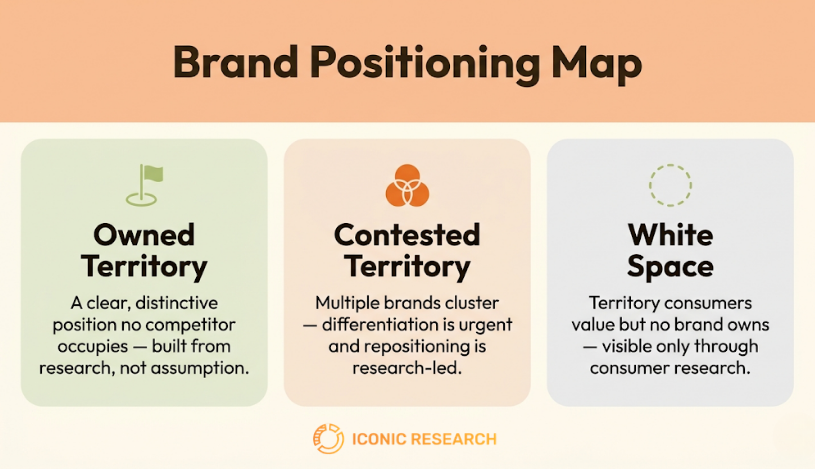
A positioning map produces coordinates. The strategic value comes from interpreting what those coordinates mean for competitive positioning. Every map reveals three types of territory:
Owned territory — where the brand holds a clear, distinctive position that competitors do not occupy. In Thailand, Japanese automotive brands held this territory on reliability and after-sales trust for decades — a position built from research, not assumption.
Contested territory — where multiple brands cluster, indicating a positioning collision. In Thai FMCG and electronics, the arrival of Chinese challengers has pushed multiple established brands into contested territory simultaneously — making differentiation urgent and research-led repositioning the only viable response.
White space — positioning territory that consumers value but no brand currently owns. In Thailand’s premium healthcare and financial services categories, trust-based positioning with strong after-sales reassurance frequently emerges as unclaimed territory — visible only through consumer research, invisible to internal planning teams.
A brand positioning map is only as reliable as the research that builds it. Maps built from internal assumptions consistently misidentify where the brand sits and where the opportunities are [2]. Iconic Research builds brand positioning maps from quantitative research data — consumer-reported attribute associations across a defined competitive set — not from marketing team consensus.
Brand Positioning in Thailand — The Chinese Disruptor Problem
Thailand’s brand positioning landscape is being reorganised at speed. Chinese brands entering the Thai market — across home appliances, automotive, electronics, and lifestyle categories — are not competing on price alone. They are competing on positioning: occupying the value-for-money territory with products that match or approach the functional specifications of established incumbents, while undercutting on price by a significant margin.
The home appliance category illustrates the dynamic. Samsung and LG built dominant positions in Thailand over decades — premium, reliable, aspirational. Their positioning was clear and functionally justified by a genuine product quality gap relative to lower-cost alternatives. Hisense’s entry changed the positioning geometry by offering comparable specifications at substantially lower price points — compressing the value-for-money territory that Samsung and LG occupied and forcing a repositioning question neither brand had previously faced: if the functional gap has narrowed, what does the premium positioning rest on?
The answer lies in the attributes Chinese competitors cannot easily replicate. Krungsri Research’s Thailand Industry Outlook identifies that Thai consumers prioritise convenience, transparency, and emotional assurance in brand choice [6] — service network reliability, after-sales transparency, and long-term brand trust are the dimensions where established brands retain defensible positioning. The brands that measure this — verifying whether their claimed territory is still held in consumer perception — will retain it. The brands that assume it will not. See brand strategy consulting for the research-led tracking methodology.
How to Research Brand Positioning
Stage 1 — Define the competitive set and attributes. Brand positioning research begins by defining which brands to include in the map and which attributes to measure. Attribute selection is the most consequential methodological decision — the wrong attributes produce a map that is technically accurate but strategically useless. Iconic Research uses qualitative research — focus groups and in-depth interviews — to surface the attributes consumers actually use to evaluate brands in the category, before any quantitative measurement begins. The attributes that matter in Thai purchase decisions frequently differ from those assumed by regional marketing teams [3].
Stage 2 — Measure consumer perceptions quantitatively. Structured surveys measure how each brand in the competitive set is perceived on each attribute by a representative sample of target consumers. For most Thai market studies, 150–300 respondents per target segment produces stable estimates. The output is a perception matrix that feeds directly into the positioning map.
Stage 3 — Build and interpret the positioning map. The perception matrix is plotted on a brand positioning map with axes representing the two attributes that most strongly drive purchase decisions. Iconic Research delivers the map with strategic interpretation — what the positions mean, which are defensible, and what repositioning would require.
Stage 4 — Track positioning over time. A positioning map produced once is a photograph. Positioning tracked at consistent intervals — annually for most categories, more frequently in contested markets — becomes a strategic instrument. Movement on the map indicates whether brand-building investment is shifting consumer perception in the intended direction, or whether competitive activity is eroding held territory.
Brand Repositioning — When the Position Needs to Change
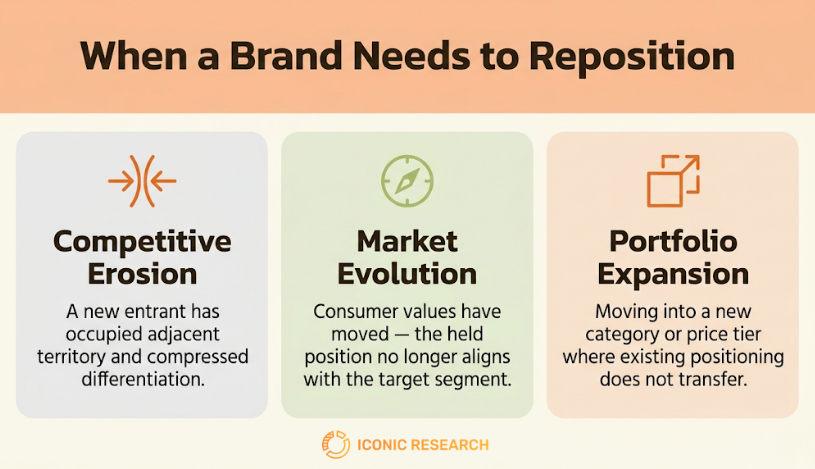
Brand repositioning is the research-led process of shifting a brand’s perceived position in the consumer’s mind [1]. It is more complex than initial positioning because it requires moving existing associations, not just building new ones. Three situations require repositioning research:
Competitive erosion — a new entrant has occupied adjacent territory and compressed differentiation. The Hisense and Samsung dynamic is the clearest current example in Thailand. For a documented example of repositioning research in the automotive category, see our EV brand repositioning case study [4].
Market evolution — consumer values have shifted and the brand’s held position no longer aligns with what the target segment prioritises. Common in categories affected by sustainability values, health consciousness, or generational transition.
Portfolio expansion — the brand is moving into a new category or price tier where its existing positioning does not transfer or actively works against the new offer.
In all three cases, repositioning research must establish the current position accurately before designing the repositioning strategy. Attempting to reposition without this baseline produces campaigns that push in the wrong direction. Brand identity research establishes the foundation that repositioning builds from. Brand awareness research confirms whether the brand has sufficient mental availability in the new territory to make repositioning viable.
Frequently Asked Questions
What is brand positioning?
The territory a brand occupies in the consumer's mind relative to competitors, defined by the attributes consumers associate with it. It exists in perception, not in strategy documents — research is the only way to measure it accurately.
What is a brand positioning map?
A visual representation of how consumers perceive competing brands across two key attributes. Built from quantitative survey data, it reveals owned territory, contested positions, and white space — the gaps competitors have not occupied.
What is the difference between brand positioning and product positioning?
Product positioning defines where a specific product sits in a category by price, function, and target user. Brand positioning defines the broader values and territory the brand as a whole occupies. Both require research to measure accurately.
What is brand repositioning?
Shifting a brand's perceived position in consumer minds — in response to competitive pressure, market evolution, or portfolio change. Requires a baseline measurement of current position before any strategic movement is designed.
How do you build a brand positioning map?
Through quantitative consumer research measuring how target consumers perceive each competing brand on the attributes that drive purchase decisions. Scores are plotted on a two-axis map with axes representing the most decision-relevant attributes.
Why is brand positioning research different in Thailand?
After-sales reliability, emotional assurance, and service transparency carry more weight in Thai purchase decisions than standard global frameworks assume. Chinese competitor entry is also reshuffling positioning hierarchies faster than regional brand trackers are capturing.
References
[1] Ries, A. & Trout, J. (2001). Positioning: The Battle for Your Mind. McGraw-Hill, New York.
[2] Kotler, P. & Keller, K.L. (2016). Marketing Management (15th ed.). Pearson, Harlow.
[3] Tiwsakul, R. & Hackley, C. (2012). Postmodern paradoxes in Thai-Asian consumer identity. Journal of Business Research, 65(4), 490–496. https://doi.org/10.1016/j.jbusres.2011.02.002
[4] Iconic Research. Navigating Thailand’s EV Market — Automotive Market Research Case Study. https://iconicthai.com/case-study/case-study-navigating-thailands-ev-market-a-comprehensive-research-approach/
[5] Iconic Research. Brand Strategy Consulting. https://iconicthai.com/services/brand-strategy-consulting/
[6] Krungsri Research (2025). Thailand Industry Outlook 2025–2027. Bank of Ayudhya. https://www.krungsri.com/en/research/industry/summary-outlook/thailand-industry-outlook-summary-2025-2027
If you wish to quote any information from this article, please kindly cite the source along with the link to the original article to respect copyright. |
 |
Iconic Research Thailand Your trusted partner in market research and consulting across Thailand and Southeast Asia. Headquartered in Bangkok, we provide research-driven insights across the Philippines, Malaysia, Indonesia, Singapore, Laos, and Vietnam. We help businesses navigate Thailand's market complexities through consumer insights, market entry strategy, and trend foresight. Contact us if you have any queries! (+66)888 954 954 |
Contact us
We always looking for new and exciting opportunities. Let’s connect.
Related posts
 Growth Strategy: The Expansion Decisions That Need Evidence
Growth strategy is the set of decisions about where a company expands next. Only 25% of companies grow sustainably — the difference is evidence, not ambition.
9 min read Brand Strategy: The Decisions That Should Be Built on Evidence
Brand strategy is the set of decisions that determine how a brand competes. Those decisions only pay off when they’re built on consumer evidence — not a workshop.
11 min read Key Opinion Leader: What Thai Brands Should Research Before, During, and After a KOL Campaign
Platform metrics mislead brands choosing and measuring KOLs in Thailand. A research-first look at what to verify before, during, and after a campaign.
10 min read