

Customer loyalty is the degree to which customers consistently choose a brand over alternatives — not because switching is inconvenient, but because the brand has earned genuine preference. It is measured through a combination of behavioural indicators (repeat purchase, retention rate, share of wallet) and attitudinal indicators (NPS, brand advocacy, emotional commitment). The gap between behavioural and attitudinal loyalty is where churn risk lives — and where research finds it before transaction data does.
Table of Contents
- Loyal vs. Captive — The Distinction That Changes Everything
- How Thai Promotional Culture Distorts Loyalty Measurement
- Customer Loyalty Metrics — What to Measure and How
- The 90-Day Loyalty Formation Window
- Customer Loyalty in the Context of Competitive Disruption
- References
Most customer loyalty programmes measure repeat purchase and call it loyalty. Repeat purchase is not loyalty — it is behaviour. A customer who keeps buying because switching costs are high or promotions make the brand temporarily cheaper is not loyal. Remove the friction and they leave. This article explains how to measure genuine customer loyalty — separating attitudinal commitment from captive behaviour — and how to identify churn risk before it appears in transaction data.
Loyal vs. Captive — The Distinction That Changes Everything
A loyal customer chooses the brand actively — they would choose it even if a cheaper or more convenient alternative existed. A captive customer stays because leaving is effortful: high switching costs, lack of awareness of alternatives, or accumulated loyalty points that feel too valuable to abandon. Captive behaviour looks identical to loyalty in transaction data. It is only distinguishable through attitudinal research [1].
The strategic implication is significant. A customer base measured as high-retention but low-advocacy is a captive base, not a loyal one. Any competitor that lowers the switching cost — a better price, a smoother onboarding, a more compelling promotion — will drain it rapidly. Customer loyalty management that treats captive customers as loyal ones sets investment priorities incorrectly: retention spending on customers who would defect at the first credible offer, while neglecting the brand-building and service investment that creates genuine loyalty.
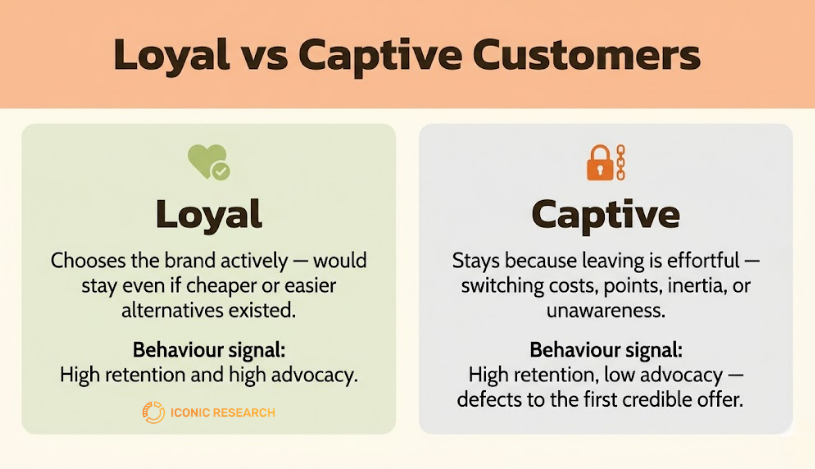
Thailand’s telecom, banking, and utilities markets contain large captive customer populations — consumers who stay because number portability is inconvenient, because their salary is paid into a specific bank account, or because they have accumulated points in a specific ecosystem. Customer loyalty research in these categories must separate switching-cost retention from brand-driven loyalty to produce actionable findings. See customer satisfaction survey for the measurement instruments that distinguish the two.
How Thai Promotional Culture Distorts Loyalty Measurement
Thailand’s retail and FMCG markets operate on heavy, continuous promotional cycles — credit card cashback, platform vouchers, department store loyalty schemes. Thai consumers are sophisticated promotion-followers: they know which brand is on promotion, stock up during campaigns, and shift to a competitor when the promotion shifts. Measuring repeat purchase in this environment and calling it customer loyalty is a measurement error [2].
Genuine customer loyalty research in Thailand must control for promotional switching. This requires research design that separates brand-driven repurchase from price-driven repurchase — through attitudinal questioning that captures brand preference independently of current pricing and promotion status. A consumer who prefers a brand but buys a competitor during heavy promotions is attitudinally loyal to the first brand and behaviourally loyal to neither. Standard transaction-based metrics cannot make this distinction. Survey-based loyalty research can.
The Central Group ecosystem illustrates the problem: consumers accumulating points are loyal to the ecosystem, not to any individual brand within it. Brand-level loyalty research must separate ecosystem loyalty from brand loyalty — which requires primary research, not transaction data. See brand research and brand positioning for the frameworks that isolate brand-specific loyalty from ecosystem effects.
Customer Loyalty Metrics — What to Measure and How
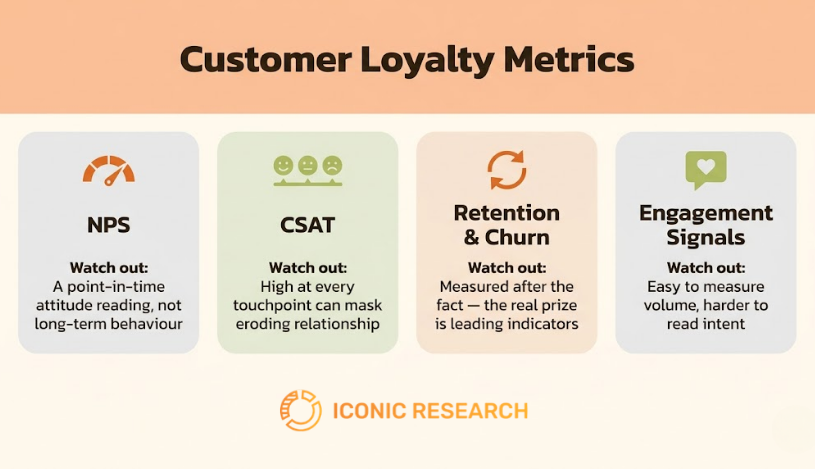
NPS (Net Promoter Score) measures advocacy and relationship sentiment. The single question — how likely are you to recommend this brand? — separates promoters (9–10), passives (7–8), and detractors (0–6). NPS is the most widely used loyalty metric and the most misused: it measures attitudinal loyalty at a point in time, not behavioural loyalty over time. Changes in NPS directionally identify which stage of the customer relationship is gaining or losing ground [3]. See customer satisfaction survey for NPS design and deployment.
Customer satisfaction and loyalty tracking — CSAT measures satisfaction at specific interactions; loyalty tracking measures overall relationship health over time. High CSAT at individual touchpoints is compatible with low overall loyalty — a customer can have satisfactory individual interactions while the cumulative relationship erodes. Tracking both reveals where the gap is.
Customer retention rate and churn analysis — retention rate measures what percentage of customers remain active over a defined period. Churn analysis identifies which segments are leaving and at what point in the customer lifecycle. The research task is to identify the leading indicators of churn — the attitudinal and behavioural signals that precede defection — rather than measuring churn after the fact.
Customer engagement and loyalty signals — engagement metrics provide leading indicators of loyalty strength. In Thailand, LINE ecosystem engagement is a particularly useful proxy — customers who engage actively with a brand’s LINE OA are significantly less likely to defect. Social listening surfaces early churn signals in platform conversations before they appear in structured measurement.
The 90-Day Loyalty Formation Window
Customer loyalty is not formed at purchase — it is formed in the period immediately following it. The first 90 days of a customer relationship are the highest-risk window: the customer is evaluating whether the brand’s delivered experience matches the expectation set at acquisition. If the gap is large enough, defection occurs before loyalty has been established [4].
In Iconic Research’s telecom customer satisfaction study, CATI interviews identified post-acquisition dissatisfaction as the primary driver of churn in high-risk segments. Aggregate satisfaction scores were stable — the problem was invisible in top-line tracking because it was concentrated in new customer cohorts that steady-state measurement did not isolate. The finding required research designed to track new customer cohorts separately from the established base — a design decision most standard loyalty tracking programmes do not make.
Customer loyalty management programmes that measure the full customer base at a single point in time miss the formation window entirely. Loyalty research must include new customer cohorts tracked at 30, 60, and 90 days post-acquisition to identify where the onboarding experience is failing to build the loyalty it needs to. See customer experience and touchpoint for the measurement framework.
Customer Loyalty in the Context of Competitive Disruption
Customer loyalty built over decades can erode in months when a credible competitor enters with a compelling value proposition. Thailand’s automotive market is the current illustration: Japanese brands built loyalty over generations on reliability, after-sales service, and resale value certainty. Chinese EV entrants are offering comparable specifications at substantially lower price points — creating the first serious loyalty challenge these brands have faced in Thailand.
The customers most at risk are not the most dissatisfied — they are the attitudinally neutral ones: satisfied with current performance but holding no strong brand commitment. These customers are invisible in standard satisfaction tracking because their scores look acceptable. They only surface through loyalty research that measures advocacy and commitment separately from satisfaction [1].
This is where brand positioning research and customer loyalty research intersect: a brand with strong positioning on dimensions competitors cannot replicate — service network reliability, after-sales transparency, long-term ownership cost certainty — has a loyalty defence. A brand that cannot demonstrate those dimensions in consumer research terms does not.
Frequently Asked Questions
What is customer loyalty?
The degree to which customers choose a brand because it has earned genuine preference — not because switching is inconvenient. Measured through behavioural indicators (retention, repeat purchase) and attitudinal indicators (NPS, advocacy).
What is the difference between customer loyalty and customer retention?
Retention measures whether customers stay. Loyalty measures why. High retention with low advocacy indicates a captive base — one that will defect when a competitor reduces switching costs.
How do you measure customer loyalty?
NPS for advocacy, CSAT for interaction-level satisfaction, churn analysis for behavioural patterns, and qualitative research for defection motivations. No single metric is sufficient.
Why is customer loyalty research different in Thailand?
Heavy promotional culture means repeat purchase frequently reflects promotion-following rather than brand preference. Large captive populations in telecoms, banking, and utilities require research that separates switching-cost retention from genuine brand loyalty.
What is the 90-day loyalty formation window?
The post-acquisition period when customers evaluate whether delivered experience matches the expectation set at purchase. Churn concentrated here indicates an onboarding failure — invisible unless new customer cohorts are tracked separately from the established base.
References
[1] Oliver, R.L. (1999). Whence Consumer Loyalty? Journal of Marketing, 63(4), 33–44. https://journals.sagepub.com/doi/10.1177/00222429990634s105
[2] Reichheld, F.F. & Schefter, P. (2000). E-Loyalty: Your Secret Weapon on the Web. Harvard Business Review, 78(4), 105–113. https://hbr.org/2000/07/e-loyalty-your-secret-weapon-on-the-web
[3] Reichheld, F.F. (2003). The One Number You Need to Grow. Harvard Business Review, 81(12), 46–54. https://hbr.org/2003/12/the-one-number-you-need-to-grow
[4] Iconic Research. Multi-Channel Customer Satisfaction Research CATI — Telecommunications. https://iconicthai.com/case-study/telecom-cati-case-study/
[5] Iconic Research. Customer Satisfaction Survey. https://iconicthai.com/customer-satisfaction-survey/
If you wish to quote any information from this article, please kindly cite the source along with the link to the original article to respect copyright. |
 |
Iconic Research Thailand Your trusted partner in market research and consulting across Thailand and Southeast Asia. Headquartered in Bangkok, we provide research-driven insights across the Philippines, Malaysia, Indonesia, Singapore, Laos, and Vietnam. We help businesses navigate Thailand's market complexities through consumer insights, market entry strategy, and trend foresight. Contact us if you have any queries! (+66)888 954 954 |
Contact us
We always looking for new and exciting opportunities. Let’s connect.
Related posts
 Growth Strategy: The Expansion Decisions That Need Evidence
Growth strategy is the set of decisions about where a company expands next. Only 25% of companies grow sustainably — the difference is evidence, not ambition.
9 min read Brand Strategy: The Decisions That Should Be Built on Evidence
Brand strategy is the set of decisions that determine how a brand competes. Those decisions only pay off when they’re built on consumer evidence — not a workshop.
11 min read Key Opinion Leader: What Thai Brands Should Research Before, During, and After a KOL Campaign
Platform metrics mislead brands choosing and measuring KOLs in Thailand. A research-first look at what to verify before, during, and after a campaign.
10 min read