
A customer touchpoint is any interaction between a customer and a brand — across every channel and every stage of the relationship — that shapes perception. Most companies have no systematic picture of which touchpoints are working, which are broken, and which ones customers actually care about. Mapping, auditing, and researching customer touchpoints in Thailand requires a different framework from standard Western CX models — the channels are different, the consumer behaviour is different, and the unowned digital conversation carries more weight than most brand measurement programmes account for.
Table of Contents
- What Is a Customer Touchpoint?
- Types of Touchpoints
- Digital Touchpoints in Thailand
- Touchpoint Mapping
- How to Audit and Research Touchpoints
- Case Study: Telecom Touchpoint Audit in Thailand
- Measuring Touchpoint Performance
- References
Most companies know they have touchpoints but have no systematic picture of which ones are working, which are broken, and which ones customers actually care about. What is a touchpoint in practice? It is a search result, a mall promoter conversation, a delivery notification, a LINE OA message. Some are owned by the brand. Many are not. All of them are measurable. This article covers how to map, audit, and research customer touchpoints in the Thai market context.
What Is a Customer Touchpoint?
A touchpoint is any moment of contact between a customer and a brand that shapes perception, whether direct — owned and managed by the brand — or indirect — shaped by third parties outside brand control [1]. The customer journey is the full sequence of these moments across the relationship. Touchpoints are the individual instances within that sequence. The two are related but distinct: you cannot optimise a customer journey without first inventorying the touchpoints that compose it.
To define touchpoint precisely: it is not limited to advertising or customer service. Three concrete examples from the Thai market: a LINE OA message after purchase is a touchpoint. A Shopee product listing — including its review score and in-platform chat response time — is a touchpoint. A conversation with a mall promoter in a Bangkok department store is a touchpoint. All three shape brand perception. None of them appear in most standard touchpoint frameworks designed for Western markets [2].
Types of Touchpoints
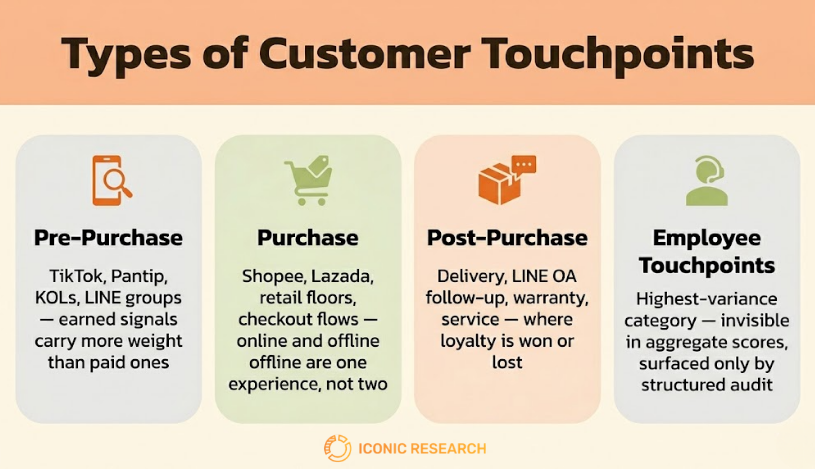
Pre-purchase touchpoints determine whether a customer enters the consideration set. In Thailand this means search results, TikTok discovery content, KOL endorsements, Pantip reviews, and word-of-mouth circulating in LINE groups. Most Thai brands overinvest in paid pre-purchase touchpoints and underresearch the earned ones — the peer reviews and community conversations that carry more weight with Thai consumers than advertising does.
Purchase touchpoints are the moments of transaction and the interactions immediately surrounding it — e-commerce product pages on Shopee and Lazada, physical retail environments, in-app checkout flows, and in-store staff interactions. Friction at any purchase touchpoint is a direct conversion failure [3]. The most common Thai brand error here is treating online and offline purchase touchpoints as separate measurement problems rather than a single customer experience.
Post-purchase touchpoints are where loyalty is won or lost in Thailand. Delivery experience, LINE OA follow-up messaging, customer service interactions, and warranty claim handling all shape whether a first-time buyer becomes a repeat customer. Most brands underinvest in researching this stage relative to its impact on lifetime value [5]. The gap is structural — post-purchase touchpoints produce less visible data than acquisition touchpoints, so they receive less research budget.
Employee touchpoints are any human interaction — in-store staff, call centre agents, delivery personnel, LINE customer service representatives. Employee touchpoints are the highest-variance category: the same brand can deliver wildly different experiences across 50 retail locations. The diagnostic problem is that employee touchpoint failures are invisible in aggregate satisfaction scores — they only surface through structured audit methodology that samples specific locations, times, and interaction types.
Every touchpoint is also a brand touchpoint — shaping brand associations whether the brand intends it or not. A slow LINE response, a damaged delivery package, or an inconsistent mall promoter pitch are all brand touchpoints, even when no brand team is paying attention to them. Understanding how each touchpoint shapes brand perception is the foundation of brand research.
How those touchpoints are perceived depends on whether the underlying brand identity is clearly defined and consistently executed.
Digital Touchpoints in Thailand
Digital touchpoints in Thailand operate differently from Western markets. The channel mix and the behaviour within each channel require specific research design.
LINE OA is the primary post-purchase communication channel for most consumer categories — response speed is read as a brand signal, not just a logistics variable. TikTok drives discovery and consideration, particularly for younger demographics and FMCG. Facebook remains significant for older consumers and B2B consideration. Shopee and Lazada product pages — including review scores, Q&A sections, and in-platform chat — are active purchase-stage touchpoints, not passive listings.
Pantip operates as a peer review touchpoint that sits entirely outside brand control but heavily influences consideration in electronics, automotive, and financial services categories. A brand that measures digital touchpoints only through owned analytics — website traffic, LINE open rates, ad impressions — is missing the unowned digital conversation where consumers compare, criticise, and recommend. Social listening provides the monitoring infrastructure for unowned digital touchpoints, capturing brand perception signals that structured surveys never surface.
Touchpoint Mapping
Brands routinely misidentify which touchpoints matter most because they rely on operational data — website traffic, open rates, transaction volumes — rather than customer-reported experience. The touchpoints with the highest internal visibility are rarely the same as the touchpoints with the highest customer impact [2]. Customer touchpoint mapping corrects this by building the inventory from the customer’s perspective, not the brand’s data architecture [1].
A customer journey map touchpoints view plots which touchpoints occur at each stage; the touchpoint inventory is what makes that mapping possible.
Five-step process:
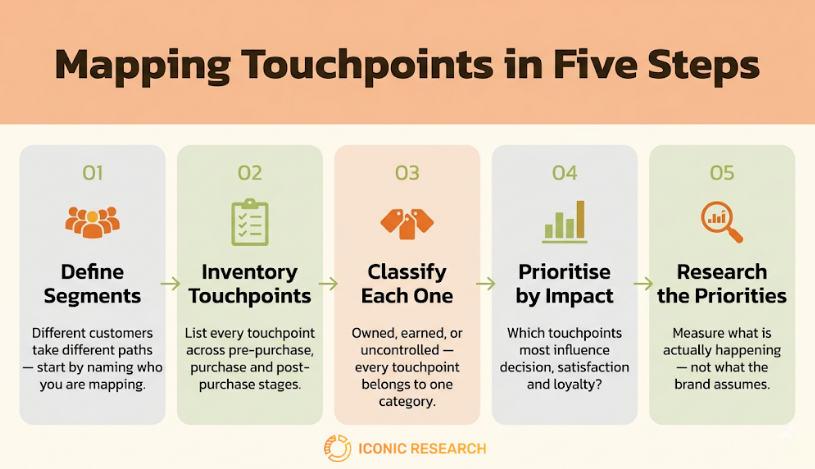
- Define the customer segments and journeys to map — different segments take different paths through the same brand
- Inventory every touchpoint across pre-purchase, purchase, and post-purchase stages
- Classify each touchpoint — owned, earned, or uncontrolled
- Prioritise by impact — which touchpoints have the highest influence on purchase decision, satisfaction, and loyalty
- Research the priority touchpoints — measure what is actually happening, not what the brand assumes
How to Audit and Research Touchpoints
Mystery shopping is the most direct method for auditing human and physical touchpoints. Trained investigators experience the brand as real customers across retail locations, call centres, dealer networks, and service points. Mystery shopper programmes surface inconsistency — where the same touchpoint delivers different experiences across locations or times of day.
Customer surveys and quantitative research measure satisfaction and effort at specific touchpoints. CSAT and NPS measure outcomes; touchpoint-level surveys identify which specific interactions drove those outcomes. In a telecom touchpoint case study conducted by Iconic Research, CATI interviews with telecom customers identified specific gaps in employee touchpoints — customer support quality — and digital touchpoints — pricing transparency — that aggregate satisfaction scores had obscured [4].
Social listening monitors unowned digital touchpoints continuously. It captures what customers say about brand interactions on Pantip, TikTok, Facebook, and review platforms — without prompting and without survey bias. Voice of customer signals from social listening frequently surface touchpoint problems before they appear in structured measurement.
These three methods constitute touchpoint services — the research infrastructure for building a complete picture of every point of contact. Mystery shopping audits the human and physical layer. Surveys measure the customer-reported experience at owned touchpoints. Social listening captures the unowned digital conversation. Together they eliminate the blind spots that any single method leaves.
Case Study: Telecom Touchpoint Audit in Thailand
A Thai telecommunications provider needed to understand where in the customer relationship loyalty was eroding before it appeared in top-line metrics. The research question was specific: which touchpoints were competitors outperforming them on, and which customer segments were most at risk of switching [4].
Iconic Research deployed a two-phase programme. Phase one used targeted surveys across a stratified sample of telecom customers — individual consumers and business executives — mapping the full customer relationship from acquisition through renewal. The instrument measured importance and perceived performance across each touchpoint. Phase two used CATI interviews with customers identified in Phase one as high churn risk, probing the specific friction points that surveys could identify but not fully explain.
Three findings shaped the recommendations. The most significant performance gap was at the customer support touchpoint — resolution speed was ranked the single most important factor in provider loyalty, and the client received its lowest comparative score on exactly that criterion. Pricing transparency at digital touchpoints was the second gap. The third was digital self-service — functional for routine tasks but producing dead ends when issue resolution was needed.
The findings were invisible in the client’s aggregate satisfaction scores. They only surfaced through touchpoint-level measurement. See the full telecom touchpoint case study.
Measuring Touchpoint Performance
CSAT measures satisfaction at a specific interaction — the right instrument for post-purchase, post-service, and post-support touchpoints where moment-level feedback is needed [3]. Customer experience research measures what happens at each interaction. Customer loyalty research measures what that cumulative experience produces — whether it builds genuine commitment or captive behaviour.
NPS measures overall relationship sentiment. It is not a touchpoint-level metric, but changes in NPS over time often trace back to a specific touchpoint that has improved or degraded. Use NPS directionally to identify which journey stage to investigate further.
CES (Customer Effort Score) measures friction at a specific touchpoint — how much effort the customer had to expend to complete an interaction. High effort is a churn predictor regardless of whether the outcome was positive, and it is particularly relevant for customer service and digital touchpoints where process friction is the primary failure mode.
For full methodology on CSAT, NPS, and CES design and deployment, see customer satisfaction survey.
Frequently Asked Questions
What is a touchpoint?
Any moment of contact between a customer and a brand that shapes perception — a search result, a retail interaction, a LINE message, a delivery. Touchpoints occur before, during, and after purchase.
What are examples of customer touchpoints in Thailand?
LINE OA messages, Shopee product pages, mall promoter interactions, Pantip reviews, KOL endorsements, and delivery experiences. Thai touchpoints include several channels that standard Western frameworks do not account for.
What is customer touchpoint mapping?
The process of identifying and documenting every interaction a customer has with a brand across the full journey. Touchpoint mapping is the foundation of customer journey design and customer experience improvement programmes.
How do you audit customer touchpoints?
Through mystery shopping for human and physical touchpoints, customer surveys and CATI for owned touchpoints, and social listening for unowned digital touchpoints. Each method captures a different layer of the customer experience.
What is the difference between a touchpoint and the customer journey?
Touchpoints are the individual moments of contact. The customer journey is the sequence of those moments across the full relationship. Optimising individual touchpoints without understanding the journey produces a fragmented experience.
References
[1] Lemon, K.N. & Verhoef, P.C. (2016). Understanding Customer Experience Throughout the Customer Journey. Journal of Marketing, 80(6), 69–96. https://doi.org/10.1509/jm.15.0420
[2] Rawson, A., Duncan, E. & Jones, C. (2013). The Truth About Customer Experience. Harvard Business Review, 91(9), 90–98. https://hbr.org/2013/09/the-truth-about-customer-experience
[3] Dixon, M., Freeman, K. & Toman, N. (2010). Stop Trying to Delight Your Customers. Harvard Business Review, 88(7/8), 116–122. https://hbr.org/2010/07/stop-trying-to-delight-your-customers
[4] Iconic Research. Multi-Channel Customer Satisfaction Research CATI — Telecommunications. https://iconicthai.com/case-study/telecom-cati-case-study/
[5] Verhoef, P.C. et al. (2009). Customer Experience Creation: Determinants, Dynamics and Management Strategies. Journal of Retailing, 85(1), 31–41. https://doi.org/10.1016/j.jretai.2008.11.001
If you wish to quote any information from this article, please kindly cite the source along with the link to the original article to respect copyright. |
 |
Iconic Research Thailand Your trusted partner in market research and consulting across Thailand and Southeast Asia. Headquartered in Bangkok, we provide research-driven insights across the Philippines, Malaysia, Indonesia, Singapore, Laos, and Vietnam. We help businesses navigate Thailand's market complexities through consumer insights, market entry strategy, and trend foresight. Contact us if you have any queries! (+66)888 954 954 |
Contact us
We always looking for new and exciting opportunities. Let’s connect.
Related posts
 Growth Strategy: The Expansion Decisions That Need Evidence
Growth strategy is the set of decisions about where a company expands next. Only 25% of companies grow sustainably — the difference is evidence, not ambition.
9 min read Brand Strategy: The Decisions That Should Be Built on Evidence
Brand strategy is the set of decisions that determine how a brand competes. Those decisions only pay off when they’re built on consumer evidence — not a workshop.
11 min read Key Opinion Leader: What Thai Brands Should Research Before, During, and After a KOL Campaign
Platform metrics mislead brands choosing and measuring KOLs in Thailand. A research-first look at what to verify before, during, and after a campaign.
10 min read