
Customer journey mapping — the practice of visualising that sequence — has become a core discipline for any brand serious about reducing friction, improving conversion, and building retention. In Thailand, the customer journey adds layers that global frameworks are not built for: LINE as a commerce and CRM channel, TikTok Shop as a discovery-to-purchase platform, and physical retail touchpoints that remain decisive even for digitally-savvy consumers.
Table of Contents
- What Is a Customer Journey
- Customer Journey Stages
- What Is a Customer Journey Map
- The Thai Customer Journey
- Market Research’s Role in Customer Journey Mapping
- Conclusion
- References
The customer journey is the complete sequence of interactions a customer has with a brand — before, during, and after purchase. It spans emotional responses, behavioural patterns, and channel touchpoints that shape both purchasing decisions and long-term loyalty. Understanding it is the foundation of modern marketing, CX, and product strategy.
What Is a Customer Journey
The customer journey is the end-to-end experience a customer goes through when interacting with a brand — from first awareness through to post-purchase advocacy. It is not a single transaction. It is a sequence of touchpoints, decisions, and emotional states that together determine whether a customer buys, returns, and recommends.
The customer decision journey recognises that this process is rarely linear. Customers move between stages, revisit consideration after purchase, and are influenced by external signals — reviews, social content, peer recommendations — at every point. A brand that only optimises for the purchase moment is optimising for a fraction of the journey that determines its outcome.
Customer Journey Stages
The customer journey stages provide a framework for understanding how consumers move from initial awareness to brand advocacy. Each stage involves distinct touchpoints, motivations, and decision criteria.
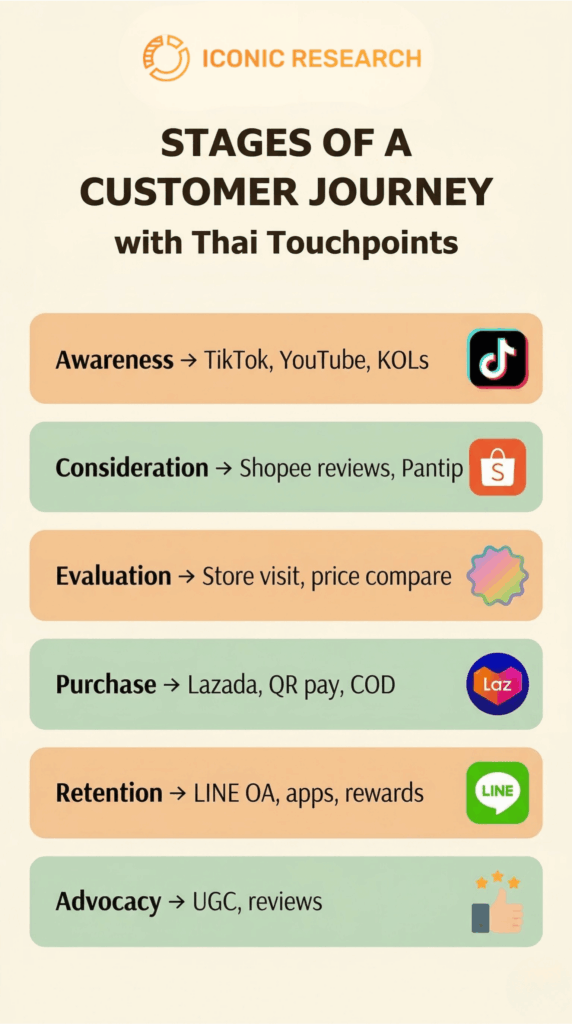
Awareness — Consumers discover brands through social media content, influencer endorsement, out-of-home advertising, search, and word of mouth. This stage is about reach and relevance: the brand must appear in the right context at the right moment.
Consideration — Once aware, consumers evaluate options. They read reviews, compare alternatives, and seek social proof. Trust signals matter more here than at any other stage — and where those signals live varies significantly by market.
Evaluation — Consumers narrow their choices. Price comparison, consultation with friends and family, and physical product inspection all play roles. Many consumers who started a journey online complete their evaluation offline.
Purchase — The transaction occurs. Channel, payment method, and friction level all influence whether consideration converts. A seamless purchase experience reduces abandonment; a difficult one creates drop-off that is hard to recover.
Retention — Post-purchase engagement determines repeat behaviour. Loyalty programs, personalised communication, and responsive customer service are the mechanisms. A retained customer has a lower cost of acquisition and higher lifetime value than a new one.
Advocacy — Satisfied customers generate user content, referrals, and reviews that fuel new journeys. In practice, advocacy is the most efficient acquisition channel a brand can develop — and the hardest to manufacture artificially.
Each stage requires a different strategic emphasis. Awareness demands cultural relevance and reach. Consideration requires social validation. Purchase requires frictionless execution. Retention depends on communication that feels personal rather than automated. Each stage of the journey is composed of individual customer touchpoints — the specific interactions that shape perception at every point of contact.
What Is a Customer Journey Map
A customer journey map is a visual representation of the customer experience across channels and stages — documenting touchpoints, emotional states, goals, pain points, and opportunities at each point in the journey.
The customer experience journey map serves two functions. Externally, it reflects the reality of how customers actually behave — not how the brand assumes they behave. Internally, it creates a shared reference point across marketing, product, CX, and sales teams, aligning decisions around the customer’s actual path rather than organisational silos.
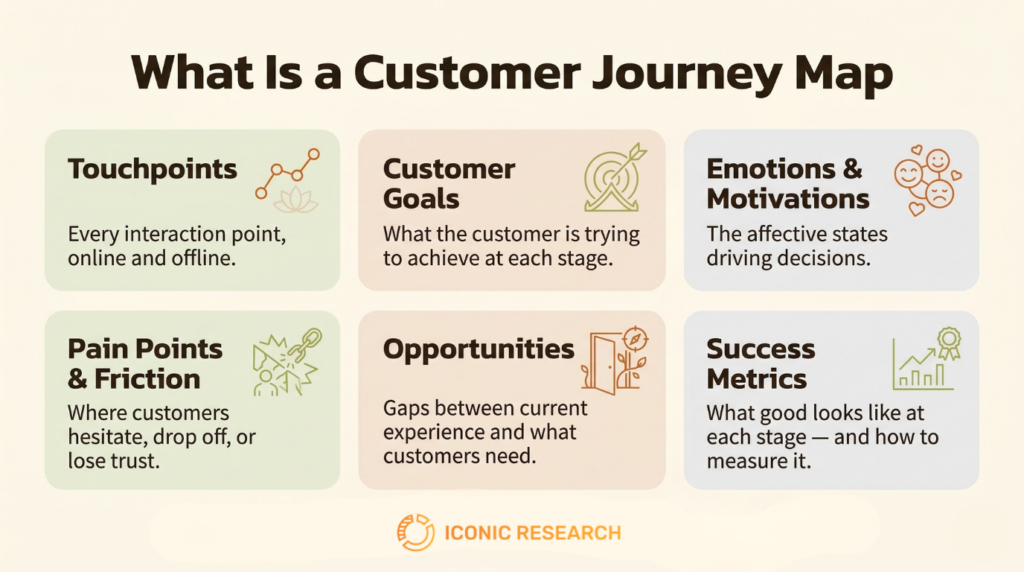
Core components of an effective customer journey map:
- Touchpoints — every interaction point, online and offline
- Customer goals — what the customer is trying to achieve at each stage
- Emotions and motivations — the affective states driving decisions
- Pain points and friction — where customers hesitate, drop off, or lose trust
- Opportunities — gaps between current experience and what customers need
- Success metrics — what good looks like at each stage, and how to measure it
The Thai Customer Journey
The customer experience journey in Thailand follows the same fundamental stages as any market — but the platforms, trust mechanisms, and cultural dynamics that govern each stage are different enough to require a dedicated mapping approach.
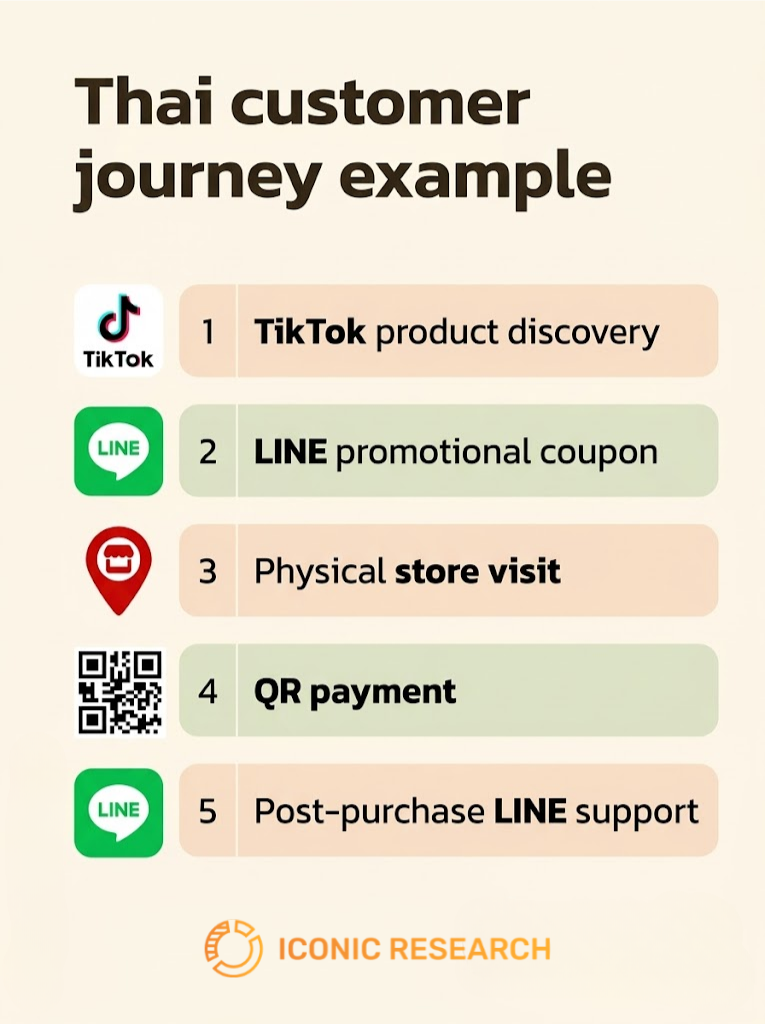
A representative Thai customer journey example: TikTok product discovery → Shopee review research → LINE inquiry to brand → physical store visit for validation → QR payment at checkout → LINE Official Account post-purchase support. This hybrid digital-physical path is not an edge case. It is the norm for a significant share of Thai consumer categories.
Platform-specific behavioural patterns:
LINE is used by approximately 50 million Thais and functions simultaneously as a communication channel, CRM system, and sales channel. A brand’s LINE Official Account is where trust is maintained after purchase — through loyalty points, personalised offers, and responsive customer service. Consumers who do not receive a response on LINE within a reasonable window do not complain; they leave silently. This is a kreng jai dynamic that standard satisfaction surveys will not capture.
TikTok Shop has restructured the awareness-to-purchase path for a significant portion of Thai consumers. Discovery happens through short-form video content; purchase follows within the same platform without requiring search intent. The customer decision journey on TikTok is compressed — consumers are not researching a product they already want, they are encountering products they did not know they needed. This requires a different touchpoint strategy than search-driven channels.
Shopee and Lazada function as evaluation and social proof environments. Review volume, seller ratings, and Q&A threads are the primary trust signals at the consideration and evaluation stages. Consumers who discover on TikTok frequently validate on Shopee before purchasing.
Offline touchpoints remain decisive. For categories including personal care, food and beverage, and household goods, the 7-Eleven, Lotus’s, and Watsons network provides physical validation that online channels cannot replicate. A consumer who has researched a product online may still visit a convenience store before committing. Journey maps that treat Thailand as a digital-only market systematically misrepresent this behaviour.
Cultural dynamics. Kreng jai — the Thai value of avoiding imposition on others — means that negative experiences are underreported and brand-switching happens quietly. Face consciousness means that purchase decisions in certain categories carry social meaning beyond functional utility. Sanuk — the preference for enjoyment and lightness — shapes content engagement at the awareness stage. These are not soft cultural observations. They are structural features of the Thai customer journey that alter how each stage should be designed and measured.
For a detailed breakdown of how these consumer behaviour patterns play out across segments and demographics, see our consumer behaviour in Thailand analysis.
Market Research’s Role in Customer Journey Mapping
A customer journey map is only as accurate as the research behind it. Without primary research, journey maps reflect internal assumptions — and internal assumptions about customer behaviour are reliably wrong in markets with structural differences from the brand’s home market.
The research methods that feed effective journey mapping:
Research Method | Application | Insight Type |
Consumer Surveys & Segmentation | Demographic and psychographic patterns | Quantitative behavior data |
Social Listening | Real-time sentiment analysis | Authentic customer voice |
CX Analytics & Heatmaps | Digital behavior tracking | Actual usage patterns |
In-Depth Interviews | One-on-one qualitative research | Motivations and pain points |
Customer Journey Discovery | Ethnographic research | Unmet needs identification |
AI Sentiment Analysis | Review and social media analysis | Scale insights automation |
In Thailand’s B2B context, journey mapping must additionally account for relationship-driven sales processes, face-saving communication styles, and hierarchical approval structures. B2B customer journey mapping here typically involves longer evaluation cycles, multiple stakeholder touchpoints, and higher proof requirements — all of which require research design that goes beyond standard consumer survey methodology.
Conclusion
The customer journey is no longer linear — and in Thailand, it was never the tidy funnel that global frameworks describe. It is hybrid, conversational, and shaped by platform dynamics and cultural values that standard models do not carry.
Brands that invest in accurate journey mapping — built on real Thai consumer data rather than adapted global templates — create a measurable advantage: lower friction at purchase, stronger retention, and advocacy that compounds over time. The map is not the destination. It is the tool that makes every other decision more precise.
If you are scoping a customer journey mapping project in Thailand, Iconic Research’s Consumer & Stakeholder Insight service is the starting point.
Frequently Asked Questions
What is a customer journey?
A customer journey is the complete sequence of interactions a customer experiences with a brand before, during, and after purchase, including online and offline touchpoints.
What are the main stages of a customer journey?
The stages include awareness, consideration, evaluation, purchase, retention, and advocacy—each requiring different strategies and touchpoints.
How do you map a customer journey?
A customer journey map is a visual representation of the customer experience across stages and channels, documenting touchpoints, emotions, pain points, and opportunities. Building an accurate customer journey map aligns internal teams around the customer's actual path rather than the organisation's assumed version of it.
Why is customer journey mapping important in Thailand?
Thai consumers blend LINE messaging, social commerce, and physical retail in unique ways, requiring hybrid journey mapping that accounts for mobile-first, conversational behaviors.
What is B2B customer journey mapping?
B2B international customer journey mapping tracks longer sales cycles with multiple stakeholders, higher proof requirements, and complex approval processes across digital and physical channels.
References
[1] Adobe. “The customer journey map and why it’s important.” https://business.adobe.com/blog/basics/what-is-customer-journey-map
[2] Contentsquare. “10 Major Benefits of Customer Journey Mapping.” https://contentsquare.com/guides/customer-journey-map/benefits/
[3] Pantouvakis, A. “Theoretical and Practical Evolution of Customer Journey in Services.” MDPI, 2022. https://www.mdpi.com/2071-1050/14/15/9610
[4] Walker XM. “Customer journey mapping and why it’s important.” https://walkerxm.com/blog/what-is-customer-journey-mapping-why-is-it-important
[5] Jaipeng C., Udomraksasup P. “Customer Journey Analysis to Selecting Accommodation During the New Normal Situation of Thai Tourists.” TNSU Journal, 2024. https://he02.tci-thaijo.org/index.php/TNSUJournal/article/view/263014
[6] Everyday Marketing. “วิเคราะห์ Customer Journey Mapping จากรายงานผู้บริโภคในประเทศไทย.” https://everydaymarketing.co/consumer-insights/customer-journey-mapping-analysis-from-niq-thailand-consumer-report/
If you wish to quote any information from this article, please kindly cite the source along with the link to the original article to respect copyright. |
 |
Iconic Research Thailand Your trusted partner in market research and consulting across Thailand and Southeast Asia. Headquartered in Bangkok, we provide research-driven insights across the Philippines, Malaysia, Indonesia, Singapore, Laos, and Vietnam. We help businesses navigate Thailand's market complexities through consumer insights, market entry strategy, and trend foresight. Contact us if you have any queries! (+66)888 954 954 |
Contact us
We always looking for new and exciting opportunities. Let’s connect.
Related posts
 Growth Strategy: The Expansion Decisions That Need Evidence
Growth strategy is the set of decisions about where a company expands next. Only 25% of companies grow sustainably — the difference is evidence, not ambition.
9 min read Brand Strategy: The Decisions That Should Be Built on Evidence
Brand strategy is the set of decisions that determine how a brand competes. Those decisions only pay off when they’re built on consumer evidence — not a workshop.
11 min read Key Opinion Leader: What Thai Brands Should Research Before, During, and After a KOL Campaign
Platform metrics mislead brands choosing and measuring KOLs in Thailand. A research-first look at what to verify before, during, and after a campaign.
10 min read