

Consumer Behavior in Thailand: Digital Trends and Market Insights
13 min readConsumer behavior in Thailand in 2026 reflects evolving preferences shaped by digital penetration, generational shifts, and economic factors. Understanding digital consumer behavior unlocks critical consumer insights and market research opportunities, enabling businesses to tailor strategies that resonate with diverse Thai consumer segments.
Table of Contents
- Introduction
- Consumer Behavior in Thailand: Overview
- Consumer Behavior Models in Thailand
- Online & Digital Consumer Behavior
- Generational Insights
- Nudging & Behavioral Economics
- Consumer Research in Thailand
- Case Studies: Iconic Research Thailand
- Conclusion & TL;DR
- References
Introduction
Thailand’s consumer market is transforming amid rapid digital adoption and socio-economic change. For Thai businesses, grasping consumer behavior patterns is essential for sustainable growth. From urban millennials consumer behavior to rural low income consumer behavior segments, understanding what drives purchase decisions empowers brands to sharpen targeting, innovation, and customer engagement.
This article explores the multifaceted landscape of consumer behavior research in Thailand, with a focus on digital trends dominating 2026. For brands that need to act on these consumer insights, our consumer insights research translates Thai consumer behavior patterns into strategic decisions. Consumer research companies and brands alike are discovering that traditional consumer behavior models must evolve to capture the complexity of Thailand’s diverse market, where internet consumer behavior increasingly shapes purchasing patterns across all demographics.
Consumer Behavior in Thailand: Overview
Thailand’s consumer landscape shows clear macro shifts driven by digitalization and economic realities. Urban consumers adopt mobile-first lifestyles and digital services, while rural consumers balance modern convenience with traditional values. Economic pressures heighten price sensitivity, with households leaning into promotions and private-label alternatives [5]. Consumer behavior analysis across these segments reveals distinct purchasing triggers that uniform marketing approaches consistently miss.
In high-involvement categories like automotive, understanding consumer behavior extends beyond surveys into specialized research like car clinics and verified owner recruitment. Learn about our automotive market research capabilities for vehicle testing and Thai driver insights.
As of January 2025, Thailand had ~65.4 million internet users (~91% penetration) and ~51.0 million social media identities (~71% of population)—baseline drivers of digital consumer behavior patterns across the country [1]. This massive digital adoption fundamentally shapes how consumer behavior in Thailand manifests across different market segments.
Capturing accurate insights into these complex behaviors requires survey methodologies tailored to Thailand’s unique market dynamics—learn more in our comprehensive guide to survey strategies in Thailand.

Generational differences create distinct customer journies and consumer behavior models: younger cohorts gravitate toward experiential, personalized brands and embrace consumer behavior in online shopping, while older segments display more utilitarian consumer behavior—prioritizing necessity and functionality over brand experience [6]. Understanding these generational splits has become crucial for consumer market research initiatives, as Gen Y consumer behavior increasingly drives market trends and purchasing power in urban centers.
Understanding how Thai consumers evaluate and internalise brand associations is the foundation of brand identity research in this market.
Consumer Behavior Models in Thailand
Two paradigms frame Thai consumer behavior: utilitarian and hedonic. Utilitarian consumer behavior emphasizes functionality and value, while hedonic consumers seek pleasure, status, and emotional satisfaction. Thai research on mobile financial services shows these styles moderate how social and reference cues shape adoption—evidence that both modes matter in market design [7].
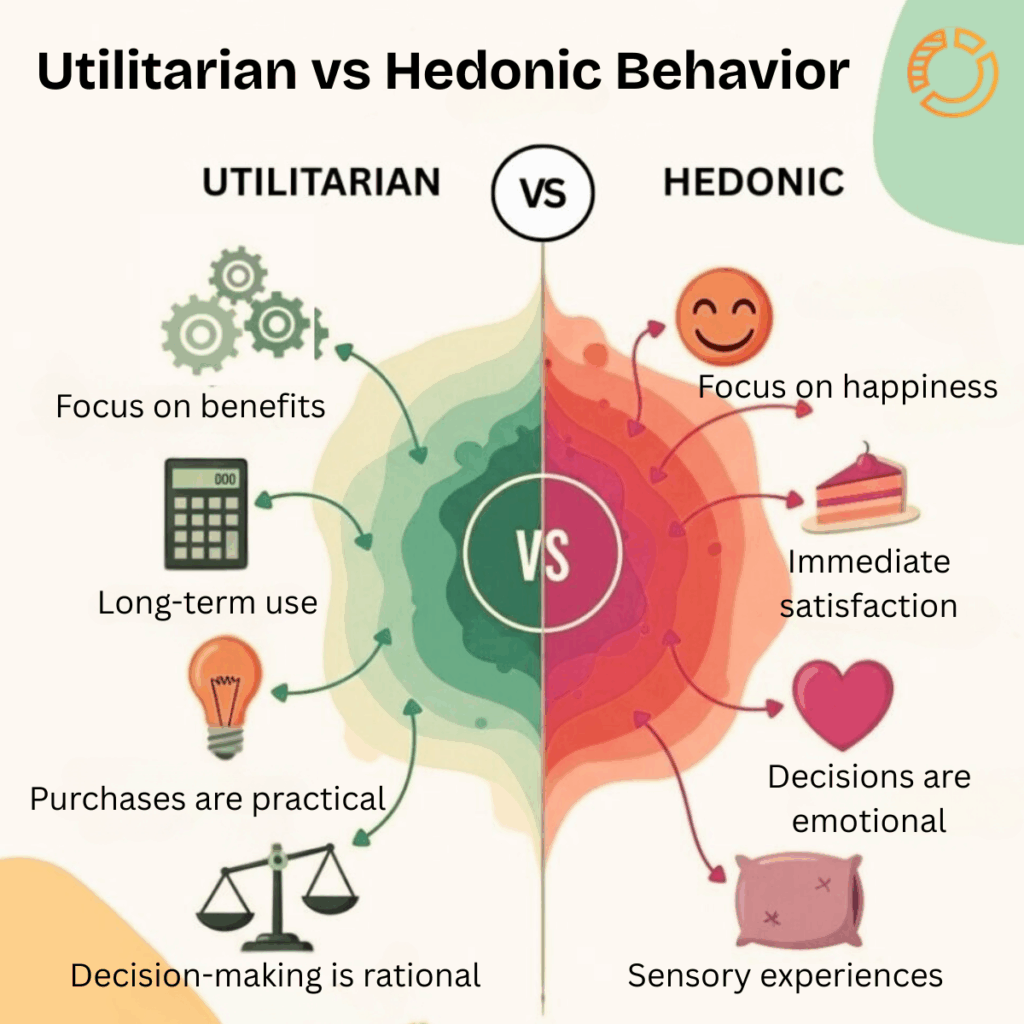
For example, millennials consumer behavior often balances utilitarian needs with hedonic desires, engaging in “smart indulgence” by selecting products that deliver both value and enjoyable experiences. This dual approach has become a defining characteristic of how younger Thai consumers navigate purchasing decisions.
Online & Digital Consumer Behavior
Thailand’s e-commerce market reached ~THB 1.1 trillion in 2024 and is projected to ~THB 1.6 trillion by 2027 (≈11% CAGR), reflecting sustained digital retail momentum [2]. This growth demonstrates how consumer behavior in online shopping has become central to Thailand’s retail landscape.
Social commerce is a defining feature of internet consumer behavior: ~91% of Thai online shoppers have purchased via social platforms, among the highest globally [3]. Understanding what Thai consumers say about brands across these platforms — unprompted — is what social listening in Thailand captures that surveys cannot. This trend highlights how digital consumer behavior in Thailand uniquely blends social interaction with commerce.
Across Southeast Asia, e-commerce growth has re-accelerated ~+15% YoY, with video commerce now ~20% of e-commerce GMV—trends visible in Thailand’s consumer journey as well [4]. Mobile-first behavior also raises expectations for seamless UX—easy navigation, instant payments, and dependable delivery.
Real-time payments such as PromptPay are now embedded in everyday spending, with the central bank noting ~71 million daily transactions as of March 2025—evidence of broad payment habit change feeding into purchase behavior [8]. This infrastructure development significantly influences how consumer behavior in Thailand manifests in digital spaces.
Generational Insights
- Gen Z & Millennials (Gen Y): Digitally native, authenticity-seeking, and convenience-driven; their journeys blend marketplace, brand.com, and social/video touchpoints [4]. Gen Y consumer behavior particularly demonstrates sophisticated omnichannel expectations and social commerce adoption.
- Low-Income Consumers: Highly price-sensitive; they favor essential goods, bundles, and value options—mirroring broader APAC shifts toward trusted private labels [5]. Low income consumer behavior patterns show increasing sophistication in value-seeking despite budget constraints.
- Utilitarian Segments: Overlap with older/rural groups; they prize reliability, clarity, and tangible value [6]. These consumers demonstrate classic utilitarian consumer behavior focused on functional benefits over emotional appeals.
Understanding how these demographic and behavioural differences translate into actionable groups is covered in detail in our guide to market segmentation in Thailand.
Nudging & Behavioral Economics
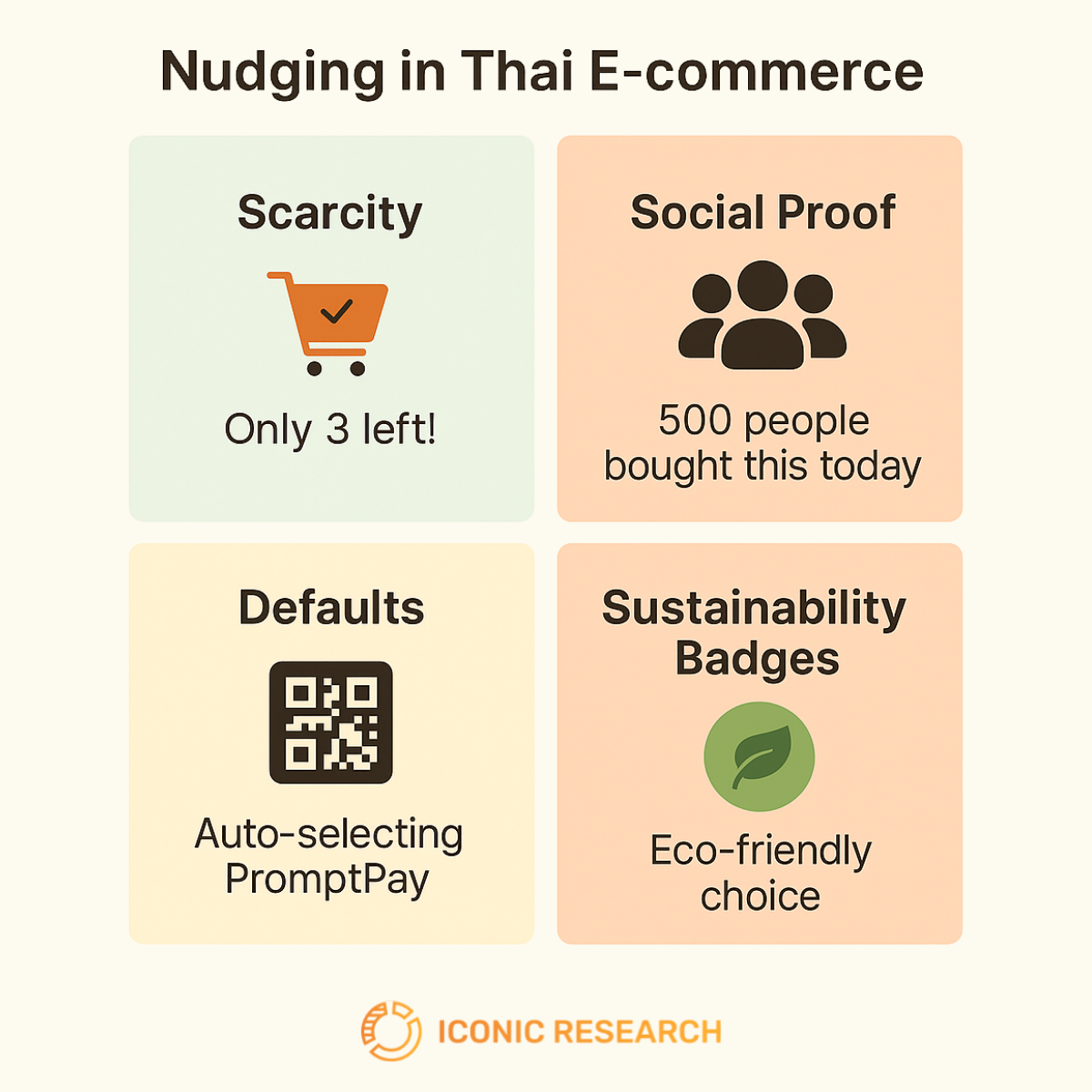
Nudging consumer behavior strategies—defaults, salience, and social proof—are increasingly referenced in Thai policy and financial system discourse (e.g., behavioral nudges across the debt cycle). They also appear in app UX, retail prompts, and sustainability cues, where subtle changes steer consumers without restricting choice [9]. Understanding these nudging consumer behavior techniques has become essential for brands designing customer experiences.
Consumer Research in Thailand
Our consumer insights research translates these behaviour patterns into strategic decisions for brands operating in Thailand. Consumer market research in Thailand requires methodologies calibrated to indirect communication styles, regional variance, and omnichannel attribution that standard global research frameworks do not account for. Research increasingly focuses on digital behavior patterns, while brands also watch platform partnerships (e.g., YouTube x Shopee) that reshape discovery-to-purchase journeys in Thailand and Southeast Asia [10]. Our fieldwork and research recruitment capabilities ensure research reaches the right respondents across Bangkok and provincial Thailand.
Related Research Guides:
- Competitor Analysis in Thailand — frameworks and methodologies for competitive intelligence
- Brand Awareness – how to measure each level correctly and what the numbers actually tell you
- Customer Loyalty – this article explains how to measure genuine customer loyalty
- Customer Persona – a research-based profile of a specific type of customer
- Market Research – Methods, Examples and Key Questions for Business Growth
- Quantitative Research – Methods, Examples and Data Collection in Thailand
- Market Survey Methods for Thailand — survey types, offline vs online, best practices
- Business Model Canvas Guide — how to validate all 9 blocks with Thailand-specific research
- Data Collection Methods for Thailand — primary, secondary, and fieldwork approaches
- Customer Journey in Thailand — mapping the Thai purchase path
- Market Segmentation in Thailand — segmentation frameworks applied to Thai consumers
- Customer Satisfaction – how to measure it in Thailand
- Customer Experience – how touchpoints accumulate into brand perception
- Target Audience – understanding which consumers are actually yours
Case Studies: Iconic Research Thailand
Consumer research projects demonstrate how understanding local behavior patterns drives business results:
- Case 1: Gen Z Online Shopping Habits A leading consumer brand partnered with Iconic Research to identify how Gen Y consumer behavior prioritizes convenience and authenticity in consumer behavior in online shopping. Through comprehensive consumer behaviour research, the study revealed specific influencer partnership strategies and checkout optimization approaches that boosted engagement significantly.
- Case 2: Digital Consumer Behavior in Thailand As Thai Gen Z becomes the most digital-first generation, global media and entertainment companies need to understand how audiences spend time across music, video, and social platforms. This consumer insight research explored how “Me Time” activities shape digital consumer behavior and identified emotional triggers that drive platform choice among Thai youth.
- Case 3: Digital Payment Application One of Thailand’s leading financial institutions faced challenges with mobile banking adoption despite digital transformation investments. The bank observed negative app store feedback and increased support calls. Iconic Research conducted targeted consumer market research to gather insights on nudging consumer behavior techniques, informing UX improvements that enhanced user experience and reduced friction.
Conclusion & TL;DR
Thailand’s digital consumer behavior is reshaping markets in 2026.
- Generational and income differences require segment-specific strategies
- Utilitarian vs. hedonic models remain relevant to decode motivations
- E-commerce expansion, social commerce, and real-time payments drive journeys
- Nudging and localized research methods help brands convert intent into action
Frequently Asked Questions
What is consumer behavior?
Consumer behavior describes how individuals select, purchase, and use products — shaped by psychological drivers, social influences, cultural norms, and economic conditions. In Thailand, face-saving norms and indirect communication mean stated preferences frequently diverge from actual purchasing decisions, making research design more consequential than in Western markets.
How is consumer behavior changing in Thailand?
Consumer behavior in Thailand is shifting toward mobile-first digital engagement, social commerce, and platform-driven discovery — with ~91% of online shoppers having purchased via social platforms. Provincial and lower-income segments continue to behave differently from Bangkok, meaning national-level data without regional breakdown frequently misrepresents the full picture.
What are the main consumer behavior models?
The two primary frameworks are utilitarian — where consumers prioritize functionality and value — and hedonic, where decisions are driven by pleasure, status, and emotional satisfaction. Thai research shows both modes operate simultaneously, and effective segmentation strategies account for both rather than treating them as mutually exclusive.
Who conducts consumer research in Thailand?
Consumer research firms with local fieldwork capability, Thai-language moderation, and regional recruitment networks are best placed to conduct reliable research in Thailand. Iconic Research provides end-to-end consumer behavior research across Bangkok and all Thai regions — from recruitment and qualitative moderation through to quantitative fieldwork and strategic analysis.
What is consumer behavior analysis?
Consumer behavior analysis examines purchasing patterns, motivations, and decision triggers across segments to identify what drives and blocks conversion. In Thailand it requires primary research methods calibrated to indirect communication styles, regional variation, and the gap between what consumers report and what fieldwork observation reveals.
How do consumer research firms approach the Thai market?
Consumer research firms in Thailand combine qualitative consumer behavior research — IDIs, focus groups, ethnography — with quantitative surveys and social listening. The most reliable programmes use locally embedded fieldwork teams and Thai-language moderators rather than defaulting to Bangkok-heavy online panels.
What is consumer market research and when is it needed?
Consumer market research is the systematic study of target consumers to inform product, pricing, and marketing decisions. It is needed when published data does not answer the specific strategic question — particularly for provincial Thailand, specialist segments, or when willingness-to-pay needs to be measured rather than assumed.
References
[1] DataReportal. “Digital 2025: Thailand.” (Mar 3, 2025). https://datareportal.com/reports/digital-2025-thailand
[2] Nation Thailand. “Thai e-commerce hits 1 trillion baht milestone, projects 1.6 trillion by 2027.” (Jul 13, 2025). https://www.nationthailand.com/business/economy/40052525
[3] VML. The Future Shopper Report 2023. (global; includes Thailand social commerce usage). https://woocommerce.com/wp-content/uploads/2024/10/VML-Commerce-The-Future-Shopper-Report-2023.pdf
[4] Bain, Google & Temasek. e-Conomy SEA 2024. https://www.bain.com/insights/e-conomy-sea-2024/
[5] NielsenIQ. “APAC consumers embrace private labels while brands sustain their strength.” (May 14, 2025). https://nielseniq.com/global/en/news-center/2025/niq-apac-consumers-embrace-private-labels-while-name-brands-sustain-their-strength/
[6] NielsenIQ. “Shopper Trends 2024: How shoppers in Asia are redefining grocery shopping.” (Jul 29, 2024). https://nielseniq.com/global/en/insights/analysis/2024/shopper-trends-2024-how-shoppers-in-asia-are-redefining-grocery-shopping/
[7] International Journal of Behavioral Science (Thailand). “The Moderating Role of Hedonic and Utilitarian Consumers on Mobile Banking Adoption.” (2022). https://so06.tci-thaijo.org/index.php/IJBS/article/view/254136
[8] Bank of Thailand. “JCC Dinner Talk 2025: The Thai Economy.” (Mar 10, 2025). https://www.bot.or.th/content/dam/bot/documents/en/news-and-media/speeches/2025/speechgov-10mar2025.pdf
[9] Bank of Thailand. Financial Stability Report 2024. https://www.bot.or.th/content/dam/bot/documents/en/research-and-publications/reports/financial-stability-report/FSR2024e.pdf
[10] Reuters. “YouTube and Shopee partner in Southeast Asia e-commerce tie-up.” (Sep 18, 2024). https://www.reuters.com/business/retail-consumer/youtube-shopee-partner-southeast-asia-e-commerce-tie-up-2024-09-18/
If you wish to quote any information from this article, please kindly cite the source along with the link to the original article to respect copyright. |
 |
Iconic Research Thailand Your trusted partner in market research and consulting across Thailand and Southeast Asia. Headquartered in Bangkok, we provide research-driven insights across the Philippines, Malaysia, Indonesia, Singapore, Laos, and Vietnam. We help businesses navigate Thailand's market complexities through consumer insights, market entry strategy, and trend foresight. Contact us if you have any queries! (+66)888 954 954 |
Contact us
We always looking for new and exciting opportunities. Let’s connect.
Related posts
 Growth Strategy: The Expansion Decisions That Need Evidence
Growth strategy is the set of decisions about where a company expands next. Only 25% of companies grow sustainably — the difference is evidence, not ambition.
9 min read Brand Strategy: The Decisions That Should Be Built on Evidence
Brand strategy is the set of decisions that determine how a brand competes. Those decisions only pay off when they’re built on consumer evidence — not a workshop.
11 min read Key Opinion Leader: What Thai Brands Should Research Before, During, and After a KOL Campaign
Platform metrics mislead brands choosing and measuring KOLs in Thailand. A research-first look at what to verify before, during, and after a campaign.
10 min read