

A market survey is a structured method of collecting data from individuals or organizations to measure opinions, satisfaction, or market trends. Survey research across consumer, employee, and brand categories provides both quantitative and qualitative intelligence for business, marketing, and policy decisions.
Table of Contents
- The Role of Surveys in Thailand’s Business Strategy
- Research Methodology: Primary vs Secondary Approaches
- Why Offline Surveys Deliver Superior Data Quality
- Qualitative Research: Essential for Valid Interpretation
- Digital Tools for Research Efficiency
- Applications Across Business Sectors
- Best Practices for Survey Excellence
- Market Survey Services from Iconic Research
- Conclusion
- References
The Role of Surveys in Thailand’s Business Strategy
Surveys remain essential for understanding Thai consumer behavior and market dynamics. As businesses navigate digital transformation and economic uncertainty, structured feedback mechanisms provide critical intelligence for decision-making
According to Krungsri Research’s Thailand Industry Outlook 2025–2027, Thai consumers demonstrate cautious spending alongside selective investment in premium categories [1]. Customer satisfaction surveys and market research help track these shifting preferences and adapt strategies accordingly.
PwC’s Voice of the Consumer Survey 2025 highlights that Thai consumers increasingly prioritize sustainability, health, and technology-driven experiences [2]. Research provides the data foundation companies need to align with evolving expectations.
Understanding how survey Thailand data differs from global benchmarks — in platform mix, cultural response patterns, and regional variation — is the starting point for research that produces reliable insight.
Research Methodology: Primary vs Secondary Approaches
Survey research categorizes into two fundamental approaches, each serving distinct strategic purposes.
Primary surveys involve direct data collection through structured questionnaires, interviews, or telephone methods. These include customer satisfaction surveys measuring service quality, engagement surveys assessing workplace culture, and brand awareness surveys tracking market perception.
Secondary surveys analyze existing datasets from government agencies or industry reports. Thailand’s National Statistical Office conducts the Household Socio-Economic Survey and Labor Force Survey, providing macro-level insights into income, employment, and demographic patterns [3]. Market and survey researchers often combine secondary data with primary research to build comprehensive market understanding.
Customer satisfaction surveys measure how well a product, service, or experience meets customer expectations — typically through CSAT scores, NPS (Net Promoter Score), and CES (Customer Effort Score). They are most valuable when deployed at defined touchpoints: post-purchase, post-service interaction, or at regular intervals in a loyalty or subscription relationship. In Thailand, where negative experiences are underreported due to kreng jai, indirect questioning and anonymous response options produce more reliable data than direct verbal feedback.
For a full breakdown of data collection methods used across primary and secondary research in Thailand, see our data collection guide.
Common research types include satisfaction surveys for loyalty measurement, market surveys for demand analysis, employee engagement surveys for organizational health, brand awareness surveys for competitive positioning, and client surveys for B2B feedback.
Why Offline Surveys Deliver Superior Data Quality
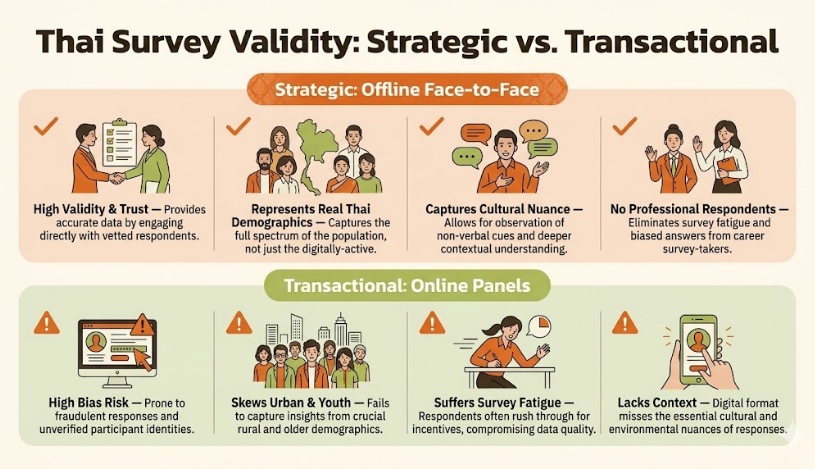
While digital tools offer convenience, methodology choice profoundly impacts data validity. Offline quantitative surveys—conducted face-to-face or via telephone—consistently outperform online panels in data quality.
Key advantages of offline methodologies:
- Higher response validity: Personal interaction reduces thoughtless clicking and satisficing behavior
- Better sample representation: Reaches demographics underrepresented online including older consumers and rural populations
- Eliminates panel bias: Avoids respondent fatigue and professional survey-takers common in online panels
- Enables deeper engagement: Trained interviewers clarify questions and maintain quality control
Phone survey companies in Thailand combine CATI (Computer-Assisted Telephone Interviewing) systems with skilled interviewers to maintain research rigor. While e survey suits quick pulse checks or transactional feedback, strategic research requiring robust validity benefits from offline methodologies that ensure genuine, representative responses.
Qualitative Research: Essential for Valid Interpretation
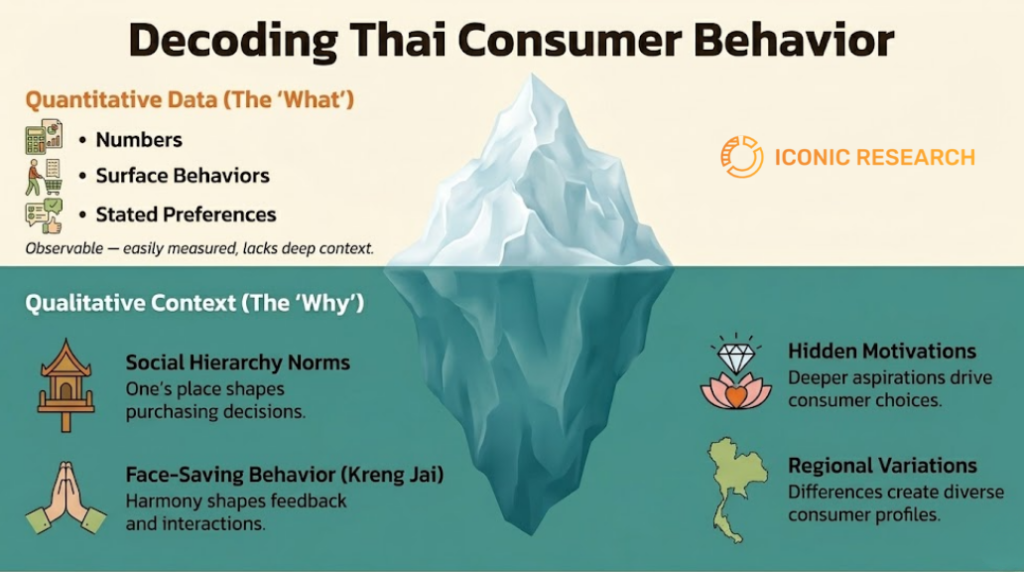
Just as the method of data collection matters, so does the depth of inquiry. Survey data without qualitative context remains incomplete and often misleading. Numbers reveal what consumers do, but qualitative methods—interviews, focus groups, ethnography—uncover why they do it.
In Thailand, qualitative depth is essential for validity. Cultural factors like social norms, face-saving behavior, and hierarchical communication shape responses in ways quantitative data alone cannot reveal. Satisfaction survey scores might not predict loyalty without cultural context. Stated preferences often diverge from observed behavior.
Iconic Research Thailand integrates qualitative insights with quantitative findings, ensuring businesses understand the full story behind the numbers. For market entry, product localization, and segmentation, qualitative research transforms raw data into strategic intelligence [4].
Digital Tools for Research Efficiency
Thailand’s digital infrastructure enables research process improvements without compromising data quality. DEPA’s Digital Density Survey shows rising adoption of cloud systems and platforms across Thai industries [5]. These technologies enhance research operations by making offline methodologies more efficient, not by replacing them.
Digital tools serve specific operational purposes: tablets enable field interviewers to record responses with built-in validation; cloud platforms facilitate data management; survey meter tools track quality during face-to-face collection; CATI systems help phone survey companies manage workflows while maintaining standards.
An e survey optimized for smartphones work well for existing customer feedback through LINE Official Accounts or loyalty programs—situations where convenience and speed matter more than sample representation. However, these digital self-service methods should supplement rather than replace offline research for strategic decisions requiring robust validity.
The distinction is critical: digital tools improve research efficiency and data processing, but face-to-face and telephone methodologies remain superior for primary data collection quality.
Applications Across Business Sectors
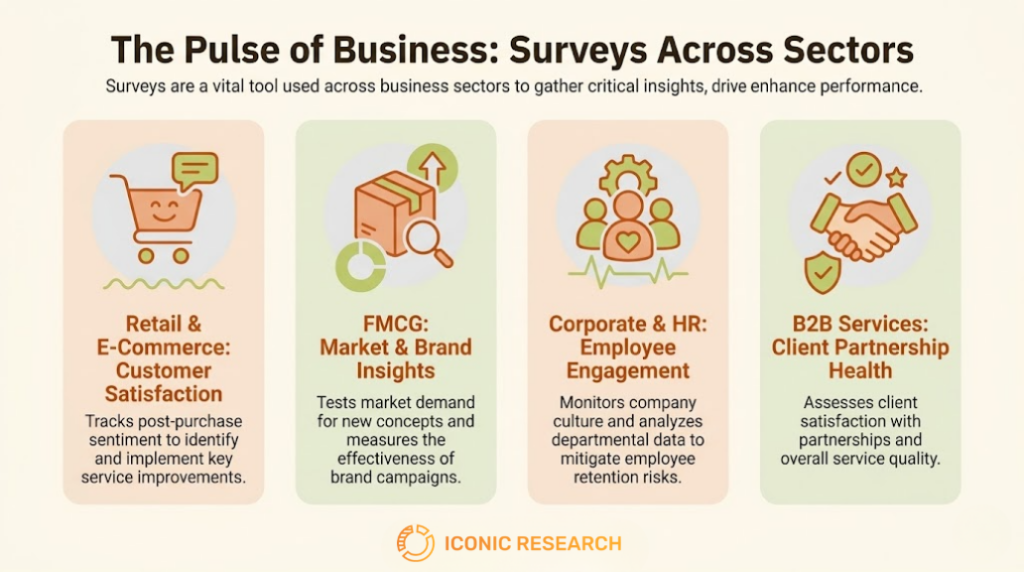
Retail & E-Commerce: Customer satisfaction surveys track post-purchase sentiment and identify service improvement opportunities across channels. For a full view of how satisfaction data connects to the broader relationship between a brand and its customers, see our guide to customer experience in Thailand.
FMCG & Consumer Goods: Market surveys reveal regional demand variations and test concepts before launch. Brand awareness surveys measure campaign effectiveness.
Corporate & HR: Employee engagement surveys monitor workplace culture, with employee survey results analyzed by department to identify retention risks and improvement priorities.
B2B Services: Client surveys assess partnership satisfaction and service quality for professional services and technology providers.
Best Practices for Survey Excellence
Sound survey methodology starts with matching the method to the decision — not to the budget or the timeline. Prioritize research quality over speed. Strategic decisions require offline quantitative methods with representative sampling, while e survey suits transactional feedback.
Avoid online panels for critical decisions. Professional panels suffer from fatigue and demographic limitations that compromise data integrity.
Integrate qualitative research systematically. Combine survey findings with interviews to ensure valid, actionable insights.
For evaluation of sales interactions and service standards that surveys cannot capture, mystery shopper programmes provide observational data from actual customer encounters.
Tailor research to specific sectors. Generic approaches miss category nuances in beauty, FMCG, or fitness.
Partner with experienced researchers who maintain rigorous standards and understand Thai consumer dynamics.
Market Survey Services from Iconic Research
Iconic Research runs market surveys across Thailand for global and Thai brands — online, face-to-face and by telephone (CATI), with nationally representative samples from Bangkok to the provinces. A typical consumer survey of 500–1,000 respondents runs four to six weeks from questionnaire design to cleaned data and summary report. Recent work includes a 1,200-respondent consumer survey across Thailand, and nationwide CATI fieldwork for a telecom operator.
See our market survey services to scope a study.
Conclusion
Surveys remain foundational for Thai market research, but methodology determines value. Offline quantitative approaches deliver the data quality strategic decisions require, while qualitative research provides cultural context that makes findings actionable. Businesses that invest in rigorous, integrated research—combining offline excellence with qualitative depth—gain competitive advantages in understanding consumers and navigating Thailand’s dynamic market landscape.
Frequently Asked Questions
What is a market survey and when should you use one?
A market survey is a structured research method used to measure demand, test concepts, track brand perception, or understand consumer behaviour in a specific market. It is the right method when a business decision requires direct data from target consumers rather than secondary published sources.
How does survey methodology differ for Thailand versus global markets?
Survey methodology in Thailand requires adjustment for cultural response patterns — acquiescence bias, face-saving norms, and regional variation between Bangkok and provincial markets. Survey Thailand data collected without these adjustments will systematically overstate satisfaction and underrepresent non-urban populations.
What is the difference between primary and secondary surveys?
Primary surveys collect new data directly from respondents, while secondary surveys analyze existing datasets like government statistics or industry reports.
Why are offline surveys better quality than online panels?
Offline surveys eliminate panel bias, respondent fatigue, and satisficing behavior while reaching representative samples including demographics underrepresented online.
How does qualitative research improve survey validity?
Qualitative insights explain the cultural context and motivations behind survey responses, ensuring data interpretation is accurate rather than misleading.
References
[1] Krungsri Research. “Thailand Industry Outlook 2025–2027.” https://www.krungsri.com/en/research/industry/summary-outlook/thailand-industry-outlook-summary-2025-2027
[2] PwC. “Voice of the Consumer Survey 2025.” https://www.pwc.com/gx/en/industries/consumer-markets/consumer-insights-survey.html
[3] National Statistical Office of Thailand. “Household Socio-Economic Survey.” http://www.nso.go.th/sites/2014en/pages/survey/household.aspx
[4] Iconic Research Thailand. “Qualitative Market Research Services.” https://iconicthai.com/services/
[5] DEPA Thailand. “2024 Digital Density Survey in Thai Industry.” https://depa.or.th/en/article-view/20250423_01
If you wish to quote any information from this article, please kindly cite the source along with the link to the original article to respect copyright. |
 |
Iconic Research Thailand Your trusted partner in market research and consulting across Thailand and Southeast Asia. Headquartered in Bangkok, we provide research-driven insights across the Philippines, Malaysia, Indonesia, Singapore, Laos, and Vietnam. We help businesses navigate Thailand's market complexities through consumer insights, market entry strategy, and trend foresight. Contact us if you have any queries! (+66)888 954 954 |
Contact us
We always looking for new and exciting opportunities. Let’s connect.
Related posts
 Growth Strategy: The Expansion Decisions That Need Evidence
Growth strategy is the set of decisions about where a company expands next. Only 25% of companies grow sustainably — the difference is evidence, not ambition.
9 min read Brand Strategy: The Decisions That Should Be Built on Evidence
Brand strategy is the set of decisions that determine how a brand competes. Those decisions only pay off when they’re built on consumer evidence — not a workshop.
11 min read Key Opinion Leader: What Thai Brands Should Research Before, During, and After a KOL Campaign
Platform metrics mislead brands choosing and measuring KOLs in Thailand. A research-first look at what to verify before, during, and after a campaign.
10 min read