

Focus Group Discussion: Strategies, Insights and Applications in Thailand
9 min readFocus group discussion (FGD) is a qualitative research method where 6–10 participants discuss products, services, or brand experiences in a session guided by a trained focus group moderator. Unlike surveys that show “what” people do, focus group discussions reveal the “why” — uncovering motivations, cultural influences, and emotional triggers that quantitative data cannot capture. In Thailand, focus group research helps businesses test products, validate concepts, and adapt marketing strategies to local consumer realities.
Table of Contents
- What Is a Focus Group Discussion?
- Advantages and Limitations of Focus Groups
- The Complete Focus Group Process
- Focus Group Moderator in Thailand: Skills That Actually Matter
- Focus Group vs In-Depth Interview: Which Does Your Research Need?
- Case Study Examples from Iconic Research Thailand
- Conclusion
- Sources
What Is a Focus Group Discussion?
A focus group discussion represents a carefully orchestrated qualitative research method where 6-10 strategically selected participants engage in guided discussions about products, services, concepts, or brand experiences. Unlike market research methodology called surveys that capture the “what” of consumer behavior, focus group discussions dive deep into the “why” – revealing motivations, cultural influences, and emotional triggers that quantitative data cannot capture.
The methodology’s strength lies in its social dynamics. Participants react to each other’s perspectives, build upon shared experiences, and often arrive at insights that wouldn’t emerge in individual interviews. This interactive element makes focus groups particularly valuable for understanding how consumers think and make decisions in real-world social contexts. When combined with in depth interviews, which explore individual motivations without group influence, researchers gain comprehensive understanding of both collective and personal consumer drivers.
Advantages and Limitations of Focus Groups
Focus group discussion offers unique benefits while carrying inherent limitations that must be considered when designing research strategies. Understanding both sides helps determine when this methodology provides the greatest value for your business objectives.
Table 1: Advantages vs. Limitations of Focus Groups
Advantages | Limitations |
Replicates real-world social influence | Small sample size – not statistically representative |
Enables real-time product/creative testing | Group dynamics may suppress minority opinions |
Generates cultural insights specific to Thai context | Requires skilled moderation (esp. with kreng jai) |
Flexible, adaptive discussion formats | Higher cost vs. surveys |
However, the limitations require careful consideration. In Thailand’s cultural context, the concept of “kreng jai” (consideration for others) can inhibit direct criticism, making skilled local moderation essential for extracting honest feedback.
The Complete Focus Group Process
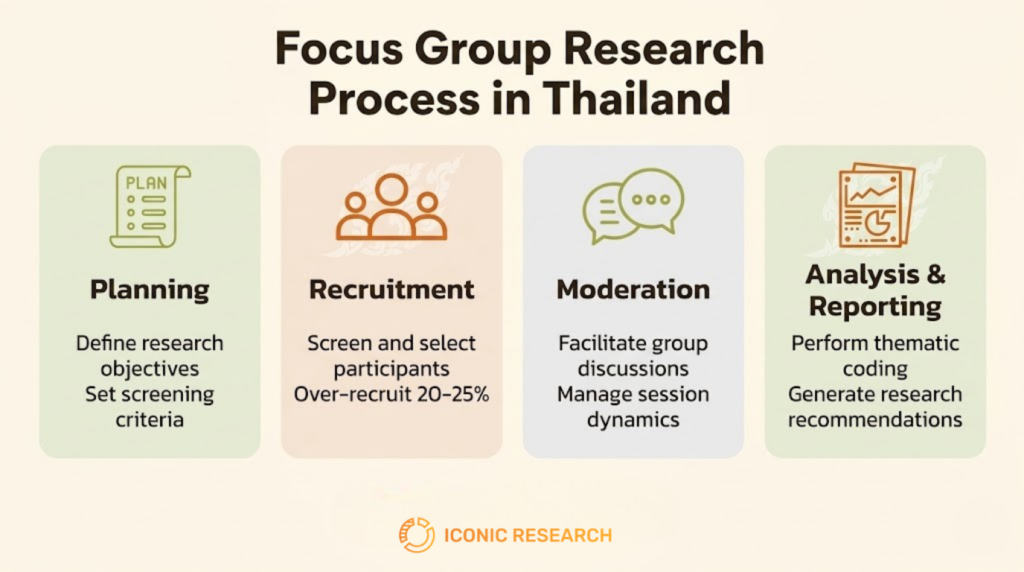
Understanding how to run a focus group discussion (FGD) effectively begins with clear objective setting and extends through comprehensive analysis and reporting.
Strategic Planning and Recruitment
Successful focus group research begins with recruiting participants who accurately represent your target market while bringing diverse perspectives to discussions. Professional recruitment involves detailed screening to ensure participants meet specific demographic, behavioral, and attitudinal criteria.
In Thailand, working with established focus group research companies provides access to carefully maintained participant databases and local market knowledge. Over-recruitment by 20-25% compensates for typical no-show rates, while appropriate incentives ensure committed participation.
How to Conduct a Focus Group Interview
Effective moderation balances structure with flexibility, creating environments where participants feel comfortable sharing honest opinions while maintaining productive group dynamics. Skilled moderators understand when to probe deeper, how to manage dominant personalities, and techniques for encouraging reserved participants to contribute.
Thai focus group moderation requires particular cultural sensitivity. Creating “safe spaces” for honest feedback often means acknowledging hierarchy within groups, using indirect questioning techniques, and reading nonverbal cues. Experienced moderators build rapport early, establish ground rules for respectful discussion, and ensure all voices are heard.
Comprehensive Analysis and Reporting
Focus group data analysis transforms hours of recorded discussion into actionable business insights. Professional analysis goes beyond simple transcription to identify recurring themes, cultural insights, emotional triggers, and practical recommendations.
A comprehensive focus group analysis report typically includes executive summaries, detailed findings organized by research objectives, participant quotes that illustrate key points, and specific recommendations for business action.
Focus Group Moderator in Thailand: Skills That Actually Matter
A focus group moderator does more than run a discussion — they determine whether participants say what they actually think or what they think you want to hear. In Thailand’s research environment, that gap can be significant.
We work with experienced moderators across disciplines. Beyond our in-house team, we engage specialist moderators for sectors where the dynamics of the room are fundamentally different:
Healthcare research involves patients, caregivers, and clinicians who require a moderator fluent in medical context and sensitive to disclosure boundaries — participants often hold back not from kreng jai but from genuine privacy concerns and stigma around diagnosis and treatment.
Automotive sessions — particularly car clinics and dealer experience research — require moderators who understand technical product evaluation, can navigate the gap between what buyers say drives their decision and what actually does, and are familiar with how Japanese and European OEM standards shape the research brief.
Public and social research brings together participants across education levels, regions, and sometimes political sensitivities. Moderators here need to create environments where people without business or research experience speak as honestly as those who do — and where community dynamics don’t suppress the voices most relevant to the research question.
All sessions are conducted in Thai by native speakers, with bilingual analysis and reporting for international clients.
Focus Group vs In-Depth Interview: Which Does Your Research Need?
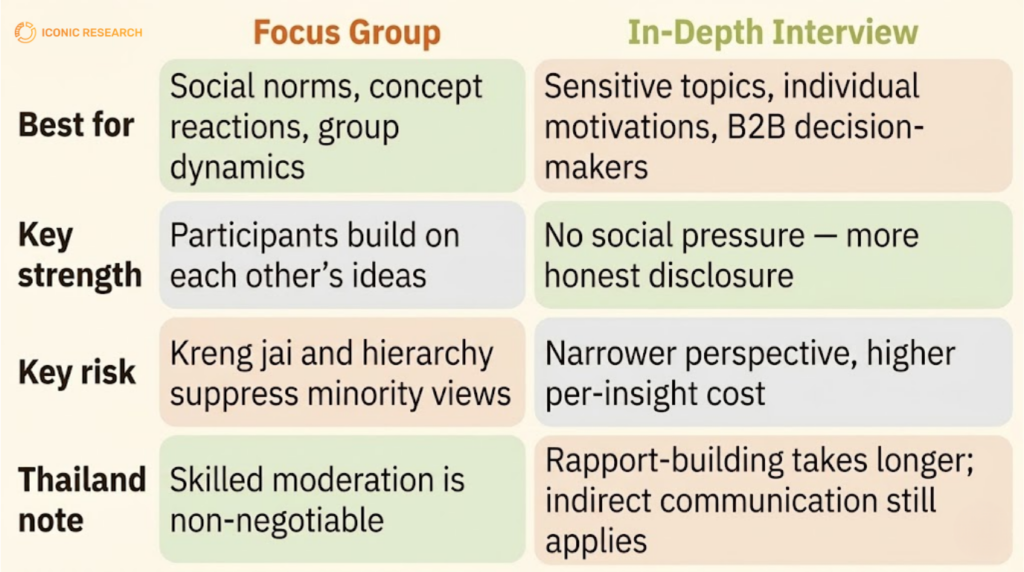
Choose a focus group discussion when group reaction is itself the data — brand perception, concept testing, shared consumer experiences. Choose in-depth interviews when the topic is sensitive, when participants won’t speak honestly in front of peers, or when you’re researching expert decision-makers.
The strongest qualitative research designs combine both: focus groups to map the landscape, in-depth interviews to go deeper on what the groups surface.
For a complete overview of qualitative and quantitative data collection methods in Thailand, including when each applies, see our data collection guide.
Case Study Examples from Iconic Research Thailand
🎵 Exploring Everyday Listening Habits
A global audio platform needed deeper understanding of how young Thai audiences connect with music in personal moments. Through four carefully designed focus groups, we explored listening routines, emotional drivers, and reactions to creative concepts. Participants shared intimate details about when, where, and why they choose specific music, revealing opportunities for the platform to position itself more meaningfully in daily life contexts. The insights directly informed content curation strategies and user experience improvements.
💳 Brand Positioning in the Payment Sector
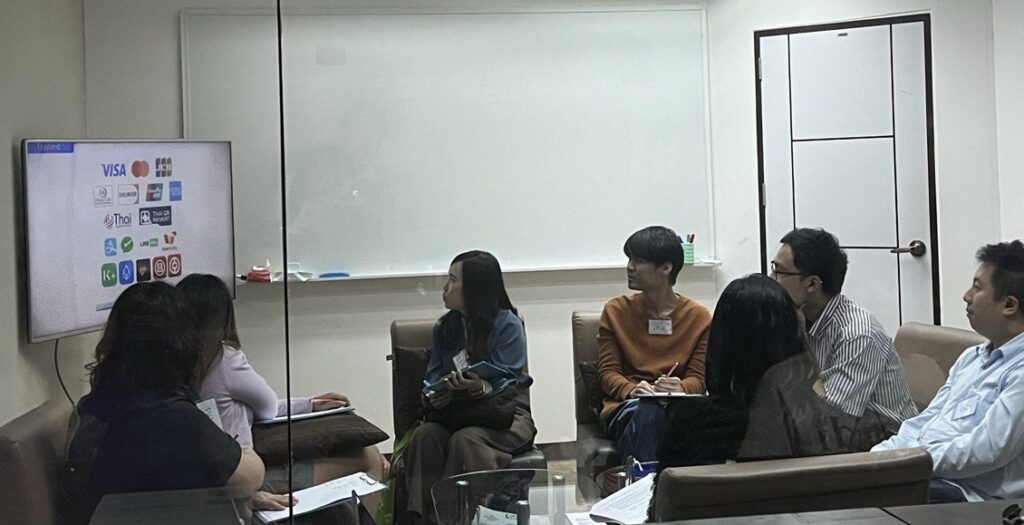
A leading payments company faced intense competition in Southeast Asia’s crowded digital payment market. Our deep-dive focus groups in Thailand and Singapore included participants across different life stages, all active digital payment users. By combining reflective pre-tasks with localized group discussions, we uncovered the real drivers of trust and choice in payment methods. These findings directly shaped the client’s brand identity, logo development, and messaging strategy, ensuring resonance across different cultural contexts and consumer segments.
🏠 Understanding Thai Real Estate Market Dynamics
An online property platform wanted sharper insights into evolving buyer preferences in Thailand’s changing real estate market. Through mini-group discussions and complementary in-depth interviews with active home seekers, we mapped complex decision-making factors including location preferences, price sensitivity, and growing demand for co-living spaces. The client used these insights to enhance platform features, introducing improved property comparison tools and richer virtual tour experiences that addressed specific user needs identified through our research.
Conclusion
Focus group discussions work in Thailand when the moderation, recruitment, and cultural context are right — and fail quickly when they’re not. The methodology surfaces what surveys can’t, but only if kreng jai is read and worked around, not ignored.
Frequently Asked Questions
What is a focus group discussion in market research?
A focus group discussion is a qualitative research method involving 6-10 participants in guided discussions about products, services, or concepts to uncover deep consumer insights and motivations.
What are the main advantages of focus groups?
Key advantages include replicating real-world social influence, enabling real-time product testing, generating cultural insights specific to Thailand, and offering flexible discussion formats.
How much do focus groups cost in Thailand?
Focus group costs vary based on scope, participant requirements, and facilities needed. The investment typically pays for itself through prevented market mistakes and improved product development.
Can a focus group discussion be conducted online?
Yes, modern focus groups include online and hybrid formats that maintain group dynamics while enabling participation from across Thailand's diverse regions.
What's the difference between focus groups and surveys?
Focus groups explore the "why" behind consumer behavior through in-depth discussions, while surveys capture the "what" through quantitative data. Both methods complement each other.
What makes Thai focus group discussions different?
Thai focus groups require cultural sensitivity around concepts like "kreng jai" (consideration for others), indirect communication styles, and hierarchy awareness to encourage honest feedback.
How are focus group participants recruited?
Professional recruitment involves detailed screening to ensure participants meet specific demographic, behavioral, and attitudinal criteria, with over-recruitment to compensate for no-shows.
Sources
[1] Focus Group – an overview | ScienceDirect Topics https://www.sciencedirect.com/topics/psychology/focus-group
[2] Focus Groups and the Nature of Qualitative Marketing Research | JSTOR https://www.jstor.org/stable/3150774
[3] The Role Of Market Research Focus Groups – Andrew Reise Consulting https://www.andrewreise.com/insights/the-role-of-market-research-focus-group
[4] How to Run a Focus Group: 5 Tips for Conducting Successful Sessions | StudioQual https://www.studioqual.com/blog/how-to-run-a-focus-group
[5] Excelling in business communication in Thailand | Focus Audit Tool https://focusaudits.eu/excelling-in-business-communication-in-thailand-a-guide-to-cultural-appropriateness/
If you wish to quote any information from this article, please kindly cite the source along with the link to the original article to respect copyright. |
 |
Iconic Research Thailand Your trusted partner in market research and consulting across Thailand and Southeast Asia. Headquartered in Bangkok, we provide research-driven insights across the Philippines, Malaysia, Indonesia, Singapore, Laos, and Vietnam. We help businesses navigate Thailand's market complexities through consumer insights, market entry strategy, and trend foresight. Contact us if you have any queries! (+66)888 954 954 |
Contact us
We always looking for new and exciting opportunities. Let’s connect.
Related posts
 Growth Strategy: The Expansion Decisions That Need Evidence
Growth strategy is the set of decisions about where a company expands next. Only 25% of companies grow sustainably — the difference is evidence, not ambition.
9 min read Brand Strategy: The Decisions That Should Be Built on Evidence
Brand strategy is the set of decisions that determine how a brand competes. Those decisions only pay off when they’re built on consumer evidence — not a workshop.
11 min read Key Opinion Leader: What Thai Brands Should Research Before, During, and After a KOL Campaign
Platform metrics mislead brands choosing and measuring KOLs in Thailand. A research-first look at what to verify before, during, and after a campaign.
10 min read