

Singapore Market Research: The Gateway Market and What It Actually Tells You
9 min readSingapore market research is Southeast Asia’s most researched market and its most misleading regional proxy. GDP per capita of nearly $99,000, 95.8% internet penetration, and a highly educated, English-fluent population make it the natural first stop for international brands entering ASEAN. It is also the market least representative of the 680 million consumers in the region around it. What Singapore research tells you — and what it cannot — is the strategic question every regional entry brief should answer before fieldwork begins.
Table of Contents
- Singapore at a Glance
- The Singaporean Consumer
- What the Gateway Assumption Gets Wrong
- Key Research Considerations for Singapore
- Working with a Research Partner for Singapore
- References
Singapore is where most ASEAN market research programmes begin and where most regional assumptions are formed. International businesses establish regional headquarters here, test products here, and read Singapore consumer signals as proxies for broader Southeast Asian behaviour. The Singapore market research brief is rarely just about Singapore. It is about what Singapore is being asked to predict — and whether that prediction is warranted. Understanding the difference between Singapore as a market and Singapore as a gateway is the starting point for regional research strategy.
Singapore at a Glance
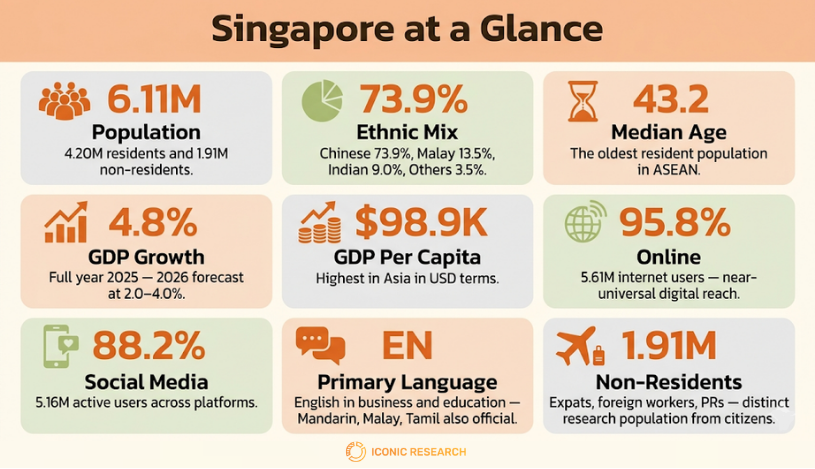
Facts only [1][2][4]:
- Total population: 6.11 million (June 2025) — residents 4.20 million, non-residents 1.91 million [1].
- Ethnic composition (residents): Chinese 73.9%, Malay 13.5%, Indian 9.0%, Others 3.5% [1].
- Median age: 43.2 years — the oldest resident population in ASEAN [1].
- GDP growth: 4.8% full year 2025 [4]. GDP growth forecast: 2.0–4.0% in 2026 [4].
- GDP per capita: $98,878 USD (2025) — highest in Asia [3].
- Language: English (primary business and education language), Mandarin, Malay, Tamil. Research instruments can run in English for most demographics.
- Digital penetration: 5.61 million internet users, 95.8% of the population [2]. 5.16 million social media users, 88.2% penetration [2].
- Key economic sectors: financial services, trade and logistics, advanced manufacturing, technology, biomedical sciences, and regional headquarters for multinational corporations.
- Non-resident population: 1.91 million — expatriates, foreign workers, and permanent residents. A distinct research population with different consumption patterns from Singapore citizens.
The Singaporean Consumer
Singapore consumer trends are shaped by three forces that operate simultaneously and differently from every other ASEAN market: extreme affluence, ethnic plurality, and a non-resident population that constitutes nearly a third of the total headcount.
The Gateway vs The Market
Singapore’s consumer base of 6.11 million is smaller than metropolitan Jakarta, Kuala Lumpur, or Manila. International brands that validate in Singapore and project ASEAN-wide are drawing regional conclusions from a market that represents less than 1% of the region’s population — and the wealthiest, most digitally connected, most English-fluent 1% at that. Singapore consumer behaviour is a signal about premium urban ASEAN consumers. It is not a signal about ASEAN consumers.
Ethnic Plurality in a Small Population
Singapore’s resident ethnic composition — Chinese 73.9%, Malay 13.5%, Indian 9.0% — produces research dynamics distinct from Malaysia, where the same three communities exist in different proportions and with different political and economic contexts. For categories with halal requirements, the Malay Muslim community requires specific research treatment despite representing 13.5% of residents. Ethnic quota sampling in Singapore requires careful design given the small base.
The Ageing Consumer
A median age of 43.2 years is the oldest in ASEAN and rising [1]. Singapore’s consumer base skews significantly older than its regional neighbours — relevant for healthcare, financial services, retirement planning, and premium lifestyle categories. Research designs built on younger demographic assumptions imported from other ASEAN markets misrepresent Singapore’s actual purchase decision-makers.
The Expat and Non-Resident Layer
1.91 million non-residents — nearly a third of Singapore’s total population — are a distinct research population. Expatriate professionals in financial services and technology have consumption patterns, brand relationships, and aspirations that differ significantly from Singapore citizens. Research that does not specify which population it is measuring produces aggregate findings that represent no specific group accurately.
What the Gateway Assumption Gets Wrong
Singapore as a Regional Proxy
The most common Singapore market research error is not methodological — it is strategic. Singapore findings are used to justify regional rollout decisions. A product that performs with affluent, digitally connected, English-fluent Singapore consumers may perform very differently with the broader consumer bases of Indonesia, Vietnam, or Thailand. Singapore’s GDP per capita is approximately 70 times that of Vietnam and 30 times that of Indonesia. Consumer behaviour research conducted in Singapore does not travel reliably down the income curve.
The Premium Market Ceiling
Singapore consumer trends skew premium. Willingness to pay, brand sensitivity, packaging expectations, and quality thresholds validated in Singapore consistently overestimate the ASEAN-wide addressable market. Pricing research conducted only in Singapore produces price points that exclude the majority of regional consumers.
Singapore Ecommerce as an ASEAN Benchmark
Singapore ecommerce penetration and consumer behaviour are more advanced than the regional average. Shopee and Lazada usage patterns, delivery expectations, and digital payment adoption in Singapore are not representative of Vietnam, Indonesia, or the Philippines. Treating Singapore as an ecommerce benchmark for ASEAN produces digital channel strategies that are ahead of where most of the region’s consumers actually are.
The English Assumption
Singapore operates in English. ASEAN does not. Qualitative research conducted in English in Singapore produces findings that reflect English-language consumer framing — relevant for other English-fluent markets but not directly transferable to Vietnamese, Indonesian, or Bahasa Malaysia-language consumer contexts.
Key Research Considerations for Singapore
Defining Which Singapore You Are Researching
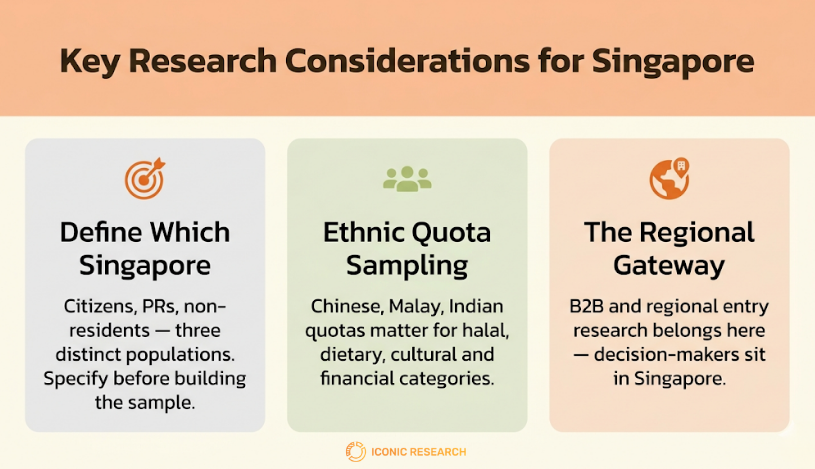
Citizen residents, permanent residents, or non-residents — these are three distinct populations with different consumption profiles. Every Singapore research brief should define the target population precisely before the sampling frame is built. Quantitative research that mixes groups in uncontrolled proportions produces findings that represent no group accurately.
Ethnic Quota Sampling
Singapore’s small resident population requires careful quota sampling across Chinese, Malay, and Indian communities for category research where ethnicity is relevant — halal, dietary, cultural occasions, and financial products all require ethnic segment-specific design.
The Gateway Research Programme
Singapore’s genuine research value for international businesses is not only as a consumer endpoint but as a regional intelligence hub. Qualitative research with Singapore-based regional business decision-makers — buyers, procurement leads, category managers at regional headquarters — produces a different and equally valuable brief from consumer research. For B2B categories and regional market entry strategy, Singapore is the right research location precisely because regional decision-making happens here.
For qualitative research design specifically — including multicultural group composition, ethnic quota sampling, and ASEAN-wide programme coordination from Singapore — see Focus Group Singapore.
Multi-Country Coordination
Singapore is frequently the strategic anchor of a broader ASEAN research programme — the market where regional findings are synthesised and presented to headquarters.
In practice, this means coordinating research programmes spanning Indonesia, Vietnam, Malaysia, and the Philippines — with Singapore-based teams receiving, synthesising, and presenting regional findings to international headquarters.
For clients building regional intelligence, Singapore findings are most valuable when read alongside — not instead of — parallel studies across the ASEAN cluster. That comparability is a design decision made at briefing, not something that can be retrofitted after fieldwork.
Working with a Research Partner for Singapore
International businesses researching Singapore need a partner who understands both the market and its regional role. The relevant questions: Can the agency design research that distinguishes between citizen, permanent resident, and non-resident populations? Do they understand Singapore’s function as a regional headquarters market — and the research implications of that? Can they connect Singapore findings to parallel studies across ASEAN?
Iconic Research coordinates international market research programmes through a long-term local research partnership in Singapore — established, multi-industry, and built specifically around the Singapore-as-hub model. Research is designed and executed with our Singapore partner, and delivered as part of unified regional findings where relevant.
Whether the brief is Singapore-only or Singapore as part of a broader ASEAN rollout, the methodology is built to make findings travel. See fieldwork and recruitment for how we structure in-country execution.
Frequently Asked Questions
What does market research in Singapore involve?
Defining which population — citizens, permanent residents, or non-residents — then designing ethnic quota sampling where relevant. Determining what the findings will be used to decide: Singapore-only strategy or regional rollout.
Can Singapore research predict ASEAN consumer behaviour?
Partially. Singapore findings reliably signal premium, digitally advanced, English-fluent urban ASEAN behaviour. They do not reliably predict behaviour across the income distribution, language diversity, or cultural complexity of Indonesia, Vietnam, or the Philippines.
What does doing business in Singapore require from a research perspective?
Understanding which Singapore consumer you are targeting — citizen, expatriate professional, or non-resident — and whether Singapore is a consumer endpoint or a gateway for broader ASEAN strategy.
Does Iconic Research conduct fieldwork in Singapore?
Yes — through a long-term local research partnership in Singapore, coordinated from Bangkok, covering consumer research, B2B research, and multi-country ASEAN programme debrief.
What sectors does Iconic Research cover in Singapore?
Financial services, technology, healthcare and biomedical, FMCG premium segments, and B2B research for international brands using Singapore as their ASEAN headquarters base.
References
[1] Singapore Department of Statistics (2025). Population Trends 2025. https://www.singstat.gov.sg/-/media/files/publications/population/population2025.ashx
[2] We Are Social / Meltwater (2025). Digital 2025: Singapore. https://datareportal.com/reports/digital-2025-singapore
[3] CEIC / Singapore Department of Statistics (2025). Singapore GDP Per Capita 2025. https://www.ceicdata.com/en/indicator/singapore/gdp-per-capita
[4] Ministry of Trade and Industry Singapore (February 2026). Economic Survey of Singapore 2025. https://www.mti.gov.sg/resources/economic-survey-of-singapore/economic-survey-of-singapore-and-feature-articles/economic-survey-of-singapore-2025/
[5] Iconic Research. Qualitative Market Research. https://iconicthai.com/services/qualitative-market-research/
If you wish to quote any information from this article, please kindly cite the source along with the link to the original article to respect copyright. |
 |
Iconic Research Thailand Your trusted partner in market research and consulting across Thailand and Southeast Asia. Headquartered in Bangkok, we provide research-driven insights across the Philippines, Malaysia, Indonesia, Singapore, Laos, and Vietnam. We help businesses navigate Thailand's market complexities through consumer insights, market entry strategy, and trend foresight. Contact us if you have any queries! (+66)888 954 954 |
Contact us
We always looking for new and exciting opportunities. Let’s connect.
Related posts
 Growth Strategy: The Expansion Decisions That Need Evidence
Growth strategy is the set of decisions about where a company expands next. Only 25% of companies grow sustainably — the difference is evidence, not ambition.
9 min read Brand Strategy: The Decisions That Should Be Built on Evidence
Brand strategy is the set of decisions that determine how a brand competes. Those decisions only pay off when they’re built on consumer evidence — not a workshop.
11 min read Key Opinion Leader: What Thai Brands Should Research Before, During, and After a KOL Campaign
Platform metrics mislead brands choosing and measuring KOLs in Thailand. A research-first look at what to verify before, during, and after a campaign.
10 min read