
Business Model: What It Is, How It Works, and How Research Strengthens It
11 min readBusiness model defines how a company creates value for customers and captures a share of that value as revenue. Every company has one — whether it was designed deliberately or emerged by accident. Deliberate design means testing assumptions before committing resources. Accidental emergence means discovering what works only after absorbing the cost of what does not. For businesses entering Thailand or expanding across ASEAN, the business model is the starting point — but only if each component is built on local evidence rather than assumptions carried over from other markets.
Table of Contents
- What Is a Business Model?
- Types of Business Models
- What Is a Business Model Canvas?
- The Core Problem — Assumptions vs. Evidence
- The 9 Blocks — What You Assume vs. What Research Reveals
- How to Prioritise — Not Every Block Needs Research Immediately
- Business Models in the Thai Market Context
- Conclusion
- References
Validating a business model before committing capital requires research — not assumptions. The customer segments block, the value proposition block, and the revenue streams block are the three most commonly wrong because they are the three most commonly built on hope rather than evidence. A business model built on assumptions looks rigorous on paper and fails in the market. Replacing those assumptions with primary research is what separates a canvas that survives market contact from one that does not.
What Is a Business Model?
A business model answers three questions: what do we offer, who do we offer it to, and how do we make money doing it. The difference between a good one and a failed one is rarely the idea — it is whether the answers were built on evidence or assumption.
Types of Business Models
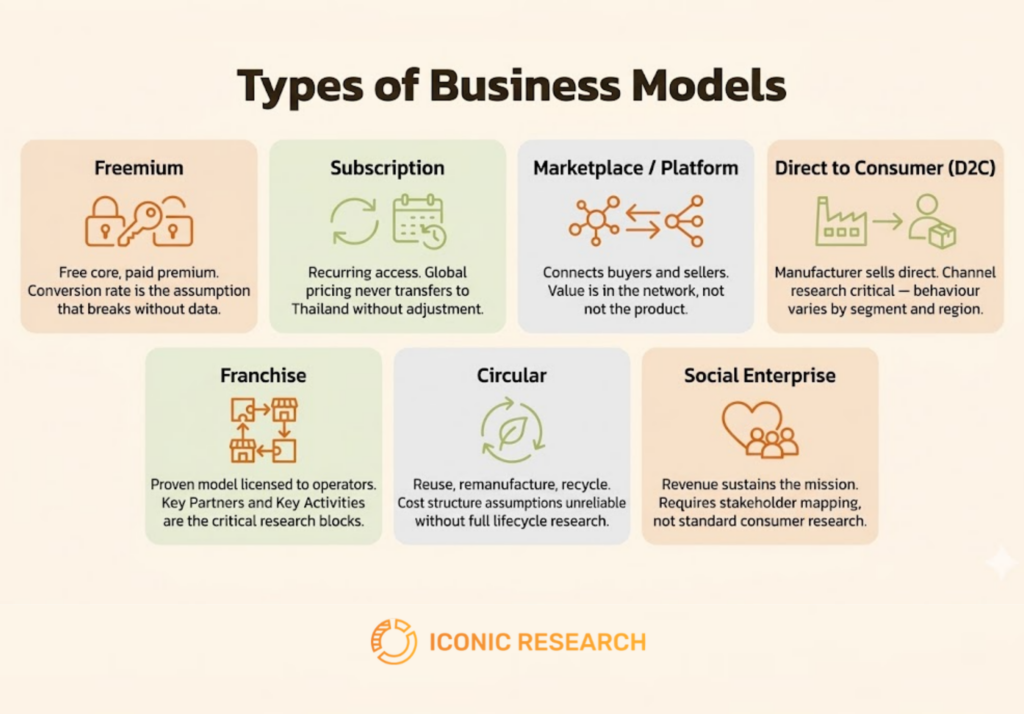
Business models differ fundamentally in how value is created and captured. The main types relevant to businesses operating in Thailand and ASEAN:
Freemium — the core product is free, premium features are paid. Works when research identifies which features create enough value to convert free users. Used by LINE, Canva, and Spotify. The conversion rate assumption is the block that most often fails without data.
Subscription — recurring revenue for ongoing access. Netflix, SaaS platforms, and streaming services operate on this model. Requires willingness-to-pay research by market — global pricing rarely transfers to Thailand without adjustment, as Netflix’s own Thailand launch demonstrated.
Marketplace / Platform — connects buyers and sellers and takes a commission or fee. Lazada, Shopee, and Grab built their models on network effects rather than owned inventory. Value is in the network, not the product — which means the Key Partners block carries more strategic weight than in most other model types.
Direct to Consumer (D2C) — manufacturer sells directly, cutting out distributors. Growing in Thailand as e-commerce reduces the cost of channel ownership. Channel research is critical here — Thai consumers’ discovery and purchase behaviours vary significantly by segment and region.
Franchise — a proven model licensed to operators. CP Group’s 7-Eleven operation is the clearest Thai example at scale. The Key Partners and Key Activities blocks become the most critical research areas — the model only works if franchisee behaviour and operational standards can be consistently maintained.
Circular business model — products designed for reuse, remanufacture, or recycling. Growing in relevance as ESG compliance requirements increase across ASEAN supply chains [6]. Cost structure assumptions are particularly unreliable here without research into supplier and customer behaviour across the full product lifecycle.
Social enterprise business model — value creation is social or environmental, and revenue sustains the mission rather than maximising profit. Requires stakeholder mapping and social impact research rather than standard consumer research — the partners and beneficiaries are often the same people, which changes how every canvas block is defined.
A social enterprise business model canvas — sometimes called a social business model canvas — adapts the standard nine-block framework to make mission, beneficiaries, and impact measurement explicit alongside commercial revenue streams.
What Is a Business Model Canvas?
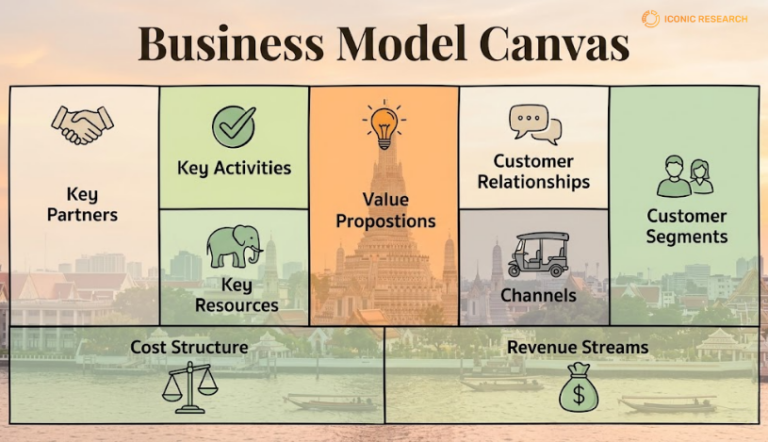
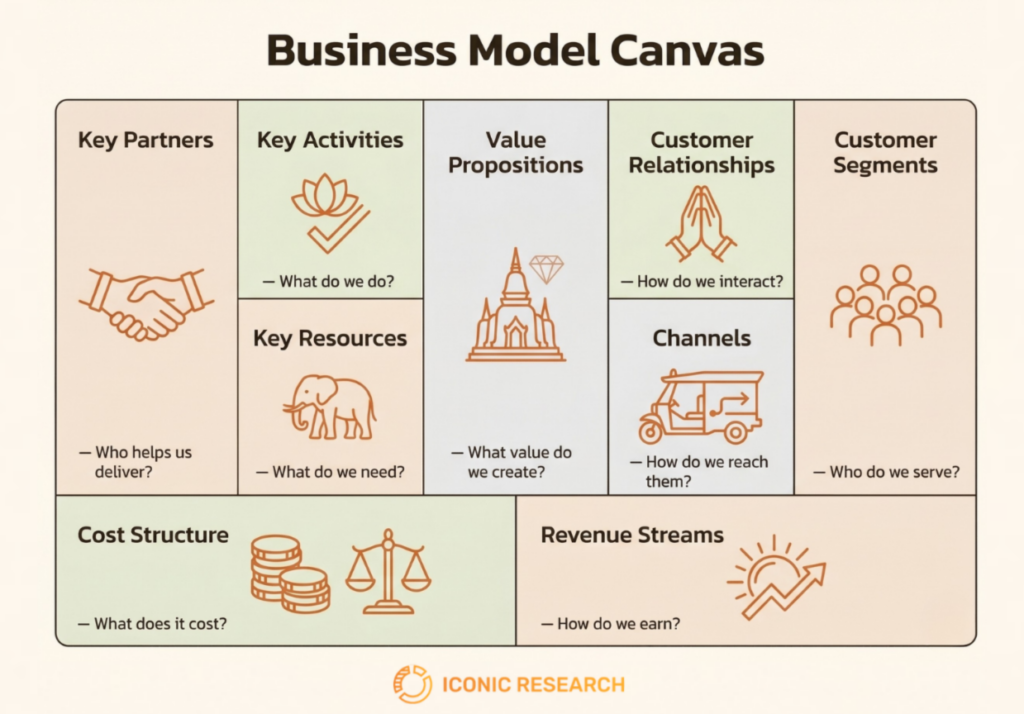
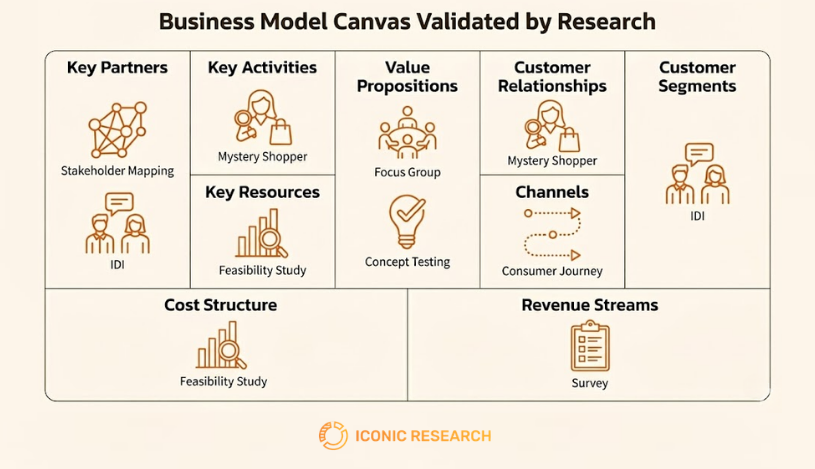
The business model canvas is a visual framework with nine components of a business model: Customer Segments, Value Propositions, Channels, Customer Relationships, Revenue Streams, Key Resources, Key Activities, Key Partners, and Cost Structure. Each block maps a different dimension of how the business operates and how value flows between the company and its customers. A lean business model canvas simplifies this further for early-stage startups — stripping it to the highest-risk assumptions before infrastructure exists to test the rest. The nine-block version remains the standard for established and growth-stage businesses assessing market entry, product expansion, or business model innovation.
The Core Problem — Assumptions vs. Evidence
Every block in the canvas is a hypothesis. Customer Segments is a hypothesis about who will buy. Value Propositions is a hypothesis about why they will choose you. Channels is a hypothesis about how they want to be reached. The canvas is not a strategy — it is a structured set of bets. Reinventing business models happens when companies test those bets against reality and redesign based on what they find.
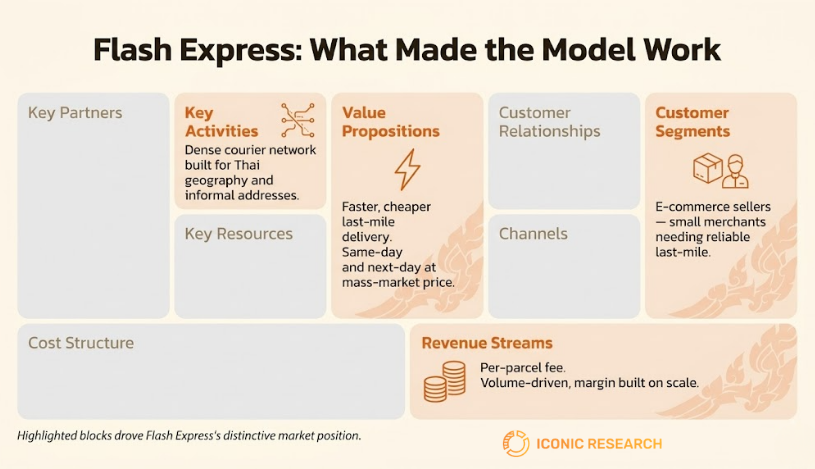
Flash Express did not invent logistics. They tested the hypothesis that Thai e-commerce sellers needed faster, cheaper last-mile delivery than existing providers offered — and built their entire model around what the data confirmed [2]. The canvas gave them the structure. Evidence gave them the business model that worked.
The 9 Blocks — What You Assume vs. What Research Reveals
Work through each block below. For each one, the assumption is what most teams write down. The evidence is what research provides.
1. Customer Segments
Who your business creates value for.
Segmentation research identifies who actually buys, what distinguishes high-value segments from low-value ones, and which segments are underserved. In-depth interviews are the most reliable method for validating segment assumptions before quantitative research scales them. CP Group maps mass-market consumers, B2B food service clients, and franchise operators as distinct segments — each with different pricing sensitivities and channels [3].
2. Value Propositions
Why customers choose you over alternatives.
Focus group discussions test whether a value proposition resonates before concept testing quantifies it. Both reveal which elements of your offer customers genuinely value versus which ones you assume they value. Starbucks’ value proposition in Thailand is not coffee — research consistently shows it is a social environment and status signal.
3. Channels
How you reach and deliver to your customer segments.
Customer journey research maps where customers actually discover, evaluate, and purchase in your category. In Thailand this varies dramatically by segment — rural consumers rely on local trade stores and LINE recommendations; urban consumers discover via Instagram but purchase through Lazada or Shopee. Assuming one channel fits all segments is one of the most common and costly canvas mistakes.
4. Customer Relationships
The type of relationship you establish with each segment.
Qualitative research and customer experience audits reveal what customers actually experience versus what the brand believes it delivers. Grab Thailand built its early growth on the insight that Thai passengers did not trust metered taxis — the relationship block required transparency and accountability, not just convenience.
5. Revenue Streams
How the business generates income from each segment.
Pricing studies and willingness-to-pay research using Van Westendorp or Gabor-Granger methodology reveal what customers will actually pay. Netflix’s revenue model in Thailand required local pricing research — global subscription rates were too high for Thai consumer willingness-to-pay at launch [4].
6. Key Resources
The most important assets required to make the business work.
Feasibility research and market sizing determine whether the addressable market justifies the resource investment before capital is committed.
7. Key Activities
The most important things the company must do to operate.
Mystery shopping programmes reveal where key activities break down in execution — what actually happens when no manager is watching is a research question, not a management assumption.
8. Key Partners
The network of suppliers and partners that make the business model work.
Stakeholder mapping identifies who actually influences your customers’ decisions — the contractors, pharmacists, and LINE group admins that standard partner analysis misses.
9. Cost Structure
The most important costs incurred operating the business model.
Feasibility study research and competitive intelligence reveal true cost benchmarks — what competitors actually spend on customer acquisition and retention, not what you estimate.
How to Prioritise — Not Every Block Needs Research Immediately
Start with Customer Segments and Value Propositions — these are the blocks most likely to contain the assumptions that will invalidate everything else. If you do not know who your customer is and why they will choose you, the remaining seven blocks are built on sand.
Channels and Revenue Streams come next. These are the blocks where Thai market dynamics most frequently diverge from global benchmarks — channel preference, price sensitivity, and payment behaviour all require local primary research rather than assumptions imported from other markets.
Key Resources, Key Activities, and Cost Structure can be refined as the model develops. The goal is not perfect information before you start — it is replacing your highest-risk assumptions with evidence before you commit significant resources to them.
Business Models in the Thai Market Context
Filling the canvas for a Thailand market entry or a Thai business requires local data, not global benchmarks. Consumer behaviour, channel preferences, price sensitivity, and partnership dynamics in Thailand differ significantly from Western markets and from other ASEAN markets [5]. CP Group’s canvas looks nothing like Amazon’s despite both being in retail — the Key Partners block alone reflects decades of understanding how Thai supply chains, franchise relationships, and family business networks actually operate. Business model examples from global companies provide useful structural reference but cannot substitute for Thailand-specific research in any block that touches Thai consumer or trade behaviour.
Conclusion
The business model is the most important document a company produces before market entry — and the most commonly built on assumption rather than evidence. The three blocks to research first are always the same: who is buying, why they choose you, and what they will pay. Get those wrong and the remaining six blocks are executing the wrong strategy efficiently.
Frequently Asked Questions
What is a business model?
A business model defines how a company creates value for customers and captures a share of that value as revenue. It answers three questions: what do we offer, who do we offer it to, and how do we make money doing it.
What are the 9 components of a business model canvas?
Customer Segments, Value Propositions, Channels, Customer Relationships, Revenue Streams, Key Resources, Key Activities, Key Partners, and Cost Structure. Each block represents a different dimension of how the business operates and how value flows between the company and its customers.
What is the difference between a business model and a business plan?
A business model describes the logic of how a company creates and captures value — it fits on one page. A business plan is a detailed operational document covering financials, timelines, and execution. Most investors review the business model canvas before the business plan because it reveals strategic clarity before operational detail.
What is a lean business model canvas?
A lean business model canvas is a simplified variant of the nine-block framework designed for early-stage startups. It focuses on the highest-risk assumptions — problem, solution, unique value proposition, and customer segments — before infrastructure exists to address the full canvas.
How do you validate a business model canvas?
By replacing each assumption with evidence from primary research. Customer Segments requires segmentation and interview research. Value Propositions requires concept testing and focus groups. Revenue Streams requires pricing and willingness-to-pay studies. The goal is not to fill every block with certainty before launching — it is to replace the assumptions most likely to invalidate the model before committing resources to them.
References
[1] Osterwalder, A. & Pigneur, Y. Business Model Generation. Wiley, 2010. https://www.strategyzer.com/library/business-model-generation
[2] Techsauce. “Flash Express: How Thailand’s homegrown logistics startup disrupted the market.” https://techsauce.co/en/tech-and-biz/flash-express-thailand-logistics
[3] CP Group. Corporate overview and business divisions. https://www.cpgroupglobal.com/en/about
[4] The Thaiger. “Netflix Thailand pricing and subscription changes.” https://thethaiger.com/technology/netflix-thailand
[5] Bain, Google & Temasek. “e-Conomy SEA 2024.” https://www.bain.com/insights/e-conomy-sea-2024/
[6] Ellen MacArthur Foundation. “Circular Economy Introduction.” https://ellenmacarthurfoundation.org/topics/circular-economy-introduction/overview
If you wish to quote any information from this article, please kindly cite the source along with the link to the original article to respect copyright. |
 |
Iconic Research Thailand Your trusted partner in market research and consulting across Thailand and Southeast Asia. Headquartered in Bangkok, we provide research-driven insights across the Philippines, Malaysia, Indonesia, Singapore, Laos, and Vietnam. We help businesses navigate Thailand's market complexities through consumer insights, market entry strategy, and trend foresight. Contact us if you have any queries! (+66)888 954 954 |
Contact us
We always looking for new and exciting opportunities. Let’s connect.
Related posts
 Growth Strategy: The Expansion Decisions That Need Evidence
Growth strategy is the set of decisions about where a company expands next. Only 25% of companies grow sustainably — the difference is evidence, not ambition.
9 min read Brand Strategy: The Decisions That Should Be Built on Evidence
Brand strategy is the set of decisions that determine how a brand competes. Those decisions only pay off when they’re built on consumer evidence — not a workshop.
11 min read Key Opinion Leader: What Thai Brands Should Research Before, During, and After a KOL Campaign
Platform metrics mislead brands choosing and measuring KOLs in Thailand. A research-first look at what to verify before, during, and after a campaign.
10 min read