

Target audience is the question every business faces before launch, before a campaign, before a product brief: who is this actually for? A target audience is the specific group of people most likely to buy, use, or respond to what you offer. But there are three different ways businesses answer that question — and most are using the wrong one.
Table of Contents
- What Is a Target Audience?
- Three Ways to Answer “Who Is My Target Audience?”
- Why Most Target Audience Definitions Are Wrong
- Where It Gets Complicated — B2B
- Defining Your Target Audience in Thailand
- How to Find Your Target Audience Through Research
- References
What Is a Target Audience?
A target audience is the specific group of people most likely to buy, use, or respond to what you offer — defined by shared characteristics: demographic, psychographic, behavioral, or geographic. It is not everyone who could theoretically benefit. It is the segment worth prioritising.
Target audience and target market are related but distinct. Target market is the broader category — all potential buyers of a product type. Target audience is the actionable segment within that market: the specific people you are speaking to right now, with this campaign, this message, this product configuration [1]. A target market might be “Thai households with children under 12.” A target audience within that market might be “urban mothers aged 28–40 in Bangkok and Chiang Mai who prioritise ingredient transparency in food purchasing.”
The precision matters because vague definitions produce vague strategies. A target audience definition that could apply to half the population is not a definition — it is an avoidance of one.
Three Ways to Answer “Who Is My Target Audience?”
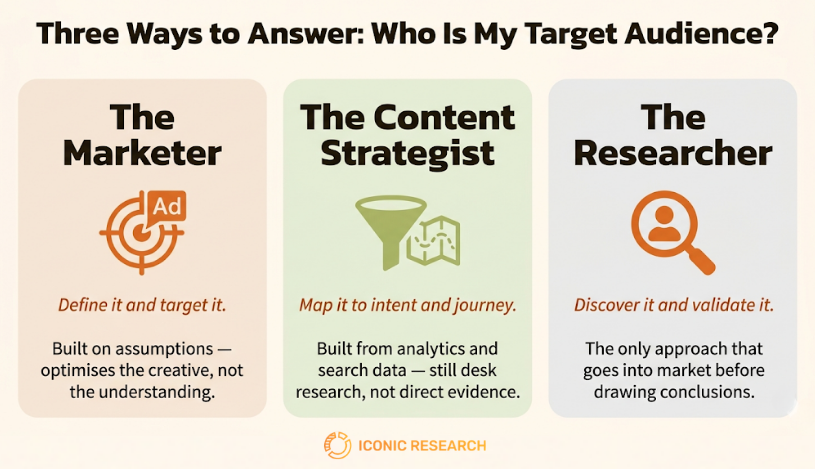
The Marketer’s Answer — Define It and Target It
In advertising and media planning, target audience is an input. You construct a profile — age range, gender, income bracket, interests — load it into Meta Ads Manager or Google Ads, and reach it. Fast, operational, and necessary for campaign execution.
The problem is structural: it is built on assumptions. You are targeting who you think your customer is, not who they actually are. When those assumptions are wrong — and they frequently are — the campaign underperforms and the data tells you what happened, not why. You optimise the creative, adjust the targeting, and run the same assumption through a different format.
The Content Strategist’s Answer — Map It to Intent and Journey
In content and SEO, target audience means understanding what your reader is searching for, at what stage of awareness, and in what format. Audience-as-reader rather than audience-as-buyer. Persona documents, funnel stages, search intent analysis.
More sophisticated than media planning, and more likely to produce content that actually answers real questions. But still largely desk research — built from analytics, keyword data, and assumptions about behaviour. The persona was constructed from what people search, not from what they say when you ask them directly.
The Researcher’s Answer — Discover It and Validate It
This is the only approach that goes into market before drawing conclusions. Qualitative research — focus groups, in-depth interviews — surfaces the motivations, language, and decision triggers of real people in the category. Quantitative research — surveys, segmentation analysis — sizes and prioritises those findings across a representative sample.
The result is not a profile you constructed. It is a segment you found. The characteristics were not assumed — they were observed, tested, and validated [2]. And when the evidence changes — new entrants, economic shifts, generational change — the definition updates with it because it is grounded in research, not in the original brief.
This is target audience analysis in its most rigorous form. It costs more and takes longer than the alternatives. It also produces decisions that hold up.
Why Most Target Audience Definitions Are Wrong
Three failure modes, each common, each correctable.
Assumption masquerading as strategy. The profile was written in a conference room by people who have not spoken to a customer in months. It reflects the team’s mental model of the buyer, not the buyer’s mental model of themselves. The distance between those two things is where campaigns go to fail.
Founder bias. The founder is the early customer. They know the problem intimately because they had it. They assume that people like them — same age, same income, same values — are the target. Sometimes they are right. Often they are not. The people who need the product most are frequently not the people who built it.
“Everyone is our customer.” A target audience that includes everyone is a decision not to decide. It produces positioning that resonates with no one strongly because it is optimised to offend no one at all.
Research is the correction mechanism for all three. Not because research is infallible — it is not — but because it introduces external evidence into a process that otherwise runs entirely on internal assumptions.
Where It Gets Complicated — B2B
In B2B, “target audience” is a category error if you treat it as a single person. You are targeting a buying committee: the end user who will live with the product, the internal champion who advocates for it, the budget holder who signs off, the decision maker whose approval is final, and procurement who reviews the contract. Each has different motivations. Each has different objections. Reach one and ignore the others and the deal stalls at the stage you did not map.
B2B target audience definition is not a profile — it is a map of influence. Research identifies who holds real purchasing power, whose objection kills a deal before it reaches the decision maker, and whose endorsement is required to get it over the line. That map looks different in every organisation and every sector. It cannot be assumed. It has to be found.
Defining Your Target Audience in Thailand
Western segmentation frameworks routinely misfire in the Thai market. Demographic and psychographic categories imported from US or European research do not account for how Thai consumers actually make decisions — the role of family in high-involvement purchases, the influence of kreng jai on stated versus actual preference, the weight of brand trust built through interpersonal relationships and peer recommendation rather than advertising exposure.
A target audience definition built on imported assumptions will produce campaigns that miss the actual decision trigger. A Bangkok millennial woman who fits every demographic criterion for a financial product may not be the purchase decision maker in her household. A provincial consumer who falls outside the primary demographic range may be the highest-volume buyer in her region.
This is why primary research in-market matters more in Thailand than in markets where the frameworks were originally built [4]. The segment exists — it just needs to be found rather than assumed. For a closer look at how Thai consumers actually make decisions, see our consumer behaviour in Thailand analysis [5].
How to Find Your Target Audience Through Research
Step 1 — Qualitative discovery
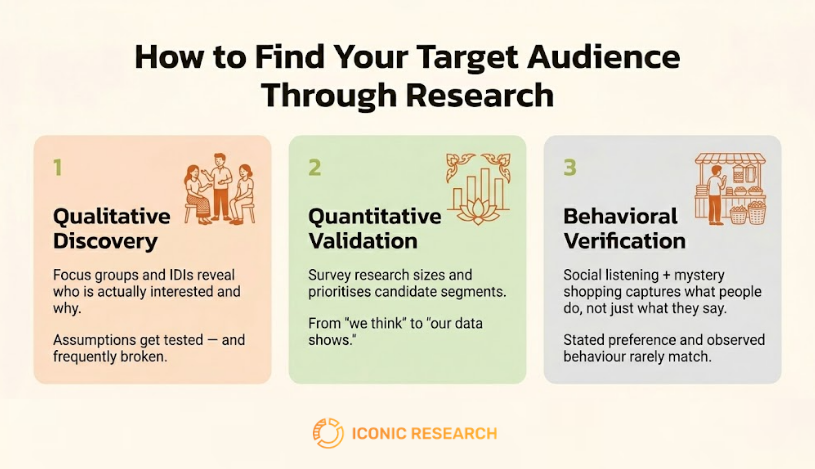
Before you can size a segment, you need to understand it. Focus groups and in-depth interviews with prospective customers reveal who is actually interested in what you offer, what language they use to describe the problem you solve, what would make them choose you over the alternative, and what would make them walk away. This is the stage where assumptions are tested and frequently broken. Qualitative research produces the hypotheses that quantitative research then tests at scale. In a new product development context, this is the ideation and concept stage — where defining the target audience and generating the product idea happen simultaneously, not sequentially.
Step 2 — Quantitative validation
Once qualitative discovery has identified candidate segments, survey research and market segmentation analysis test those segments at scale [3]. Which audience is largest? Which is most valuable? Which is most reachable given your distribution and budget? You move from insight to evidence — from “we think our buyer is X” to “our data shows that segment X represents Y% of the addressable market, with Z% purchase intent.” Quantitative research converts hypotheses into decisions.
Step 3 — Behavioral verification
What people say and what people do are different things. Social listening reveals how your target audience talks about the category, the competitors, and the problem when they are not in a research environment — unprompted, unmoderated, and therefore closer to genuine preference. Mystery shopper research shows how they behave at the actual point of decision: what they pick up, what they put back, what question they ask the salesperson. Stated preference and observed behaviour rarely match perfectly. Research that captures both produces a target audience definition you can actually act on.
Frequently Asked Questions
What is the difference between target audience and target market?
Target market is the broad category of potential buyers. Target audience is the specific, actionable segment within that market you are speaking to right now — defined more precisely by characteristics, motivations, and context.
How do I define my target audience?
Start with qualitative research — focus groups or in-depth interviews with people in the category. Understand who is responding and why. Then validate with quantitative segmentation to size the opportunity. A definition that starts with a spreadsheet starts with assumptions; one that starts with real conversations starts with evidence.
How do I find my target audience?
Research. In-depth interviews and focus groups reveal who is interested and why. Survey research sizes and prioritises the finding. Social listening shows how the audience talks and behaves unprompted. No analytics dashboard tells you why someone bought — or what would have made them choose a competitor instead.
What is target audience analysis?
The process of examining your existing or potential audience to identify shared characteristics, motivations, and behaviours — then using that to prioritise which segment to pursue and how to reach them. At its most rigorous it combines qualitative depth, quantitative scale, and behavioural observation.
Does target audience work differently in B2B?
Yes — significantly. In B2B the target audience is rarely one person. It is a buying committee: end user, internal champion, budget holder, decision maker, procurement. Each has different motivations and different objections. Research maps who holds real influence and whose objection kills the deal.
References
[1] Smart Insights (2025). STP Marketing: The Segmentation, Targeting, Positioning Model. https://www.smartinsights.com/digital-marketing-strategy/customer-segmentation-targeting/segmentation-targeting-and-positioning/
[2] GreenBook (2023). Qualitative vs Quantitative Market Research: Why Not Both? https://www.greenbook.org/insights/research-methodologies/qualitative-vs-quantitative-market-research-why-not-both
[3] Iconic Research (2025). Market Segmentation in Thailand. https://iconicthai.com/market-segmentation/
[4] Electronic Transactions Development Agency (2024). Thailand Internet User Behavior Report. ETDA. https://www.etda.or.th/en/Our-Service/statistics-of-internet-users-in-thailand.html
[5] Iconic Research (2025). Consumer Behaviour in Thailand. https://iconicthai.com/understanding-the-thai-consumer-insights-and-trends/
If you wish to quote any information from this article, please kindly cite the source along with the link to the original article to respect copyright. |
 |
Iconic Research Thailand Your trusted partner in market research and consulting across Thailand and Southeast Asia. Headquartered in Bangkok, we provide research-driven insights across the Philippines, Malaysia, Indonesia, Singapore, Laos, and Vietnam. We help businesses navigate Thailand's market complexities through consumer insights, market entry strategy, and trend foresight. Contact us if you have any queries! (+66)888 954 954 |
Contact us
We always looking for new and exciting opportunities. Let’s connect.
Related posts
 Growth Strategy: The Expansion Decisions That Need Evidence
Growth strategy is the set of decisions about where a company expands next. Only 25% of companies grow sustainably — the difference is evidence, not ambition.
9 min read Brand Strategy: The Decisions That Should Be Built on Evidence
Brand strategy is the set of decisions that determine how a brand competes. Those decisions only pay off when they’re built on consumer evidence — not a workshop.
11 min read Key Opinion Leader: What Thai Brands Should Research Before, During, and After a KOL Campaign
Platform metrics mislead brands choosing and measuring KOLs in Thailand. A research-first look at what to verify before, during, and after a campaign.
10 min read