

Key Opinion Leader: What Thai Brands Should Research Before, During, and After a KOL Campaign
10 min readA key opinion leader (KOL) is a domain expert whose influence comes from professional credentials and specialised knowledge, distinct from an influencer, whose influence comes from social media audience and content reach. In Thailand, expertise claims are harder to verify and category trust rarely transfers between domains. As a result, KOL campaigns demand different pre-campaign research from influencer campaigns — verifying credibility, audience fit, and category relevance before any budget is committed.
Table of Contents
- Key Opinion Leader vs Influencer — The Distinction That Matters for Research
- Before the Campaign — KOL Marketing Selection Research
- The Thailand-Specific KOL Credibility Problem
- During the Campaign — Consumer Attitudes Toward KOL Content
- After the Campaign — KOL Effectiveness Measurement
- Conclusion
- References
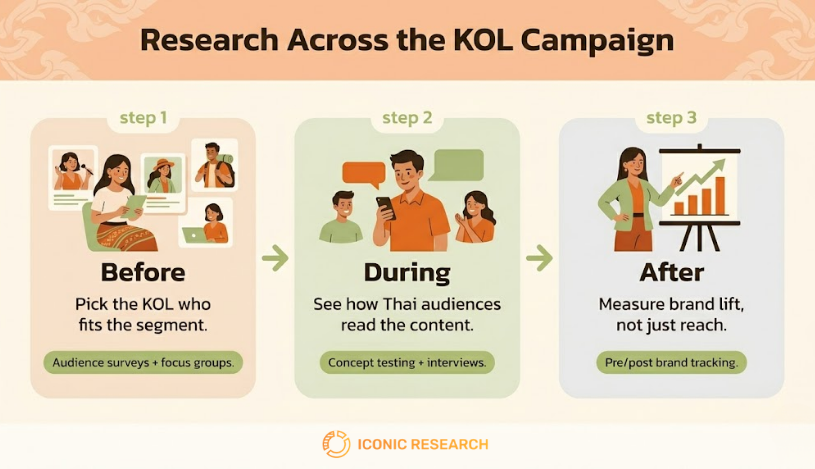
Most brands entering Thailand’s KOL space make three consecutive research errors: selecting a key opinion leader on media-kit metrics that are unreliable, briefing campaigns on assumptions about Thai consumer reception that are frequently wrong, and measuring success through platform engagement data that captures content consumption but not brand impact. Each error is correctable through research. None is correctable through better campaign execution alone. What follows is an account of what research adds at each stage — before, during, and after a campaign in Thailand.
Key Opinion Leader vs Influencer — The Distinction That Matters for Research
The terms are used interchangeably in most media plans, but the difference between a KOL influencer engagement and a standard influencer engagement determines which research instrument is appropriate. Three distinctions matter for research purposes.
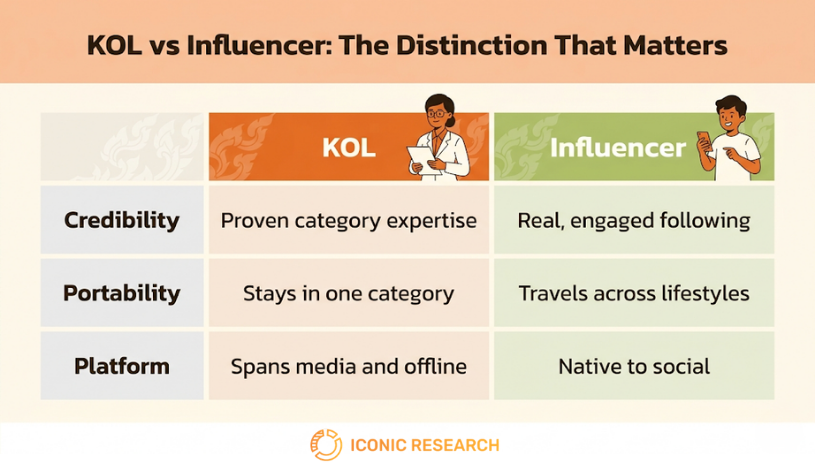
Source of credibility comes first. A KOL’s authority rests on professional expertise and a domain track record, which research verifies by asking whether the target audience actually perceives this person as an expert in the category. An influencer’s authority rests on audience connection and content consistency, which research verifies through audience data — whether the following is real and engaged. When brands treat kols and influencers as the same input, they apply the wrong test to both.
Category portability comes second. KOL credibility is category-specific and does not travel: a finance expert endorsing a beauty product loses the credibility signal entirely, and research can measure where that transfer boundary sits. Influencer credibility moves more freely across lifestyle categories. Platform dependency comes third. Influencers are native to social platforms and measurable through platform analytics, while KOLs operate across platforms, traditional media, and offline channels — which makes standard platform measurement inadequate on its own. The research instrument therefore differs by type. Conflating the two produces the wrong measurement framework [1].
Before the Campaign — KOL Marketing Selection Research
Budget is usually committed before four research problems have been solved.
The first is that fake metrics are endemic. A 2026 Forrester survey of 2,200 brand-side marketers found 71% concerned about influencer fraud [3]. Follower counts, engagement rates, and reach figures in Thai media kits are not independently verified. Tool-based follower audits catch some inflation but cannot verify what matters most: whether a KOL’s real audience matches the brand’s specific target segment. Survey-based audience verification — asking a panel of target consumers whether they follow a KOL, trust their recommendations, and whether that content shapes purchase decisions in the specific category — produces different results from an algorithmic credibility score. This is where quantitative research earns its place.
The second problem is that category credibility does not transfer. Thai consumers apply different credibility frameworks to different categories, and qualitative research surfaces the category-specific thresholds — which KOL types the target segment finds credible for this product category — before budget is committed. Focus groups are well suited to mapping where those thresholds sit.
The third problem is tier. Micro- and nano-influencers now command a combined 71.5% market share in Thailand [5], but the right tier depends on the category, the objective, and how the audience consumes content in that category — a question research settles before media planning, not after.
The fourth instrument is one neither follower audits nor consumer surveys can replicate: in-depth interviews conducted directly with KOL candidates. How a KOL evaluates partnership requests, what they understand about their audience’s trust, and which categories they can credibly endorse — this supply-side intelligence appears in no media kit and no platform metric. Iconic Research has conducted this type of in-depth interview research across multiple brand engagements in Thailand.
The Thailand-Specific KOL Credibility Problem
Three structural features make KOL selection harder in Thailand than global benchmarks suggest. The first concerns verification. Within the influencer marketing Thailand ecosystem, category expertise is frequently claimed without formal credentials, so research has to ask target consumers directly whether they perceive a person as genuinely knowledgeable in the category — a question no media kit can answer. Academic work on the “mere number effect” reinforces the point: audiences attribute higher influencing power to accounts with large follower counts even when they recognise that some followers are fake, and only demonstrated expertise reliably negates that distortion [4].
The second feature is that Thai consumers increasingly separate authentic expertise from paid endorsement. A 2024 Southeast Asia consumer survey found that around 69% of Thai consumers reported a positive purchase impact from influencer recommendations [2], yet the same body of evidence shows audiences shifting away from mega-influencers toward creators they perceive as more authentic [1]. Qualitative research locates where that credibility threshold sits for a specific category and segment.
The third feature is closed-channel influence. KOL content shared into LINE communities — family chats, professional groups, neighbourhood networks — generates purchase influence that no platform analytics tool captures. Social listening research can monitor parts of this conversation; standard influencer dashboards cannot reach it at all [1].
During the Campaign — Consumer Attitudes Toward KOL Content
Thai consumers have developed strong disclosure awareness. They recognise sponsored content and evaluate it differently depending on the match between the KOL’s established domain credibility and the product category, the disclosure format and platform, and whether the content feels native to the KOL’s usual output or anomalous. Qualitative research maps these dynamics before creative is finalised, which changes the briefing direction rather than forcing adjustments after launch; in-depth interviews add the individual-level reasoning behind those reactions [2].
Format choices compound the effect. A long-form review, a short-form mention, and a live-commerce appearance produce different responses by category and segment in Thailand. Research determines which format fits; assumption produces creative that feels right to the brand team and wrong to the audience. Concept testing with target consumers confirms whether the proposed creative direction will land before production commits.
After the Campaign — KOL Effectiveness Measurement
What brands typically measure after a campaign — reach, impressions, engagement rate, click-through, promo-code redemptions — describes content consumption, not brand impact. A campaign can reach 500,000 impressions and move brand awareness by zero, while 50,000 impressions from a highly credible KOL in the right category can shift purchase intent measurably. Platform metrics cannot tell those two outcomes apart.
Pre/post brand tracking surveys close that gap. Fielded before launch and again after the campaign concludes, they measure awareness uplift, purchase-intent shift, and brand-association change attributable to the KOL. The method is standard for television advertising evaluation in Thailand and almost never applied to KOL campaigns of comparable budget. Effective kol strategy requires this measurement framework to be established before the campaign launches, not assembled afterward. Kol management without pre-defined brand-impact metrics produces engagement reports that cannot answer the question a CMO needs answered: did this move the brand? The same holds for key opinion leader management across a portfolio of category experts — without pre/post tracking, the contribution of any individual KOL to brand health cannot be isolated. This is why brand research and quantitative research belong in the measurement plan from the outset [3].
Conclusion
KOL marketing in Thailand is a legitimate and effective brand-building channel. The research gaps — in selection, in audience understanding, and in measurement — are not arguments against using KOLs. They are arguments for approaching the channel the way sophisticated brands approach any other significant marketing investment: with a research framework that precedes the brief and a measurement approach that outlasts the campaign.
Frequently Asked Questions
What is a key opinion leader?
A key opinion leader is a domain expert whose influence derives from professional credentials and specialised knowledge in a specific field. This distinguishes a KOL from an influencer, whose influence derives from social media audience and content reach.
What is the difference between a KOL and an influencer?
KOL credibility comes from expertise and is category-specific, while influencer credibility comes from audience connection and is more transferable across lifestyle categories. That distinction determines which research instrument is appropriate for selection and for measurement.
How should brands select KOLs in Thailand?
Beyond follower counts and engagement rates, which are unreliable in Thailand, selection benefits from audience-verification research, qualitative category-credibility research, and in-depth interviews with KOL candidates that surface supply-side intelligence no media kit contains.
How is KOL effectiveness measured beyond engagement?
Pre/post brand tracking surveys measure awareness uplift, purchase-intent shift, and brand-association change. A kol specialist brief without pre-defined brand-impact metrics produces engagement data but not strategic evaluation.
What is KOC and how does it differ from KOL?
A KOC (Key Opinion Consumer) is an everyday consumer whose product experience and peer recommendations influence purchases within their own network — usually smaller in scale than a KOL but often perceived as more authentic. In Thailand, KOC influence frequently moves through LINE groups and community platforms that standard analytics cannot track.
References
[1] Cube Asia & impact.com. 2024 Southeast Asia eCommerce Influencer Marketing Report. Survey of 2,400 consumers, creators, and industry experts across six SEA markets including Thailand (2024). https://www.thepeakmagazine.com.sg/influence/trust-authenticity-and-changing-face-e-commerce-southeast-asia
[2] Cube. Share of consumers whose purchase decisions were positively impacted by influencer recommendations in Southeast Asia, by country. Survey of 400 Thai respondents (August 2024). Statista. https://www.statista.com/statistics/1537691/sea-consumer-trust-in-influencer-product-suggestion-by-country/
[3] Amra & Elma / Forrester Research. Influencer Fraud Statistics 2026. Based on a Forrester survey of 2,200 brand-side marketing decision-makers. https://www.amraandelma.com/influencer-fraud-statistics/
[4] Zhou, L., Jin, F., Wu, B., Chen, Z., & Wang, C. L. (2023). Do fake followers mitigate influencers’ perceived influencing power on social media platforms? The mere number effect and boundary conditions. Journal of Business Research, 158, 113589. https://doi.org/10.1016/j.jbusres.2022.113589
[5] Dataxet (2026). Thailand Media Landscape 2026: Consumer Behavior Redefines the Game in the Age of AI and Video-First. https://www.dataxet.co/pr-th/irdp0pr8pegkaa1bx4w2plilxnnoxq3a
If you wish to quote any information from this article, please kindly cite the source along with the link to the original article to respect copyright. |
 |
Iconic Research Thailand Your trusted partner in market research and consulting across Thailand and Southeast Asia. Headquartered in Bangkok, we provide research-driven insights across the Philippines, Malaysia, Indonesia, Singapore, Laos, and Vietnam. We help businesses navigate Thailand's market complexities through consumer insights, market entry strategy, and trend foresight. Contact us if you have any queries! (+66)888 954 954 |
Contact us
We always looking for new and exciting opportunities. Let’s connect.
Related posts
 Growth Strategy: The Expansion Decisions That Need Evidence
Growth strategy is the set of decisions about where a company expands next. Only 25% of companies grow sustainably — the difference is evidence, not ambition.
9 min read Brand Strategy: The Decisions That Should Be Built on Evidence
Brand strategy is the set of decisions that determine how a brand competes. Those decisions only pay off when they’re built on consumer evidence — not a workshop.
11 min read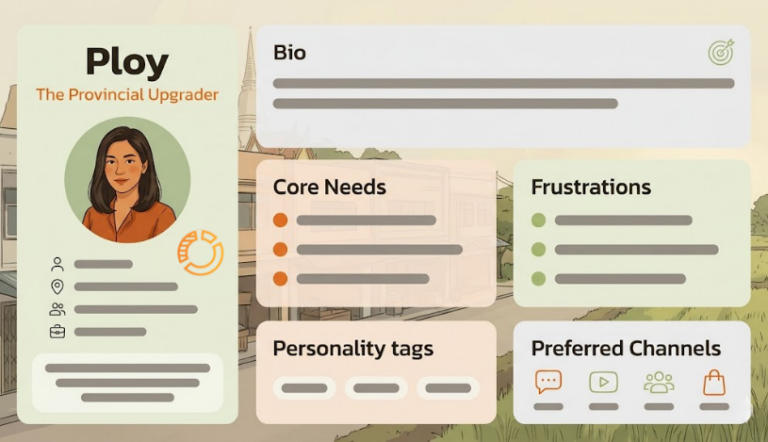 Customer Persona: Build One That Reflects Real Thai Consumers
Most Thai brands have customer personas built from assumptions. Research-backed personas reveal a different consumer — and drive different decisions.
9 min read