

Thailand’s economic transformation, codified as Thailand 4.0, has reached a defining year in 2026. What began as a 20-year roadmap to escape the “Middle-Income Trap” is no longer just policy – it’s operational reality for thousands of enterprises. The focus has shifted from simple digitization to full-scale digital Thailand 4.0 integration, where AI and IoT are embedded into core business models across the nation’s leading industries.
Table of Contents
- Understanding Thailand’s Economic Evolution
- The Blueprint: What is Thailand 4.0 in 2026?
- The New Growth Engines: S-Curve Industries
- The Regional Reality: Thailand 4.0 vs. ASEAN Hubs
- The Talent Pivot: Thailand 4.0 Education
- Evaluating Progress: The 2026 Reality Check
- Strategic Recommendations: Navigating Thailand 4.0 with Local Intelligence
- References
For investors, 2026 represents the year of the “Digital Divide.” While the World Bank projects modest GDP growth of 1.6% due to structural headwinds and high household debt [1], the gap between digital-first innovators and traditional firms is widening dramatically. This creates significant opportunities for those who can navigate the new “S-Curve” sectors driving productivity forward.
Understanding Thailand’s Economic Evolution
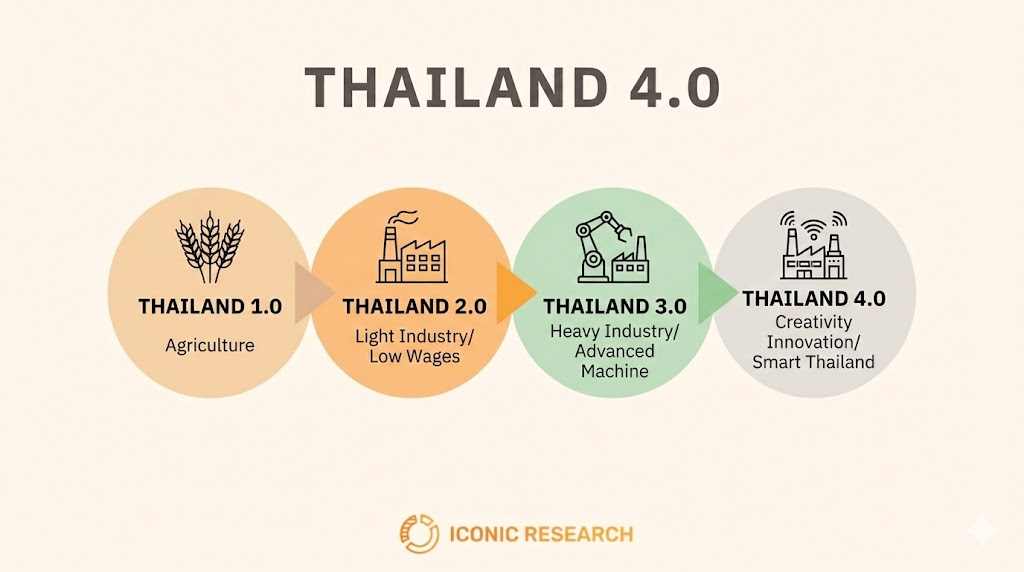
Thailand 4.0 represents the fourth stage in the country’s economic development model, building on three previous phases:
Thailand 1.0 (Pre-1960s): Agriculture Economy driven by farming and agricultural exports – rice, rubber, and crops formed the economic foundation.
Thailand 2.0 (1960s-1990s): Light Industry & Low Wages Shift to light manufacturing and labor-intensive industries. Thailand became a low-cost production hub for textiles, garments, and basic assembly.
Thailand 3.0 (1990s-2010s): Heavy Industry & Advanced Machinery Transition to heavy manufacturing, automotive assembly, and electronics production. Thailand became the “Detroit of Asia” but remained dependent on efficiency and cost competitiveness rather than innovation.
Thailand 4.0 (2016-Present): Creativity, Innovation & Smart Thailand The current transformation focuses on value-driven growth through innovation, digital technology, R&D, and high-value services. The goal is escaping the middle-income trap through knowledge-based industries rather than competing on labor costs.
The Blueprint: What is Thailand 4.0 in 2026?
At its core, Thailand 4.0 represents the transition from “efficiency-driven” to “innovation-driven” growth. By 2026, the government’s focus has sharpened on creating an innovation economy that achieves stability and prosperity [5].
The policy is anchored by three key pillars:
Economic Prosperity: Increasing R&D spending to 2% of GDP to drive high-income status, with particular emphasis on Thailand industry 4.0 transformation across manufacturing sectors [5].
Social Well-being: Leveraging technology to reduce wealth disparity through “Smart Farming” initiatives and digital accessibility programs that extend innovation benefits beyond Bangkok.
Environmental Protection: Transitioning toward a Bio-Circular-Green (BCG) model, with green exports now accounting for nearly 10% of total trade [1].
In 2026, this blueprint is being executed through the “Digital FastPass” mechanism, designed to accelerate investment applications in strategic projects, particularly within the Eastern Economic Corridor (EEC) [3].
The New Growth Engines: S-Curve Industries
The maturity of industry 4.0 Thailand is most visible in the “New S-Curve” industries. These sectors have moved beyond simple assembly into higher-value production segments that define the digital Thailand 4.0 landscape.
Next-Gen Automotive (EVs)
Thailand has successfully maintained its position as regional automotive hub by pivoting to Electric Vehicles. By 2026, more than 80% of auto-parts production has been adapted for EV compatibility [4]. The government has incentivized this shift by cutting excise taxes on Battery Electric Vehicles (BEVs) from 8% to 2% to encourage domestic manufacturing [4].
This transformation exemplifies Thailand industry 4.0 principles-traditional manufacturing excellence combined with advanced digital integration, IoT-enabled production lines, and AI-driven quality control.
Intelligent Electronics and Semiconductors
The electronics boom increasingly defines Thailand’s industrial landscape. Driven by global supply-chain shifts, Thailand has seen surging investment for Printed Circuit Boards (PCBs) and smart appliances [2]. While the country still faces raw material shortages for upstream production, it has carved out a strong midstream niche, ranking 12th globally in Integrated Circuit (IC) exports [4].
Digital Infrastructure
A critical component of digital Thailand 4.0 is data center expansion. In 2026, the data center industry is projected to grow at 7.5–8.5% annually [4]. The EEC has become the primary cluster for these investments, though the Board of Investment (BOI) notes that future growth depends heavily on electrical infrastructure reliability [2].
The Regional Reality: Thailand 4.0 vs. ASEAN Hubs
How does Thailand 4.0 compare to neighboring economies in 2026? Investors increasingly view Thailand as a “Trusted Gateway” for specific strategic reasons.
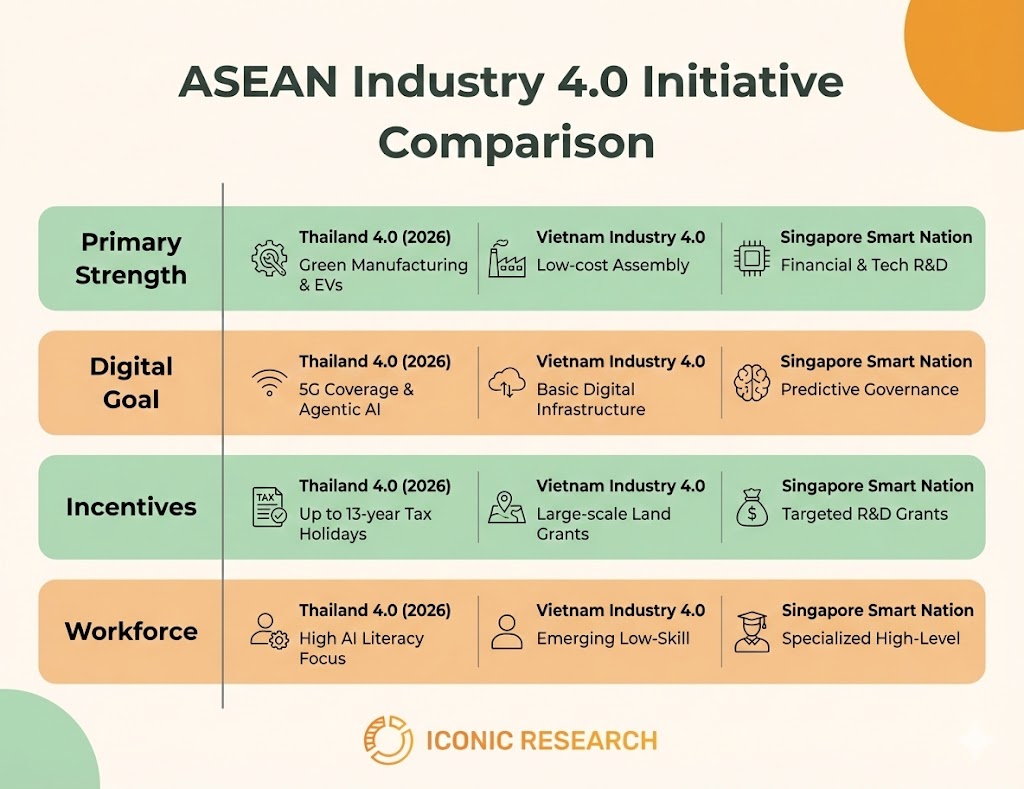
While Singapore remains the high-end R&D leader, Thailand has secured its role as the region’s premier hub for advanced green manufacturing. The gap between Thailand’s “Green Complexity Index” and its potential highlights substantial opportunities for expansion into complex, higher-value activities [4].
The Talent Pivot: Thailand 4.0 Education
The most critical pillar of 2026 is Thailand 4.0 education reform. The government recognizes that traditional skill models no longer match industrial needs. To address this, the Ministry of Higher Education, Science, Research and Innovation (MHESI) was granted a 160 billion THB budget for 2026 [5].
The Digital School Model
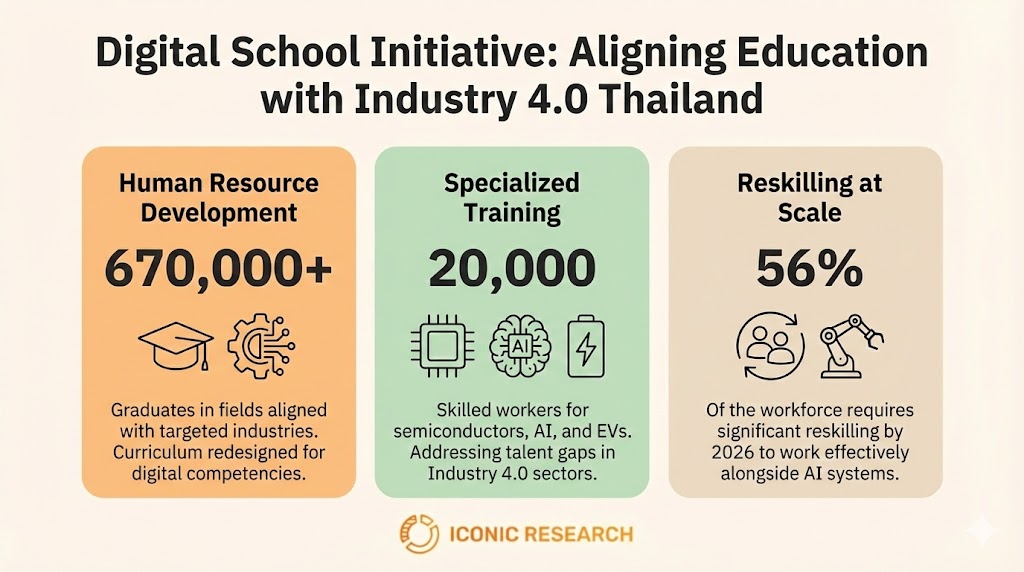
The “Digital School” initiative focuses on aligning education with industry 4.0 Thailand requirements:
Human Resource Development: Producing over 670,000 graduates in fields aligned with targeted industries, with curriculum redesigned around digital competencies [5].
Specialized Training: Cultivating 20,000 skilled workers specifically for semiconductors, AI, and EVs-addressing critical talent gaps in Thailand industry 4.0 sectors [5].
Reskilling at Scale: Approximately 56% of the workforce requires significant reskilling by 2026 to work effectively alongside AI systems [2].
The Ministry of Labour has outlined a 6.9 billion THB budget specifically to upskill the workforce in AI and digital competencies, utilizing partnerships with global tech leaders like Microsoft [5]. This Thailand 4.0 education infrastructure aims to close the talent gap that threatens to constrain industrial transformation.
Evaluating Progress: The 2026 Reality Check
Despite government roadmap optimism, Thailand 4.0 implementation in 2026 reveals mixed realities that investors must understand.
Successes:
Investment Surge: BOI incentive applications reached record highs, driven by digital industries and renewable energy investments [4].
5G Leadership: Thailand’s 5G network now covers over 89% of the population, providing the second-highest connectivity index in ASEAN-critical infrastructure for digital Thailand 4.0 [4].
Green Goods Export Growth: Green products now account for nearly 10% of total exports, validating the BCG model’s commercial viability [1].
Challenges:
Structural Weakness: High household debt and an aging society continue weighing on domestic demand, capping GDP growth potential [1].
The “Middle-Income Trap”: While manufacturing remains a cornerstone (25% of GDP), the sector has struggled to upgrade entirely to highest-value activities [1].
Digital Divide: A clear divide exists between digital-first firms thriving under Thailand 4.0 and traditional businesses in steep decline, such as print media [2].
Strategic Recommendations: Navigating Thailand 4.0 with Local Intelligence
Thailand 4.0 provides the framework, but successful execution requires deep local intelligence. The “Great Digital Divide” of 2026 means generic data no longer suffices to de-risk investment decisions.
Investors must navigate “Micro-Risks” including:
Labor Mapping: Identifying specific provinces where the 670,000 Thailand 4.0 education graduates are actually located, not just national statistics.
Infrastructure Audits: Verifying if “Smart Factory” sites in the EEC have energy capacity for 24/7 automation, not just promotional claims about digital readiness.
Regulatory Compliance: Navigating complex tax incentives and “FastPass” requirements to maximize ROI in industry 4.0 Thailand investments.
At Iconic Research, we provide the market data and feasibility audits necessary to turn the vision of Thailand 4.0 into operational success. Our research helps investors distinguish between government targets and ground-level capabilities.
Frequently Asked Questions
What is Thailand 4.0?
Thailand's economic transformation strategy transitioning from efficiency-driven to innovation-driven growth through digital integration, advanced manufacturing, and green technology across S-Curve industries.
What are the main Thailand 4.0 industries in 2026?
Next-gen automotive (EVs), intelligent electronics and semiconductors, digital infrastructure (data centers), robotics, aviation, biotechnology, and Bio-Circular-Green manufacturing.
How does Thailand 4.0 education support industrial transformation?
160 billion THB budget producing 670,000 graduates in targeted fields, 20,000 specialized workers for semiconductors/AI/EVs, and nationwide reskilling programs addressing the 56% workforce digital skills gap.
What makes Thailand 4.0 different from Vietnam or Singapore?
Thailand focuses on green manufacturing and EVs with 13-year tax holidays, while Vietnam emphasizes low-cost assembly and Singapore leads in R&D and financial technology.
What are the biggest risks for Thailand 4.0 investors in 2026?
High household debt constraining domestic demand, skilled labor shortages despite education reforms, energy infrastructure reliability for digital operations, and the widening digital divide between advanced and traditional firms.
References
[1] World Bank. “Thailand Economic Monitor February 2026: Advanced Green Manufacturing for Growth.” https://www.worldbank.org/en/country/thailand/publication/thailand-economic-monitor-february-2026-advanced-green-manufacturing-for-growth
[2] Government Public Relations Department. “Thai Economy Is Improving with Higher GDP Growth Than Expected (2026).” https://thailand.prd.go.th/en/content/category/detail/id/48/iid/477098
[3] Board of Investment (BOI) Thailand. “Thailand FastPass and 2026 Investment Promotion Measures.” https://www.boi.go.th/index.php?page=press_releases_detail&topic_id=138324
[4] Krungsri Research. “Thailand Industry Outlook 2026-2028: Summary and Sector Analysis.” https://www.krungsri.com/en/research/industry/summary-outlook/2026-2028
[5] Office of National Higher Education Science Research and Innovation Policy Council (NXPO). “Cabinet approves 160 billion THB budget for higher education, science, research and innovation in 2026.” https://www.nxpo.or.th/th/en/31014/
If you wish to quote any information from this article, please kindly cite the source along with the link to the original article to respect copyright. |
 |
Iconic Research Thailand Your trusted partner in market research and consulting across Thailand and Southeast Asia. Headquartered in Bangkok, we provide research-driven insights across the Philippines, Malaysia, Indonesia, Singapore, Laos, and Vietnam. We help businesses navigate Thailand's market complexities through consumer insights, market entry strategy, and trend foresight. Contact us if you have any queries! (+66)888 954 954 |
Contact us
We always looking for new and exciting opportunities. Let’s connect.
Related posts
 AI Thailand: The Opportunity Is Real, But So Is the Complexity
Thailand’s AI market is projected to reach 114 billion baht by 2030, yet most Thai consumers remain cautious. Understanding who they are – and what they actually need from AI – is the difference between a product that lands and one that doesn’t.
13 min read Unlocking the “Why” Behind Thai Culture: Introducing PhumPanya
Thai culture can feel like a puzzle. At PhumPanya, we believe the key to understanding Thai language and culture is in the words themselves. Explore our free database of Thai words, their roots, and the cultural logic hidden inside the language.
3 min read EEC Thailand: Investment Guide to Industrial Clusters
Thailand’s Eastern Economic Corridor has evolved from infrastructure project to sophisticated high-tech ecosystem—here’s how to identify high-yield opportunities in 2026.
8 min read