

Thailand is Southeast Asia’s leading medical tourism and health tourism destination and one of Asia’s most strategically positioned healthcare markets. With over 2 million annual medical visits, 62 JCI-accredited hospitals, and an active government Medical Hub policy running to 2034, Thailand’s healthcare sector offers significant opportunity for pharmaceutical companies, medical device manufacturers, health-tech businesses, and hospital groups assessing market entry or expansion. This article provides market intelligence on Thailand’s healthcare landscape, demographic drivers, digital health adoption, and the research that informs commercial decisions in this sector.
Table of Contents
- Thailand’s Healthcare Market: Scale and Structure
- Thailand Medical Hub Policy 2025–2034
- The Aging Society: The Demand Driver Every Healthcare Business Needs to Understand
- Digital Health and Telemedicine in Thailand
- Pharmaceutical and Medical Device Market
- Competitive Landscape: Medical Tourism Destinations in Asia
- Healthcare Market Research in Thailand
- Conclusion
- Sources
Thailand’s Healthcare Market: Scale and Structure
Thailand’s healthcare industry is projected to grow at a CAGR of 5.3%, expanding from THB 679.6 billion in 2025 to over THB 880.5 billion by 2030. The sector serves both a domestic population of 72 million and approximately 2 million annual international medical visitors, generating market revenue of USD 24.4 billion in 2023 with a projected CAGR of 13.3% through 2032.
The system operates across two distinct sectors. The public sector — comprising approximately 80% of the country’s nearly 1,300 hospitals — is administered by the Ministry of Public Health and anchored by the Universal Coverage Scheme, which provides broad access to essential services for Thai residents. The private sector operates independently, with internationally trained staff, multilingual personnel, and premium facilities oriented toward both affluent domestic patients and international medical travelers. Private hospitals account for a disproportionate share of medical tourism revenue: at Bumrungrad International, international patients represented 66% of total revenue in the first half of 2023.
Thailand holds 62 hospitals accredited by the Joint Commission International — more than any other country in Southeast Asia — and ranks among the top five medical tourism destinations globally according to the Medical Tourism Index. The country’s combination of clinical quality, cost efficiency, and Thai hospitality continues to attract patients from the Middle East, CLMV countries, and increasingly from the broader ASEAN region seeking treatment across cardiology, oncology, orthopedics, and elective procedures.
Thailand Medical Hub Policy 2025–2034
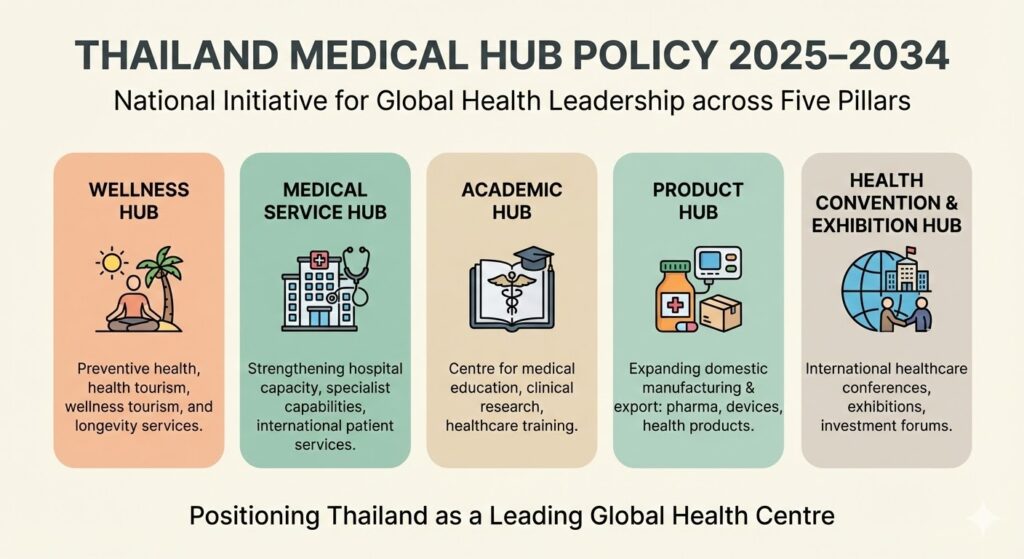
The Thai government’s Medical Hub Policy 2025–2034 is a national initiative with direct implications for every foreign business assessing Thailand’s healthcare market. It moves beyond the earlier Medical Hub framework and commits Thailand to becoming a leading global health centre across five defined pillars:
Wellness Hub — positioning Thailand as a destination for preventive health, health tourism, wellness tourism, and longevity services targeting both domestic and international consumers.
Medical Service Hub — strengthening hospital capacity, specialist capabilities, and international patient services across the private sector.
Academic Hub — developing Thailand as a centre for medical education, clinical research, and healthcare professional training in the region.
Product Hub — expanding domestic manufacturing and export capability in pharmaceuticals, medical devices, and health products.
Health Convention and Exhibition Hub — attracting international healthcare conferences, exhibitions, and investment forums, anchored by events such as Medical Fair Thailand.
For foreign healthcare businesses, the policy creates both opportunities and navigation challenges. Regulatory frameworks around medical device registration, pharmaceutical licensing, and clinical trial approvals are actively evolving under this strategy. Market entry decisions made without current intelligence on how these pillars are being implemented — and where government priority and private sector investment are actually converging — carry meaningful risk.
The Aging Society: The Demand Driver Every Healthcare Business Needs to Understand
Thailand’s demographic shift is the single most consequential trend shaping healthcare demand through the next decade.
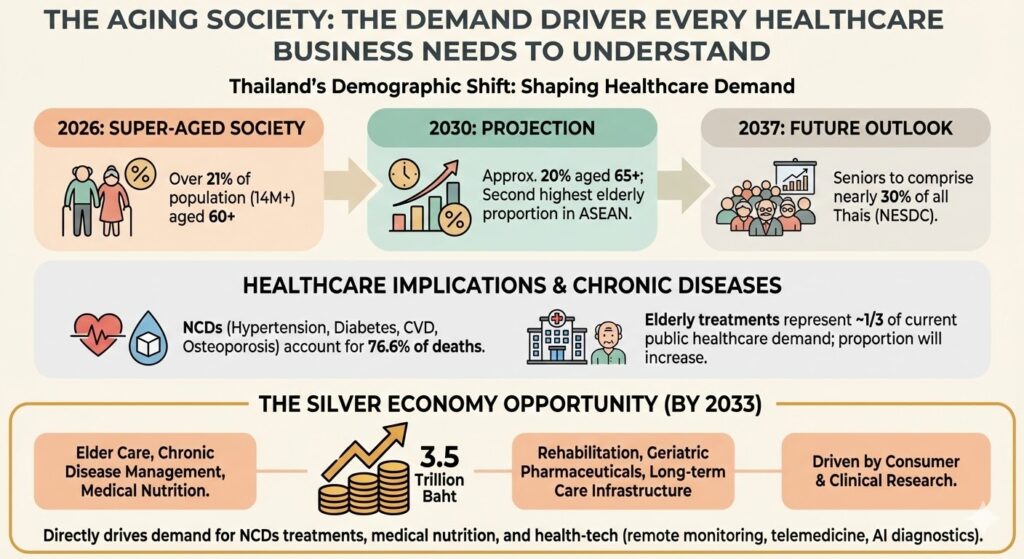
As of 2026, people aged 60 and above account for more than 21% of Thailand’s population — over 14 million people. The country has formally entered what demographers classify as a super-aged society stage. By 2030, those aged 65 and above are projected to reach approximately 20% of the population. By 2037, seniors will comprise nearly 30% of all Thais according to NESDC projections. Thailand will have the second highest proportion of elderly individuals in ASEAN by 2030.
The healthcare implications are specific and substantial. Chronic non-communicable diseases — hypertension, diabetes, cardiovascular disease, and osteoporosis — already account for 76.6% of all deaths in Thailand. Treatments for the elderly currently represent approximately one-third of all demand on the public healthcare system. As the elderly population expands, that proportion will increase.
The silver economy is projected to reach 3.5 trillion baht by 2033. This creates identifiable commercial opportunities across elder care services, chronic disease management products, medical nutrition, rehabilitation, geriatric pharmaceuticals, and long-term care infrastructure — all of which require consumer and clinical research before investment decisions can be made with confidence.
For pharmaceutical companies, the aging trajectory directly drives demand for NCDs treatment pipelines. For medical nutrition companies, it signals growing clinical need in hospital and home settings. For health-tech businesses, it frames the addressable market for remote monitoring, telemedicine, and AI-assisted diagnostics.
Digital Health and Telemedicine in Thailand
Telemedicine usage in Thailand grew by more than 30% compared to 2023, accelerated by post-pandemic adoption and active government investment in digital health infrastructure. Leading hospital networks have integrated AI-assisted diagnostics — Siriraj Hospital operates AI screening tools for initial illness assessment — while platforms such as Raksa provide video and voice-based telemedicine access at scale.
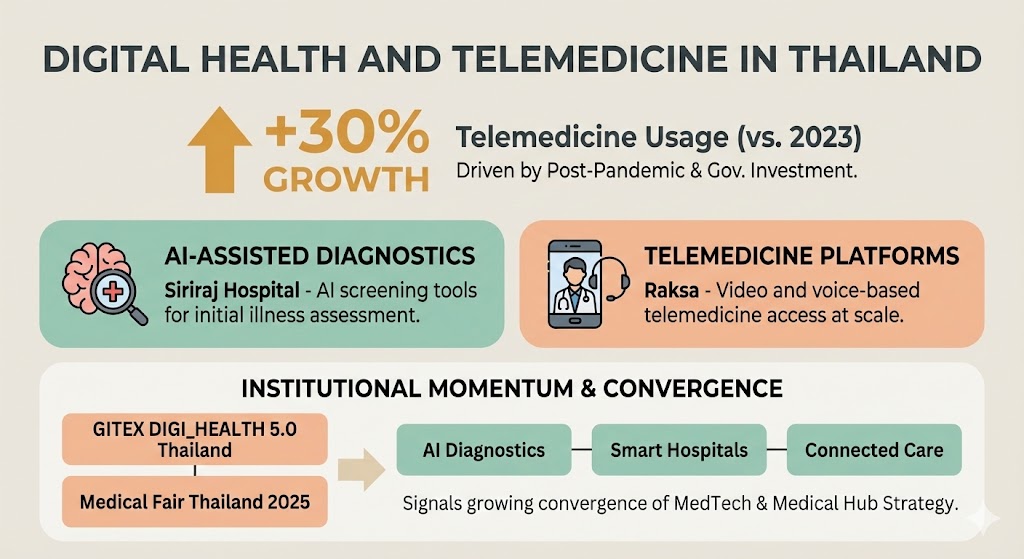
The launch of GITEX DIGI_HEALTH 5.0 Thailand, co-located with Medical Fair Thailand 2025, signals institutional momentum behind digital health as a priority investment sector. Sessions covering AI diagnostics, smart hospital ecosystems, and connected care attracted international manufacturers, investors, and decision-makers, reflecting growing convergence between Thailand’s MedTech ambitions and its Medical Hub strategy.
For digital health companies assessing Thailand, the opportunity is real but the market dynamics are complex. Adoption varies significantly between Bangkok’s private hospital networks — which have the capital and appetite for advanced health technology — and regional public hospitals operating under tighter budget constraints. Understanding where clinical decision-makers stand on specific technologies, what procurement pathways look like across public and private systems, and how patient digital health literacy shapes adoption requires primary research, not published reports.
Pharmaceutical and Medical Device Market
Thailand is the third-largest pharmaceutical market in Southeast Asia, valued at approximately 212 billion baht in 2023. Domestic drug sales are projected to grow 6.0–7.0% annually from 2025 to 2027, driven by the aging population, rising NCD prevalence, and government healthcare spending commitments.
The medical device market is on a parallel trajectory, growing at an annual rate of 6.2% between 2024 and 2029 and projected to reach THB 109.2 billion (USD 2.8 billion) by the end of the decade, according to BMI Research. Medical device exports already represent 1.2% of Thai GDP, with strong manufacturing capacity in single-use products and growing government ambition to move up the value chain into higher-complexity devices.
For multinational pharmaceutical and medical device companies, the market presents a well-established commercial opportunity alongside specific local navigation challenges — including regulatory approval timelines through the FDA Thailand, pricing and reimbursement dynamics under the three public health insurance schemes, and prescribing behaviour patterns that differ meaningfully from Western markets.
Competitive Landscape: Medical Tourism Destinations in Asia
Thailand’s position as a leading medical tourism destination is under active competitive pressure. Singapore maintains its premium positioning for complex tertiary care and attracts high-net-worth patients for whom price sensitivity is low. Malaysia is investing aggressively in its own medical hub ambitions under its National Industrial Master Plan 2030. Turkey, the UAE, and Qatar are expanding internationally accredited hospital capacity targeting Middle Eastern and European patient flows.
For businesses assessing Thailand’s medical tourism market, the competitive question is not whether Thailand remains attractive — it does — but which patient segments and clinical specialisations will drive growth over the next five years, and how competitor markets are repositioning relative to Thailand on price, quality, and geographic accessibility.
Healthcare Market Research in Thailand
Foreign companies making investment decisions in Thailand’s healthcare sector consistently require primary market intelligence that published industry reports cannot provide. Treatment landscape assessments, healthcare professional attitudes toward new products, patient journey research, and product positioning studies all depend on access to clinical professionals and patients with verified credentials — a recruitment challenge that generic research panels consistently fail.
At Iconic Research, we conduct healthcare market research across pharmaceutical, medical device, medical nutrition, and health-tech sectors.
Our Expertise
Our firm specializes in healthcare market research within Southeast Asia, with particular expertise in the Thailand medical tourism industry. Recent projects include:
Case Study 1: Blood disorders study for a global pharmaceutical company planning to launch a new treatment in Thailand
Case Study 2: Medical nutrition research in the healthcare industry in Thailand
Research Methodology
We employ a mixed-method approach combining:
- Primary research with patients, healthcare providers, and hospital industry stakeholders
- Secondary data analysis from government sources and Thailand healthcare industry reports
- Real-time market monitoring and trend analysis for the Thailand medical tourism industry
- Advanced analytics for patient flow prediction and market sizing in Thai medical tourism
Conclusion
Thailand’s healthcare market in 2026 is defined by the convergence of three forces: a government Medical Hub policy with a 10-year horizon and five strategic pillars, a demographic shift toward a super-aged society that is reshaping demand across every healthcare segment, and active investment in digital health infrastructure that is accelerating transformation in both public and private hospital networks.
For pharmaceutical companies, medical device manufacturers, health-tech businesses, and healthcare investors, the opportunity is substantial and the strategic context is clearer than at any previous point. What remains difficult is understanding the market at the level of detail that commercial decisions require — clinical practice patterns, procurement decision-making, patient behaviour, and product positioning — which is where primary research becomes the foundation for confident entry and growth.
Sources
- Intellify. Thailand Healthcare Industry Outlook 2025–2030. https://www.intellifyglobal.com/thailand-healthcare-industry-outlook-2025/
- Thailand.go.th, Ministry of Public Health. Thailand Prepares to Become a Medical Hub: A Booming Health Economy Driven by Middle Eastern Investment. https://thailand.go.th/issue-focus-detail/thailand-prepares-to-become-a-medical-hub-a-booming-health-economy-driven-by-middle-eastern-investment
- The Nation Thailand / NESDC. NESDC Report an Eye-Opener on Thailand’s Ageing Population. https://www.nationthailand.com/thailand/general/40037217
- Krungsri Research. Industry Outlook 2025–2027: Medical Devices Industry. https://www.krungsri.com/en/research/industry/industry-outlook/other-industries/medical-devices/io/medical-devices-2025
- TDRI (Thailand Development Research Institute). Breaking Barriers for Thai Innovations. https://tdri.or.th/en/2025/08/breaking-barriers-for-thai-innovations/
Contact us
We always looking for new and exciting opportunities. Let’s connect.
Related posts
 AI Thailand: The Opportunity Is Real, But So Is the Complexity
Thailand’s AI market is projected to reach 114 billion baht by 2030, yet most Thai consumers remain cautious. Understanding who they are – and what they actually need from AI – is the difference between a product that lands and one that doesn’t.
13 min read Thailand 4.0 in 2026: An Investor’s Blueprint for the Innovation Economy
Thailand 4.0 has reached a defining year in 2026 – transitioning from policy vision to operational reality with AI integration, EV manufacturing, and digital infrastructure driving the innovation economy.
9 min read Unlocking the “Why” Behind Thai Culture: Introducing PhumPanya
Thai culture can feel like a puzzle. At PhumPanya, we believe the key to understanding Thai language and culture is in the words themselves. Explore our free database of Thai words, their roots, and the cultural logic hidden inside the language.
3 min read