

The customer journey represents the complete sequence of interactions—online and offline—that a customer experiences before, during, and after engaging with a brand. This encompasses emotional responses, behavioral patterns, and channel-based touchpoints that shape purchasing decisions and long-term loyalty. In Thailand’s unique market, customer journeys blend digital platforms like LINE and TikTok with traditional offline touchpoints, creating hybrid paths that require culturally-informed understanding to optimize effectively.
Table of Contents
- Why Customer Journey Mapping Matters in Thailand
- Stages of a Customer Journey: Understanding Customer Behavior
- What Is a Customer Journey Map and Why It Matters
- How to Map Customer Journey: A Step-by-Step Approach
- Market Research’s Role in Customer Journey Mapping
- Digital Transformation and the Evolving Customer Journey
- Conclusion: Customer Journey Strategy for 2025
- References
Why Customer Journey Mapping Matters in Thailand
Customer journey design has become essential for marketing and customer experience strategy. In Thailand, it takes on unique dynamics shaped by mobile-first behavior and cultural preferences.
Thai consumers are digital natives: 94% use LINE daily for communication and commerce, trust is built through online reviews and KOL endorsements, and purchasing decisions blend online research with offline validation at stores like 7-Eleven, Lotus’s, and Watsons. They expect fast, conversational responses—often within hours.
Adobe notes that journey mapping is essential to understand how customers think, feel, and act across touchpoints [1]. In Thailand, where LINE messaging, social commerce, and physical retail overlap, this becomes particularly critical.
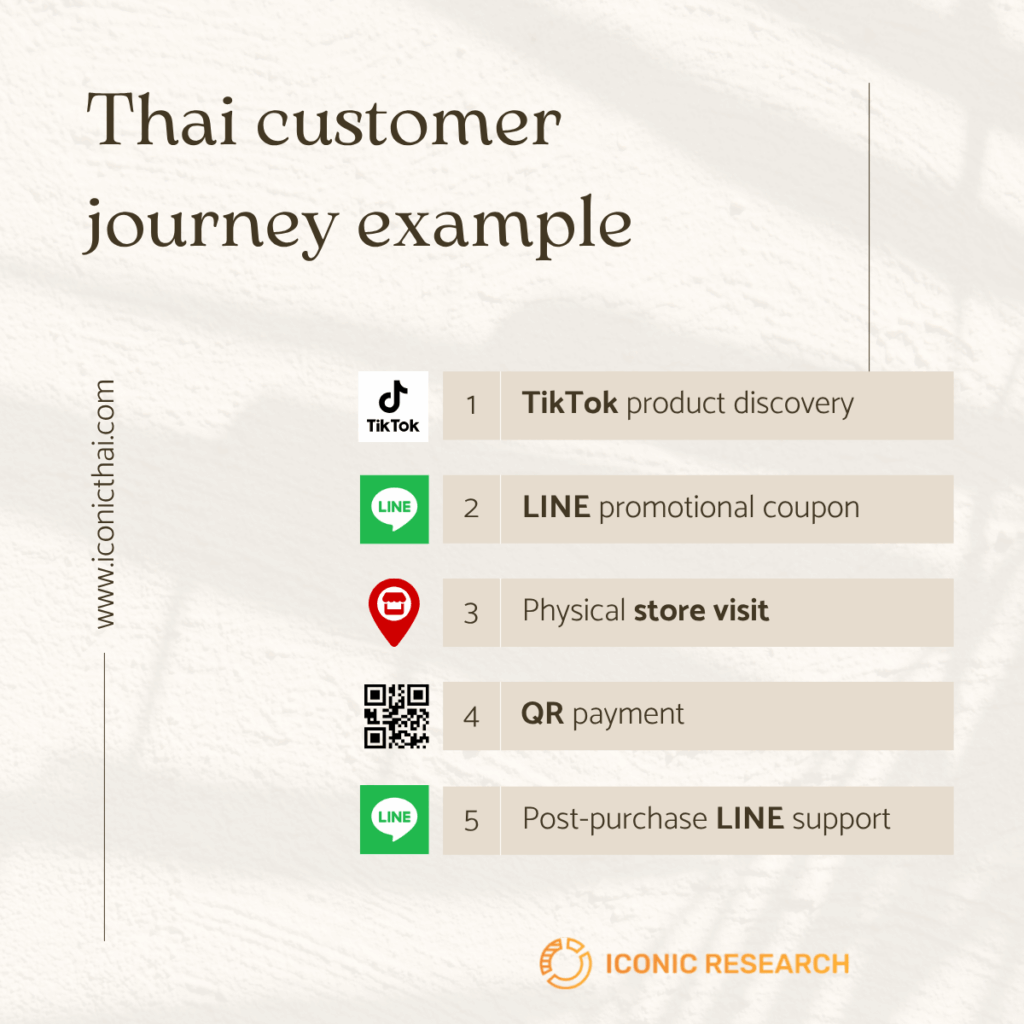
A typical customer journey example: TikTok product discovery → LINE promotional coupon → physical store visit → QR payment → post-purchase LINE chat support. This hybrid digital-physical path defines Thai consumer behavior.
Stages of a Customer Journey: Understanding Customer Behavior
The stages of a customer journey provide a framework for understanding how consumers progress from initial awareness to becoming brand advocates. In Thailand’s market, each stage involves distinct touchpoints and behavioral patterns:
Awareness: Consumers discover brands through TikTok, Facebook, influencer content, out-of-home advertising, and YouTube. Thai consumers are particularly receptive to social media discovery, making this stage crucial for brand visibility.
Consideration: During evaluation, consumers research through Shopee reviews, Pantip discussion threads, LINE chat inquiries with brands, and recommendations from trusted sources. Social proof is paramount at this stage.
Evaluation: Price comparison, physical store visits, and consultation with friends and family help consumers narrow their choices. The omnichannel customer journey map reveals how consumers move fluidly between online research and offline validation.
Purchase: Transactions occur across multiple channels—e-commerce platforms like Shopee and Lazada, TikTok Shop, cash-on-delivery options, and QR code payments that have become ubiquitous in Thailand.
Retention: Brands maintain relationships through LINE Official Account messaging, membership app benefits, and cashback programs that reward loyalty.
Advocacy: Satisfied customers create user-generated content, post TikTok unboxing videos, write reviews, and provide referrals that fuel new customer journeys.
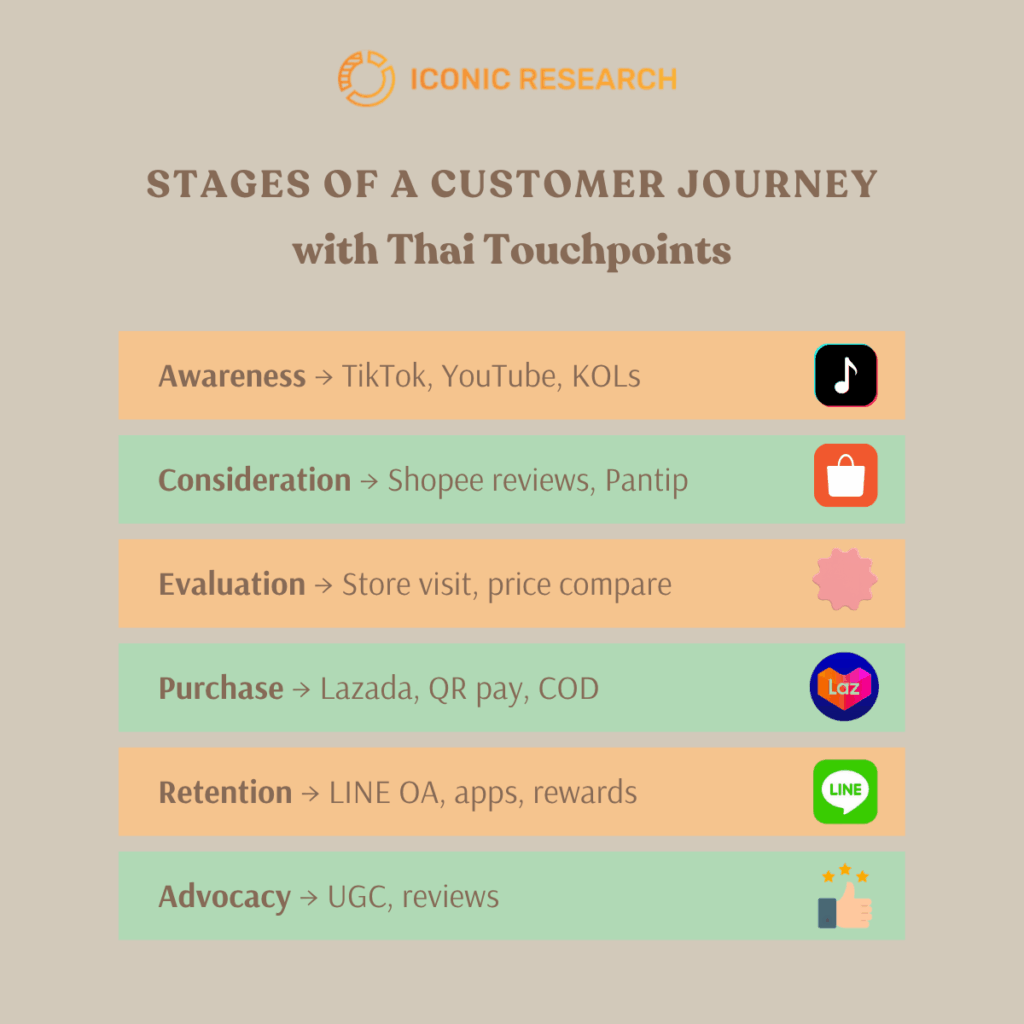
Each stage requires different customer experience strategies. Awareness demands cultural relevance, consideration needs social validation, purchase requires frictionless payment options, and retention depends on personalized LINE messaging that feels natural rather than intrusive.
What Is a Customer Journey Map and Why It Matters
A customer journey map visualizes customer experience across channels, identifying behaviors, emotions, pain points, and opportunities for improvement. Adobe highlights journey maps as a core tool for aligning teams and improving CX consistency across channels [1], while Contentsquare adds that they help brands prioritize high-impact improvements that deliver measurable results [2].
Core components of an effective customer journey map include:
- Touchpoints – spanning both online and offline interactions
- Customer goals – at each stage of their journey
- Emotions and motivations – driving decision-making
- Pain points and frictions – that create abandonment or dissatisfaction
- Success metrics – and drop-off points requiring attention
In Thailand’s context, customer journey mapping must account for unique touchpoints including LINE Official Account messages, Shopee and Lazada chat functions, in-store interactions with sales staff, PromptPay QR checkout processes, and post-purchase surveys delivered through preferred channels.
The ecommerce customer journey has evolved significantly as digital transformation reshapes retail. Thai consumers now expect seamless transitions between discovery on social platforms, research through reviews, purchase via mobile apps, and support through messaging—all integrated into a single, coherent experience.
How to Map Customer Journey: A Step-by-Step Approach
Learning how to map customer journey effectively requires combining structured methodology with cultural understanding. Based on best practice frameworks [1][2], here’s a proven six-step approach:
1. Define Your Persona: Clearly identify whether you’re mapping journeys for Thai retail shoppers, B2B buyers, Gen Z consumers, or other specific segments. B2B international customer journey mapping requires particular attention to longer sales cycles, multiple stakeholders, and complex approval processes.
2. Collect Customer Insights: Gather both qualitative and quantitative data through surveys, interviews, digital behavior analytics, and social listening. Understanding actual customer behavior rather than assumed behavior is crucial for accurate mapping.
3. Map All Touchpoints: Document every interaction point including LINE conversations, TikTok discovery, offline retail visits, and payment processes. Don’t overlook the offline customer journey—physical touchpoints often play decisive roles even for digitally-savvy consumers.
4. Identify Pain Points and Emotions: Discover where customers experience hesitation, confusion, or distrust. Understanding emotional states at each stage helps brands address underlying concerns rather than just surface symptoms.
5. Align Internal Teams: Ensure customer experience, marketing, product, and retail teams share a common understanding of the customer journey and collaborate on improvements.
6. Iterate and Optimize: Continuously test, learn, and refine based on actual performance data and evolving customer behavior. Customer journeys change as technology and preferences evolve.
Related concepts that enhance journey mapping include customer journey discovery research, customer journey case study analysis, and cross-functional workshops that bring diverse perspectives to the mapping process.
Market Research’s Role in Customer Journey Mapping
Market research provides the foundation for accurate, actionable journey mapping. Without proper research, journey maps reflect assumptions rather than reality.
Essential Research Methods:
Research Method | Application | Insight Type |
Consumer Surveys & Segmentation | Demographic and psychographic patterns | Quantitative behavior data |
Social Listening | Real-time sentiment analysis | Authentic customer voice |
CX Analytics & Heatmaps | Digital behavior tracking | Actual usage patterns |
In-Depth Interviews | One-on-one qualitative research | Motivations and pain points |
Customer Journey Discovery | Ethnographic research | Unmet needs identification |
AI Sentiment Analysis | Review and social media analysis | Scale insights automation |
Contentsquare emphasizes that journey mapping improves decision-making because it makes customer reality visible rather than relying on assumptions [2].
B2B International Customer Journey Mapping Considerations:
B2B journeys differ significantly from consumer journeys, requiring additional research depth:
- Multiple decision-makers and stakeholders
- Extended evaluation cycles (weeks to months)
- Higher proof requirements (ROI, performance data, TCO)
- Hybrid digital-physical negotiation processes
- Distributor and partnership touchpoints
In Thailand’s B2B context, journey mapping must account for relationship-driven sales processes, face-saving communication styles, and hierarchical approval structures that influence purchasing decisions.
Digital Transformation and the Evolving Customer Journey
The digital transformation customer journey has fundamentally changed how brands interact with customers. In Thailand, key shifts include:
LINE commerce integration where the messaging platform serves simultaneously as CRM system and sales channel
QR payment normalization making mobile transactions effortless
Social commerce platforms like TikTok Shop and Facebook Live enabling discovery-to-purchase within single platforms
Customer Data Platforms providing unified views across touchpoints
AI-powered personalization adapting experiences to individual preferences
Adobe notes that journey mapping and modern customer experience systems must evolve alongside rising consumer expectations [1]. In Thailand’s market, LINE operates as both customer relationship management tool and sales channel, social commerce can represent over 40% of product discovery, and some brands now manage full-funnel marketing inside single platforms.
Conclusion: Customer Journey Strategy for 2025
The customer journey is no longer linear. In Thailand, it’s hybrid, mobile-first, and conversational—requiring brands to design for actual behavior rather than theoretical funnels.
Success requires:
- Treating offline and online as one continuous pathway
- Optimizing for fast, conversational interactions
- Using data to reduce friction points
- Localizing content and trust signals for Thai culture
- Continuously refining based on real insights
Brands investing in comprehensive journey mapping differentiate through superior customer experience, effective personalization, and improved lifetime value. As Adobe states: Journey mapping is now critical to meeting customer expectations across every channel [1].
Frequently Asked Questions
What is a customer journey?
A customer journey is the complete sequence of interactions a customer experiences with a brand before, during, and after purchase, including online and offline touchpoints.
What are the main stages of a customer journey?
The stages include awareness, consideration, evaluation, purchase, retention, and advocacy—each requiring different strategies and touchpoints.
How do you map a customer journey?
Map customer journeys by defining personas, collecting insights, documenting touchpoints, identifying pain points, aligning teams, and continuously optimizing based on data.
Why is customer journey mapping important in Thailand?
Thai consumers blend LINE messaging, social commerce, and physical retail in unique ways, requiring hybrid journey mapping that accounts for mobile-first, conversational behaviors.
What is B2B customer journey mapping?
B2B international customer journey mapping tracks longer sales cycles with multiple stakeholders, higher proof requirements, and complex approval processes across digital and physical channels.
References
[1] Adobe. “The customer journey map and why it’s important.” https://business.adobe.com/blog/basics/what-is-customer-journey-map
[2] Contentsquare. “10 Major Benefits of Customer Journey Mapping.” https://contentsquare.com/guides/customer-journey-map/benefits/
[3] Pantouvakis, A. “Theoretical and Practical Evolution of Customer Journey in Services.” MDPI, 2022. https://www.mdpi.com/2071-1050/14/15/9610
[4] Walker XM. “Customer journey mapping and why it’s important.” https://walkerxm.com/blog/what-is-customer-journey-mapping-why-is-it-important
[5] Jaipeng C., Udomraksasup P. “Customer Journey Analysis to Selecting Accommodation During the New Normal Situation of Thai Tourists.” TNSU Journal, 2024. https://he02.tci-thaijo.org/index.php/TNSUJournal/article/view/263014
[6] Everyday Marketing. “วิเคราะห์ Customer Journey Mapping จากรายงานผู้บริโภคในประเทศไทย.” https://everydaymarketing.co/consumer-insights/customer-journey-mapping-analysis-from-niq-thailand-consumer-report/
If you wish to quote any information from this article, please kindly cite the source along with the link to the original article to respect copyright. |
 |
Iconic Research Thailand Your trusted partner in market research and consulting across Thailand and Southeast Asia. Headquartered in Bangkok, we provide research-driven insights across the Philippines, Malaysia, Indonesia, Singapore, Laos, and Vietnam. We help businesses navigate Thailand's market complexities through consumer insights, market entry strategy, and trend foresight. Contact us if you have any queries! (+66)888 954 954 |
Contact us
We always looking for new and exciting opportunities. Let’s connect.
Related posts
 AI Thailand: The Opportunity Is Real, But So Is the Complexity
Thailand’s AI market is projected to reach 114 billion baht by 2030, yet most Thai consumers remain cautious. Understanding who they are – and what they actually need from AI – is the difference between a product that lands and one that doesn’t.
13 min read Thailand 4.0 in 2026: An Investor’s Blueprint for the Innovation Economy
Thailand 4.0 has reached a defining year in 2026 – transitioning from policy vision to operational reality with AI integration, EV manufacturing, and digital infrastructure driving the innovation economy.
9 min read Unlocking the “Why” Behind Thai Culture: Introducing PhumPanya
Thai culture can feel like a puzzle. At PhumPanya, we believe the key to understanding Thai language and culture is in the words themselves. Explore our free database of Thai words, their roots, and the cultural logic hidden inside the language.
3 min read