

Healthcare Market Research in Thailand: What to Know Before You Brief
10 min readThailand’s healthcare sector covers the full spectrum — hospital services and primary care delivered through the public and private systems, medical tourism, pharmaceuticals, medical devices and MedTech, biotech, and an expanding digital health layer. Each segment operates under different regulatory frameworks, procurement structures, and respondent dynamics, and each presents its own research challenges.
Table of Contents
- What Each Sector Needs from Research
- The Briefing Mistakes That Cost Time and Money
- Getting the Brief Right Is the Research
- Sources
This article focuses on the four product and technology industries where briefing mistakes are most costly: pharmaceuticals, medical devices and MedTech, biotech, and digital health. These are the sectors where a poorly constructed brief most reliably produces fieldwork that cannot answer the commercial question it was commissioned to address.
This article is not a market overview. For context on Thailand’s pharmaceutical sector, see our Thailand Pharmaceutical Industry analysis. For the broader Medical Hub framework, see Thailand as a Medical Hub. What follows is what each sector needs from research and what goes wrong in the briefing process.
What Each Sector Needs from Research
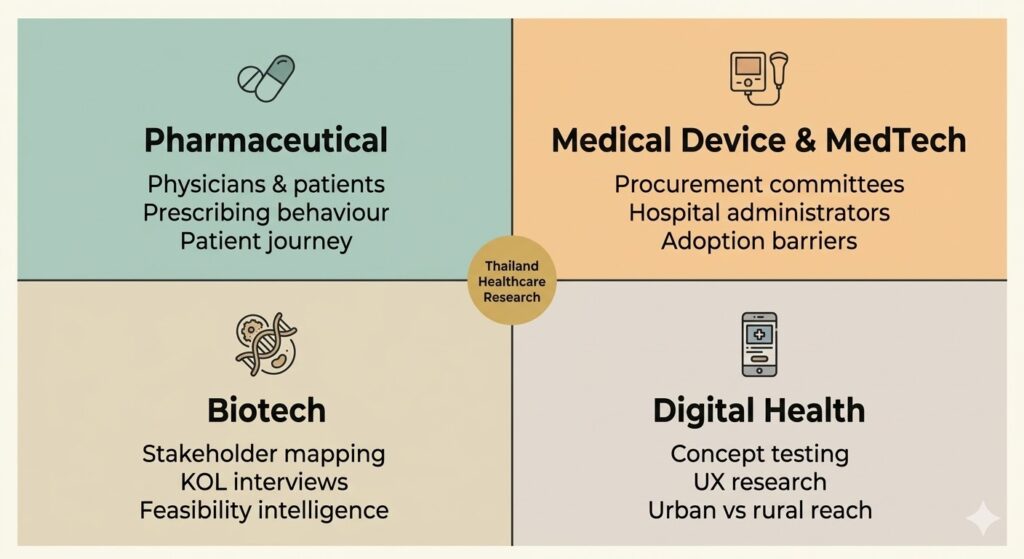
Pharmaceutical
The commercial question in pharma research is almost always about behaviour and influence: what physicians prescribe, why they prescribe it, and where brand perception is working for or against a product. In practice, this demands physician research with verified specialists — not GPs recruited from online panels — conducted in settings where doctors will speak candidly about prescribing rationale rather than give socially acceptable answers about clinical guidelines.
Patient journey research carries a specific meaning in the Thai context. Thailand’s public-private divide creates non-linear journeys: patients frequently begin in the public system, receive a diagnosis, then migrate to private hospitals for branded treatment. A patient journey study that only captures the private hospital segment misses the diagnostic origin and the referral dynamics that actually drive prescribing.
Clinical trials are a separate but related track. Thailand conducted 527 clinical trials in 2024, the highest volume in ASEAN [1]. Companies building regional clinical research programmes here need primary research to understand physician attitudes toward trial participation and realistic patient recruitment windows before committing to site selection.
Medical Device and MedTech
The medical device industry in Thailand operates at USD 2.23 billion in 2024 [2]. Research questions here are fundamentally different from pharma: procurement decisions involve hospital administrators, biomedical engineers, and department heads — not prescribing physicians. The purchasing pathway runs through Thailand’s government e-bidding system for public hospitals, or through distributor relationships for private ones.
Research for medical device and MedTech companies entering Thailand needs to map decision-maker hierarchies, not treatment attitudes. The buyer is not the clinician. A brief that specifies surgeons as the target respondent for a capital equipment study is describing the wrong person — the surgeon influences the specification, but the procurement committee and hospital administrator decide.
Chinese and Korean device manufacturers are firmly established in Thailand’s public hospital segment, competing on price with clinical validation built over years [3]. Foreign entrants need to understand institutional inertia favouring incumbent suppliers — a question that requires qualitative depth with procurement decision-makers, not attitude surveys with clinicians.
Biotech
Biotech in Thailand is an earlier-stage commercial opportunity than pharma or medical devices. The research questions are consequently different: stakeholder mapping of the institutional ecosystem (NSTDA, TCELS, BOI-affiliated research institutions), expert interviews with key opinion leaders in cell therapy and genomics, and regulatory intelligence rather than prescriber surveys.
Thailand has been building its biotech credentials through TCELS and government investment in precision medicine and cell and gene therapy [4]. Companies assessing Thailand’s biotech environment are typically asking feasibility questions — who are the right partners, what are realistic technology transfer timelines, which regulatory pathway applies to their product — rather than brand or prescribing questions. The brief needs to specify the stakeholder types and the exact feasibility questions being answered. A general healthcare research agency briefed without this level of specificity produces thin output.
Digital Health
Digital health in Thailand reached USD 1.03 billion in 2024, with telemedicine projected to grow at 29.1% CAGR through 2030 [5]. Research questions here are the most consumer-facing of the four: product concept testing, user experience research, and understanding how Thai patients engage with health apps and remote monitoring tools in practice.
The structural challenge unique to digital health research in Thailand is the urban-rural divide. Approximately 70% of Thailand’s population lives outside Bangkok, while 70% of medical specialists are concentrated in the capital [5]. Research briefs that recruit Bangkok professionals as a proxy for “Thailand” are measuring market fit for a fraction of the addressable population. Clinician attitudes toward digital tool adoption are also a separate research track from patient readiness and willingness to pay — briefs that conflate the two produce findings that cannot inform product decisions.
The Briefing Mistakes That Cost Time and Money
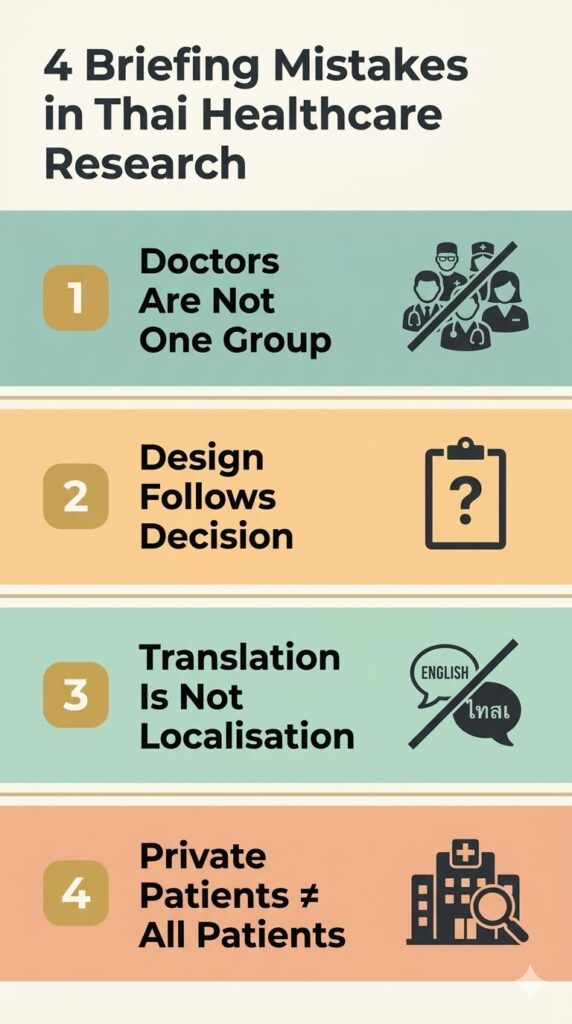
Mistake 1: Treating “Thai doctors” as a homogeneous group
Physician research in Thailand needs to distinguish between private clinic practitioners, public hospital staff physicians, hospital-based specialists in private institutions, and academic clinicians. These groups operate under different institutional pressures, have different relationships with pharmaceutical representatives, and respond differently in research settings.
A private clinic GP in Bangkok has prescribing autonomy and commercial relationships with pharma reps that differ entirely from a government hospital specialist writing within a formulary. Briefing for “HCP research” without specifying tier, setting, and specialty produces an analytically incoherent sample — you cannot draw valid conclusions about prescribing behaviour from a population that conflates these groups.
Mistake 2: Building the research design before specifying the commercial decision
“We need focus groups and a survey” is not a brief — it is a pre-determined research design that may or may not address the actual question. Before any methodological decision, a brief needs to specify what commercial decision will be made differently as a result of the research.
If the decision is whether to pursue Thai FDA registration for a branded generic, the research question is about prescriber awareness and generic substitution behaviour. If the decision is whether to enter through a distributor or a direct sales force, the research question is about hospital procurement dynamics and distributor landscape. The methodology follows the decision. When it precedes it, the research produces data that does not enable the decision it was commissioned to inform.
Mistake 3: Specifying “translation of English instruments” as localisation
Thai patients consistently underreport symptoms, treatment non-adherence, and dissatisfaction with care. Thai physicians in institutional settings provide answers calibrated to professional norms rather than actual behaviour. These are predictable cultural dynamics that research design can accommodate or ignore.
A topic guide built in English and translated into Thai does not solve this. Medical terminology, stigma around specific conditions, and the way patients describe symptoms to researchers versus to doctors are different registers. Materials need to be built in Thai first, by researchers who understand the clinical and cultural context simultaneously. Briefs that treat translation as localisation are setting up artefact production, not insight generation.
Mistake 4: Scoping patient journey research around the private hospital segment
Patient journey research in the Thai medical industry frequently fails because it defaults to the private hospital segment — the accessible, English-speaking, urban population that is easy to recruit. This segment is real but unrepresentative.
Thailand’s healthcare system operates across a stark divide: well-resourced private hospitals on one side; the public system serving approximately 75% of the population under Universal Coverage on the other. A patient journey study that only reaches private hospital patients is measuring a premium segment’s experience of a system that most Thai patients never use. The brief needs to specify which system is in scope — and if both, the research design needs to account for them separately.
Getting the Brief Right Is the Research
In healthcare and MedTech research, the brief is not the preamble to the work — it is where research quality is determined. An under-specified brief produces a mixed sample, instruments that generate socially acceptable answers, and findings that cannot be tied to a commercial decision.
For companies entering Thailand’s healthcare or medical industry — whether in pharmaceuticals, MedTech, biotech, or digital health — the quality of the research foundation directly determines the quality of the market entry decision. Iconic Research’s healthcare market research services in Thailand are built around getting this right from the brief stage, not after fieldwork has started.
For broader context before scoping research, our Thailand Medical Hub intelligence article covers the government framework and sector structure. Our Thailand Pharmaceutical Industry analysis covers the pharma landscape in depth.
Frequently Asked Questions
What is the difference between pharma and MedTech research in Thailand?
Pharma research targets prescribing physicians and patients. MedTech research targets procurement committees, biomedical engineers, and hospital administrators. The respondent types, recruitment approach, and analytical framework are entirely different.
Why does the brief matter so much in Thai healthcare research?
Restricted respondent access and a dual public-private system make sampling decisions consequential. An under-specified brief defaults to the easiest-to-recruit sample — urban, private-sector, Bangkok-based — which is unrepresentative for most commercial questions.
How long does physician research take in Thailand?
Specialist physician studies typically require 4–8 weeks from finalised brief to completed fieldwork, depending on specialty and sample size.
What does "physician research" mean in the Thai context?
It requires specifying practitioner type, setting (private clinic, public hospital, academic centre), and verification standard. Treating "doctors" as a homogeneous group produces samples that cannot support valid prescribing behaviour conclusions.
Does the same agency cover pharma, MedTech, biotech, and digital health?
Only if it has verified respondent networks and domain experience across all four. Strong pharma physician networks do not automatically translate to MedTech procurement research or digital health UX work.
Sources
- Bangkok Post. Challenges to clinical trial growth in Thailand. https://www.bangkokpost.com/business/general/3121113/challenges-to-clinical-trial-growth-in-thailand
- Nexdigm. Thailand Medical Devices Market Report 2024. https://www.nexdigm.com/market-research/report-store/thailand-medical-devices-market-report/
- Intralink Group. Thailand: A booming if challenging medtech market. https://www.intralinkgroup.com/latest/intralink-insights/thailand-a-booming-if-challenging-medtech-market
- GeneOnline. Thailand’s Biotech Boom: Innovations in Precision Medicine, Cell Therapy, and Wellness Drive APAC Leadership. https://www.geneonline.com/thailands-biotech-boom-innovations-in-precision-medicine-cell-therapy-and-wellness-drive-apac-leadership/
- Grand View Research. Thailand Telehealth Market Size, Share & Trends Analysis 2024–2030. https://www.grandviewresearch.com/industry-analysis/thailand-telehealth-market-report
If you wish to quote any information from this article, please kindly cite the source along with the link to the original article to respect copyright. |
 |
Iconic Research Thailand Your trusted partner in market research and consulting across Thailand and Southeast Asia. Headquartered in Bangkok, we provide research-driven insights across the Philippines, Malaysia, Indonesia, Singapore, Laos, and Vietnam. We help businesses navigate Thailand's market complexities through consumer insights, market entry strategy, and trend foresight. Contact us if you have any queries! (+66)888 954 954 |
Contact us
We always looking for new and exciting opportunities. Let’s connect.
Related posts
 Growth Strategy: The Expansion Decisions That Need Evidence
Growth strategy is the set of decisions about where a company expands next. Only 25% of companies grow sustainably — the difference is evidence, not ambition.
9 min read Brand Strategy: The Decisions That Should Be Built on Evidence
Brand strategy is the set of decisions that determine how a brand competes. Those decisions only pay off when they’re built on consumer evidence — not a workshop.
11 min read Key Opinion Leader: What Thai Brands Should Research Before, During, and After a KOL Campaign
Platform metrics mislead brands choosing and measuring KOLs in Thailand. A research-first look at what to verify before, during, and after a campaign.
10 min read