

Thailand’s Automotive Industry Transformation: Thailand’s position as ASEAN’s largest automotive hub is being reshaped by electric vehicle adoption, Chinese brand expansion, and a shift from price competition to trust-based consumer decisions.
Table of Contents
- The Global Context: Thailand as EV Battleground
- EV Automotive Industry Competitive Analysis: The 2026 Market Structure
- Thailand Auto Industry Reality: The “Liquidation” Phase
- The Core Conflict: The “Trust Crisis”
- The Policy Cliff: The Car Manufacturing Industry “Production Trap”
- Data Analytics & Automotive Industry Experts: Winning the Trust War
- Conclusion: Survival of the Fittest in Thailand’s Automotive Industry
- References
Walking through the Impact Challenger Hall at Motor Expo 2025 this week, the sheer scale of the event was undeniable. The floor space was dominated not by concepts, but by production-ready electric vehicles (EVs) from brands that didn’t exist in Thailand three years ago. The crowds were massive, the booths were glossy, and the sales teams were aggressive.
But looking past the energetic brochure-waving, the mood has shifted. In 2023, the atmosphere was one of Curiosity (“How far can it drive?”). In 2024, it was Excitement (“Look how cheap it is!”). Now, at the close of 2025, the mood is one of Calculation (“Will this brand be here in five years?”).
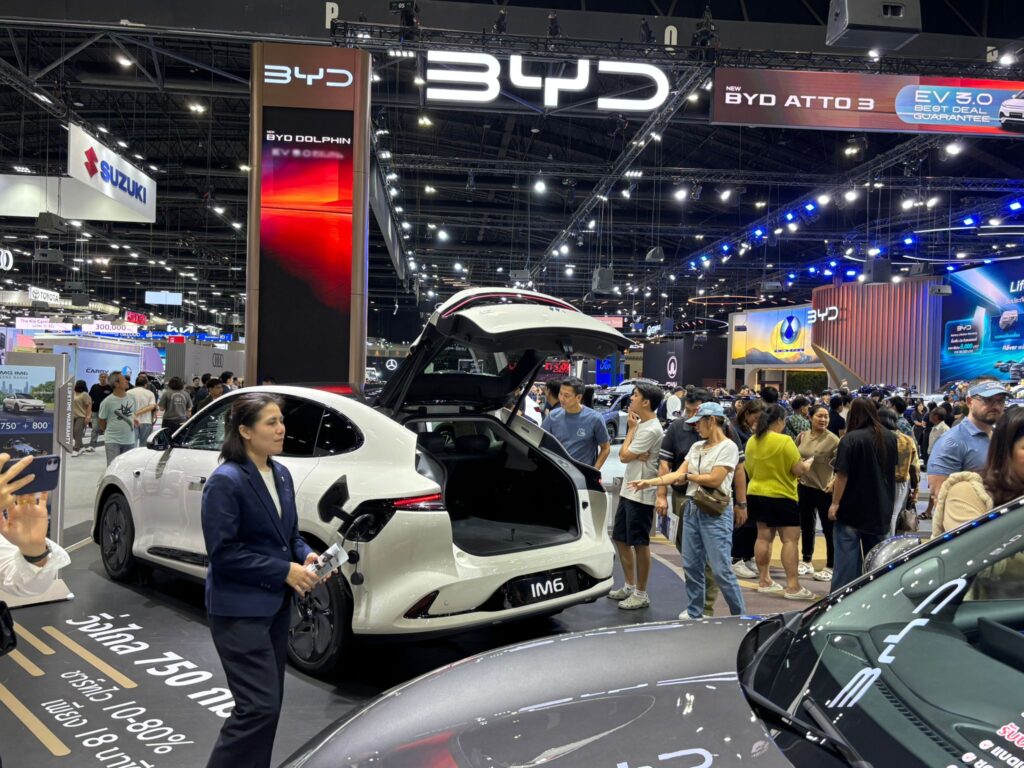
We are witnessing a fundamental pivot in the Thailand automotive industry. While electric vehicles represent approximately 18% of total market share, this EV segment is where the most dramatic transformation is occurring. Traditional leaders like Toyota and Honda maintain overall market dominance, but the EV battlefield is being reshaped by Chinese entrants and poses strategic questions for established players. The “Honeymoon Phase” of early adoption is over. As we head into 2026, the Thai EV market is moving from a brutal Price War to a strategic Trust War.
The Global Context: Thailand as EV Battleground
Thailand’s automotive market has become the primary battleground for China’s global export push. According to PwC Strategy&, global EV sales hit record highs in Q3 2025, surging 35% year-on-year [1]. However, as Western markets erect tariff walls, Chinese OEMs are diverting their immense capacity to Southeast Asia.
China broke the 2 million unit export barrier in Q3 2025 alone [1]. For the Thailand auto industry, this means the influx of new models is not slowing down—it is accelerating, creating a market saturated with options but starved of certainty. Thailand’s strategic position as ASEAN’s automotive manufacturing hub makes it the critical testing ground for brands seeking regional dominance.
EV Automotive Industry Competitive Analysis: The 2026 Market Structure
Before diving into the numbers, it is crucial to understand the new hierarchy emerging from our EV automotive industry competitive analysis.
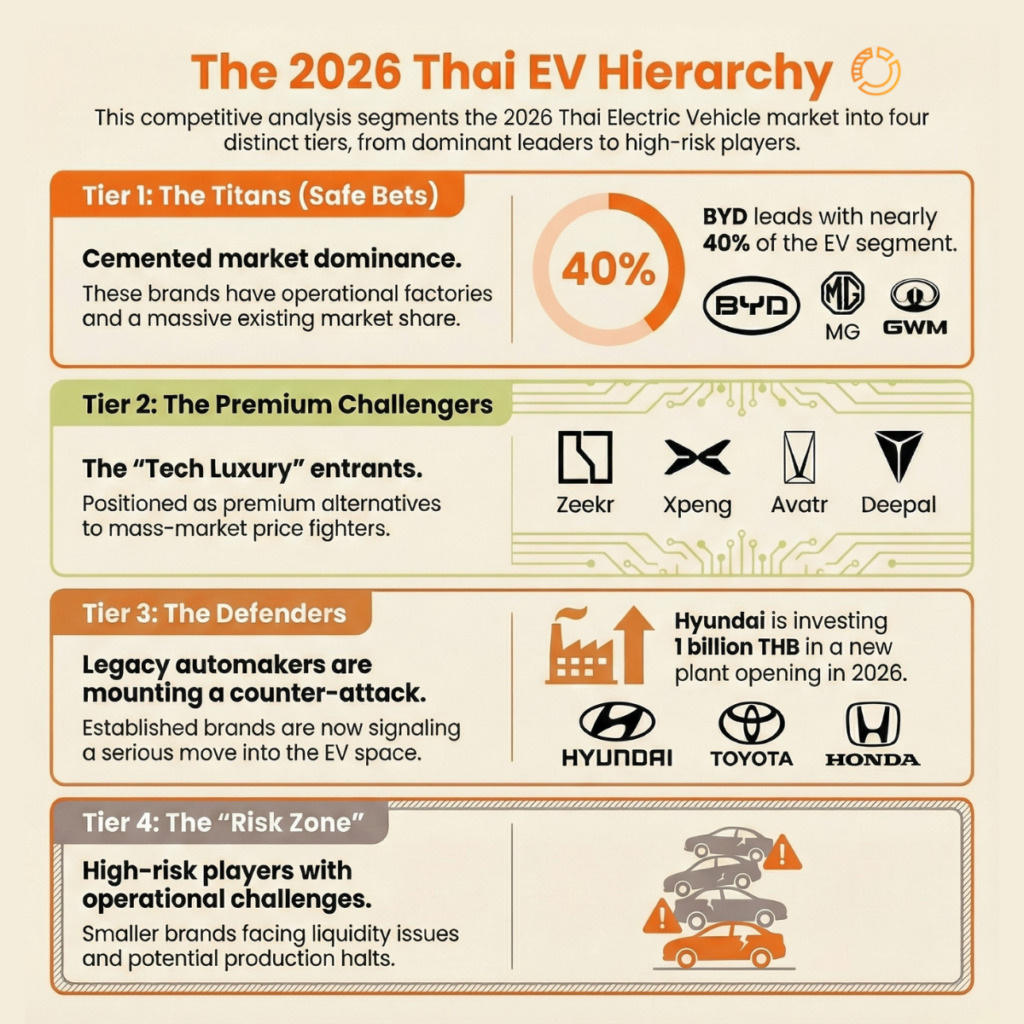
The Titans (Safe Bets): BYD, MG, GWM dominate the electric vehicle segment specifically, with BYD commanding nearly 40% of EV sales.
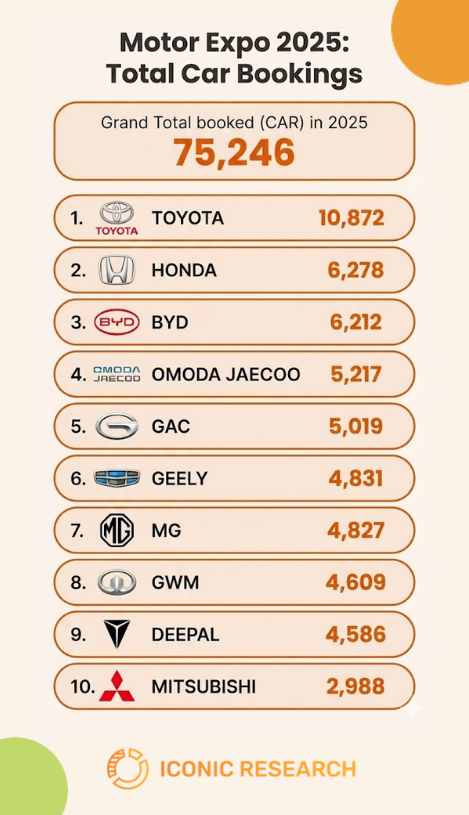
However, traditional leaders Toyota and Honda still control overall automotive market leadership, with Motor Expo 2025 bookings showing Toyota, Honda, and BYD as the top three brands across all powertrains. [5]. * As of 12.12.2025
The Premium Challengers: Zeekr, Xpeng, Avatr, Deepal. These entrants are fighting to prove they are “Tech Luxury,” distinct from the mass-market price fighters.
The Defenders: The Defenders: Toyota, Honda, and Hyundai. Despite maintaining overall market leadership (Toyota and Honda ranked #1 and #2 at Motor Expo 2025), these established brands lag in EV-specific offerings.
The “Risk Zone”: Smaller players facing liquidity issues and production halts. This is where consumer anxiety is highest and brand attrition will be most severe.
Thailand Auto Industry Reality: The “Liquidation” Phase
Q4 2025 has effectively become a “Liquidation Phase” for one simple reason: the money is running out.
With the generous 150,000 THB government subsidy expiring on December 31st, dealers are panic-selling inventory to lock in the cash for their customers. While the 28,000+ bookings at the Motor Expo [5] look like a boom, they are actually “borrowed” sales. We are pulling demand from 2026 into 2025 to save money. Once the subsidy drops and prices rise in January, we expect a “hangover” effect where sales plummet significantly.
This dynamic reflects broader pressures across the market, where fiscal incentives have artificially inflated demand while masking underlying fragilities.
The Core Conflict: The “Trust Crisis”
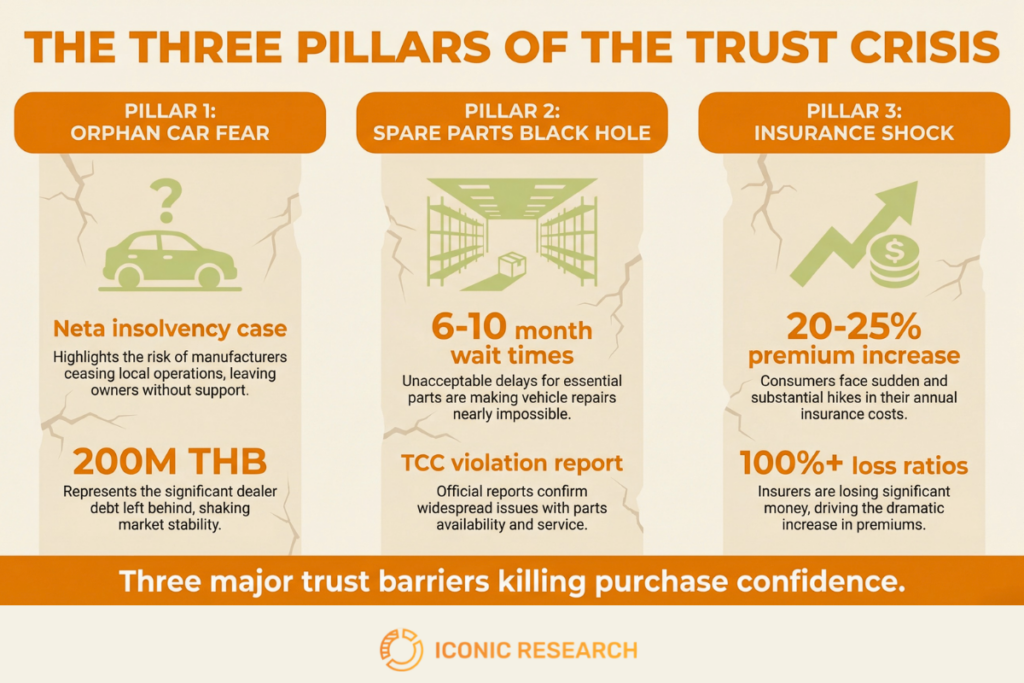
The most critical insight for automotive industry experts and marketers in 2026 is that Price is no longer the primary differentiator. The market has been rattled by the instability of early entrants, creating a “Trust Crisis.”
1. The “Orphan Car” Fear
In mid-2025, reports surfaced regarding the financial insolvency of Neta Auto’s parent company in China. Locally, this translated into severe operational friction, with 18 Thai dealers filing complaints over 200 million THB in unpaid debts [3].
For the Thai consumer, this was a wake-up call. The fear of owning an “Orphan Car”—a vehicle with no parent company to service it—has become the #1 barrier to purchase. Buyers are no longer just looking at the sticker price; they are auditing the company’s balance sheet.
2. The “Spare Parts” Black Hole
The Thailand Consumer Council (TCC) flagged “Lack of Spare Parts” as a critical consumer rights violation in their 2025 report [4]. Documented cases of EV car owners in Thailand waiting 6–10 months for collision repairs have circulated widely on social media.
This has destroyed the “Smart Buy” narrative. A cheap EV car in Thailand is not cheap if it sits in a garage for half the year waiting for a bumper.
3. The Insurance Shock
Perhaps the most tangible hit to consumer confidence is the rise in insurance premiums. In 2025, EV insurance premiums in Thailand jumped by 20–25%, with loss ratios for some insurers exceeding 100% (meaning they paid out more in claims than they collected) [5].
Some insurers have responded by doubling deductibles or refusing to cover “High Risk” brands entirely. This financial reality is eroding the “Low Cost of Ownership” advantage that EVs previously enjoyed over internal combustion engines.
The Policy Cliff: The Car Manufacturing Industry “Production Trap”
Looking ahead to 2026, the supply side of the car manufacturing industry faces its own crisis. Under the BOI’s conditions, the ratio for mandatory local production doubles.
- 2024-2025: Produce 1 local car for every 1 imported (1:1)
- 2026 Onward: Produce 2 local cars for every 1 imported (1:2) [2]
This creates a “Production Trap.” Brands must ramp up manufacturing to avoid penalties, even if market demand softens. We expect this to lead to a flood of “Tactical Registrations” (brands buying their own cars) and further volatility in resale values.
For the Thailand automotive industry, this policy shift will separate serious long-term players from opportunistic short-term entrants. Only brands with committed manufacturing infrastructure will survive the 2026 consolidation.
Data Analytics & Automotive Industry Experts: Winning the Trust War
At Iconic Research, we have helped automotive industry clients navigate this exact transition.
Our approach combines data analytics automotive industry expertise with deep qualitative consumer research, revealing that purchase decisions now hinge on three trust pillars: brand longevity signals, service network density, and parts availability guarantees. Data analytics in the automotive industry enables precise tracking of sentiment shifts, while automotive industry experts interpret these patterns within Thailand’s cultural and economic context.

Case Study: Engineering Premium EV Value Perception
How we helped a premium EV challenger brand command their price point in Thailand’s Trust War by quantifying intangible ownership security drivers. Using advanced conjoint analysis and competitor service audits, we revealed that Thai luxury buyers prioritize resale value guarantees over technology specs—enabling successful positioning against European marques. [Read the Full Case Study]
Case Study: Localizing Product Fit for ASEAN B-MPV Market
How our automotive industry research prevented a manufacturer from launching features that failed to address real Thai family needs. Through ethnographic consumer studies and comparative user research across Philippines, Vietnam, and Thailand, we validated culturally-specific innovations like flood detection and motorcycle collision avoidance—features that solve genuine daily problems rather than showcase technology. [Read the Full Case Study]
Case Study: Chinese EV Market Research in Southeast Asia
How we coordinated multi-country consumer research across five ASEAN markets to map brand perception and purchase drivers for Chinese electric vehicles. Our qualitative research revealed that Chinese EVs are increasingly viewed as technological trendsetters rather than budget alternatives—challenging assumptions about skepticism and enabling strategic positioning in Thailand’s competitive automotive industry landscape. [Read the Full Case Study]
Conclusion: Survival of the Fittest in Thailand’s Automotive Industry
The “Gold Rush” era of the Thai EV market is over. 2026 will be the year of consolidation. We expect smaller players to exit or merge, while the “Titans” and “Defenders” fight for the remaining market share.
For new entrants to the EV Thailand market, the lesson is clear: You cannot win a Trust War with a Price War strategy. To survive 2026, you must stop selling cars and start selling certainty.
The automotive industry experts who recognize this fundamental shift—and adapt their strategies accordingly—will emerge as the long-term winners in Southeast Asia’s most dynamic automotive market.
Frequently Asked Questions
Which brands are committed to local car manufacturing in Thailand?
BYD, MG, GWM, Changan, and Hyundai have operational or planned production facilities meeting BOI's 2:1 local production requirements.
What are the key trust barriers in Thailand's automotive industry EV segment?
Three critical barriers: orphan car risk from brand instability, 6-10 month spare parts wait times, and 20-25% insurance premium increases.
How should automotive industry experts approach the 2026 Trust War?
Shift from performance marketing to ownership security messaging—emphasize resale value guarantees, service network density, and parts availability over specifications.
References
[1] PwC Strategy&. “Electric Vehicle Sales Review Q3-2025.” https://www.strategyand.pwc.com/de/en/industries/automotive/electric-vehicle-sales-review-q3-2025.html
[2] Board of Investment (BOI). “Incentive Measures for EV 3.5 Project.” https://www.boi.go.th/index.php?page=press_releases_detail&topic_id=134676&_mod&language=en
[3] Bangkok Post. “Detailing Neta’s Fall from Grace: Dealer Debt Crisis.” https://www.bangkokpost.com/business/motoring/3067716/detailing-netas-fall-from-grace
[4] The Nation Thailand. “Thailand Consumer Council Annual Report on Automotive Sector.” https://www.nationthailand.com/business/automobile/40051076
[5] The Nation Thailand. “EV Sales Soar to 18% Share as Market Edges Up.” https://www.nationthailand.com/business/automobile/40054156
[6] Bangkok Post. “Hyundai Allocates B1bn for Electric Vehicle Expansion.” https://www.bangkokpost.com/business/general/2855832/hyundai-allocates-b1bn-for-electric-vehicle-expansion
If you wish to quote any information from this article, please kindly cite the source along with the link to the original article to respect copyright. |
 |
Iconic Research Thailand Your trusted partner in market research and consulting across Thailand and Southeast Asia. Headquartered in Bangkok, we provide research-driven insights across the Philippines, Malaysia, Indonesia, Singapore, Laos, and Vietnam. We help businesses navigate Thailand's market complexities through consumer insights, market entry strategy, and trend foresight. Contact us if you have any queries! (+66)888 954 954 |
Contact us
We always looking for new and exciting opportunities. Let’s connect.
Related posts
 AI Thailand: The Opportunity Is Real, But So Is the Complexity
Thailand’s AI market is projected to reach 114 billion baht by 2030, yet most Thai consumers remain cautious. Understanding who they are – and what they actually need from AI – is the difference between a product that lands and one that doesn’t.
13 min read Thailand 4.0 in 2026: An Investor’s Blueprint for the Innovation Economy
Thailand 4.0 has reached a defining year in 2026 – transitioning from policy vision to operational reality with AI integration, EV manufacturing, and digital infrastructure driving the innovation economy.
9 min read Unlocking the “Why” Behind Thai Culture: Introducing PhumPanya
Thai culture can feel like a puzzle. At PhumPanya, we believe the key to understanding Thai language and culture is in the words themselves. Explore our free database of Thai words, their roots, and the cultural logic hidden inside the language.
3 min read