
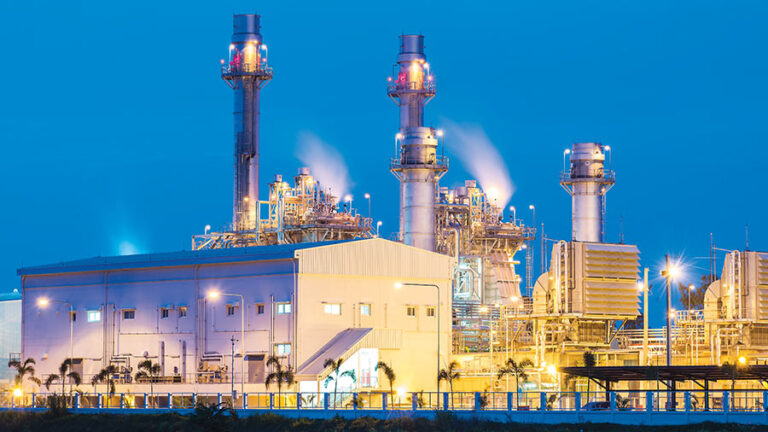
Thailand manufacturing has been a cornerstone of Southeast Asia’s industrial economy for more than four decades. As one of the region’s most advanced production bases — combining deep automotive and electronics supply chains with an increasingly sophisticated push into high-value industries — Thai manufacturing sits at the intersection of established industrial strength and active government-led transformation. This article provides strategic intelligence on Thailand’s major industries, the BOI and EEC investment frameworks, and the research that informs serious market entry and expansion decisions.
Table of Contents
- Thailand’s Manufacturing Sector: Scale and Structure
- Thailand’s Major Manufacturing Industries
- BOI Incentives and the Eastern Economic Corridor
- Thailand Digital Transformation and Industry 4.0
- Thailand Renewable Energy Policy and Green Manufacturing
- Challenges Facing Thailand Manufacturing
- Manufacturing Market Research in Thailand
- Conclusion
- Sources
Thailand’s Manufacturing Sector: Scale and Structure
Manufacturing accounts for approximately 25% of Thailand’s GDP, making it the single largest contributor to the economy ahead of services and agriculture. The sector employs close to 10% of the workforce, spanning production facilities in automotive, electronics, food processing, petrochemicals, and medical devices across industrial estates concentrated in the Central and Eastern regions.
Thailand’s manufacturing strength is built on a combination of factors that have sustained foreign investment for decades: a mature supplier ecosystem, deep port and logistics connectivity through Laem Chabang, a skilled technical workforce, and a regulatory environment that — while requiring navigation — offers genuine incentives for qualifying investment. The country sits at the centre of ASEAN and provides direct access to a regional consumer market of over 600 million people.
Thailand main industries by export value are electronics and electrical equipment, motor vehicles and automotive parts, and processed foods — together accounting for the majority of Thailand’s annual merchandise export revenue of over USD 280 billion.
Thailand’s Major Manufacturing Industries
Thailand’s manufacturing strength extends across several distinct sectors, each contributing to its position as one of Southeast Asia’s primary production hubs.
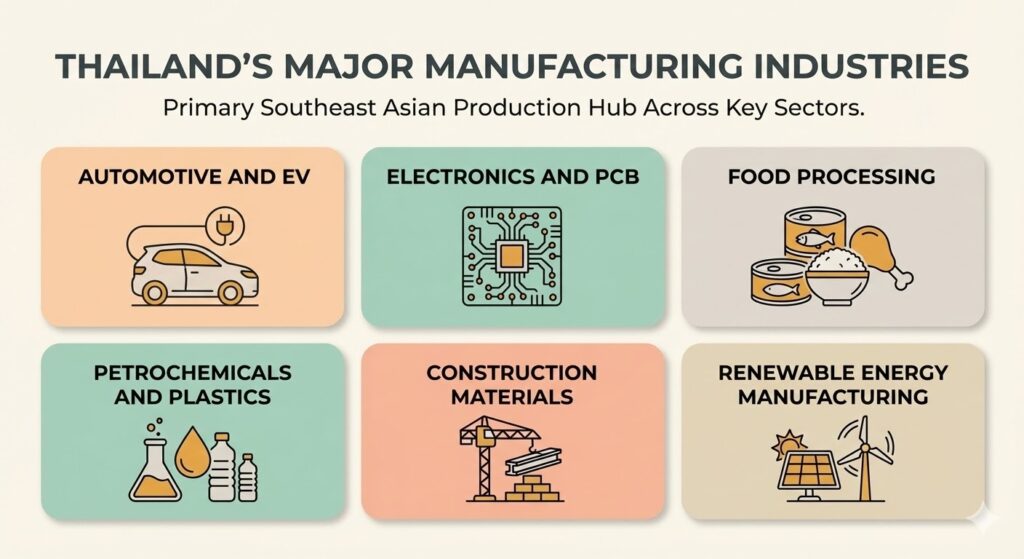
Automotive and EV remains the anchor of Thai manufacturing, accounting for roughly 10% of GDP. Thailand produces around 1.8 million vehicles annually and is actively repositioning as a regional EV manufacturing base. For a deeper analysis of this transition, see our Thailand Automotive Industry report.
Electronics and PCB production is the second pillar of Thailand major industries. Thailand is among the top global producers of hard disk drives and a significant manufacturer of printed circuit boards, semiconductors, and electrical appliances. The sector has attracted sustained Japanese and American investment and is now expanding into higher-value components as part of the Thailand 4.0 agenda and digital transformation push.
Food processing is Thailand’s most export-oriented manufacturing sector and one of the largest in Asia. As the world’s leading exporter of canned tuna, rice, and processed chicken, Thailand’s food manufacturing industry benefits from deep agricultural supply chains and proximity to regional markets. Agritech Thailand investment is accelerating this sector’s modernisation, with automation and traceability becoming baseline requirements for export compliance.
Petrochemicals and plastics form a less visible but economically significant segment, concentrated in Map Ta Phut Industrial Estate in Rayong — one of the largest integrated petrochemical complexes in Asia. This sector underpins Thailand’s packaging, automotive parts, and electronics manufacturing supply chains.
Construction materials and infrastructure manufacturing has grown alongside Thailand’s sustained infrastructure investment programme. Cement, steel, and prefabricated construction components represent a stable domestic demand base, with Thailand construction activity driving consistent output growth particularly in the EEC zone.
Renewable energy manufacturing is an emerging sector. Thailand’s renewable energy policy targets 33% of electricity from renewables by 2030 and 51% by 2037, creating domestic demand for solar panels, wind components, and energy storage systems that local manufacturers are beginning to serve.
BOI Incentives and the Eastern Economic Corridor
For any manufacturer evaluating Thailand seriously, two frameworks dominate the investment decision: the Board of Investment (BOI) incentive structure and the Eastern Economic Corridor (EEC).
BOI incentives are Thailand’s primary tool for attracting foreign manufacturing investment. Qualifying businesses can receive corporate income tax exemptions of up to eight years, import duty waivers on machinery and raw materials, and rights to own land — a significant concession in a market where foreign land ownership is otherwise restricted. Target sectors receiving the most generous BOI packages currently include EVs and automotive components, electronics and semiconductors, medical devices, food innovation, and digital infrastructure. Manufacturing investors typically engage BOI early in the feasibility process, before site selection and capital commitment.
The Eastern Economic Corridor is a special economic zone covering Chonburi, Rayong, and Chachoengsao provinces — Thailand’s industrial heartland. The EEC offers enhanced BOI privileges, streamlined regulatory processing through a one-stop service centre, world-class industrial estate infrastructure, and direct connectivity to Laem Chabang Port and U-Tapao International Airport. For manufacturers in automotive, electronics, and high-tech production, the EEC is typically the default location decision.
Thailand Digital Transformation and Industry 4.0
Thailand digital transformation is reshaping the country’s manufacturing base faster than at any previous point. The Thailand 4.0 strategy — a national economic model that has guided industrial policy since its launch — commits Thailand to moving from labour-intensive, export-driven production toward innovation-led, high-value manufacturing. In practical terms, this means increasing automation, IoT integration, AI-assisted production, and smart factory infrastructure across priority sectors.
The Thailand digital transformation market was valued at approximately USD 10 billion in 2025 and is projected to grow at a CAGR of around 8.75% through 2031, driven by government investment, hyperscale cloud infrastructure, and 5G deployment. Manufacturing is among the primary beneficiaries: the BOI offers dedicated incentive packages for smart industrial estates, and the EEC Automation Park serves as a knowledge and implementation hub for robotics and Industry 4.0 technologies.
For foreign manufacturers assessing Thailand, the digital transformation agenda has two direct implications. First, it signals where government capital and regulatory priority are directed — businesses investing in automation, smart manufacturing, and digital supply chains will find a more supportive environment than those maintaining purely labour-intensive models. Second, it is reshaping the competitive dynamics of Thai manufacturing relative to regional peers: as smart factory adoption increases, Thailand’s cost and quality proposition relative to Vietnam and Indonesia shifts in its favour for higher-complexity production.
Understanding which specific technologies are being adopted, at what pace, and by which types of manufacturers across the public and private estate requires primary research rather than published estimates.
Thailand Renewable Energy Policy and Green Manufacturing
Thailand renewable energy policy has reached an inflection point. The government’s revised Power Development Plan targets 33% of electricity generation from renewables by 2030 and 51% by 2037 — a substantial increase from the previous 20% target. Solar energy is the dominant technology, with Thailand’s estimated solar potential of approximately 300 GW vastly exceeding current installed capacity. The country is also expanding wind capacity, particularly in the northeast and south, and developing hybrid hydro-solar installations through the Electricity Generating Authority of Thailand (EGAT).
For manufacturers operating in Thailand or evaluating entry, the renewable energy transition creates both compliance expectations and commercial opportunities. Energy-intensive manufacturers in automotive, petrochemicals, and electronics are increasingly expected to demonstrate decarbonisation commitments by global customers and investors. Access to renewable power purchase agreements, green tariffs, and on-site generation has become a site selection consideration alongside traditional factors such as land cost and logistics connectivity.
The manufacturing opportunity is also direct: domestic demand for solar panels, energy storage systems, and wind components is growing, and the BOI offers incentives for renewable energy equipment production under its BCG (Bio-Circular-Green) economy framework. The TDRI has noted that declining solar generation costs — projected to fall a further 27% by 2030 — strengthen the investment case for both renewable power adoption and domestic manufacturing of solar equipment.
Challenges Facing Thailand Manufacturing
Thailand’s manufacturing sector, while robust, faces several key challenges in 2026. Rising operational costs and regional competition from Vietnam, Indonesia, and increasingly India are pushing manufacturers to adapt and innovate. The Thailand machinery industry particularly demonstrates resilience through strategic modernisation and efficiency improvements.
Three structural challenges shape the decisions of both existing manufacturers and new entrants.
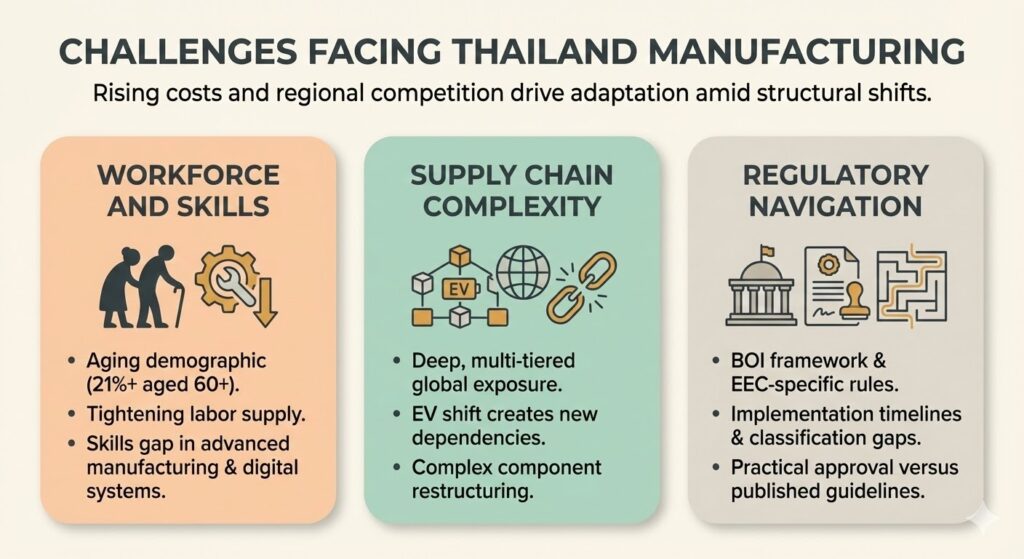
Workforce and skills. Thailand’s aging demographic — with over 21% of the population now aged 60 and above — is tightening the labour supply. While the industry has responded with automation investment, the transition creates a near-term skills gap in advanced manufacturing, digital systems, and technical roles. Manufacturers entering Thailand need a clear workforce strategy, not just a production plan. For deeper stakeholder intelligence on labour availability and workforce dynamics across specific regions and sectors, our Consumer & Stakeholder Insights provide primary research from verified industry participants.
Supply chain complexity. Thailand’s manufacturing supply chains are deep but increasingly multi-tiered and exposed to global disruption. The shift toward EV production, for example, is creating new component dependencies as traditional automotive supply chains are restructured around battery systems, power electronics, and software-defined vehicle architectures. Mapping supply chain risk and identifying local versus imported component strategies requires on-the-ground supplier intelligence.
Regulatory navigation. While Thailand’s BOI framework is broadly transparent, implementation timelines, sector classifications, and EEC-specific rules require direct engagement with relevant agencies. The gap between published guidelines and practical approval processes is meaningful.
Manufacturing Market Research in Thailand
Foreign companies making manufacturing investment decisions in Thailand consistently require primary intelligence that desk research and published reports cannot provide. Technical capability assessments, supplier qualification, workforce availability studies, competitor analysis, and market sizing for specific product categories all depend on direct access to industry participants — a requirement that generic panels and secondary data sources cannot satisfy.
At Iconic Research, we conduct manufacturing market research across industrial, automotive, electronics, food processing, and construction sectors. Two examples of our approach:
Machinery Industry Assessment. Working with a global industrial equipment manufacturer, we conducted comprehensive market analysis to understand the dynamics of Thailand’s machinery industry. Through primary research including expert interviews, technical assessments, and market analysis, we evaluated Thailand’s manufacturing capabilities, supply chain structure, and competitive positioning. The research directly informed the client’s market entry and distribution strategy. More detail is available through our Quantitative research services.
Market Entry Feasibility. We support manufacturers at the pre-entry stage with feasibility research covering market sizing, competitive landscape, regulatory requirements, and BOI qualification assessment — providing the primary intelligence needed to move from interest to commitment with confidence.
Conclusion
Thailand manufacturing in 2026 is defined by the convergence of established industrial depth and active government-led transformation. The country’s position as Southeast Asia’s most mature manufacturing base remains intact across automotive, electronics, food processing, and petrochemicals. Simultaneously, the Thailand 4.0 agenda, BOI incentive evolution, EEC development, and the renewable energy transition are reshaping what high-performing manufacturing investment looks like in Thailand.
For manufacturers and investors, the opportunity is substantial. What requires work is understanding the market at the level of specificity that capital decisions demand — capability assessments, supply chain intelligence, workforce research, and regulatory clarity — which is where primary research becomes the foundation for confident entry and growth.
Frequently Asked Questions
What are Thailand's major manufacturing industries?
Automotive and EV, electronics and PCB production, food processing, petrochemicals, construction materials, and an emerging renewable energy manufacturing sector.
What BOI incentives are available for manufacturers?
Up to eight years of corporate income tax exemption, import duty waivers on machinery and raw materials, and the right to own land for qualifying investments.
What is the Eastern Economic Corridor?
A special economic zone across Chonburi, Rayong, and Chachoengsao, offering enhanced BOI privileges, streamlined approvals, and direct port and airport connectivity.
How is Thailand's digital transformation affecting manufacturing?
The Thailand 4.0 strategy is driving automation, IoT, and smart factory adoption across priority sectors, with the BOI offering dedicated incentives for qualifying digital manufacturing investment.
What is Thailand's renewable energy target?
The revised Power Development Plan targets 33% of electricity from renewables by 2030 and 51% by 2037, driven primarily by solar expansion.
Sources
- Board of Investment Thailand. BOI Investment Promotion: Target Industries and Incentive Structure. https://www.boi.go.th/en/
- Eastern Economic Corridor Office of Thailand. EEC Overview: Infrastructure, Zones, and Investment. https://www.eeco.or.th/en
- Ember Energy. Thailand’s 2037 Power Sector Targets: Renewable Energy Development Plan Analysis. https://ember-energy.org/latest-insights/thailands-cost-optimal-pathway-to-a-sustainable-economy/thailands-2037-power-sector-targets/
- Mordor Intelligence. Thailand Digital Transformation Market Size and Forecast 2026–2031. https://www.mordorintelligence.com/industry-reports/thailand-digital-transformation-market
- TDRI (Thailand Development Research Institute). Thailand’s Path to Clean Energy: Solar, Wind, and Policies. https://tdri.or.th/en/2025/06/thailands-path-to-clean-energy-solar-wind-and-policies/
If you wish to quote any information from this article, please kindly cite the source along with the link to the original article to respect copyright. |
 |
Iconic Research Thailand Your trusted partner in market research and consulting across Thailand and Southeast Asia. Headquartered in Bangkok, we provide research-driven insights across the Philippines, Malaysia, Indonesia, Singapore, Laos, and Vietnam. We help businesses navigate Thailand's market complexities through consumer insights, market entry strategy, and trend foresight. Contact us if you have any queries! (+66)888 954 954 |
Contact us
We always looking for new and exciting opportunities. Let’s connect.
Related posts
 AI Thailand: The Opportunity Is Real, But So Is the Complexity
Thailand’s AI market is projected to reach 114 billion baht by 2030, yet most Thai consumers remain cautious. Understanding who they are – and what they actually need from AI – is the difference between a product that lands and one that doesn’t.
13 min read Thailand 4.0 in 2026: An Investor’s Blueprint for the Innovation Economy
Thailand 4.0 has reached a defining year in 2026 – transitioning from policy vision to operational reality with AI integration, EV manufacturing, and digital infrastructure driving the innovation economy.
9 min read Unlocking the “Why” Behind Thai Culture: Introducing PhumPanya
Thai culture can feel like a puzzle. At PhumPanya, we believe the key to understanding Thai language and culture is in the words themselves. Explore our free database of Thai words, their roots, and the cultural logic hidden inside the language.
3 min read