

Competitor analysis is the systematic evaluation of rival businesses’ strategies, strengths, weaknesses, and market positioning to identify competitive advantages and strategic opportunities. In Thailand’s rapidly digitizing market, it combines global frameworks with local consumer insights, social listening, and ASEAN regional dynamics to inform business decisions and maintain competitive edge.
Table of Contents
- Core Competitor Analysis Frameworks
- Steps to Conduct a Competitor Analysis
- Key Components of a Strong Competitor Analysis
- B2B and Industry-Specific Competitor Analysis
- Competitor Analysis in Thailand and Southeast Asia
- Case Study: Iconic Research Thailand
- Competitor Analysis Consulting
- Conclusion
- References
Core Competitor Analysis Frameworks
Various frameworks help businesses systematically analyze competition. Among the most widely used are:
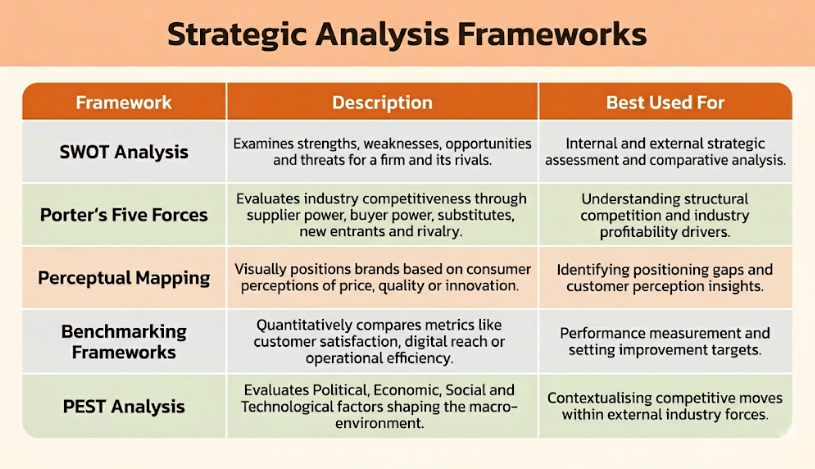
According to Cascade’s 2024 framework study, integrating at least two analytical models—one strategic (like Porter’s Five Forces) and one operational (like benchmarking)—yields the most actionable insights [2]. This combination ensures you understand both the big-picture competitive dynamics and the specific operational metrics that drive success in your industry.
Steps to Conduct a Competitor Analysis
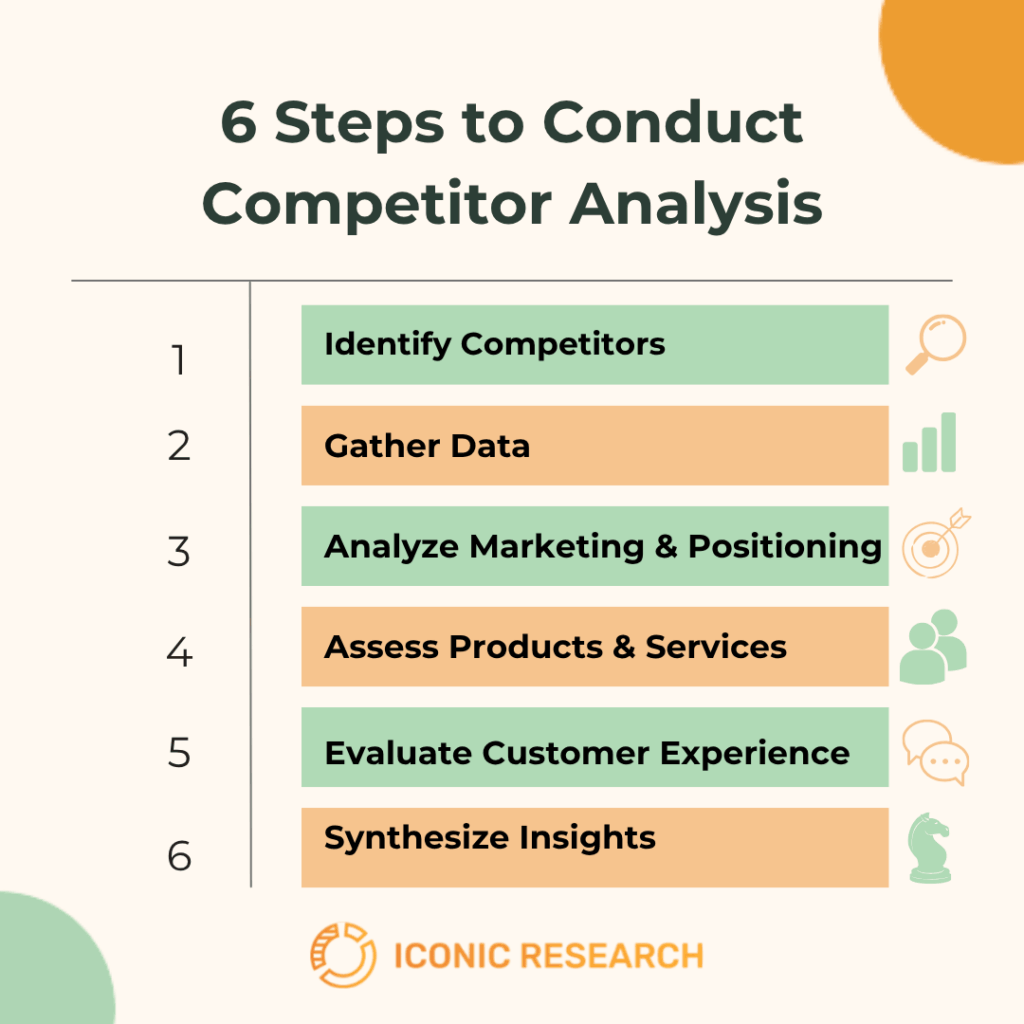
Slideworks recommends a six-step process to make competitor analysis scalable and repeatable [3]:
1. Identify key competitors. Build a list of direct and indirect players using industry databases, market reports, and social monitoring. Include adjacent industries and emerging disruptors.
2. Gather data. Collect from public filings, product catalogs, digital analytics, and customer feedback. Competitor analysis surveys provide primary data on customer perceptions across competing brands.
3. Analyze marketing and positioning. Review brand messages, pricing, SEO performance, and advertising tone — how competitors communicate value and which segments they prioritize.
4. Assess products and services. Compare features, value propositions, and customer satisfaction. Look beyond what competitors offer to how well they deliver on their promises.
5. Evaluate customer experience. Study reviews, social engagement, and support responsiveness. Customer sentiment often reveals competitive vulnerabilities invisible elsewhere.
6. Synthesize insights. Convert data into strategic actions — repositioning, new product launches, or partnership opportunities.
Iconic Research delivers competitor analysis across the full research spectrum. Consumer & Stakeholder Insight maps competitor positioning from the customer’s perspective. Mystery Shopping captures how competitors perform at the point of experience. Social Listening tracks how they are perceived in real-time conversation.
Key Components of a Strong Competitor Analysis
A complete competitor analysis includes several components working together to produce actionable intelligence:
Market Overview — market size, segmentation, and growth trends.
Competitive Positioning — where each brand sits in the customer’s mind and what differentiators they emphasize.
Pricing & Distribution — affordability, promotions, and channel advantages.
Customer Sentiment — voice-of-customer data that reveals what drives preference.
Digital Footprint — social media presence, ad campaigns, and online reputation.
Competitor SWOT Analysis — strengths, weaknesses, opportunities, and threats for each rival, with strategic implications for decision-making [1][3].
B2B and Industry-Specific Competitor Analysis
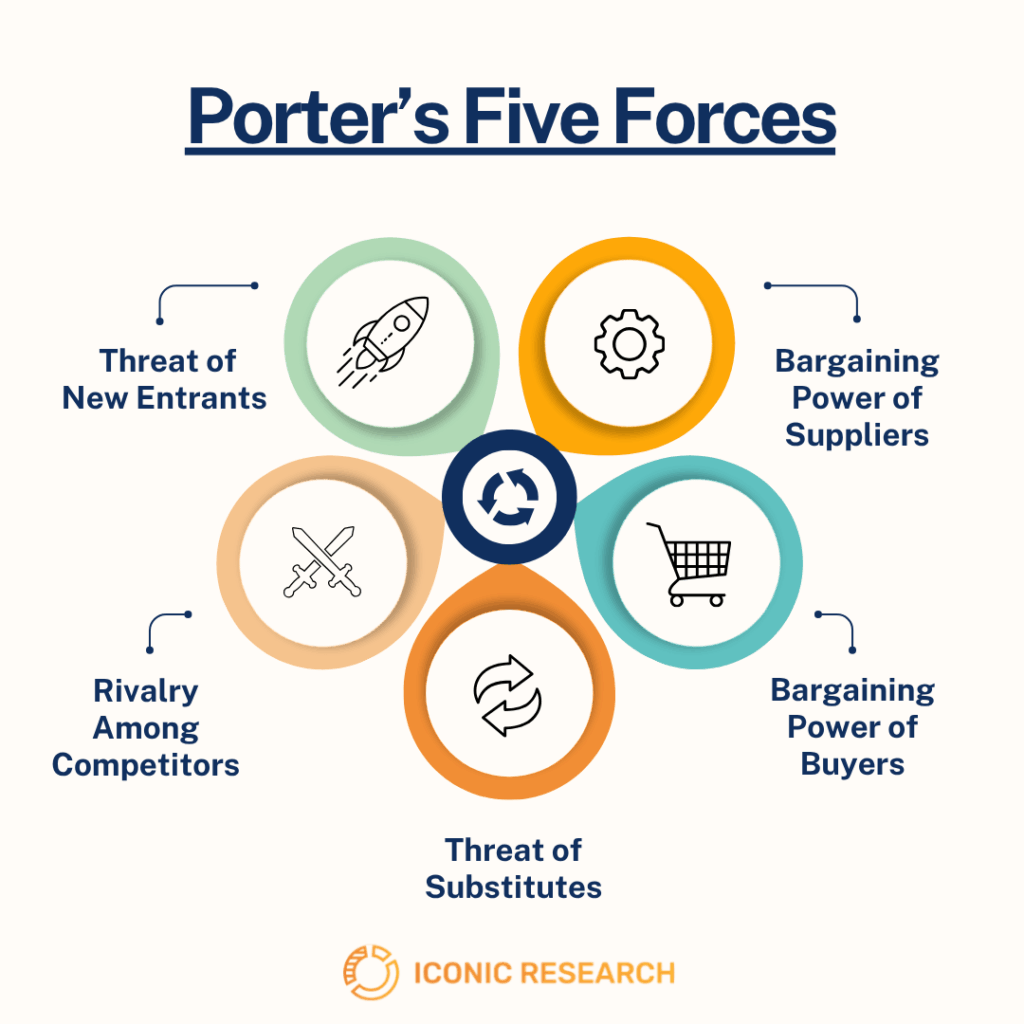
B2B competitor analysis differs from consumer-facing industries in depth and scope. Instead of focusing on branding or customer experience, B2B studies evaluate product roadmaps, partnership networks, and pricing transparency. Porter’s Five Forces and SWOT help identify strategic alliances and technology gaps that define long-term positioning [2].
A SaaS provider, for example, tracks client churn, integration compatibility, and contract terms — metrics rarely relevant in B2C. B2B teams often develop a structured competitor analysis template to ensure consistent evaluation across sales cycle length, decision-maker personas, and technical specifications. B2B competitive intelligence focuses more on relationship dynamics, sales cycle efficiency, and technical capabilities that shape buying decisions in complex organizational contexts.
Competitor Analysis in Thailand and Southeast Asia
Most competitor analysis guides focus on what you can see from a desk — SEO rankings, social media follower counts, ad spend estimates, website traffic. These are useful signals, but in Thailand they tell an incomplete story. Some of the most consequential competitive activity here happens offline: unadvertised pricing, sales tactics at the point of interaction, distributor relationships, and the gap between what a competitor claims and what they actually deliver.
Effective competitor analysis in Thailand combines three layers of intelligence.
Digital monitoring tracks the visible competitive landscape — search positioning, social sentiment, content strategy, and paid media. Thai brands increasingly use tools like ZocialEye and Wisesight for real-time competitor monitoring, particularly effective in telecom and food delivery. Our Social Listening service captures brand mentions and sentiment across Thai-language platforms including Pantip, Facebook, and LINE, where global listening tools underperform.
Primary field research captures what digital tools cannot. Through competitor benchmarking mystery shopping, trained researchers document pricing intelligence — including unadvertised discounts that never appear in public marketing — sales pitch analysis, objection handling tactics, and operational standards rivals actually maintain versus what they claim. For automotive, retail, financial services, and hospitality, where the frontline sales interaction is the product, this intelligence is irreplaceable.
Stakeholder intelligence maps the competitive landscape before you enter it. Our market entry research combines key-informant interviews with local industry players, distribution channel analysis, and regulatory assessment — producing intelligence grounded in on-the-ground reality rather than publicly available data that all competitors can access equally.
The most useful intelligence combines all three layers to answer not just what competitors are doing, but why — and where the gaps are that strategy can exploit. For companies conducting Southeast Asia competitor research across multiple markets, this methodology adapts across Vietnam, Indonesia, Malaysia, and Singapore — with each market requiring locally calibrated field access and Thai-equivalent language capability.
Case Study: Iconic Research Thailand
A major electronics producer sought to evaluate competitive positioning before launching a franchise expansion in Thailand, needing intelligence across both established players and emerging brands.
Approach: Iconic Research designed a multi-phase program combining qualitative interviews with industry operators, quantitative consumer surveys, web scraping of pricing and digital presence, mystery shopping audits of competitor stores, and desk research on market dynamics.
Outcome: The methodology — integrating market mapping, operator insights, and consumer understanding — delivered actionable perspectives that guided the client’s franchise decisions. The analysis revealed positioning gaps, optimal pricing strategies, and customer experience benchmarks that informed their market entry approach.
Competitor Analysis Consulting
Most companies attempt competitor analysis in-house first. For a domestic market the team already knows, that often works. For Thailand, it reliably produces incomplete intelligence — because the most consequential competitive activity is not discoverable from a desk in another country.
Conclusion
Competitor analysis in Thailand requires more than global frameworks applied to a local market. The frameworks in this guide provide the structure. Field research, local networks, and stakeholder access provide the substance. Together they produce decisions that hold up under commercial scrutiny.
Frequently Asked Questions
What is competitor analysis?
Competitor analysis is the systematic evaluation of rival businesses' strategies, strengths, weaknesses, and market positioning to identify opportunities and inform strategic decisions.
What are the main frameworks for competitor analysis?
The most widely used frameworks include SWOT Analysis, Porter's Five Forces, PEST Analysis, Perceptual Mapping, and Benchmarking. Combining strategic and operational frameworks yields the most actionable insights.
How often should companies conduct competitor analysis?
Competitor analysis should be an ongoing process rather than a one-time exercise. Leading companies conduct quarterly reviews with continuous monitoring of key competitors through digital tools and market intelligence.
What's the difference between B2B and B2C competitor analysis?
B2B competitor analysis focuses on product roadmaps, partnership networks, technical capabilities, and sales cycle metrics, while B2C analysis emphasizes brand perception, customer experience, and emotional engagement.
How is competitor analysis different in the Thai market?
In Thailand, effective competitor analysis requires understanding mobile-first consumer behavior, social media dynamics, and ASEAN regional competition. Local tools for social listening and real-time monitoring are essential given Thailand's high digital engagement.
When should you hire competitor analysis consulting?
Hire external consulting when the decision depends on non-public intelligence, when the team lacks Thai-market language and network access, or when the work requires simultaneous digital monitoring, field research, and stakeholder interviews that few in-house teams are staffed to execute.
References
[1] AlphaSense. “Competitor Analysis Framework: How-To and Best Practices.” https://www.alpha-sense.com/blog/product/competitor-analysis-framework/
[2] Cascade. “6 Competitive Analysis Frameworks.” https://www.cascade.app/blog/competitive-analysis-frameworks
[3] Slideworks. “How To Do Competitive Analysis (6-Step Framework and Template).” https://slideworks.io/resources/competitive-analysis-framework-and-template
[4] Bluebik. “Five Forces Model สุดยอดเครื่องมือวิเคราะห์ ‘การแข่งขันธุรกิจ’.” https://bluebik.com/th/blog/five-forces-model/
If you wish to quote any information from this article, please kindly cite the source along with the link to the original article to respect copyright. |
 |
Iconic Research Thailand Your trusted partner in market research and consulting across Thailand and Southeast Asia. Headquartered in Bangkok, we provide research-driven insights across the Philippines, Malaysia, Indonesia, Singapore, Laos, and Vietnam. We help businesses navigate Thailand's market complexities through consumer insights, market entry strategy, and trend foresight. Contact us if you have any queries! (+66)888 954 954 |
Contact us
We always looking for new and exciting opportunities. Let’s connect.
Related posts
 Growth Strategy: The Expansion Decisions That Need Evidence
Growth strategy is the set of decisions about where a company expands next. Only 25% of companies grow sustainably — the difference is evidence, not ambition.
9 min read Brand Strategy: The Decisions That Should Be Built on Evidence
Brand strategy is the set of decisions that determine how a brand competes. Those decisions only pay off when they’re built on consumer evidence — not a workshop.
11 min read Key Opinion Leader: What Thai Brands Should Research Before, During, and After a KOL Campaign
Platform metrics mislead brands choosing and measuring KOLs in Thailand. A research-first look at what to verify before, during, and after a campaign.
10 min read