

Young Thais Put Financial Security Before Marriage: Next Generation Thailand in 7 Charts
9 min read- 84% of Thais aged 18–30 are optimistic about their own career; 66% are optimistic about Thailand’s economic and political condition. (n = 2,000)
- 59% of Thais aged 18–30 name family as an influence on their views. In Bangkok, 64% name friends and peers. (n = 2,000; Bangkok n = 89)
- 53% of Thais aged 18–30 trust social media for news, from 73% in the Northeast to 19% in the East. (n = 2,000)
- 62% of Thais aged 18–30 name financial security as a marker of success; 10% name getting married or having a stable relationship. (n = 2,000)
- 58% of Thais aged 18–30 name Thai cuisine as a source of national pride; 3% say they are not proud to be citizens. (n = 2,000)
- 89% of Thais aged 18–30 see English as an important language to learn, and 63% say the same of Mandarin. (n = 1,978)
- 30% of Thais aged 18–30 would be willing to move abroad. Of that group, 33% find Japan the most attractive destination. (n = 590)
Table of Contents
- 84% are optimistic about their own careers. 66% feel the same about Thailand’s economy and politics.
- 59% say family shapes their views. In Bangkok, 64% name friends.
- 53% trust social media for news. By region, it ranges from 73% to 19%.
- 62% define success as financial security. 10% name marriage or a stable relationship.
- 58% are proud of Thai cuisine. 3% say they are not proud to be Thai citizens.
- 89% see English as an important language to learn. Mandarin is second at 63%.
- 30% would be willing to move abroad. Of that group, 33% choose Japan.
- Planning around constraints
Next Generation Thailand surveyed 2,000 young people in Thailand aged 18–30 in autumn 2025, online and face to face, in every region of the country. The study was published by the British Council with Iconic Research as co-author. The finding that frames the rest: young Thais are more confident about their own futures than about the country’s.
84% are optimistic about their own careers. 66% feel the same about Thailand’s economy and politics.
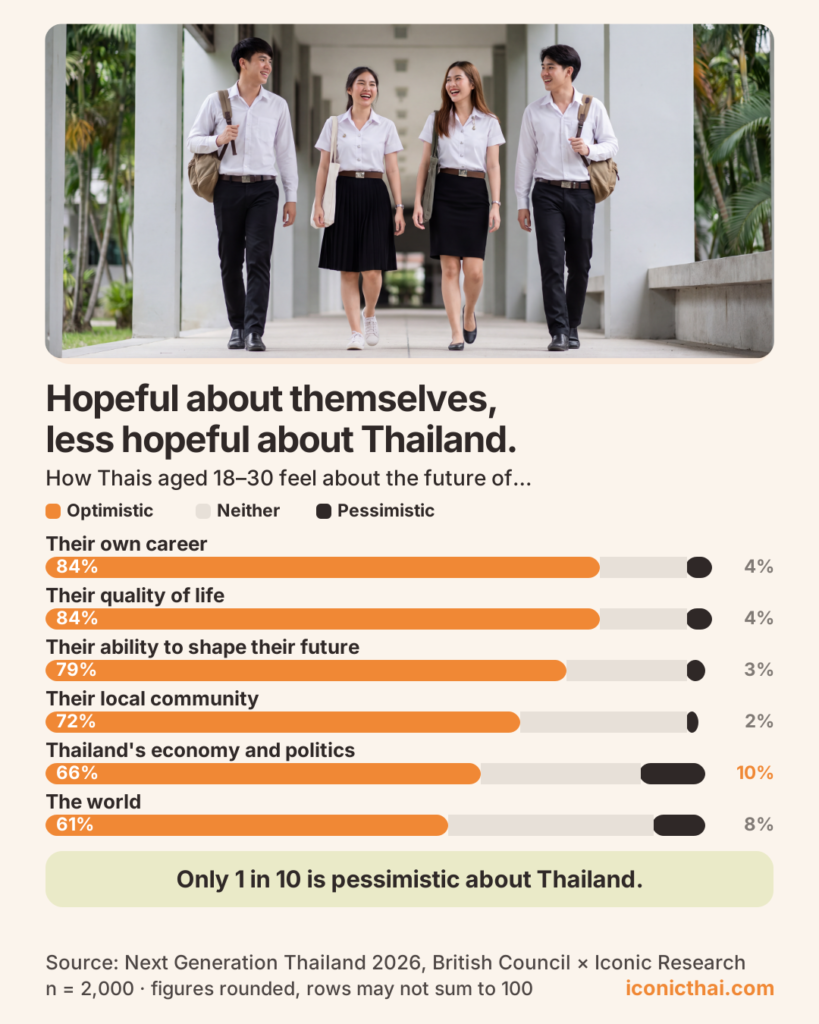
84% of Thais aged 18–30 are optimistic about their future careers, and the same share about their quality of life. 79% are optimistic about their ability to shape their own future. Optimism falls as the subject moves further from the self: 72% for their local community, 66% for Thailand’s economic and political condition and 61% for global conditions. Pessimism stays low throughout, peaking at 10% for Thailand’s economy and politics.
The report ties this optimism to personal effort rather than confidence in institutions. In the focus groups, self-improvement came up again and again: “If I keep improving myself, opportunities will come eventually” (Female, 22, Central). The report concludes that young people “do not necessarily feel they have the agency or power to influence the systems around them”.
59% say family shapes their views. In Bangkok, 64% name friends.
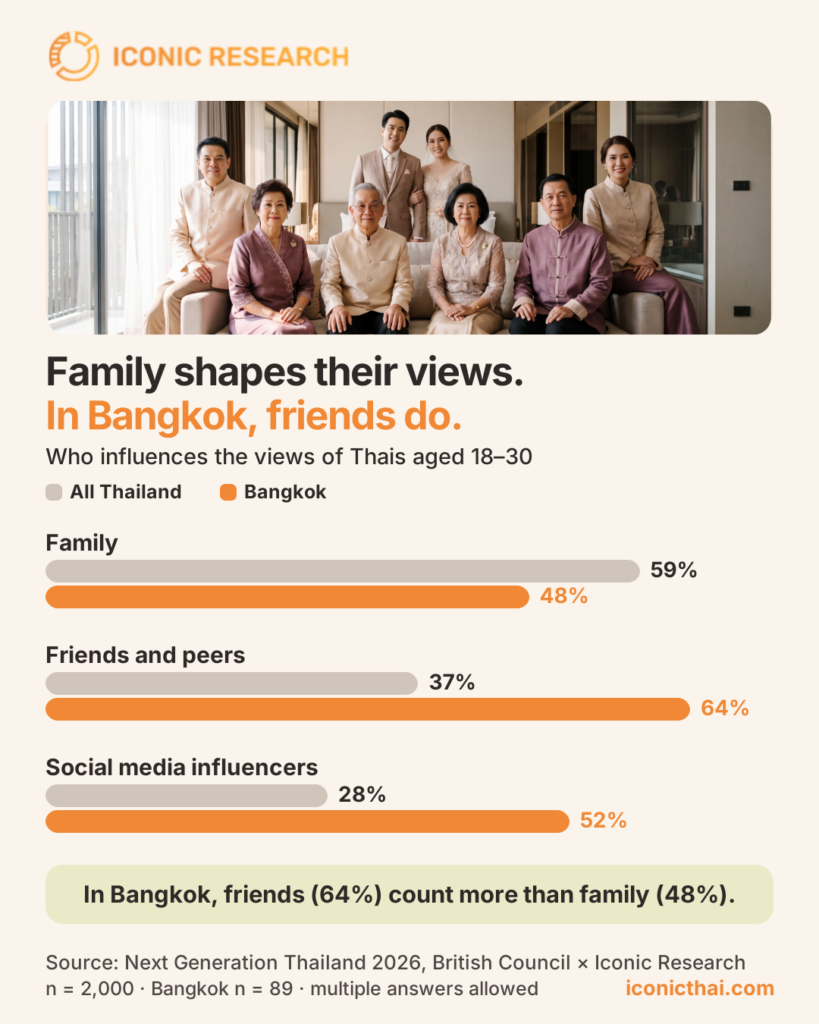
Family is the strongest influence on the views of young people in Thailand: 59% of Thais aged 18–30 name it. Friends and peers (37%), social media influencers (28%), teachers and professors (23%), journalists and the media (22%) and online communities (22%) follow.
Bangkok reverses the order. There, 64% name friends and peers, 52% social media influencers and 48% family. The Bangkok sample is small, at 89 respondents, so these figures are indicative. Elsewhere, family can count for even more: in the Central region, up to 92% cite it.
Age shifts the picture too. Those aged 18–24 lean more on peers (42%) and teachers (28%), while those aged 25–30 lean more on journalists and the media (25%) and online communities (24%). As one participant from the Northeast put it: “online, we learn fast, but sometimes parents don’t understand that world” (Female, 25).
For brands, the national influencer figure of 28% hides a Bangkok figure close to double. The question measured influence on views, not on purchases.
53% trust social media for news. By region, it ranges from 73% to 19%.
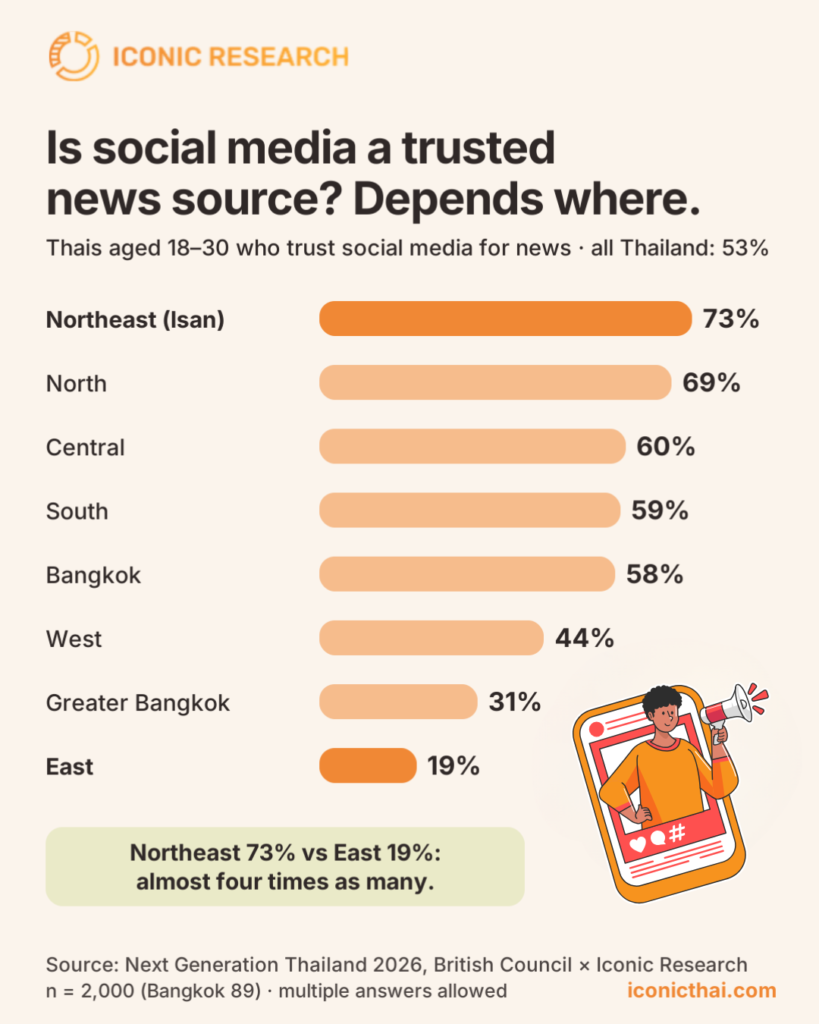
53% of Thais aged 18–30 trust social media as a source of news and current events. Online platforms are trusted most (63%), followed by family and friends (59%), social media (53%), traditional media (51%), teachers and professors (26%) and religious and community leaders (20%).
The national figure hides a wide regional range. Trust in social media for news is highest in the Northeast (73%) and the North (69%), and lowest in Greater Bangkok (31%) and the East (19%). Central (60%), the South (59%), Bangkok (58%) and the West (44%) sit in between. The East reverses the pattern: 76% of young people there trust traditional media, the highest of any region.
Trust does not mean passive acceptance. At the report’s validation workshop, students said they check information across several sources and treat election content on social media as advertising that needs verifying.
For brands, a channel plan built on the national 53% will misjudge most regions. The question asked about news, not advertising.
62% define success as financial security. 10% name marriage or a stable relationship.
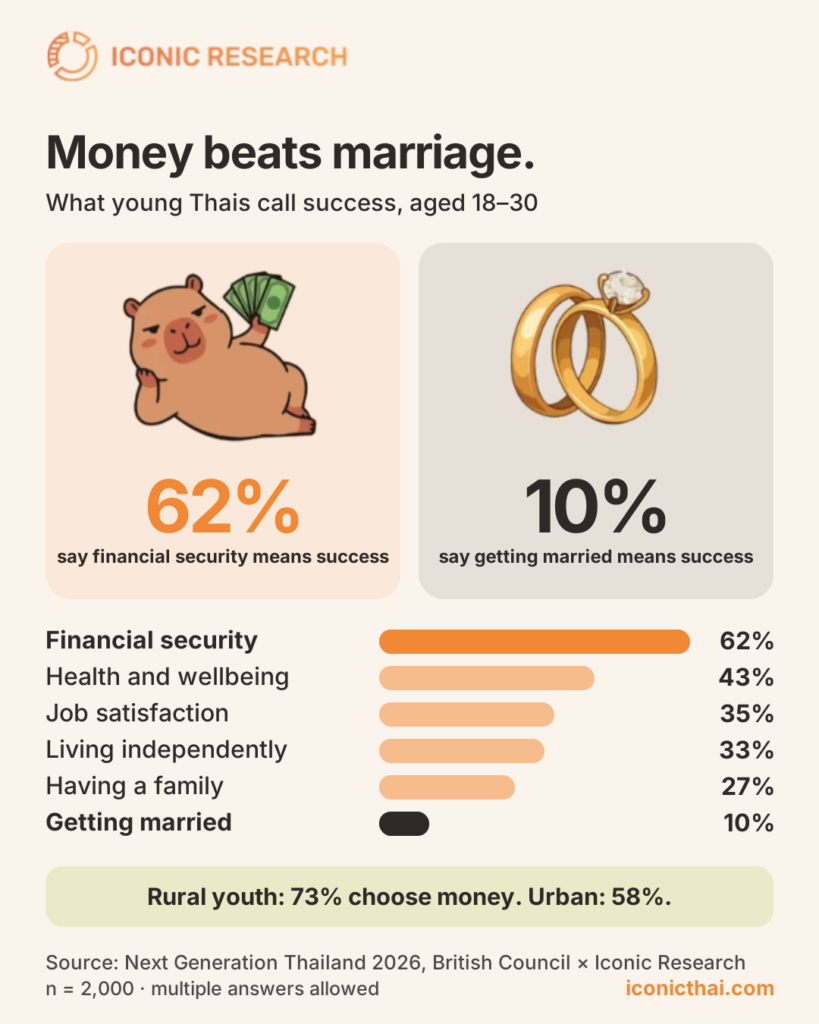
62% of Thais aged 18–30 name financial security as a marker of success, and 43% good health and wellbeing. Job satisfaction (35%), living independently (33%) and having a family (27%) follow. Getting married or having a stable relationship comes near the bottom, at 10%.
The gap widens outside the cities: 73% of rural respondents named financial security, against 58% in urban areas. The report links this to stronger economic pressure where education and jobs are harder to reach. As one focus group participant put it: “For me, stability means not having to worry about next month’s bills” (Male, 23, Central).
For brands speaking to this age group, security is the measure of having made it. Marriage ranks near the bottom.
58% are proud of Thai cuisine. 3% say they are not proud to be Thai citizens.
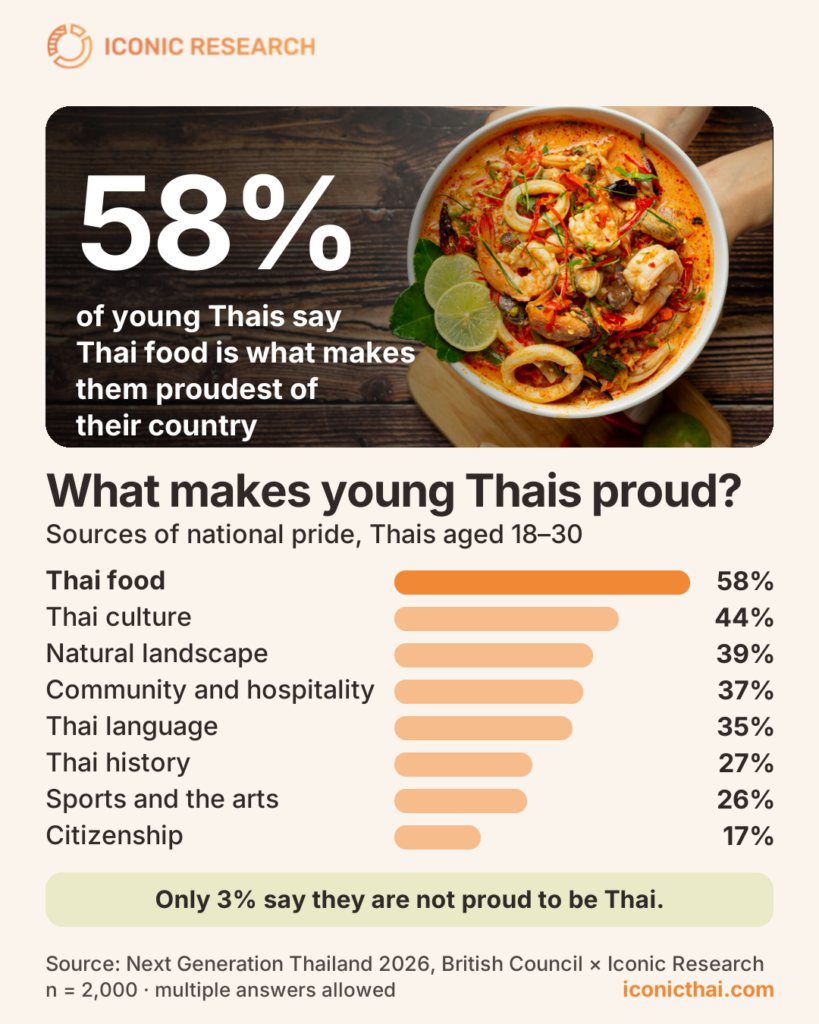
58% of Thais aged 18–30 name Thai cuisine as a source of national pride. For Thai youth, the identity of Thailand rests on culture and everyday life: Thai culture (44%), the natural landscape (39%), a sense of community and hospitality (37%) and the Thai language (35%) follow. Thai history (27%), achievement in sports and arts (26%) and citizenship (17%) rank lower, and 3% say they are not proud to be citizens.
Men and women answer almost identically. The one clear difference is sports and arts, cited by 29% of women and 23% of men.
For brands drawing on Thai identity, food and culture are the reference points this generation shares most. Citizenship is among the least.
89% see English as an important language to learn. Mandarin is second at 63%.
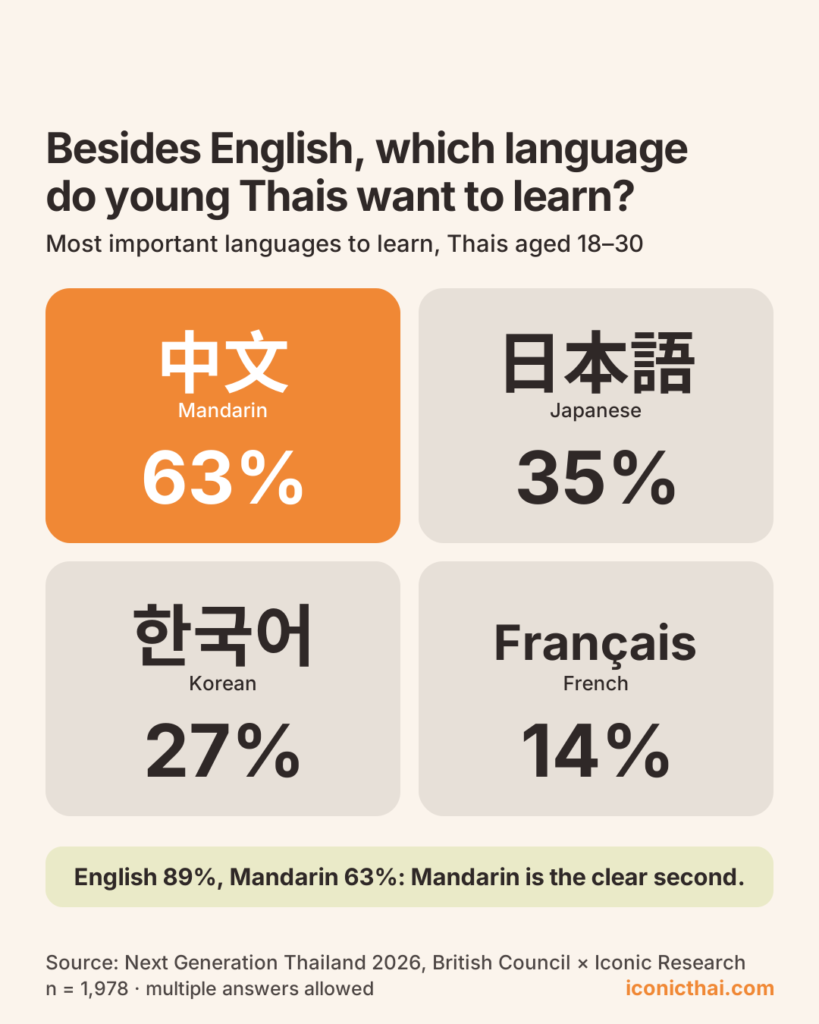
89% of Thais aged 18–30 see English as an important language to learn, and 63% say the same of Mandarin. Japanese (35%), Korean (27%), French (14%) and Malay (9%) follow. Because respondents could choose several languages, the figures overlap and should not be added together.
The reasons for learning English are practical. Asked why (1,351 respondents), 72% cited better employment opportunities, 60% travel and 55% their own education goals. At the validation workshop, students added that technical textbooks are mostly in English and that the language matters more as AI use grows. The report describes English for this generation as a “lingua franca” or “life skill” rather than a language tied to one country.
30% would be willing to move abroad. Of that group, 33% choose Japan.
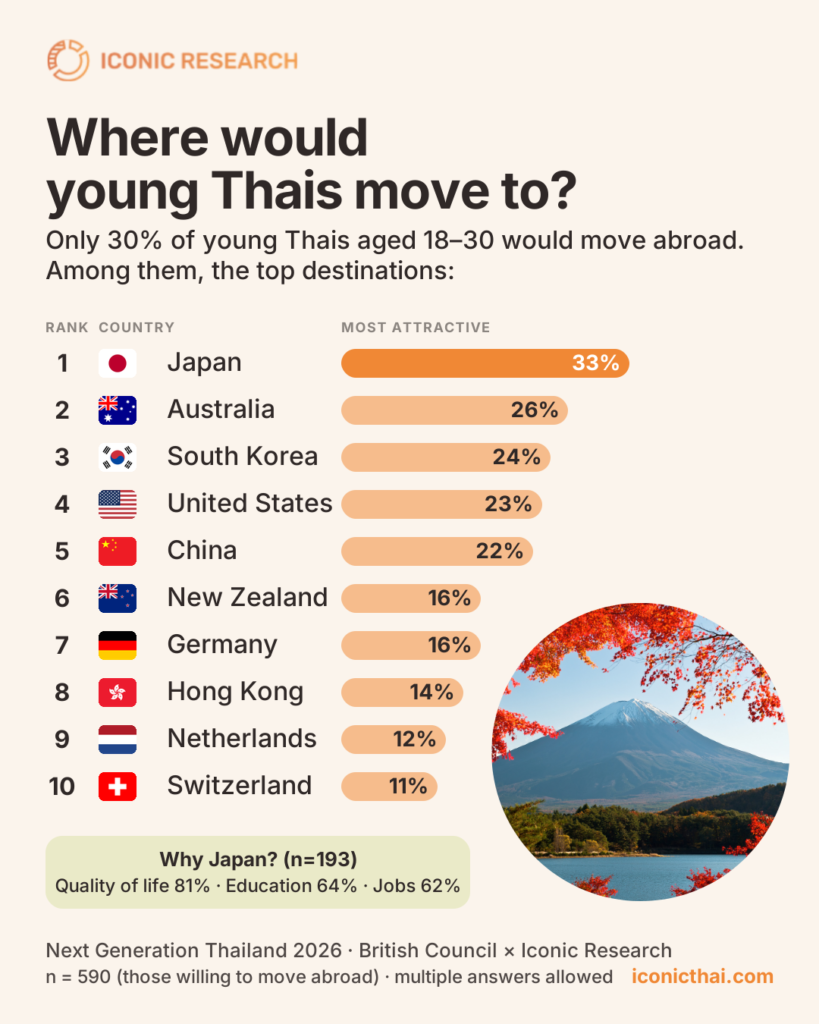
30% of Thais aged 18–30 would be willing to move to another country. Among that group of 590, Japan is the most attractive destination (33%), followed by Australia (26%), South Korea (24%), the United States (23%) and China (22%). New Zealand and Germany (16% each), Hong Kong SAR (14%), the Netherlands (12%) and Switzerland (11%) complete the top ten, and the United Kingdom ranks 16th of 25. These are shares of those willing to move, not of all young Thais.
Those who chose Japan (193 respondents) cited quality of life (81%), education opportunities (64%) and employment opportunities (62%). Students at the validation workshop linked its appeal to cultural similarity with Thailand.
The same students read the 30% as a sign of practical limits rather than low interest. Moving abroad takes money, decent accommodation and a visa, which puts it out of reach for most young Thais.
Planning around constraints
Across the seven charts, Thai youth answer as people planning around constraints. They think about money before marriage, about English for jobs, and about visas and costs before moving abroad. Their optimism is real, but it is about what they can do themselves. The report finds they do not feel able to change the systems around them.
Method
- Sample: 2,000 respondents aged 18–30, nationally representative
- Profile: 51% male, 49% female · 50% aged 18–24, 50% aged 25–30 · 70% urban (1,400), 30% rural (600)
- Fieldwork: autumn 2025
- Mode: 1,400 online interviews in urban provinces with internet access, and 600 face-to-face interviews by enumerators in remote and less populated areas. The same Thai-language questionnaire was used in both modes.
- Sampling: stratified quotas by region, age group and gender, allocated by youth population share (National Statistical Office, 2024)
- Qualitative work:
- 13 key informant interviews (6 in Thai, 7 in English)
- 7 focus groups with 42 participants: five by region (Bangkok and Greater Bangkok; Central, East and West; North; Northeast; South), plus one each with LGBTQ+ and disabled youth
- a validation workshop with 10 university students
- stakeholder validation workshops
- a 9-member Youth Task Force
- 5 Youth Peer Researchers
- Partner: British Council, with Iconic Research as co-author
- What the data doesn’t show: This is a single survey wave, so it shows levels, not change over time. The destination question measures which countries respondents find attractive, not whether they plan to move.
Cite as:
Hultin, F. K., Khan, A., Khambunma, P., & Langprasert, S. (2026). Next Generation Thailand. British Council. https://doi.org/10.57884/872T-RV30
The full report is free to download in English and Thai from the British Council. For how the study was run, see the Next Generation Thailand case study.
Iconic Research runs studies like this for brands and organisations in Thailand. Talk to us.
Contact us
We always looking for new and exciting opportunities. Let’s connect.
Related posts
 Growth Strategy: The Expansion Decisions That Need Evidence
Growth strategy is the set of decisions about where a company expands next. Only 25% of companies grow sustainably — the difference is evidence, not ambition.
9 min read Brand Strategy: The Decisions That Should Be Built on Evidence
Brand strategy is the set of decisions that determine how a brand competes. Those decisions only pay off when they’re built on consumer evidence — not a workshop.
12 min read Key Opinion Leader: What Thai Brands Should Research Before, During, and After a KOL Campaign
Platform metrics mislead brands choosing and measuring KOLs in Thailand. A research-first look at what to verify before, during, and after a campaign.
10 min read