
CSR — corporate social responsibility — is the commitment a company makes to operate in ways that benefit society beyond its legal obligations. In Thailand, CSR is no longer optional positioning. It is a stakeholder expectation, an increasingly codified regulatory requirement, and a reputational factor that shapes consumer trust, investor confidence, and community licence to operate. Most companies running CSR programmes underinvest in the part that matters most: measuring and evidencing impact. A programme that cannot be verified cannot be defended.
Table of Contents
- What Is CSR?
- CSR in Thailand: The Local Context
- The Four Pillars of CSR
- Why CSR Measurement Matters
- Conclusion
- References
What Is CSR?
Corporate social responsibility is the framework through which companies take responsibility for their impact on employees, communities, the environment, and governance [1]. CSR meaning extends well beyond charitable giving — philanthropy is a one-off transfer of resources, while CSR is an ongoing operational commitment embedded in how a business runs. The two overlap, but they are not equivalent.
CSR also sits alongside — but is not identical to — ESG. ESG (environmental, social, and governance) is the investor-facing measurement framework used to evaluate a company’s sustainability performance against standardised criteria. CSR is broader in scope and more stakeholder-facing in orientation: it addresses community obligation, workforce welfare, and environmental stewardship as matters of corporate conduct, not just financial risk. A company can run an active CSR programme and still score poorly on ESG disclosure — and vice versa. The distinction matters when deciding what to measure and who the primary audience for that measurement is.
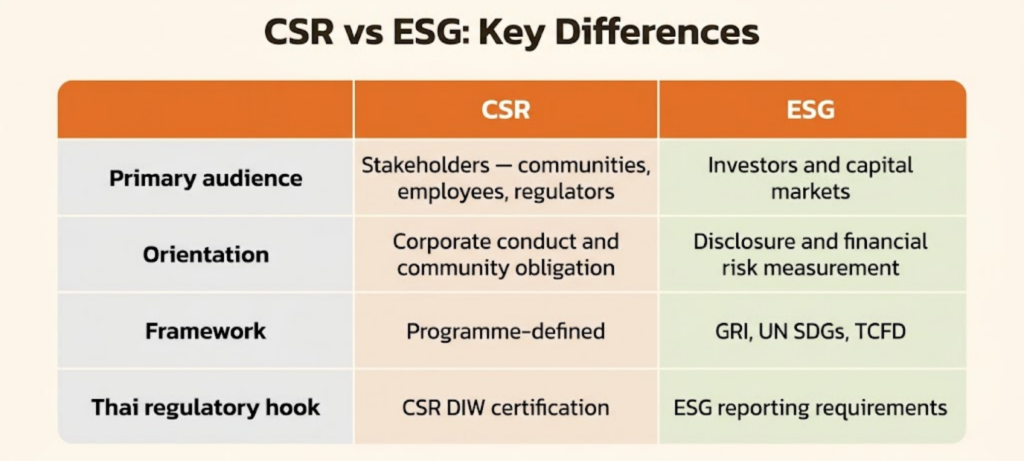
The four pillars that structure most CSR programmes are community, environment, workplace, and governance. These provide the organising framework for both programme design and impact reporting.
CSR in Thailand: The Local Context
CSR has deep roots in Thai corporate culture. Major conglomerates — SCG, PTT, CP Group — have operated long-running community and environmental programmes that set visible benchmarks for all companies operating here. For international businesses entering Thailand, these programmes establish stakeholder expectations that cannot be dismissed as aspirational. Thai communities and regulators measure incoming companies against what they already see from incumbent operators.
CSR DIW is the dimension most likely to affect industrial operators directly. Thailand’s Department of Industrial Works operates a CSR DIW certification programme that requires industrial operators to demonstrate responsible practice across community, environment, labour, and governance dimensions [2]. This is compliance-driven, not voluntary. International manufacturers, logistics operators, and industrial businesses with Thai facilities need to understand CSR DIW requirements before they assume their global CSR framework is sufficient. It is not — DIW certification requires locally documented evidence, not a translated group report.
Community expectations in Thailand are shaped by Buddhist values of reciprocity and collective welfare. CSR programmes that treat Thai communities as passive recipients of corporate generosity consistently underperform against those that involve communities in programme design. The cultural expectation is participation, not charity. Programmes that ignore this dynamic spend budget without building the trust they are designed to create.
Thai consumers increasingly factor CSR reputation into purchasing decisions. A significant share of Thai online consumers report that a company’s social and environmental conduct influences their brand preference [3]. Post-pandemic consumer sentiment has accelerated this shift, particularly among urban millennial and Gen Z segments who cross-reference brand claims against social media commentary. A CSR claim that cannot withstand public scrutiny is a reputational liability. Monitoring how CSR programmes are discussed across platforms — including Pantip and X — is part of managing that risk. Social listening tools provide the real-time visibility that reputation management requires.
The Four Pillars of CSR
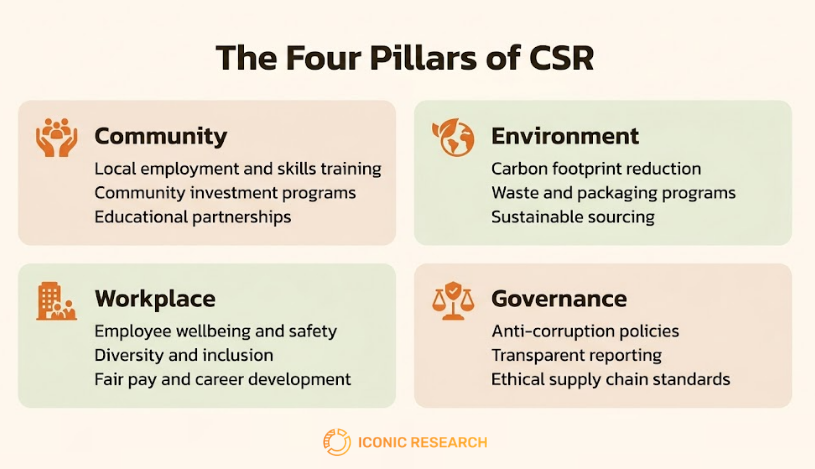
CSR programmes address four areas — community, environment, workplace, and governance — each requiring distinct design, delivery, and measurement approaches.
Community development covers education programmes, local infrastructure investment, employment of community members, and support for community enterprises. This is the highest-visibility category and the one most scrutinised by regulators and local media. In Thailand, it extends to cultural and heritage preservation — temple restoration, traditional craft support, and protection of local cultural practice carry genuine community significance and are noticed when absent.
Environmental initiatives include waste reduction systems, reforestation, carbon reduction commitments, and water management — particularly relevant for manufacturers and agribusiness operators whose operations carry direct environmental exposure.
Workplace programmes address occupational health and safety, fair labour practice, skills development, and employee welfare. For exporters supplying international buyers, workplace standards are increasingly a procurement requirement, not a voluntary add-on.
Governance covers transparency, anti-corruption practice, board accountability, and ethical business conduct — including supply chain responsibility. Raw material sourcing, subcontractor labour practices, and supplier environmental standards all carry reputational and regulatory risk that cannot be managed by focusing only on owned operations. For companies operating under CSR DIW requirements or feeding into group-level ESG reporting, governance documentation is the pillar most likely to require independent verification.
The point is not to run all four. It is to select activities aligned with genuine community need, operate them with appropriate resources, and measure their outcomes rigorously enough to report them credibly.
Why CSR Measurement Matters
A CSR programme without measurement is a budget line. It may be well-intentioned and operationally active, but it produces no evidence — and evidence is what stakeholders now require.
Investors applying ESG criteria need quantified impact data from local operations to feed into group-level reporting. Frameworks including the Global Reporting Initiative (GRI) and the UN Sustainable Development Goals (SDGs) set the disclosure standards that international headquarters must meet [4]. Thai operations cannot contribute to that reporting with narrative claims and photo documentation. They need survey data, community needs assessments, and independently gathered baseline and follow-up measurements.
CSR DIW certification requires documented evidence of community and environmental impact. Self-reported estimates do not satisfy the requirement. Companies pursuing or maintaining DIW certification need a research infrastructure that can generate the primary data documentation needs.
The reputational risk calculus has also shifted. CSR claims that cannot be substantiated are increasingly treated as greenwashing — a charge that carries material reputational and regulatory consequences [5]. Monitoring what stakeholders actually believe about a company’s CSR performance, rather than what the company reports, is a distinct research function. Stakeholder surveys, community perception studies, and media monitoring together provide the external perspective that internal CSR reporting cannot supply.
Conclusion
CSR in Thailand operates at the intersection of regulatory requirement, cultural expectation, and reputational strategy. The companies that lead here are not those with the largest budgets — they are the ones that understand local context, design programmes around genuine community need, and measure impact rigorously enough to defend it to regulators, investors, and the communities they are accountable to.
Frequently Asked Questions
What does CSR stand for?
CSR stands for corporate social responsibility — the framework through which companies take responsibility for their impact on employees, communities, the environment, and governance. In Thailand, CSR operates as both a voluntary commitment and, for industrial operators, a regulatory requirement under the Department of Industrial Works CSR DIW certification programme.
What is the difference between CSR and ESG?
CSR is the operational commitment a company makes to behave responsibly toward its stakeholders — communities, employees, environment, and governance. ESG is the investor-facing measurement framework that evaluates a company's environmental, social, and governance performance against standardised criteria. The two overlap significantly, but CSR is broader in stakeholder scope while ESG is structured for financial disclosure. A company can run active CSR activities and still score poorly on ESG disclosure if that activity is not measured and reported to the required standards.
What is CSR DIW in Thailand?
CSR DIW refers to the corporate social responsibility certification programme operated by Thailand's Department of Industrial Works. It requires industrial operators to demonstrate responsible practice across community, environment, labour, and governance dimensions through documented evidence. For international manufacturers and industrial businesses with Thai facilities, CSR DIW is a compliance requirement — not a voluntary framework — and it requires locally generated primary data, not a translated version of a global CSR report.
What are examples of CSR activities?
Common CSR activities in Thailand include community development programmes (education, local employment, infrastructure), environmental initiatives (reforestation, waste reduction, carbon programmes), workplace programmes (safety, fair labour, skills development), supply chain responsibility audits, and cultural or heritage preservation projects. Effective CSR activities are selected based on genuine community need, delivered with adequate resources, and measured against defined outcomes — not chosen for visibility alone.
How do companies measure CSR impact in Thailand?
CSR impact measurement requires primary research: community needs assessments, baseline surveys, follow-up impact studies, and stakeholder perception interviews. For CSR DIW certification, documented evidence of community and environmental impact is required — self-reported figures are insufficient. For ESG reporting, quantified local data is needed to feed into group-level GRI or SDG-aligned disclosure. Understanding how communities and consumers actually perceive CSR performance — as distinct from what a company reports — requires independent research that internal teams cannot conduct on their own behalf.
References
[1] ISO (2010). ISO 26000: Guidance on Social Responsibility. International Organisation for Standardisation. https://www.iso.org/iso-26000-social-responsibility.html
[2] Department of Industrial Works, Thailand. CSR DIW Programme. Ministry of Industry. https://www.diw.go.th
[3] Electronic Transactions Development Agency (2024). Thailand Internet User Behavior Report. ETDA. https://www.etda.or.th
[4] Global Reporting Initiative (2021). GRI Universal Standards 2021. GRI. https://www.globalreporting.org/standards/
[5] European Securities and Markets Authority (2023). Greenwashing in the EU Financial Sector. ESMA. https://www.esma.europa.eu/sites/default/files/2023-05/ESMA36-6-2517_Final_Report_on_Greenwashing.pdf
If you wish to quote any information from this article, please kindly cite the source along with the link to the original article to respect copyright. |
 |
Iconic Research Thailand Your trusted partner in market research and consulting across Thailand and Southeast Asia. Headquartered in Bangkok, we provide research-driven insights across the Philippines, Malaysia, Indonesia, Singapore, Laos, and Vietnam. We help businesses navigate Thailand's market complexities through consumer insights, market entry strategy, and trend foresight. Contact us if you have any queries! (+66)888 954 954 |
Contact us
We always looking for new and exciting opportunities. Let’s connect.
Related posts
 Growth Strategy: The Expansion Decisions That Need Evidence
Growth strategy is the set of decisions about where a company expands next. Only 25% of companies grow sustainably — the difference is evidence, not ambition.
9 min read Brand Strategy: The Decisions That Should Be Built on Evidence
Brand strategy is the set of decisions that determine how a brand competes. Those decisions only pay off when they’re built on consumer evidence — not a workshop.
11 min read Key Opinion Leader: What Thai Brands Should Research Before, During, and After a KOL Campaign
Platform metrics mislead brands choosing and measuring KOLs in Thailand. A research-first look at what to verify before, during, and after a campaign.
10 min read