

E-commerce Thailand is Southeast Asia’s fastest-growing online market — but for brands deciding whether and how to enter, the size of the opportunity matters less than knowing which platform, price point, and consumer behaviour fit their category. Three players — Shopee, TikTok Shop, and Lazada — control almost all marketplace sales, yet online is still only 10–15% of total retail. This guide covers the market size, the platform landscape, and the research that turns a market-entry decision from a guess into a plan.
Table of Contents
- Market Size and Growth
- The Marketplace Landscape
- What’s Driving the Market
- The Research Behind Market Entry
- Case Study
- Conclusion
- References
E-commerce Thailand has become the headline story of Southeast Asian retail. In 2025, the market grew 51.8% year-on-year to US$35.5 billion in gross merchandise value (GMV) — the fastest growth rate of any market in the region, ahead of Malaysia and well ahead of a slowing Indonesia [1]. That acceleration matters to two audiences in particular: international brands weighing whether and how to enter, and Thai corporates defending category share against platform-native competitors and cross-border sellers. The Thailand e-commerce landscape is no longer a frontier opportunity — it is a consolidated, fast-moving market where the cost of a mistimed or mis-targeted entry is high. This article sets out the market size and the methodology behind the headline numbers, the marketplace landscape brands must navigate, the forces driving growth, and the research that separates a confident market-entry decision from an expensive guess.
Market Size and Growth
The headline figure — US$35.5 billion in platform GMV, up 51.8% in a single year — comes from Momentum Works and measures the gross value of goods transacted across marketplaces [1]. It is not the only number in circulation, and the differences are worth understanding rather than averaging away. ECDB, measuring e-commerce revenue rather than GMV, puts the 2025 figure at roughly US$32.5 billion growing 10–15% year-on-year [2]. The two are not in conflict: GMV counts the total transaction value flowing across platforms, while revenue measures a narrower base. The right reading is that e-commerce growth in Thailand is real and steep, and that any single “the market is worth X” claim should be treated with the methodology attached.
The more strategically useful number is penetration. Online still represents only 10–15% of total Thai retail, with ECDB forecasting a move toward 15–20% in 2026 [2]. Low penetration in a market this size is headroom, not weakness — most of the category shift from offline to online has yet to happen. The user base supports that trajectory: more than 50 million Thais now shop online, against a backdrop of high mobile and internet adoption [5].
Three structural forces underpin the growth. Mobile-first behaviour dominates — handsets account for more than 80% of online sales, and mobile wallets for around 23% of transactions [4]. Logistics infrastructure has matured, with the e-commerce logistics market reaching US$2.99 billion in 2025 and growing at a 10.28% CAGR [4]. And content commerce has shifted from a marketing tactic to a primary demand channel, a point the marketplace data makes unavoidable.
The Marketplace Landscape
E-commerce market share in Thailand is concentrated to a degree that few markets match. The marketplace Thailand picture is effectively a three-player contest, and the gap between those three and everyone else is the single most important fact for a brand deciding where to sell.
Platform | Position | Strategic angle |
Shopee | Market leader, >50% GMV share | Scale, breadth, and logistics depth |
TikTok Shop | #2 and gaining fastest | "Shoppertainment" — live and content commerce |
Lazada | #3 | Premium, brand-led ("confidence commerce") pivot |
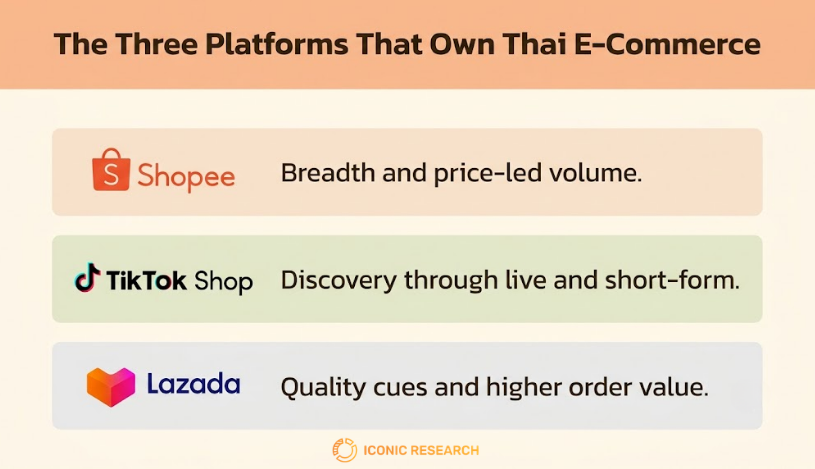
Across Southeast Asia, these same three platforms now control roughly 98.8% of platform GMV, and in Thailand they dominate just as completely [1]. The concentration has direct consequences for the top e-commerce in Thailand decision a brand faces. Choosing where to sell is no longer a question of reach — all three deliver reach — but of fit: Shopee for breadth and price-led volume, TikTok Shop for categories where discovery happens through live and short-form content, and Lazada for brands whose proposition depends on perceived quality and higher average order value. The wrong platform choice is not a missed opportunity; it is spend deployed against an audience that buys differently than assumed.
What’s Driving the Market
The defining e-commerce trend in Thailand is the structural rise of content commerce — live commerce, shoppertainment, and social selling. Across the region, content-driven channels generated an estimated 32% of platform GMV in 2025, up from 20% a year earlier, and TikTok Shop’s rapid climb to second place in Thailand is the clearest local expression of that shift [1]. Purchase decisions increasingly begin inside a feed or a livestream rather than a search bar, which changes what brand presence on a platform actually requires.
Mobile-first behaviour reinforces the pattern: with over 80% of sales completed on handsets, the format that performs is the format built for a phone screen and a short attention window [4].
The third force is cross-border e-commerce Thailand inflows. Foreign brands now sell into the country without establishing a local entity, and cross-border transactions account for roughly 30% of online sales [3]. That lowers the barrier to testing the market but raises the competitive intensity for everyone already in it — and it makes payment-method fit (e-wallets, bank transfers, buy-now-pay-later, and still-significant cash on delivery) a practical determinant of conversion rather than a back-office detail [3].
The Research Behind Market Entry
The headline numbers describe the opportunity. They do not tell a brand whether, where, or how to enter — and that is the gap research closes. Before committing capital, a brand needs evidence on several questions the market data cannot answer.
Which marketplace fits the specific category and target audience is the first, and it is rarely obvious from share figures alone. The economics of selling through a marketplace versus building a direct-to-consumer channel is the second — the two carry very different margin, control, and data-ownership profiles. Price sensitivity within the category, the real consumer journey (research-online, buy-offline remains common in Thailand for considered purchases), and the genuine depth of category demand all sit beneath the surface of aggregate GMV.
This is where Iconic Research’s work lives.
Qualitative research surfaces how Thai consumers in a category actually decide and where platform choice is driven by content rather than price.
Quantitative research sizes demand and measures price sensitivity across segments and regions.
Consumer research interprets why stated preference diverges from observed behaviour, and social listening tracks unprompted conversation about platforms, brands, and competitors.
Assessing a prospective partner or rival e-commerce company in Thailand — its positioning, pricing, and consumer perception — is itself a research task, not a desk exercise. For brands at the decision point, this connects directly to broader market entry planning.
Case Study
Iconic Research studied Bangkok shopping behaviour during Thai festivals for an international e-commerce platform. The research found that online activity spikes sharply around Songkran and Loy Krathong, with local platforms leading festival food-and-beverage demand and international platforms leading gifting tied to imported-origin festivals. On the strength of that finding, the client retimed inventory and marketing to festival-specific demand rather than a flat annual calendar — aligning supply and spend with when and why Thai consumers actually buy.
Conclusion
Understanding e-commerce Thailand is the difference between guessing and entering with evidence. The market is large, fast-growing, and consolidated — which means the upside is real and the margin for a mis-targeted entry is thin.
Frequently Asked Questions
How big is the e-commerce market in Thailand?
Platform GMV reached US$35.5 billion in 2025, up 51.8% year-on-year and the fastest growth in Southeast Asia. Revenue-based measures are lower — around US$32.5 billion — because they count a narrower base than GMV.
Why is e-commerce growing so fast in Thailand?
The main drivers are content commerce (live and shoppertainment selling), mobile-first behaviour with over 80% of sales on handsets, maturing logistics, and resilient cross-border inflows. Low retail penetration also leaves significant room for continued shift from offline to online.
Which is the top e-commerce platform in Thailand?
Shopee leads with more than 50% GMV share, followed by TikTok Shop — the fastest-growing player through its shoppertainment model — and Lazada, which has pivoted toward a premium, brand-led strategy.
What is cross-border e-commerce in Thailand?
It refers to foreign brands selling into Thailand without a local entity. Cross-border transactions account for roughly 30% of online sales, lowering the barrier to market testing while raising competitive intensity.
What should a brand research before selling online in Thailand?
Which marketplace fits the category and audience, marketplace-versus-D2C economics, price sensitivity, the real consumer journey, and genuine category demand depth. These require qualitative, quantitative, and consumer research rather than reliance on aggregate market figures.
References
[1] Momentum Works, Ecommerce in Southeast Asia 2026 — reported in Bangkok Post, “Thailand driving e-commerce growth” (April 2026). https://www.bangkokpost.com/business/general/3239004/thailand-driving-ecommerce-growth
[2] ECDB, E-Commerce Industry in Thailand (2025). https://ecdb.com/resources/sample-data/market/th/all
[3] PCMI (Payments and Commerce Market Intelligence), E-Commerce in Thailand: Market Size and Statistics 2024–2027 (November 2024). https://paymentscmi.com/insights/thailand-ecommerce-market-data-insights/
[4] Mordor Intelligence, Thailand E-Commerce Logistics Market (2025). https://www.mordorintelligence.com/industry-reports/thailand-ecommerce-logistics-market
[5] U.S. International Trade Administration, Thailand Country Commercial Guide — eCommerce. https://www.trade.gov/country-commercial-guides/thailand-ecommerce
If you wish to quote any information from this article, please kindly cite the source along with the link to the original article to respect copyright. |
 |
Iconic Research Thailand Your trusted partner in market research and consulting across Thailand and Southeast Asia. Headquartered in Bangkok, we provide research-driven insights across the Philippines, Malaysia, Indonesia, Singapore, Laos, and Vietnam. We help businesses navigate Thailand's market complexities through consumer insights, market entry strategy, and trend foresight. Contact us if you have any queries! (+66)888 954 954 |
Contact us
We always looking for new and exciting opportunities. Let’s connect.
Related posts
 Growth Strategy: The Expansion Decisions That Need Evidence
Growth strategy is the set of decisions about where a company expands next. Only 25% of companies grow sustainably — the difference is evidence, not ambition.
9 min read Brand Strategy: The Decisions That Should Be Built on Evidence
Brand strategy is the set of decisions that determine how a brand competes. Those decisions only pay off when they’re built on consumer evidence — not a workshop.
11 min read Key Opinion Leader: What Thai Brands Should Research Before, During, and After a KOL Campaign
Platform metrics mislead brands choosing and measuring KOLs in Thailand. A research-first look at what to verify before, during, and after a campaign.
10 min read