

Usability testing is a research method in which representative users complete realistic tasks with a product while a researcher observes where they succeed, hesitate or fail, according to the Nielsen Norman Group. Usability tests can be moderated or unmoderated, run in person or remotely, and applied to websites, apps, physical products and in-vehicle screens. The most common usability measures are task success, errors, time on task and the System Usability Scale (SUS), a ten-item questionnaire scored from 0 to 100. In Thailand, Iconic Research runs usability testing in Thai, with users recruited in Bangkok and the provinces.
Table of Contents
- What Is Usability Testing?
- Usability Testing Methods
- What to Measure in a Usability Test
- System Usability Scale (SUS)
- Usability Testing for Physical Products and In-Vehicle HMI
- Running Usability Testing in Thailand
- Conclusion
- References
- Related Research Guides
Usability testing shows what users do with a product, not what they say about it. A design team can describe how an app should work; only watching real users try it shows whether it does. It is the most direct form of design validation before a product reaches the market. For brands testing apps, websites, devices or car cabins with Thai users, Iconic Research provides UX research and usability testing services in Bangkok and across Thailand.
What Is Usability Testing?
Usability is the extent to which specified users can achieve specified goals with effectiveness, efficiency and satisfaction in a specified context of use, as defined by the ISO 9241-11 standard [2]. Effectiveness is whether users complete the task, efficiency is the effort it takes, and satisfaction is how they feel about it.
A usability test has three components: a participant who matches the real user, a set of realistic tasks, and a facilitator who observes without leading [1]. Participants are often asked to think aloud, so the researcher hears the reasoning behind each click or hesitation.
Usability testing is one part of wider usability research. Surveys and interviews show what users want; a usability test shows whether the product delivers it.
Usability Testing Methods
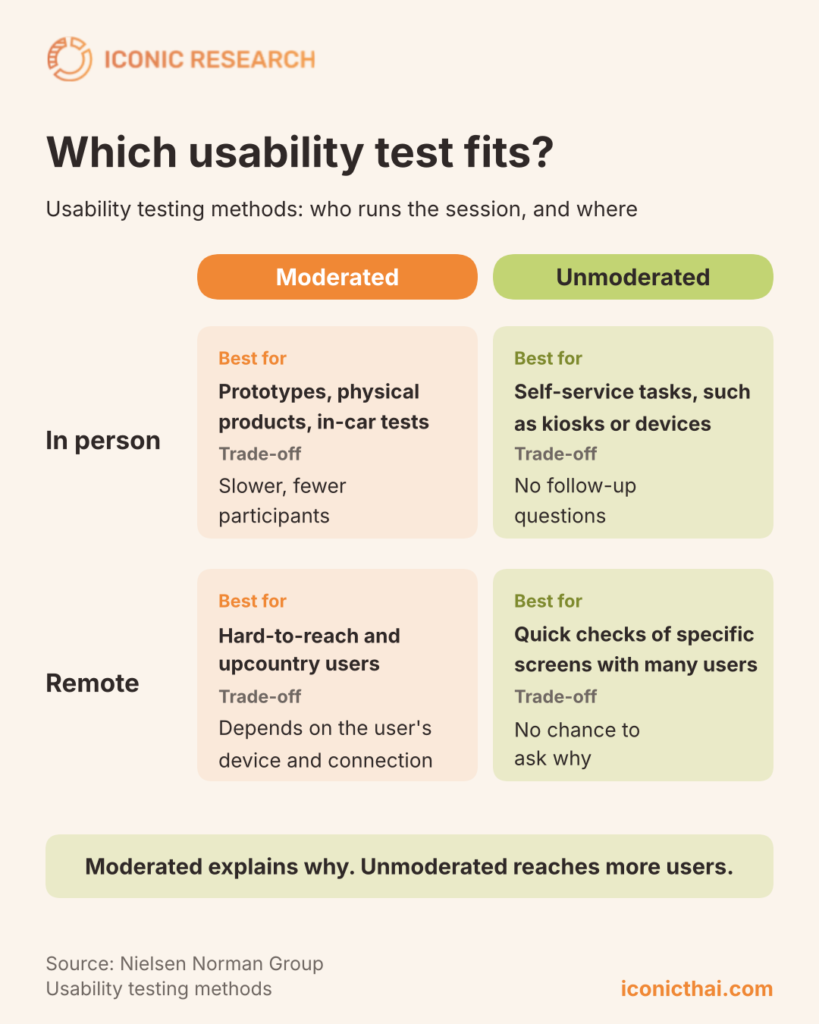
Usability testing methods differ along three lines: whether a researcher is present, where the session takes place, and how early in development it runs.
Moderated and unmoderated. In moderated usability testing, a facilitator runs the session live, asks follow-up questions and probes moments of confusion. In unmoderated usability testing, participants complete written tasks alone through an online tool, and the researcher reviews recordings afterwards [3]. Moderated sessions produce richer explanations; unmoderated sessions are faster and reach more people, but nobody can ask why a participant stopped [3].
In person and remote. In-person sessions show body language and the device in the user’s hand. Remote sessions use screen-sharing and reach users who cannot travel to a facility; they are often cheaper and faster [1], but depend on the participant’s own device and connection.
In the context of use. Some products can only be tested where they are used: a kitchen appliance at home, a navigation screen in a moving car. Testing in context shows the interruptions, noise and time pressure that a lab removes.
Timing. Usability testing does not need a finished product. Prototype testing with paper sketches, clickable mock-ups or pre-production units finds problems while they are still cheap to fix. Earlier still, concept testing checks whether the idea itself appeals before any interface exists.
Usability Heuristics vs Usability Testing
Usability heuristics are general design rules, such as keeping users informed of system status or preventing errors. In a heuristic evaluation, experts review an interface against these rules without users. It is quick, but it shows what experts expect users to struggle with, not what users struggle with, so it works best as a first pass before a usability test.
What to Measure in a Usability Test
Qualitative tests aim to find problems; quantitative tests measure performance and set benchmarks [1]. Most studies combine both, using the measures below.
- Task success. Whether the participant completed the task, partly completed it or failed. This is the core measure of effectiveness.
- Errors. Wrong taps, wrong paths and wrong entries, including errors the user recovered from. Each error points to a specific design problem.
- Time on task. How long completion takes. Long times on simple tasks point to unclear labels or too many steps.
- Cognitive load. The mental effort a task demands. It shows in hesitation, re-reading and backtracking, and it matters most where users are distracted, such as on a phone in a crowded train or a screen in a moving car.
- Satisfaction. How users rate the experience after the tasks, usually measured with a standard questionnaire such as SUS.
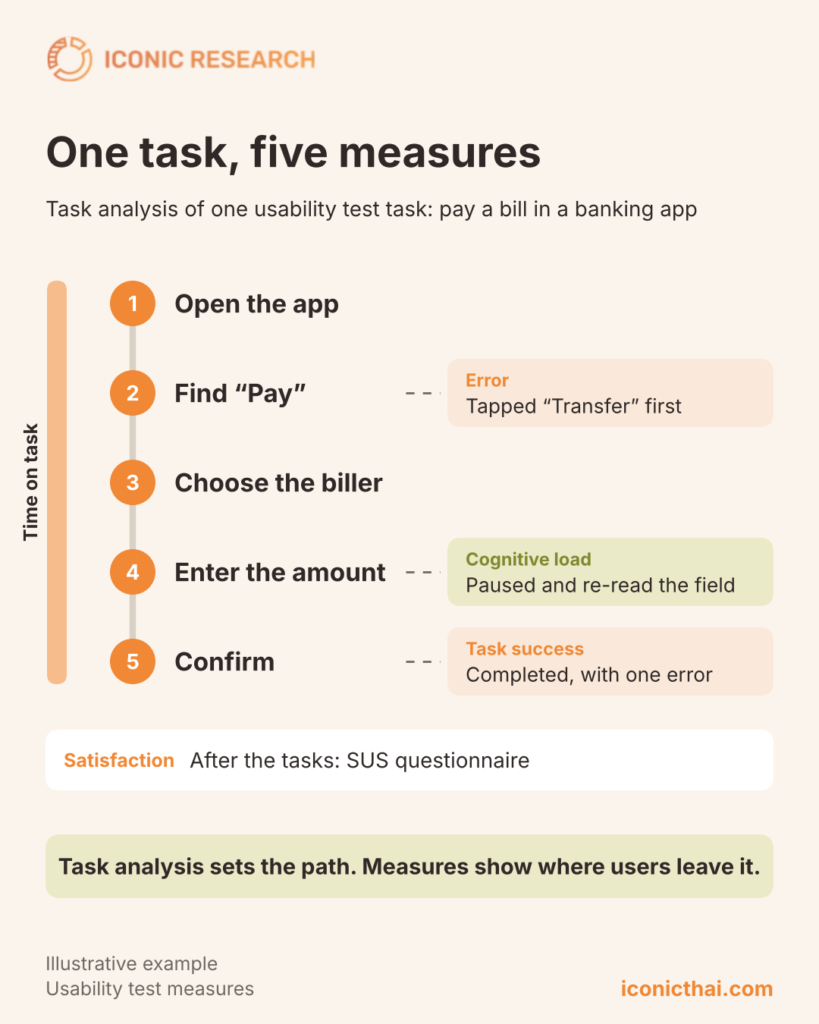
Task analysis comes before any of these measures. It breaks each goal into the steps a user must take, so the researcher knows the intended path and can record exactly where users leave it. Without task analysis, a test records that users failed but not where.
System Usability Scale (SUS)
The System Usability Scale (SUS) is a ten-statement questionnaire, created by John Brooke, that measures how usable a product feels to the people who used it [4]. Participants complete it right after the tasks, rating statements such as “I found the system unnecessarily complex” on a five-point scale from strongly disagree to strongly agree. Odd-numbered statements are positive and even-numbered statements are negative, which reduces the risk of participants agreeing with everything.
How SUS is scored. For odd-numbered items, 1 is subtracted from the response; for even-numbered items, the response is subtracted from 5. The ten results are added and multiplied by 2.5, giving a score from 0 to 100 [5]. The score is not a percentage.
How to read it. The average SUS score across 500 studies analysed by MeasuringU was 68 [5]. A score above 68 is above average; a score below 68 is below average. SUS is most useful for comparison: two designs tested with the same tasks, a product before and after a redesign, or a product against a competitor. It shows how usable a product feels, but not why, so it is paired with observation.
SUS in Thailand. The questionnaire must be translated into Thai and checked so each statement keeps its meaning, particularly the negative statements, which are easy to misread. Kreng jai, the Thai reluctance to criticise or cause discomfort, can also push ratings up, especially when the moderator is in the room. Completing SUS privately, and reading it alongside observed task success, keeps the score honest.
Usability Testing for Physical Products and In-Vehicle HMI
Usability testing applies to anything people operate, not only screens. For packaged goods and appliances, tests cover opening, assembling, using and cleaning, often at home; Iconic’s product testing guide covers these formats.
In-vehicle usability testing is a specialised case. Cars have moved climate, audio and navigation controls onto touchscreens, and every task competes with the road for the driver’s attention. Good HMI design keeps tasks short enough to complete in brief glances. The U.S. Department of Transportation’s voluntary guidelines for in-vehicle electronic devices recommend no single glance away from the road longer than two seconds and no more than twelve seconds in total for a task [6].
In-vehicle tests run in two settings: static, in a parked car or a car clinic hall, where participants complete tasks such as pairing a phone or setting a destination; and dynamic, on real roads, where a researcher rides along and records what drivers do in traffic. Thailand adds its own conditions: right-hand-drive cabins adapted from left-hand-drive designs, strong sun glare on screens, Thai-language voice commands and dense motorcycle traffic. Iconic Research runs in-vehicle studies through its car clinic and automotive research services, and its B-MPV feature research across ASEAN tested whether new in-cabin features solved real problems for local drivers.
Running Usability Testing in Thailand
Most usability guidance assumes Western users. Four conditions change the method in Thailand.
Recruitment. Participants must match real users on device, experience and region, not only age and income. Upcountry users differ from Bangkok users in devices, connection quality and digital habits, so a Bangkok-only sample can miss the problems most users face. Iconic’s recruitment and fieldwork team recruits across Bangkok and the provinces.
Thai-language moderation. Sessions must be moderated in Thai by researchers who can read hesitation and politeness. Thai participants often blame themselves rather than the product, and thinking aloud can feel unnatural; a skilled moderator makes clear that the product, not the person, is being tested.
Thai-specific interface problems. Thai text runs longer than English and has no spaces between words, so labels truncate and wrap badly. Date fields must handle the Buddhist calendar many Thai users expect. Forms built for Western names, addresses and ID formats break on Thai inputs. These problems only surface when Thai users complete real tasks in Thai.
Touchpoints beyond the app. Many Thai digital journeys start or end on LINE, in a store or at a call centre. Testing one screen in isolation misses the handover points that cause most complaints; mapping the full customer journey shows which touchpoints to test.
An international team typically needs a local usability testing agency for three things: recruitment that reaches the real user base, Thai-language moderation, and analysis that separates usability problems from politeness. A usability testing service should provide all three.
Case Study: Usability Research for a Thai Mobile Banking App
One of Thailand’s leading banks was receiving negative app store reviews and rising support calls about its mobile banking app. Iconic Research recruited a diverse group of users, mixing age groups, digital confidence and banking needs, and ran the fieldwork with a partner agency: one-on-one sessions in which trained moderators observed participants using the app [7]. The findings informed improvements to the app. Read the banking app case study.
Conclusion
Usability testing replaces assumption with evidence: real users, realistic tasks and observed behaviour. The measures, from task success to SUS, turn observation into comparable results. In Thailand, recruitment, language and culture decide whether those results reflect real users.
To plan a usability study with Thai users, contact Iconic Research. We design, recruit, moderate and report usability testing for apps, websites, physical products and vehicles.
Frequently Asked Questions
What is usability testing?
Usability testing is a research method in which representative users complete realistic tasks with a product while a researcher observes where they succeed or struggle. It shows how people use a product, rather than what they say about it.
What is the difference between moderated and unmoderated usability testing?
In moderated usability testing, a facilitator runs the session live and can ask follow-up questions. In unmoderated testing, participants complete tasks alone through an online tool, which is faster but gives no chance to ask why.
What is the System Usability Scale (SUS)?
The System Usability Scale is a standard ten-statement questionnaire that measures how usable a product feels to the people who used it. It produces a single score that can be compared across designs, versions and competitors.
Why use a usability testing agency in Thailand?
A local usability testing agency recruits users who match the real market, moderates in Thai and can tell real problems from polite answers. These three conditions decide whether results reflect how Thai users behave.
References
[1] Moran, K. (2019). Usability (User) Testing 101. Nielsen Norman Group. https://www.nngroup.com/articles/usability-testing-101/
[2] International Organization for Standardization (2018). ISO 9241-11:2018 Ergonomics of human-system interaction — Part 11: Usability: Definitions and concepts. https://www.iso.org/standard/63500.html
[3] Schade, A. (2013). Remote Usability Tests: Moderated and Unmoderated. Nielsen Norman Group. https://www.nngroup.com/articles/remote-usability-tests/
[4] Brooke, J. (2013). SUS: A Retrospective. Journal of Usability Studies, 8(2), 29–40. https://uxpajournal.org/issue/volume-8-issue-2
[5] Sauro, J. (2011). Measuring Usability with the System Usability Scale (SUS). MeasuringU. https://measuringu.com/sus/
[6] U.S. Department of Transportation. U.S. DOT Releases Guidelines to Minimize In-Vehicle Distractions. https://www.transportation.gov/briefing-room/us-dot-releases-guidelines-minimize-vehicle-distractions
[7] Iconic Research. Case Study: Improving a Banking App via Comprehensive User Feedback. https://iconicthai.com/case-study/improving-a-banking-app-via-comprehensive-user-feedback/
If you wish to quote any information from this article, please kindly cite the source along with the link to the original article to respect copyright. |
 |
Iconic Research Thailand Your trusted partner in market research and consulting across Thailand and Southeast Asia. Headquartered in Bangkok, we provide research-driven insights across the Philippines, Malaysia, Indonesia, Singapore, Laos, and Vietnam. We help businesses navigate Thailand's market complexities through consumer insights, market entry strategy, and trend foresight. Contact us if you have any queries! (+66)888 954 954 |
Related Research Guides
— Product Testing — how to test physical products with Thai consumers, from central location tests to in-home use
— Customer Journey — how to map the touchpoints that decide which screens and steps to test
— Perceptual Map — how to measure where a product sits against competitors in buyers’ minds
Contact us
We always looking for new and exciting opportunities. Let’s connect.
Related posts
 Thailand Car Sales by Brand: Top Models and EVs in 5 Charts
Five charts from 2025 Department of Land Transport registrations: which car brands and models Thais bought, and how many new cars were electric.
5 min read Perceptual Map: How to Map Brand Perception in Thailand
What a perceptual map is, where its brand perception data comes from, and how Iconic Research builds one in Thailand.
9 min read Young Thais Put Financial Security Before Marriage: Next Generation Thailand in 7 Charts
Seven charts from Next Generation Thailand, a survey of 2,000 Thais aged 18–30: who shapes their views, which news sources they trust, what they count as success, and where they’d move.
9 min read