
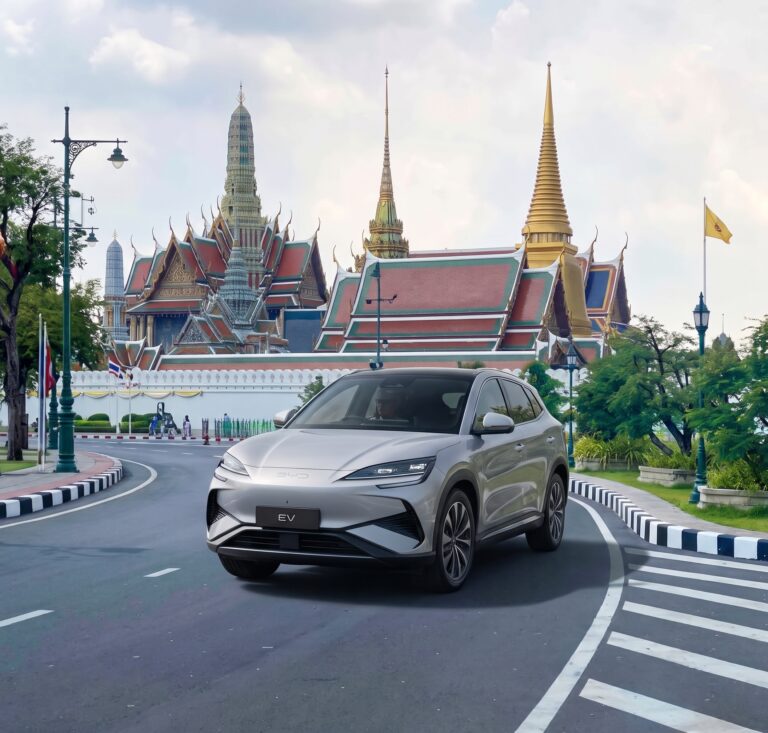
Thailand Automotive Industry 2026: Production, EVs and the Trust War
10 min readThailand’s automotive industry produced 1,455,569 vehicles in 2025, about two-thirds of them for export, according to the Federation of Thai Industries. Of the 600,373 new cars and pickups registered in Thailand that year, Japanese brands took about two-thirds and battery-electric vehicles 19.8%, according to the Department of Land Transport. In 2026, export disruption led the Federation of Thai Industries to cut its production target to 1.45 million vehicles, while electric registrations kept rising. Iconic Research expects the next phase to be decided by buyers’ trust in brand survival, service, insurance and resale value.
Table of Contents
- Production and Exports in 2025
- EV Manufacturing
- A Market Split by Powertrain
- 2026 So Far
- The Trust War — Who Wins the EV Shakeout
- Thailand Automotive Industry Outlook 2026
- What to Measure — Iconic Research
- Conclusion
- References
- Related Research Guides
Thailand’s automotive industry was built on pickups and exports. It is the largest vehicle producer in Southeast Asia, and most of what it builds leaves the country. That base is now being reshuffled from two sides: Chinese brands building electric vehicles in Thailand, and a domestic market where electric car registrations nearly doubled in 2026.
This article covers production, exports and EV manufacturing, how the 2025 market split between Japanese and Chinese brands, what has changed in 2026, and where the market is heading. The full 2025 sales figures by brand and model are on the Thailand car sales data page.
Production and Exports in 2025
Thailand produced 1,455,569 vehicles in 2025, down 0.91% from 2024, according to the Federation of Thai Industries [2].
Thailand vehicle production, 2025
2025 | Vehicles | Change vs 2024 |
Total production | 1,455,569 | −0.91% |
Built for export | 956,230 | −5.24% |
Built for the domestic market | 499,339 | +8.59% |
Source: Federation of Thai Industries [2].
About two-thirds of production — 65.69% — was built for export. Export production fell while production for the domestic market grew [2].
Pickups remain the core of the export trade. Of the vehicles built for export, 728,219 were one-ton pickups, up 2.02%, and 228,011 were passenger cars, down 22.80% [2].
EV Manufacturing
Electric vehicles are no longer only imported. Thailand built 70,914 battery-electric passenger cars in 2025, more than seven times the 2024 level, according to the Federation of Thai Industries [2].
Policy is driving the shift. Under the BOI’s EV 3.5 scheme, brands that imported electric vehicles with government support must build two vehicles in Thailand for every one imported in 2026, rising to three in 2027 [3]. Each Thai-built EV that is exported counts as 1.5 vehicles towards that obligation [4]. The rule separates brands committed to Thai production from brands that came only for subsidised imports.
The investment follows. BYD opened its Rayong plant, its first car factory outside China, in July 2024, with capacity for up to 150,000 vehicles a year and more than 35 billion baht invested across nine BOI-promoted projects [5]. Japanese makers are answering with hybrids rather than battery-electric cars: Thailand built 214,317 hybrid vehicles in 2025, up 12.30% [2].
A Market Split by Powertrain
Japanese brands took about two-thirds of the 600,373 new cars and pickups registered in 2025, led by Toyota at 37.6%. Nine of the top ten battery-electric brands were Chinese, according to Iconic Research’s count of Department of Land Transport data [1]. None of the three largest brands overall — Toyota, Honda and Isuzu — appears in the electric top ten. The full figures by brand and model are on the Thailand car sales data page.
Each side is exposed. Japanese brands have little presence in electric vehicles, the segment that is growing. No Chinese pickup, petrol or diesel model is among the ten most registered models.
2026 So Far
The year began with a subsidy cliff. Buyers rushed to take delivery in January 2026 before the EV 3.0 scheme expired, and in February battery-electric sales fell 18.56% from a year earlier, to 6,168 vehicles [4].
Conflict in the Middle East then changed the picture. Shipping through the Strait of Hormuz was disrupted, exports to the Middle East fell by more than 38%, and in July the Federation of Thai Industries cut its 2026 production target from 1.5 million to 1.45 million vehicles. The export target fell from 950,000 to 900,000; the domestic target was held at 550,000 [6].
Thailand vehicle production, exports and domestic sales, January–September 2026
January–September 2026 | Vehicles | Change vs 2025 |
Production | 1,080,030 | +0.39% |
Exports | 655,009 | −4.94% |
Domestic sales | 521,226 | +16.35% |
Source: Federation of Thai Industries [7].
Domestic demand is up, but not evenly. Pickup sales fell 16.11% from January to September [7]. Battery-electric passenger car registrations reached 167,789 over the same months, up 93.5% — already more than in the whole of 2025 [8]. Leadership is changing too: the Chery group (Omoda and Jaecoo) took 19.5% of electric registrations, ahead of the BYD group at 16.5% [8].
With pickup sales falling and electric registrations nearly doubling, the pressure falls on Japanese brands first.
The Trust War — Who Wins the EV Shakeout
The 2026 data settles one question: trust barriers are not stopping Thais from buying electric cars. What they decide is which brands keep those buyers. In one year, the Chery group overtook BYD in electric registrations [8] — buyers are moving between Chinese brands quickly, and loyalty is not yet formed.
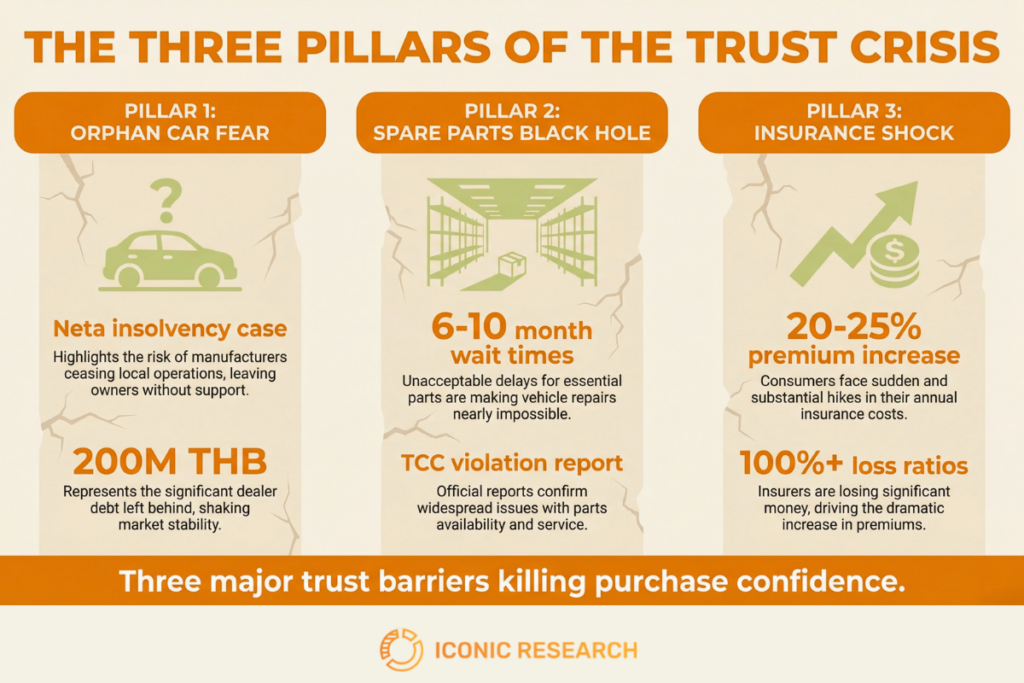
Three barriers shape that choice.
Brand survival. The collapse of Neta Auto’s parent company in China left Thai owners asking what happens to a car whose brand disappears. Neta still registered 3,256 electric cars in Thailand in 2025 [1], each one an owner exposed to that risk.
Parts and repair. An electric car that is cheap to run is expensive to own if it waits weeks for parts. Service coverage outside Bangkok matters more as electric buyers spread beyond early adopters in the capital.
Insurance. Battery and body repairs on electric cars are costly, and buyers weigh the cost of cover alongside the price of the car.
The buyers now driving growth are second-time buyers and households replacing a petrol or diesel car. They ask about resale value, service coverage and whether the brand will still be there [9].
Thailand Automotive Industry Outlook 2026
In October 2026, the Federation of Thai Industries kept its 1.45 million production target, with 900,000 vehicles for export and 550,000 for the domestic market, after nine months of flat output [7]. The risks sit on the export side, where Middle East shipping and slower pickup demand weigh on volume.
At home, the market is growing and changing shape. Electric registrations are on course for a record year, pickups are shrinking, and the EV 3.5 production rule is turning importers into local manufacturers. The next contest is less about whether Thais buy electric cars than about which brands they trust enough to buy again.
What to Measure — Iconic Research
Production and registration data show what was built and bought. They do not show why buyers chose one brand over another, or what would make them switch. Five questions do, and each can be measured:
- Will the brand survive? Buyer confidence in a brand’s future in Thailand, tracked over time against competitors.
- Can the car be serviced outside Bangkok? Perceived and actual service coverage by region.
- What will it be worth when sold? Expected resale value, and what a resale guarantee is worth to buyers against price.
- Does the promise hold at the dealership? Whether warranty, service and delivery promises are kept at the point of sale.
- Where does the brand sit against competitors? How buyers position each brand on the attributes that drive choice.
Iconic Research measures these directly. Car clinics test competing models side by side with target buyers; conjoint studies measure what resale guarantees and service coverage are worth against price; mystery shopping checks whether promised service holds at the dealership; and a perceptual map shows where each brand sits in buyers’ minds.
Premium EV value perception. Conjoint analysis showed that Thai luxury EV buyers prioritise resale guarantees and service network depth over hardware specifications — a finding that reordered product launch priorities for one OEM client [9]. Read the case study.
Chinese EV perception across five ASEAN markets. Research across Thailand, Indonesia, Vietnam, the Philippines and Malaysia found that Chinese EV brands are seen as technology leaders, not budget alternatives — a positioning gap incumbent brands have consistently underestimated. Read the case study.
If your brand is deciding where to compete in this market, our car clinic and automotive research services are the starting point.
Conclusion
Thailand’s automotive industry is holding its production level while changing what it builds and sells. Pickups and exports remain the base, electric production is scaling under the EV 3.5 rules, and domestic buyers are moving to electric cars at almost twice the pace of 2025. The brands that earn trust on service, parts, insurance and resale will keep the buyers this shift creates. The full 2025 sales figures behind this analysis are on the Thailand car sales data page.
Frequently Asked Questions
How many vehicles does the Thailand automotive industry produce?
Thailand produced 1,455,569 vehicles in 2025, about two-thirds of them for export, according to the Federation of Thai Industries. The 2026 target is 1.45 million.
Are Japanese or Chinese brands winning in Thailand?
Both, in different markets. Japanese brands took about two-thirds of new cars and pickups registered in 2025, while Chinese brands held nine of the top ten places in battery-electric vehicles.
What share of new cars in Thailand are electric?
Battery-electric vehicles were 19.8% of new cars and pickups registered in 2025. Electric passenger car registrations rose 93.5% in the first nine months of 2026.
What is the BOI 2:1 rule?
Under the EV 3.5 scheme, brands that imported electric vehicles with government support must build two vehicles in Thailand for every one imported in 2026, rising to three in 2027.
What are the main trust barriers for EV buyers in Thailand?
Fear that the brand will not survive, long waits for parts and repairs, and the cost of insurance. They now decide which brands keep electric buyers rather than whether Thais buy electric cars.
References
[1] Department of Land Transport, Thailand (2026). New vehicle registration statistics 2025. Brand, model and BEV counts by Iconic Research.
[2] Mreport (2026). Thailand’s Auto Production in Dec 2025 Hits 113,855 Units; Full-Year Output Reaches 1.45 Million. Federation of Thai Industries data. https://www.mreport.co.th/en/news/statistic-and-ranking/556-thailand-automotive-production-dec-2025
[3] Thailand Board of Investment (2024). Thailand EV Board Approves Extended Production Timeframe. https://osos.boi.go.th/EN/news/2138/Thailand-EV-Board-Approves-Extended-Production-Timeframe-for/
[4] EqualOcean (2026). Subsidy Rollbacks, Sales Cliff, and a Japanese Comeback: The Next Phase for Chinese EV Makers in Thailand. https://equalocean.com/news/2026041621836
[5] The Nation (2024). BYD’s first plant outside China starts EV manufacturing in Rayong. https://www.nationthailand.com/business/automobile/40039381
[6] BriefAsia (2026). Thailand Cuts 2026 Auto Output Target as Mideast Conflict Disrupts Exports. https://www.briefasia.com/en/article/thailand-cuts-2026-auto-output-target-mideast-conflict
[7] Posttoday (2026). ผลิตรถยนต์ ก.ย. 69 ลด 6.08% สวนยอดขาย-ส่งออกโต กระบะยังซบเซา. Federation of Thai Industries data. https://www.posttoday.com/smart-city/751040
[8] Autotirechecking (2026). Thailand BEV registrations, September 2026. Department of Land Transport data compiled by JETRO. https://www.autotirechecking.com/thailand-bev-registrations-september-2026-chery-mg-geely/
[9] Iconic Research (2026). EV Market Entry in Thailand: Automotive Market Research Case Study. https://iconicthai.com/case-study/case-study-navigating-thailands-ev-market-a-comprehensive-research-approach/
If you wish to quote any information from this article, please kindly cite the source along with the link to the original article to respect copyright. |
 |
Iconic Research Thailand Your trusted partner in market research and consulting across Thailand and Southeast Asia. Headquartered in Bangkok, we provide research-driven insights across the Philippines, Malaysia, Indonesia, Singapore, Laos, and Vietnam. We help businesses navigate Thailand's market complexities through consumer insights, market entry strategy, and trend foresight. Contact us if you have any queries! (+66)888 954 954 |
Related Research Guides
— Thailand Car Sales by Brand 2025 — the full registration figures behind this analysis, by brand, model and EV
— Perceptual Map — how to measure where a brand sits in buyers’ minds against competitors
Contact us
We always looking for new and exciting opportunities. Let’s connect.
Related posts
 Brand Perception in Thailand: What Shapes It and How to Measure It
Brand perception is the judgment buyers form about a brand from everything they know, hear and experience of it. This guide explains what shapes brand perception in Thailand, how it is measured by segment and region, and why perception and willingness to pay must be read separately.
10 min read Usability Testing: Methods, Metrics and How It Works in Thailand
How usability testing works, which methods and metrics to use, and what changes when the users are Thai.
11 min read Thailand Car Sales by Brand: Top Models and EVs in 5 Charts
Five charts from 2025 Department of Land Transport registrations: which car brands and models Thais bought, and how many new cars were electric.
5 min read