

Brand perception is the judgment buyers form about a brand from everything they know, hear and experience of it. It differs from brand identity, which is what the company intends, and from brand image, which is the set of associations buyers hold. In Thailand, brand perception is shaped by presenter credibility, peer recommendation in LINE groups, in-store promoters, marketplace reviews and country of origin, and it differs between Bangkok and the provinces. It is measured in two steps: qualitative research finds the attributes buyers use, and a survey rates each brand in a competitive set on those attributes, by segment and by region. Perception and willingness to pay are separate measures.
Table of Contents
- Brand Image vs Brand Perception vs Brand Identity
- What Shapes Brand Perception in Thailand
- How Brand Perception Is Measured
- Perception and Willingness to Pay Are Not the Same Measure
- Why Brand Perception Shifts in Thailand
- How to Improve Brand Perception
Brand Image vs Brand Perception vs Brand Identity
The three terms describe three different points between the company and the buyer.
Brand identity is what the company intends the brand to stand for, and sends out through its name, design, messaging and behaviour. Kapferer places identity on the sender’s side and image on the receiver’s side [2]. The brand identity guide covers the sender’s side.
Brand image is the picture of the brand that buyers hold in memory: the set of associations the brand brings to mind. Keller’s definition, on which most brand measurement is built, treats brand image as perceptions of a brand reflected in the associations held in consumer memory [1].
Brand perception is the judgment buyers form from that picture: whether the brand is good, whether it suits people like them, and whether it deserves its price.
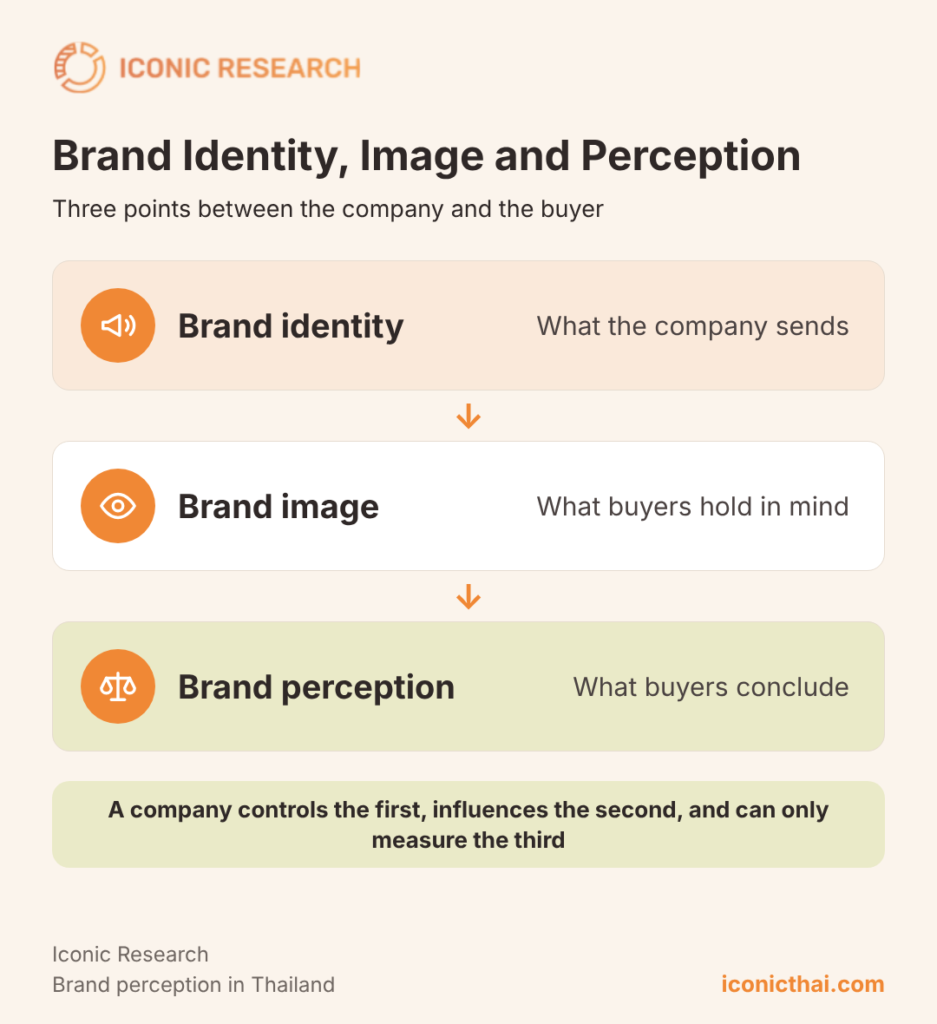
The gap between the three can be wide. A brand whose identity says “premium Japanese quality” can carry a very different image upcountry: “the one that is always on discount at Lotus’s”. Both descriptions are of the same brand. Only the second one decides what an upcountry buyer will pay for it.
What Shapes Brand Perception in Thailand
Global brand frameworks list advertising, product and price. In Thailand several other drivers carry more weight than those frameworks allow.
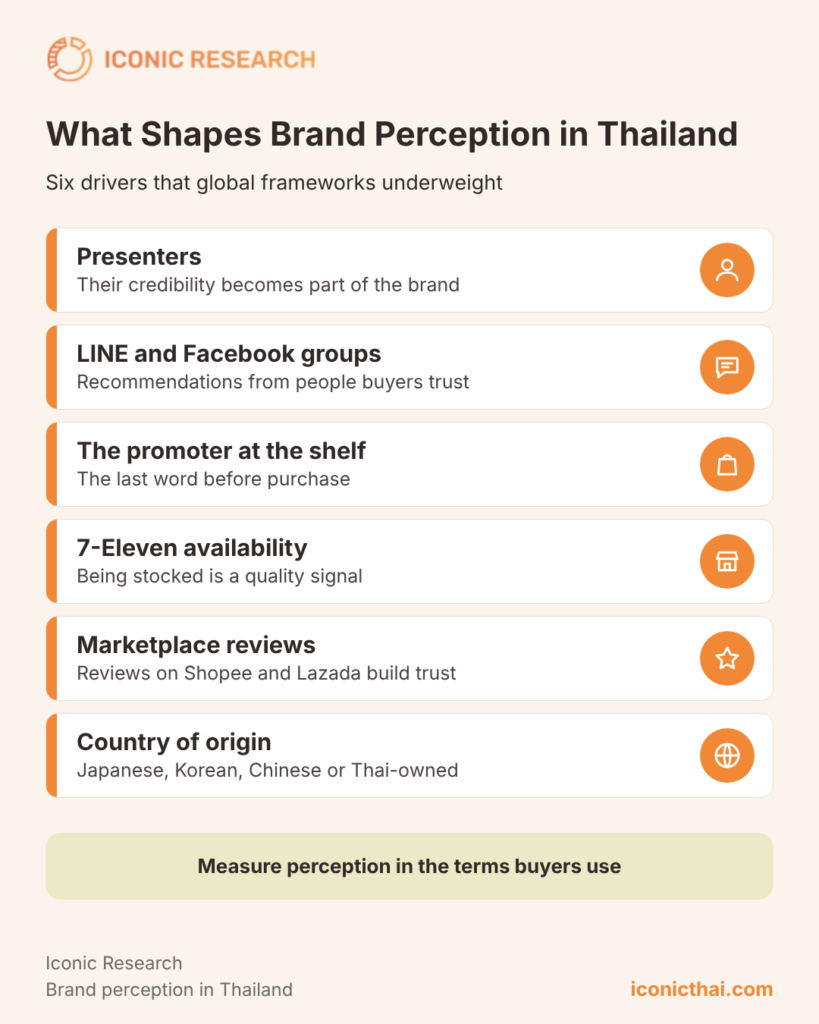
Presenters. Thai marketing relies heavily on the presenter (พรีเซนเตอร์), so the presenter’s credibility becomes part of the brand. Research among Thai online shoppers found that an influencer’s credibility and authenticity both raise purchase intention [4]. A celebrity who does not fit the brand, or is not believed to use it, damages the perception the brand paid to build.
LINE groups and Facebook communities. LINE is used by most of the Thai population [5], and family, school and neighbourhood groups pass on recommendations and warnings. A brand association formed there arrives from a trusted source, and advertising rarely overrides it.
The promoter at the shelf. In many categories the in-store promoter, known as the PC, has the last word before purchase. What the PC says about a brand, and about its competitor on the next shelf, is part of how the brand is perceived.
Availability in 7-Eleven. For many buyers, being stocked in 7-Eleven is a signal of quality and legitimacy in itself. A brand available only online has to earn that trust another way.
Marketplace reviews. On Shopee and Lazada, reviews do the work a salesperson does in a store. A study of Shopee customers in Thailand found that the quality and credibility of reviews build trust, and trust drives purchase intention [6].
Country of origin. Japanese, Korean, Chinese and Thai-owned are often the first brand associations a Thai buyer holds, ahead of any feature. The Chinese association is shifting fastest. In electric cars and consumer electronics it has moved from “cheap” towards “good value with new technology” within a few years [9].
These drivers produce the brand attributes Thai buyers actually use when they compare brands: trusted by people like me, easy to find, recommended in the store, serviced nearby. The guide to Thai culture and behavior explains the social norms behind them.
How Brand Perception Is Measured
Qualitative first. Focus groups and in-depth interviews find the attributes buyers use, in their own words. These rarely match the brand’s own list. In one study of the Thai air conditioner category, the brief listed “innovation” and “energy saving”; buyers talked about whether the brand is Thai or Japanese and whether a technician will come within a day [8].
An attribute battery across a named competitive set. A survey then asks category buyers to rate each brand on the same list of brand attributes. A competitor analysis defines which brands belong in the set.
A perceptual map per segment. Ratings are plotted on a perceptual map, which shows where buyers place each brand and which positions are open.
Read by segment and by region. Mass, mid, premium and luxury buyers are read separately, and so are Bangkok, Central, North, Northeast and South. A national average hides the differences that matter.
Two measurement problems are specific enough to Thailand to name.
Polite answers. Thai respondents are highly considerate of the interviewer [7]. In rating questions this shows up as acquiescence bias: agreement is over-reported and criticism is softened, so every brand scores well. Scales and question order have to be designed to counter it, and brands should be compared with each other, not judged on absolute scores. The data collection guide covers the techniques.
Online panels skew urban. Panels over-represent younger, higher-income, urban respondents. Face-to-face CAPI interviewing is what brings provincial buyers into the result.
Awareness is a separate measure. Top of mind and brand recall show whether buyers remember a brand, which the brand awareness guide covers; the attribute battery shows what they think of it. Repeating the same survey over waves shows whether perception is moving, which is the purpose of brand health tracking.
Perception and Willingness to Pay Are Not the Same Measure
Buyers can rate a brand as premium and still refuse to pay the premium. Thai building materials and sanitary ware show why. The architect or designer specifies the brand and rates it on design and reputation. The homeowner pays, and compares the quote with a cheaper alternative the contractor suggests. Perception sits with one person and the payment decision with another, and even when they are the same person the two answers differ.
Perception is an opinion, and giving it costs the buyer nothing. Willingness to pay is a trade-off, and it has to be asked in a different way [3].
The two are therefore asked separately and read separately. The attribute battery covers perception. The price side is measured with conjoint analysis, which makes respondents choose between complete offers at different prices and reveals what the brand name is worth in the choice.
Why Brand Perception Shifts in Thailand
- A rebrand or logo change. Recall moves first. Judgments about quality move later, and only if experience supports them.
- Chinese entrants. In automotive, FMCG and consumer technology, entrants with similar specifications at lower prices have shortened the time established brands have to defend their position. In electric cars the ranking among the Chinese brands themselves changed within a single year [9].
- Presenter scandals. When a presenter is in the news for the wrong reason, the brand is in the same headline.
- A service failure that goes viral. One complaint thread on Pantip or X can reach more buyers than a campaign, and it stays searchable.
- Commoditisation. When every brand claims the same benefits, those attributes stop separating brands, and price takes over.
- Regional expansion. A brand built in Bangkok that expands upcountry meets a different buyer, with different reference brands and a different idea of value. The study of consumer behavior in Thailand covers those differences.
How to Improve Brand Perception
Improvement starts with measurement. Without a baseline there is no way to know which attributes need work, or whether anything changed.
- Measure first. Establish how each segment and region perceives the brand against its competitors.
- Move the attributes that drive consideration in that segment. Driver analysis shows which attributes separate the brands buyers shortlist from those they reject. These are often not the attributes the brand likes to talk about. The work on brand positioning decides which of them the brand should try to own.
- Re-measure on the same design. Run the same survey again and read the change against the baseline.
Brand perception in Thailand is formed in buyers’ own terms: the presenter, the LINE group, the promoter at the shelf, the country on the label. Brands that measure it in those terms, by segment and by region, and keep it separate from willingness to pay, know where they stand.
Iconic Research measures brand perception in Thailand through qualitative research and face-to-face surveys in Bangkok and the provinces. To discuss a perception study or a tracking programme, see our brand strategy consulting service.
Frequently Asked Questions
What is brand perception?
Brand perception is the judgment buyers form about a brand from everything they know, hear and experience of it. It decides whether a brand that buyers are aware of is also one they consider.
What is the difference between brand image and brand perception?
Brand image is the set of associations buyers hold about a brand. Brand perception is the judgment they form from those associations, such as whether the brand is reliable or worth its price.
How do you measure brand perception in Thailand?
Qualitative research first finds the attributes Thai buyers use to compare brands. A survey then rates each brand in a competitive set on those brand attributes, read by segment and by region, with face-to-face interviews to reach provincial buyers.
Why does brand perception differ between Bangkok and the provinces?
Buyers meet the brand through different channels, promoters, prices and peer networks. The same brand can be seen as premium in Bangkok and as a discount brand upcountry.
How often should brand perception be measured?
It should be measured before any major change, such as a rebrand or regional expansion, and again afterwards on the same design. Brands facing new competitors usually measure it at regular intervals as part of brand health tracking.
[1] Keller, K. L. (1993). Conceptualizing, Measuring, and Managing Customer-Based Brand Equity. Journal of Marketing, 57(1), 1–22. https://doi.org/10.1177/002224299305700101
[2] Kapferer, J.-N. (2008). The New Strategic Brand Management: Creating and Sustaining Brand Equity Long Term (4th ed.). Kogan Page. ISBN 978-0749450854
[3] Breidert, C., Hahsler, M., & Reutterer, T. (2006). A Review of Methods for Measuring Willingness-to-Pay. Innovative Marketing, 2(4), 8–32. https://www.businessperspectives.org/index.php/journals/innovative-marketing/issue-111/a-review-of-methods-for-measuring-willingness-to-pay
[4] Panya, N. (2025). Influencer Characteristics, Purchase Intention, and Brand Loyalty: Evidence from Online Shoppers in Thailand. Strategic Perspectives on Business and Marketing Management, 12(1), 111–130. https://so05.tci-thaijo.org/index.php/mmr/article/view/273884
[5] Kemp, S. (2026). Digital 2027: Thailand. DataReportal. https://datareportal.com/reports/digital-2027-thailand
[6] Tan, Y. (2024). The mediating effect of trust on the relationship between eWOM and customer purchase intention on Shopee in Thailand. University of the Thai Chamber of Commerce. https://doi.nrct.go.th/ListDoi/listDetail/10.14458%2FUTCC.the.2024.6
[7] Phonthanukitithaworn, C., & Sellitto, C. (2016). A Reflection on Intercept Survey Use in Thailand: Some Cultural Considerations for Transnational Studies. Electronic Journal of Business Research Methods, 14(1), 60–70. https://academic-publishing.org/index.php/ejbrm/article/view/1341
[8] Iconic Research. Perceptual Map: worked case from the Thai air conditioner category. https://iconicthai.com/perceptual-map/
[9] Iconic Research (2026). Thailand Automotive Industry 2026: Production, EVs and the Trust War. https://iconicthai.com/thailand-automotive-industry-ev-market/
If you wish to quote any information from this article, please kindly cite the source along with the link to the original article to respect copyright. |
 |
Iconic Research Thailand Your trusted partner in market research and consulting across Thailand and Southeast Asia. Headquartered in Bangkok, we provide research-driven insights across the Philippines, Malaysia, Indonesia, Singapore, Laos, and Vietnam. We help businesses navigate Thailand's market complexities through consumer insights, market entry strategy, and trend foresight. Contact us if you have any queries! (+66)888 954 954 |
Contact us
We always looking for new and exciting opportunities. Let’s connect.
Related posts
 Usability Testing: Methods, Metrics and How It Works in Thailand
How usability testing works, which methods and metrics to use, and what changes when the users are Thai.
11 min read Thailand Car Sales by Brand: Top Models and EVs in 5 Charts
Five charts from 2025 Department of Land Transport registrations: which car brands and models Thais bought, and how many new cars were electric.
5 min read Perceptual Map: How to Map Brand Perception in Thailand
What a perceptual map is, where its brand perception data comes from, and how Iconic Research builds one in Thailand.
9 min read