Brand health tracking measures awareness, consideration, preference and perception of a brand and its competitors at regular intervals, on a fixed design. It shows whether the brand is gaining or losing ground over time.

Brand Health Tracking
Iconic Research designs and runs brand health tracking programmes in Thailand: a baseline wave that fixes where the brand stands today, then tracking waves read against the targets you set. Brand tracking, as the same work is often called, asks the same questions of the same kind of sample each time, so a change in the numbers reflects a change in the market and not a change in the method.
Three kinds of client commission it. Brand teams run it before and after a repositioning. Brands under competitive pressure use it to see where they are losing buyers. International brands use it to get a Thai baseline before they commit budget. In each case the results feed directly into brand strategy decisions: what to say, to whom, and against which competitor.
Why Iconic Research for Brand Health Tracking
Face-to-face fieldwork nationwide. Consumer waves use CAPI interviews in Bangkok and four regions, so provincial buyers are measured and not assumed.
A design that stays constant. Regions, quotas, questionnaire order and the competitive set are held from wave to wave. A movement in the numbers is a movement in the market.
Segments read separately. Mass, mid, premium and luxury buyers are reported on their own, because a market average describes none of them.
Findings tied to targets. Every wave is read against the baseline and against the target set for that metric, with recommendations for the next wave.
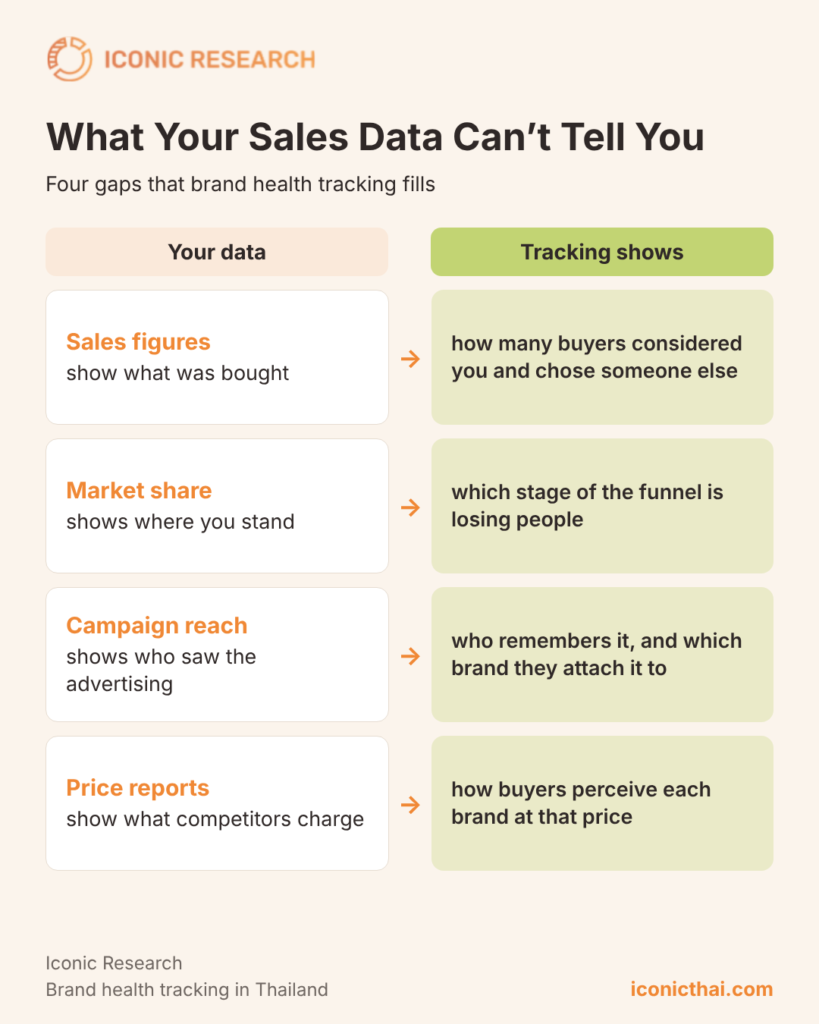
What Your Sales Data Can’t Tell You
Our Brand Health Tracking Methodologies
We design each programme around the decision you need to make: a repositioning, a rebrand, a defence against a competitor, or a first read of the Thai market. We run programmes for FMCG, automotive, banking and insurance, building materials and home improvement, telecom and healthcare brands.
1. Brand Funnel and Competitive Benchmark
The core of every wave is the brand funnel, measured for your brand and for each competitor in a named set agreed before fieldwork.
- Top of mind: the first brand a respondent names in the category.
- Unaided awareness: every brand named without prompting. This is the brand recall measure.
- Aided awareness: recognition when shown the name or logo.
- Consideration: brands the respondent would consider at the next purchase.
- Preference: the one brand they would choose first.
- Usage: brands used now, and brands used before and dropped.
- Loyalty and advocacy: intention to stay with the brand and to recommend it.
The gaps between stages show where the brand loses people. Each wave also covers advertising recall and brand confusion: how often respondents mistake a look-alike competitor for your brand. Our guide to brand awareness covers the first three stages in more depth.
2. Brand Perception by Segment
We read brand perception separately for mass, mid, premium and luxury buyers. Segment boundaries are verified first in qualitative research, without leading respondents towards a tier.
- Brand image: a battery of attributes rated for your brand and each competitor.
- Perception and price: perception and willingness to pay are measured as separate questions and read separately. A brand can be seen as premium by buyers who will not pay a premium for it.
- Perceptual map: a perceptual map for each segment shows where buyers place each brand, and which positions are still open.
3. Baseline, Waves and Targets
The baseline wave establishes the reference point. Tracking waves then run annually or semi-annually, and each metric has a target set two to three years out.
In brand tracking, sample design is held constant from wave to wave. When a design has to change, for example when a new competitor enters, we report two views: one aligned to the historical design, and one as the new baseline. A bridge between them shows how much of any movement comes from the design change.
4. Brand Health Check vs Brand Health Tracking
A brand health check is a single wave. It answers “where are we now”. Tracking repeats that wave on a fixed design and answers “are we moving”.
A check is enough for a diagnosis: a new brand team, a market entry decision, a strategy review. It is not enough when money is about to be spent on changing the numbers. In that case the check becomes the baseline for the waves that follow.
5. B2C and B2B Legs
- B2C: face-to-face CAPI in Bangkok and four regions. A sample of 1,000 to 1,500 respondents gives stable reads at segment level. See our quantitative research page for the fieldwork approach.
- B2B: the B2B research leg uses in-depth interviews with the people who specify or recommend: architects, interior designers, dealers, contractors and healthcare professionals. In one healthcare brand study, we interviewed general practitioners, endocrinologists and nurses.
Both legs can run in the same wave and report against the same competitive set.
6. Measuring a Rebrand
A rebranding is measured with a pre-wave before the change and post-waves after it.
- What moves first: recall and brand confusion, which respond to a new name, packaging or campaign.
- What moves last: preference and brand equity, which depend on buyers using the brand again under its new identity.
- The success metric: agreed before launch, with the wave at which each metric is expected to move.
From Findings to Action
Every wave ends with a report read against the baseline and the targets: the funnel for your brand against each competitor, a perceptual map by segment, driver analysis showing which attributes move consideration and preference, and segment cuts. Recommendations are tied to the next wave, so each one names what to change and which number should show it.
Ready to Set Your Baseline
Whether you need a one-off brand health check or a tracking programme with waves and targets, we can design a programme that fits. Contact Iconic Research to discuss your brief.
Frequently Asked Questions
What is brand health tracking?
What is the difference between a brand health check and brand health tracking?
A brand health check is one wave that shows where the brand stands now. Brand health tracking repeats that wave on the same design to show whether the brand is moving.
How often should tracking waves run?
Most programmes run annually or semi-annually. The right interval depends on how fast the category changes and how much marketing activity happens between waves.
Can you track B2B brands?
Yes. The B2B leg uses in-depth interviews with the people who specify or recommend the brand, such as architects, dealers, contractors and healthcare professionals.
How do you measure whether a rebrand worked?
A pre-wave before the change is compared with post-waves after it. Recall and confusion are read first, and preference and equity at later waves, against a success metric agreed before launch.
Applications of Brand Health Tracking
- Brand strategy
- Brand positioning
- Brand identity
- Brand awareness
- Customer loyalty
- Competitor analysis
- Market segmentation
- Market entry strategy Thailand
- Go-to-market
- Rebrand measurement
- Campaign evaluation
Our Brand Tracking Methodologies
- Baseline and tracking waves
- Awareness-to-loyalty funnel
- Attribute ratings by brand
- Perceptual mapping
- Conjoint analysis
- Driver analysis
- Advertising recall
- Brand confusion testing
- Benchmarking
- Segment reads by price tier
- Face-to-face CAPI surveys
- In Depth Interviews
“Sales tell you what buyers did. Brand health tracking tells you what they will do next.”
Why Iconic Research for Brand Health Tracking
A brand tracker has to be right about Thai consumers and consistent from one wave to the next. Both depend on who runs it.
Nationwide Fieldwork
Our interviewers survey consumers face to face in Bangkok and four regions. A tracker that covers only the capital describes only part of the market, so every wave reads provincial buyers as well.
Thai Consumer Insight
We know how Thai consumers talk about brands, status and price. Segments and price tiers are checked with buyers in qualitative work first, so the survey asks its questions the way buyers think.
Consumers and Professionals
We survey consumers and interview the professionals who recommend your brand, such as architects, dealers and doctors. Both run in the same programme and are reported against the same competitors.
Actionable Recommendations
We do not hand over data tables and leave. Every wave ends with what changed, why it changed, and what your team should do before the next wave is run.