

Market Research Guide: Methods, Examples & Key Questions for Business Growth
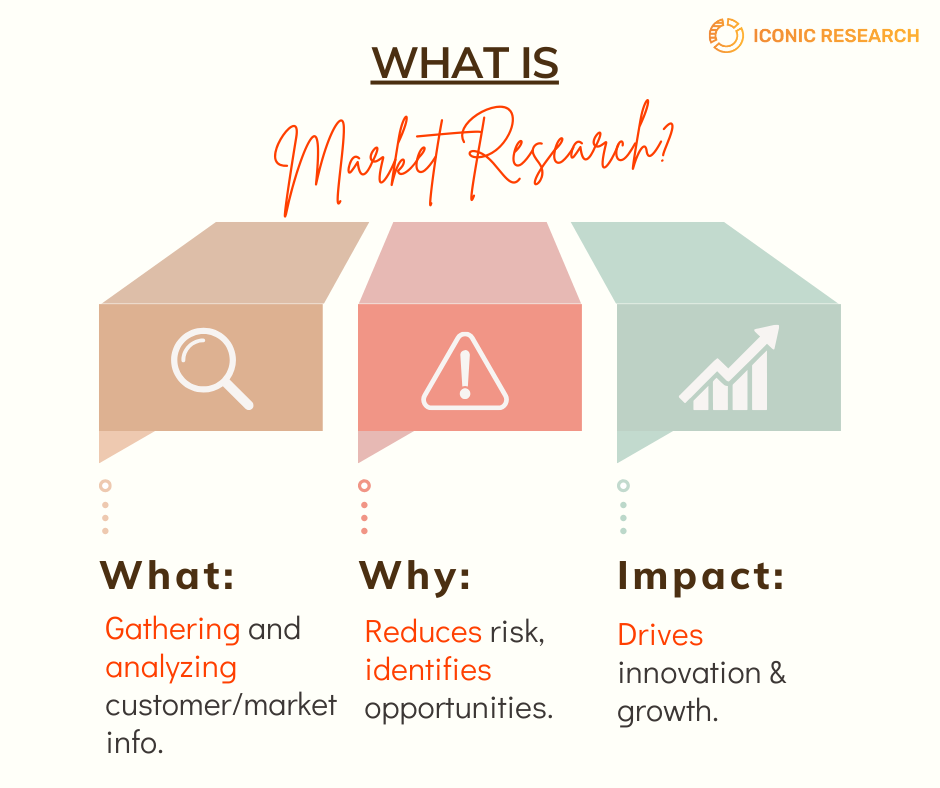
13 min readMarket research is the process of gathering and analyzing information about customers, competitors, and markets to guide business decisions. It reduces risk, identifies opportunities, and ensures strategies align with real consumer needs. When market research for you delivers actionable insights, it drives product innovation, sharper marketing, and sustainable growth [1].
Table of Contents
- What Is Market Research?
- How Does Accurate Market Research Help a Business?
- What Are Good Market Research Questions?
- What Are the Objectives of Marketing Research?
- Food and Beverage Market Research — Why It Matters
- B2B vs Consumer Market Research: Key Differences
- Technology and Online Market Research Trends
- Qualitative vs Quantitative Approaches
- Specialized Fields: Patient Market Research
- Thai Market Context: Local Nuances That Matter
- Conclusion & TL;DR
- Sources
What Is Market Research?
Market research is a systematic process of collecting and interpreting information about a market — including customers, competitors, and the wider environment. Its purpose is to help organizations make better, evidence-based decisions. The American Marketing Association describes marketing research as the function that connects organizations with their audiences through data and insights [1]. In practice, this means identifying opportunities, testing new ideas, monitoring performance, and improving processes.
Instead of relying on gut instinct or anecdotal feedback, businesses use research to ground decisions in evidence. This includes surveys, interviews, observations, and analytics [2]. When done effectively, market research reduces risk, highlights unmet needs, and builds a stronger foundation for sustainable growth.
How Does Accurate Market Research Help a Business?
How does accurate market research help a business succeed in competitive markets? Accurate market research plays a central role in business strategy by delivering actionable insights that drive decision-making.
Uncovering Consumer Insights: Research identifies motivations and emotional drivers that shape purchase decisions. These insights often spark innovation and product differentiation [3].
Supporting Strategic Decisions: Pricing, positioning, and segmentation decisions become stronger when grounded in evidence rather than assumptions.
Reducing Risk: Without data, companies risk over-investing in products that fail or targeting markets that don’t respond as expected.
Improving Marketing Effectiveness: Research helps companies craft messages that resonate and campaigns that convert [2].
Driving Growth: Firms that systematically use insights often outperform competitors by anticipating customer needs earlier [3].
When businesses combine consumer research with operational and financial data, they become better equipped to adapt to rapid market shifts, particularly in fast-changing economies like Thailand’s.
What Are Good Market Research Questions?
What are good market research questions that deliver actionable insights? The value of market research depends heavily on the quality of the questions asked. Good market research questions are purposeful, clear, and aligned with business objectives. Marketing research questions should target specific business challenges while remaining open enough to uncover unexpected insights.
- Who are our current customers and what are their demographics in terms of segmentation?
- What motivates customers to choose us instead of competitors?
- How do consumers prefer to purchase — online, offline, or through hybrid models?
- What unmet needs exist in the market?
- How sensitive are customers to price changes?
- What trends are emerging in consumer preferences?
- Which competitors are gaining traction, and how are they perceived [2]?
Insights from Iconic Research
We specialize in both Consumer Behavior Research and Stakeholder Research across Thailand. Consumer behavior research focuses on understanding end-user motivations, preferences, and decision-making processes. Stakeholder research examines the complex networks of decision-makers in B2B environments, mapping influence patterns and approval processes. This dual capability allows us to serve both consumer brands and business services companies with targeted methodologies.
What Are the Objectives of Marketing Research?
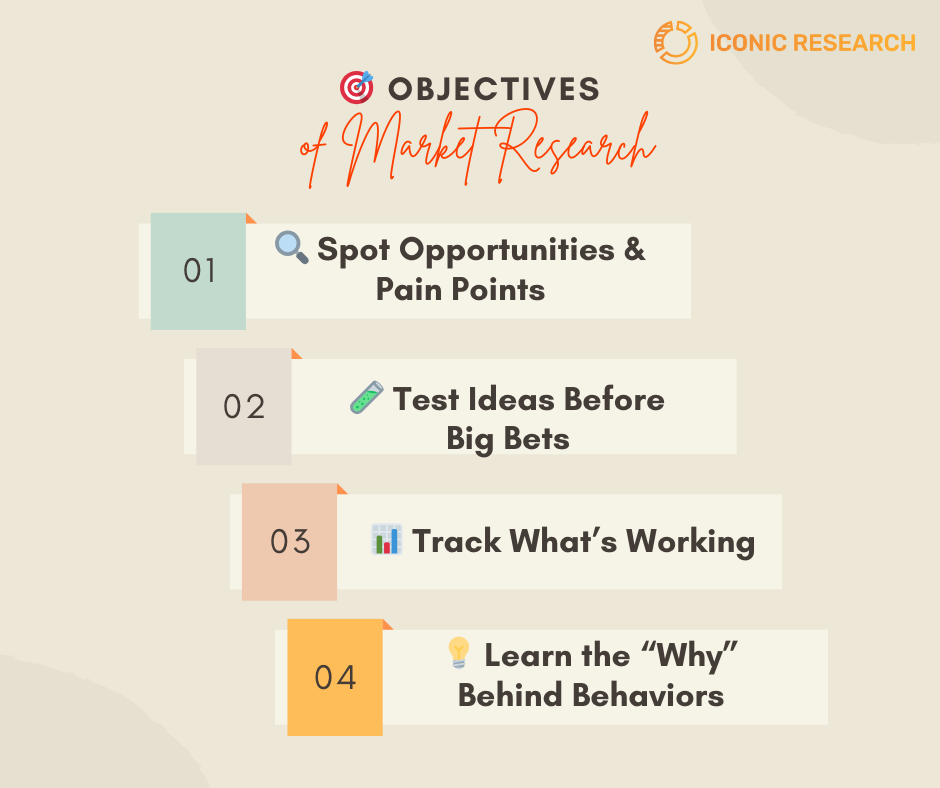
Marketing research typically supports four core objectives that work together to build comprehensive market understanding.
Identify Opportunities and Problems: Detect unmet needs, emerging preferences, or gaps in current offerings [1].
Generate and Evaluate Actions: Test concepts, advertising, or pricing before committing resources to full-scale implementation.
Monitor Performance: Track whether strategies are working through KPIs like brand awareness, customer satisfaction, and loyalty metrics.
Gain Process Insights: Understand the “why” behind behaviors, helping companies refine strategies over time [1].
These objectives ensure businesses remain customer-centric, adaptive, and competitive in evolving markets.
Food and Beverage Market Research — Why It Matters
The food and beverage (F&B) industry is among the most dynamic sectors, making market research essential for success. Consumer preferences evolve quickly — from health-driven diets and plant-based alternatives to premiumization trends that reshape entire categories.
In Thailand, the F&B sector accounts for more than one-fifth of GDP, reflecting its importance both domestically and internationally [4]. Thai consumers increasingly value health, novelty, and authenticity in their food and drink choices [5]. Research helps companies anticipate shifts like growing interest in plant-based diets, functional beverages, or novel flavor fusions [6].
Market research in F&B guides product innovation, pricing, distribution, and messaging strategies. Research might reveal that Thai millennials seek affordable organic products or that urban professionals demand convenience without compromising on health. These insights help companies remain competitive in a sector where margins are slim and competition is fierce [4][6].
B2B vs Consumer Market Research: Key Differences
B2b market research agency services differ significantly from consumer research approaches. Although the ultimate purpose remains the same — understanding the target market — methods and approaches differ significantly between B2B and B2C market research.
Aspect | B2B Market Research | B2C Market Research |
Audience Size | Small, specialized | Large, diverse |
Decision-Making | Multiple stakeholders | Individual/household |
Methods | IDIs, case studies, expert panels | Surveys, focus groups, analytics |
Sales Cycle | Long, complex | Short, emotional |
B2B Market Research Characteristics:
- Smaller populations of decision-makers
- Purchase decisions involve multiple stakeholders (procurement, finance, end-users)
- Longer sales cycles with complex evaluation processes
- Relies heavily on in-depth interviews, expert panels, and case studies [7]
- Often requires specialized b2b market research agency expertise for industry-specific insights
B2C Market Research Characteristics:
- Large, diverse customer bases spanning multiple demographics
- Shorter, emotion-driven purchase decisions
- Uses large-scale surveys, focus groups, and analytics to detect trends [7]
For example, a cybersecurity firm might interview CIOs about vendor selection criteria (B2B), while a beverage company might survey thousands of consumers about flavor preferences (B2C).
Insights from Iconic Research
B2B market research is one of our core specialties, with numerous large-scale projects completed across Bangkok and Thailand. We’ve worked extensively with multinational corporations, healthcare systems, financial services, and technology companies. Our experience spans complex stakeholder mapping, decision-maker interviews, and organizational behavior analysis that helps companies navigate Thailand’s unique business environment.
Technology and Online Market Research Trends
Online market research has transformed how businesses gather insights, making data collection faster and more accessible than ever before. Technology market research shows that digital transformation continues reshaping methodologies across industries.
Technology has fundamentally reshaped market research capabilities and methodologies through several key innovations:
AI & Analytics: Machine learning models segment consumers and predict trends with unprecedented precision [8].
Generative AI: Emerging tools simulate “synthetic customers,” allowing companies to test ideas rapidly before committing to full studies [9].
Online Panels & Surveys: Fast, cost-effective, and scalable approaches that reach thousands of respondents in days rather than weeks.
Social Media Listening: Provides a constant pulse on consumer sentiment and emerging trends in real-time.
Mobile Research: Captures in-the-moment feedback during shopping or product use experiences [8].
Advanced Techniques: Eye-tracking, biometrics, and neuroscience uncover subconscious reactions that traditional methods might miss [10].
These tools enhance efficiency and depth but also raise questions about data privacy and accuracy. Companies must balance innovation with trust and regulatory compliance.
Qualitative vs Quantitative Approaches
Qualitative research firms and qualitative research companies offer different methodologies that complement quantitative approaches. Understanding when to use each approach maximizes research effectiveness.
Approach | What It Is | Best For | Examples |
Quantitative | Structured, numeric data | Measuring "how many / how much" | Surveys, polls, analytics |
Qualitative | Exploratory, narrative data | Understanding "why / how" | Focus groups, in-depth interviews, ethnography |
Quantitative Research: Surveys, polls, and structured data provide measurable insights from large samples. Best for answering “how many” or “how much” questions [10].
Qualitative Research: Focus groups, in-depth interviews, and ethnographic studies provide context, emotions, and motivations behind behaviors. Qualitative research companies specialize in these deeper, exploratory methods [10].
The most effective research projects combine both approaches: qualitative research generates hypotheses and provides depth, while quantitative research validates findings with scale and statistical confidence.
Specialized Fields: Patient Market Research
Healthcare requires tailored approaches that account for sensitive subject matter and regulatory constraints. Patient market research focuses on understanding experiences, treatment barriers, and unmet needs directly from patients [11]. Unlike provider-centric studies, patient insights highlight challenges like adherence to treatment, quality of life impacts, and trust in healthcare systems.
Methods include patient surveys, interviews, and experience diaries. Challenges include small sample sizes, ethical considerations, and sensitivity in recruitment processes. Despite these difficulties, patient research is essential for developing patient-centric products and improving care delivery [11].
Thai Market Context: Local Nuances That Matter
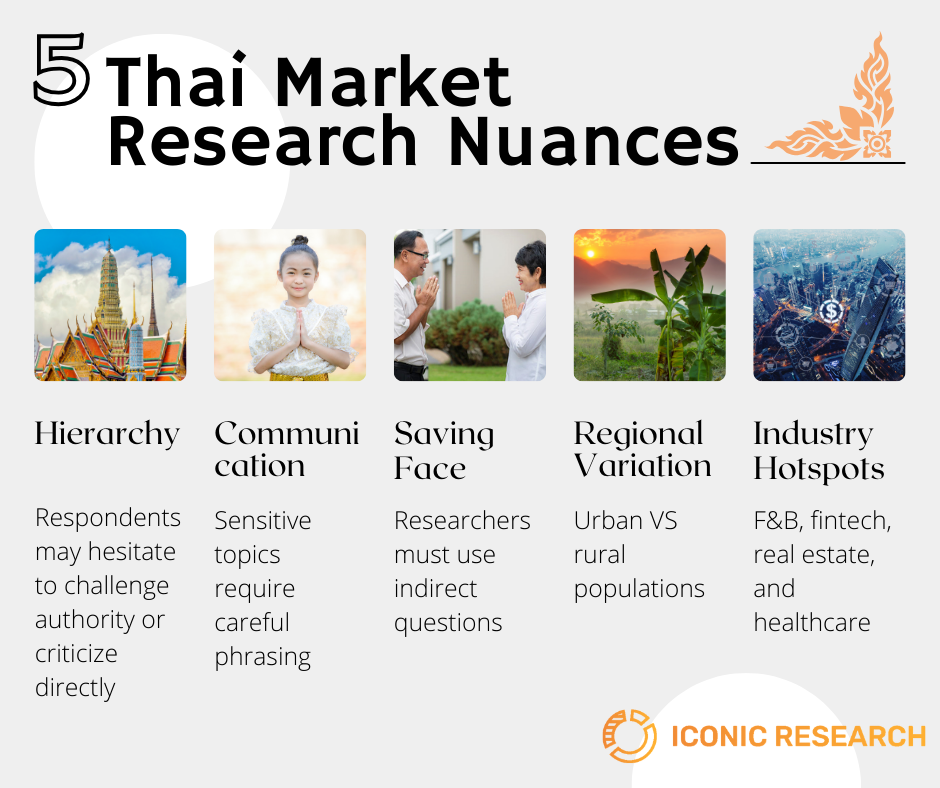
Conducting market research in Thailand requires attention to cultural dynamics that influence how people respond and share information.
Hierarchy: Respondents may hesitate to challenge authority figures or criticize directly [6].
Indirect Communication: Sensitive topics require careful phrasing to avoid discomfort and encourage honest responses.
Saving Face: Researchers must use indirect or scenario-based questions to elicit genuine feedback without causing embarrassment.
Regional Variation: Urban and rural populations often display different consumer behaviors and preferences.
Mobile-First Market: Online and mobile research methods are effective, but translation and cultural adaptation are critical for accuracy.
Industry Hotspots: Sectors such as F&B, fintech, real estate, and healthcare particularly benefit from research-driven strategies.
Insights from Iconic Research
Here’s what sets us apart: we actually understand Thai culture. While other researchers get polite, surface-level responses, we know how to read between the lines. We catch the subtle cues and cultural nuances that reveal what people really think, not just what they think they should say.
Conclusion & TL;DR
Market research links businesses to consumers, guiding strategies with evidence rather than assumptions. It helps identify opportunities, reduce risks, and improve performance across industries.
Key Takeaways:
- Accurate market research drives innovation and sharper decision-making
- Strong questions and clear objectives ensure actionable insights
- Qualitative and quantitative methods complement each other effectively
- F&B, B2B, and healthcare are examples where research makes measurable impact
- In Thailand, cultural nuances — from hierarchy to indirect communication — must be carefully considered to capture authentic insights
For companies competing in fast-changing markets, research serves as both compass and guide: it shows where opportunities lie and how to navigate toward growth with confidence.
Frequently Asked Questions
What is Market Research?
Market research is collecting and analyzing information about customers, competitors, and markets to guide business decisions and reduce risk.
What are the main types of Market Research?
Quantitative research (surveys, statistics) measures "how many," while qualitative research (interviews, focus groups) explores "why."
How long does Market Research take?
Online surveys take days, while comprehensive studies typically require 4-8 weeks for recruitment, data collection, and analysis.
Can small businesses afford Market Research?
Yes, through cost-effective methods like online surveys, customer interviews, social media listening, and free analytics tools.
What makes a good Market Research question?
Clear, unbiased questions that focus on one concept and encourage honest responses aligned with business objectives.
Sources
[1] American Marketing Association – https://www.ama.org/the-definition-of-marketing-what-is-marketing/
[2] Salesforce – https://www.salesforce.com/marketing/how-to-conduct-market-research/
[3] McKinsey & Company – https://www.mckinsey.com/capabilities/quantumblack/our-insights/capturing-value-from-your-customer-data
[4] WorldFirst – https://www.worldfirst.com/sg/blog/business-expansion/expand-your-food-and-beverage-business-to-thailand/
[6] Orissa International / Estonian Ministry of Foreign Affairs – https://vm.ee/sites/default/files/documents/2025-03/Thailand%20Strategy_F%26B.pdf
[7] Kadence International – https://kadence.com/en-us/how-b2b-and-b2c-market-research-differ-2/
[8] Qualtrics – https://www.qualtrics.com/news/qualtrics-announces-top-trends-in-market-research-for-2024/
[9] Beyond – https://www.bynd.com/thinking/synthetic-customers-and-what-they-mean-for-customer-experience
[10] GreenBook – https://www.greenbook.org/insights/research-methodologies/qualitative-vs-quantitative-market-research-why-not-both
[11] EMI Research Solutions – https://emi-rs.com/panel-sample/healthcare-market-research/patient-market-research/
If you wish to quote any information from this article, please kindly cite the source along with the link to the original article to respect copyright. |
 |
Iconic Research Thailand Your trusted partner in market research and consulting across Thailand and Southeast Asia. Headquartered in Bangkok, we provide research-driven insights across the Philippines, Malaysia, Indonesia, Singapore, Laos, and Vietnam. We help businesses navigate Thailand's market complexities through consumer insights, market entry strategy, and trend foresight. Contact us if you have any queries! (+66)888 954 954 |
Contact us
We always looking for new and exciting opportunities. Let’s connect.
Related posts
 AI Thailand: The Opportunity Is Real, But So Is the Complexity
Thailand’s AI market is projected to reach 114 billion baht by 2030, yet most Thai consumers remain cautious. Understanding who they are – and what they actually need from AI – is the difference between a product that lands and one that doesn’t.
13 min read Thailand 4.0 in 2026: An Investor’s Blueprint for the Innovation Economy
Thailand 4.0 has reached a defining year in 2026 – transitioning from policy vision to operational reality with AI integration, EV manufacturing, and digital infrastructure driving the innovation economy.
9 min read Unlocking the “Why” Behind Thai Culture: Introducing PhumPanya
Thai culture can feel like a puzzle. At PhumPanya, we believe the key to understanding Thai language and culture is in the words themselves. Explore our free database of Thai words, their roots, and the cultural logic hidden inside the language.
3 min read