

Market Segmentation: A Complete Guide to Segmenting the Thailand Market
14 min readMarket segmentation is the process of dividing a broad consumer or business market into smaller groups based on shared characteristics such as demographics, behavior, or geography. Effective segmentation enables businesses to tailor products, marketing strategies, and customer experiences to each segment, improving relevance and driving better results across campaigns and customer touchpoints. In Thailand’s diverse market—spanning Bangkok’s urban sophistication to regional cultural nuances—segmentation requires understanding both digital behavior and traditional values that shape purchasing decisions across different consumer groups.
Table of Contents
- Geographic Market Segmentation
- Demographic Segmentation
- Behavioural Segmentation in Marketing
- Psychographic Segmentation
- Marketing Segmentation Analysis and Cluster Research
- Market Segmentation and Targeting
- Conclusion
- References
International brands entering Thailand consistently make the same three mistakes: assuming Bangkok represents the country, applying Western demographic models that miss how Thai consumers actually make decisions, and overlooking platform-specific behavioural differences that determine where — and how — different segments engage. Thailand has approximately 65.4 million internet users and 51 million social media identities [1], but those numbers mask structural and cultural variation that makes marketing segmentation here genuinely complex.
Geographic Market Segmentation
Geographic marketing segmentation is not simply about provinces. Applied to the Thai market, it is about structurally different consumer environments.
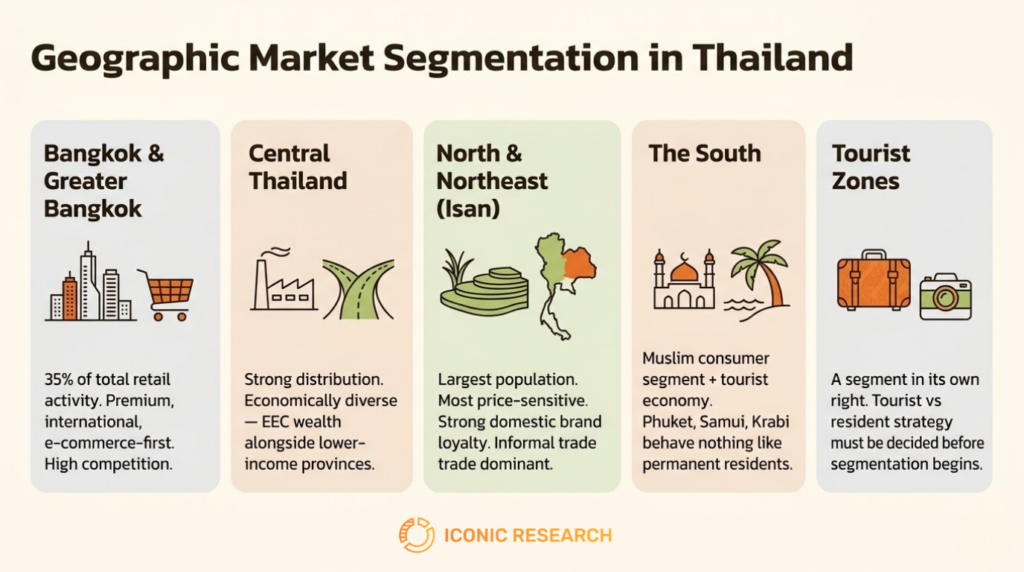
Bangkok and the Greater Bangkok metropolitan area account for roughly 35% of total retail activity and represent the primary market for modern trade, premium products, and e-commerce [2]. Brand exposure is high, purchasing power is concentrated, and consumers are experienced with international brands — a competitive environment with different dynamics, and different research requirements, than anywhere else in the country.
Central Thailand outside Bangkok includes mid-size cities such as Ayutthaya, Nakhon Ratchasima, and Chonburi. Distribution infrastructure here is generally strong, but the zone is economically diverse: Thailand’s wealthiest industrial corridors (the Eastern Economic Corridor) sit alongside provinces where household incomes are significantly below Bangkok levels. The North and Northeast (Isan) differ further. Isan is Thailand’s largest region by population, tends to be the most price-sensitive, and has strong loyalty to domestic brands and informal trade. Chiang Mai operates more like a secondary urban market. The South adds another distinct dynamic: a significant Muslim consumer segment and the country’s largest tourist economy, where Phuket, Samui, and Krabi serve populations that are partly expatriate, partly transient domestic tourists — and behave nothing like permanent residents.
Tourist zones deserve explicit treatment as a distinct segment in their own right — tourism market segmentation operates on different seasonality, spend patterns, and channel logic than resident consumer segments. The strategic decision — whether to serve the tourist segment, the resident segment, or both — needs to precede segmentation, not follow it. Finally, geographic segmentation intersects with Thailand’s ageing demographic curve: the North and Northeast are ageing significantly faster than Bangkok, as working-age adults migrate to urban centres and leave older populations behind with distinct needs and channel preferences [3].
Demographic Segmentation
Demographic marketing segmentation must account for a Thai population profile that is changing faster than most global models recognise.
The most significant structural shift is the Silver Economy. Thailand formally entered “aged society” status in 2024, with 14 million people aged 60 or older — approximately 20% of the population. By 2033, that figure is projected to reach 28% [3]. Elderly consumer spending reached 2.18 trillion baht in 2023 and is forecast to reach 3.5 trillion baht by 2033 [3]. This is not a niche segment. It is one of the fastest-growing consumer groups in the country, with concentrated spending in healthcare, food, housing, and financial services — categories where Western demographic assumptions about digital adoption and brand engagement are systematically wrong.
At the other end of the age spectrum, Gen Z and Gen Alpha interact with brands primarily through short-form video and social commerce, prioritising authenticity and peer validation over traditional advertising [4]. These two cohorts bracket a middle-income population under its own pressures. Thailand’s middle class has expanded significantly over two decades, but income inequality remains real. Consumers in the same postcode can be aspirationally premium — seeking brands that signal status — and deeply price-sensitive at the same time. Segmenting by income bracket alone misses this divide entirely. Psychographic variables are required to separate these groups, which is covered below.
For a detailed breakdown of how Thai consumers behave across LINE, TikTok, and social commerce platforms, see our consumer behavior in Thailand analysis.
Behavioural Segmentation in Marketing
Behavioural segmentation in marketing requires platform-level specificity that standard frameworks rarely provide — and nowhere is that gap wider than in Thailand.
LINE is used by approximately 50 million Thais and functions as a trust layer in consumer journeys — not a content discovery platform. Brands that maintain LINE Official Accounts use it for customer service, loyalty programs, and post-purchase communication. A significant portion of high-frequency consumer interactions happen within the LINE ecosystem, invisible to analytics tools monitoring open social channels. Brands that miss LINE’s role in behavioral market segmentation are missing the platform where purchase decisions are reinforced or reversed.
TikTok Shop represents a structurally different behavioral pattern: impulse purchasing driven by content discovery rather than intent. Thailand is consistently one of TikTok Shop’s highest-performing markets globally [4]. In 2024, Thailand’s e-commerce market grew 14% to reach 1.1 trillion baht [5], with TikTok Shop rapidly claiming share from established players. Consumers are not searching for a product they already want — they are discovering products they did not know they needed. That requires a different content strategy and a different segment profile than search-driven platforms.
Shopee and Lazada function as price comparison environments, with more than half of platform sales now driven by mega-sale campaigns [5]. For brands whose positioning depends on price stability, treating these customers as a distinct behavioral segment — with dedicated promotional mechanics — is more defensible than applying uniform pricing across all channels. Payment behavior adds another layer: the buy-now-pay-later and instalment segment — consumers accessing premium products they would not otherwise purchase outright — is measurable, growing, and behaviorally distinct from cash or single-payment buyers.
Psychographic Segmentation
Psychographic segmentation is where standard marketing segmentation models most consistently fail in Thailand — not because the concepts are wrong, but because the values driving behaviour are different.
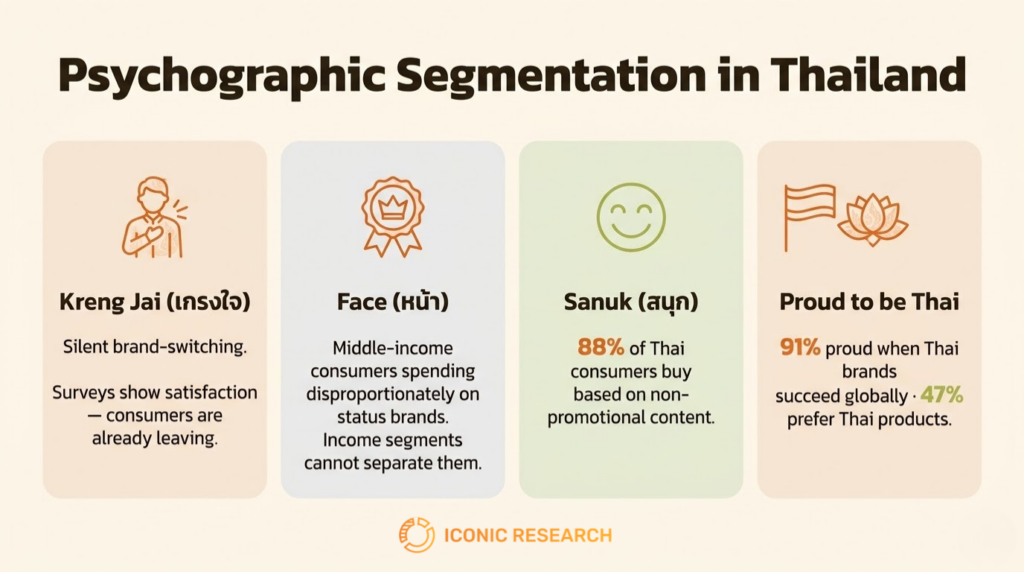
Kreng jai (เกรงใจ) — the desire to avoid imposing on others or causing discomfort — shapes how Thai consumers make decisions in ways that have no direct Western equivalent. Negative product experiences are underreported, public complaints are avoided, and brand-switching happens silently. A segment that appears satisfied in survey data may be preparing to leave. Research methodologies that rely on direct questioning without projective techniques are structurally unable to detect this.
Face (หน้า) operates as both a social mechanism and a purchasing driver. Premium aspiration in Thailand is not simply a function of income — it is about the social meaning of the brand. There are Thai consumers at middle-income levels who consistently allocate a disproportionate share of discretionary spending to products that signal status, and others at similar income levels who prioritise value entirely. These two psychographic profiles sit in the same demographic cell. Income-based segmentation cannot separate them.
Sanuk (สนุก) — the cultural value placed on fun and enjoyable experience — shapes content engagement. Over 88% of Thai consumers make purchasing decisions based on content that does not explicitly promote sales [4], which is why entertainment-led formats consistently outperform purely informational ones. Finally, the “Proud to be Thai” sentiment is a genuine segmentation variable: over 91% of Thai consumers express pride when seeing Thai brands succeed internationally, and 47% prefer Thai products [4]. International brands that treat this as background noise are missing a psychographic divide that has real implications for positioning.
Marketing Segmentation Analysis and Cluster Research
Moving from assumption to evidence is where marketing segmentation delivers its real value — and cluster analysis is the method that makes it possible.
Cluster analysis in quantitative research reveals segments that assumption-based frameworks miss. The approach takes survey or behavioural data and identifies natural groupings without imposing a predetermined structure. In Thailand, it regularly surfaces distinctions that demographic proxies obscure — a price-sensitive Silver Economy segment coexisting with a premium-aspiration segment in the same age bracket, or a TikTok-loyal behavioural segment with no geographic concentration. These distinctions are not visible in a cross-tab of age by income. They require the data to speak for itself. Iconic Research’s quantitative research service supports this work from survey design through to cluster output and strategic interpretation.
Three anonymised market segmentation examples illustrate the gap between assumed and actual segmentation. A FMCG brand entering Thailand segmented by income and urban/rural geography, expecting a price-sensitive mass market and a smaller premium urban segment. Cluster analysis revealed a third group — older rural consumers with high brand loyalty and moderate spending power — whose purchasing behaviour fit neither assumed model. A retail fashion brand assumed Gen Z in Bangkok was their core segment; behavioural data showed actual purchase volume was concentrated among 28–38 year-old women in mid-size provincial cities — a segment they were not reaching with Bangkok-centric creative. A financial services provider used income-based segmentation to identify premium product targets; psychographic profiling revealed that willingness to pay was more strongly predicted by face-consciousness than income, meaning they were selecting the right income band but the wrong psychographic profile entirely.
Market Segmentation and Targeting
Marketing segmentation identifies who exists in a market. Market segmentation and targeting decides which segments to pursue — and in what priority. Segmentation identifies the groups that exist. Defining which group to pursue — and what they need to believe, feel, and do — is where target audience definition begins. Segmentation at this stage feeds directly into the business analysis phase of new product development — where revenue projections and demand estimates depend on knowing which segment is being sized.
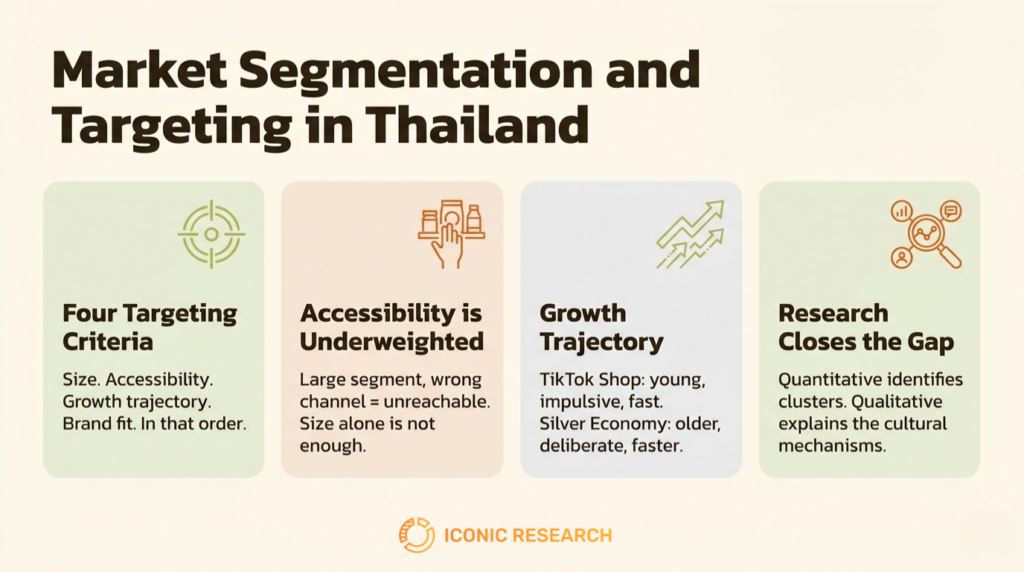
Targeting decisions in Thailand should be evaluated against four criteria: segment size, accessibility, growth trajectory, and fit with the brand’s capabilities. These criteria determine which market segmentation strategies are viable — not just which segments exist. Accessibility is the criterion international brands most consistently underweight. A segment that is large but concentrated in informal trade channels, or one primarily active on a platform the brand does not currently manage, may score well on size but poorly on near-term reach. The Silver Economy, for instance, is large and fast-growing but requires distribution, communication, and product strategies that differ materially from what most international brands have built for Bangkok’s urban consumers.
Once segments are identified, a customer persona translates the segment into a specific, researchable human profile.
Targeting decisions are stronger when made alongside a clear view of the competitive landscape. Our competitor analysis guide covers how to map that in the Thai market.
Growth trajectory matters particularly in Thailand right now. The behavioural segments forming around TikTok Shop are younger and more impulsive; the Silver Economy segments are older and more deliberate. Both are growing. A targeting decision made against today’s size without accounting for trajectory may be strategically correct for this year and wrong for the next three.
In each case, the gap was closed by research — quantitative work to identify the clusters, qualitative work to understand the cultural mechanisms driving the differences.
Conclusion
Effective marketing segmentation in Thailand requires layering geographic realities, demographic shifts (particularly the Silver Economy and Gen Z), platform-specific behavioural differences, and cultural psychographic variables that global models do not carry. Applying a standard marketing segmentation framework without Thailand-specific calibration produces segments that look credible on a slide and perform poorly in market.
If you are scoping a segmentation project in Thailand — market entry, brand repositioning, or channel strategy — the research design matters as much as the analysis. Iconic Research’s consumer and stakeholder insight services and quantitative research capabilities are built for exactly this work.
Frequently Asked Questions
What is market segmentation?
Market segmentation divides a broad market into smaller groups based on shared characteristics like demographics, behavior, or geography to enable targeted marketing strategies.
What are the main types of market segmentation?
The four main types are demographic, geographic, psychographic, and behavioral segmentation, each offering distinct advantages depending on business objectives.
How does behavioral market segmentation work?
Behavioral segmentation groups customers based on purchasing patterns, brand loyalty, and usage behavior using CRM data and digital analytics.
What is the market segmentation process?
It involves five steps: identify the market, collect data, segment customers, evaluate target segments, and implement tailored strategies with ongoing monitoring.
How is market segmentation different in Thailand?
Thailand requires hybrid segmentation combining digital behavior analytics with cultural sensitivity, accounting for regional diversity and generational differences in consumer preferences.
References
[1] DataReportal. Digital 2025: Thailand. March 2025. https://datareportal.com/reports/digital-2025-thailand
[2] Mark Wide Research. Thailand Retail Market: Size, Share, Trends, Growth & Forecast 2026–2035. January 2026. https://markwideresearch.com/thailand-retail-market/
[3] Bangkok Post. Agency preps plan for the silver economy. 2025. https://www.bangkokpost.com/business/general/3148315/agency-preps-plan-for-the-silver-economy
[4] Intellify. Thailand Consumer Trends Outlook 2025. February 2025. https://www.intellifyglobal.com/thailand-consumer-trends-2025/
[5] Nation Thailand. Thai e-commerce hits 1 trillion baht milestone amid TikTok shopping boom. July 2025. https://www.nationthailand.com/business/economy/40052525
If you wish to quote any information from this article, please kindly cite the source along with the link to the original article to respect copyright. |
 |
Iconic Research Thailand Your trusted partner in market research and consulting across Thailand and Southeast Asia. Headquartered in Bangkok, we provide research-driven insights across the Philippines, Malaysia, Indonesia, Singapore, Laos, and Vietnam. We help businesses navigate Thailand's market complexities through consumer insights, market entry strategy, and trend foresight. Contact us if you have any queries! (+66)888 954 954 |
Contact us
We always looking for new and exciting opportunities. Let’s connect.
Related posts
 Growth Strategy: The Expansion Decisions That Need Evidence
Growth strategy is the set of decisions about where a company expands next. Only 25% of companies grow sustainably — the difference is evidence, not ambition.
9 min read Brand Strategy: The Decisions That Should Be Built on Evidence
Brand strategy is the set of decisions that determine how a brand competes. Those decisions only pay off when they’re built on consumer evidence — not a workshop.
11 min read Key Opinion Leader: What Thai Brands Should Research Before, During, and After a KOL Campaign
Platform metrics mislead brands choosing and measuring KOLs in Thailand. A research-first look at what to verify before, during, and after a campaign.
10 min read