

CSAT: What the Customer Satisfaction Score Measures and How to Read It
8 min readCSAT stands for customer satisfaction score. It is the percentage of customers who say they are satisfied, usually those who choose 4 or 5 on a 5-point scale, known as the top-two-box score. CSAT can measure one interaction, such as a branch visit or a repair, or the relationship with a company overall. It differs from NPS, which measures willingness to recommend, and CES, which measures the effort a task required. In Thailand, polite answering inflates CSAT, so a score should be compared with its own earlier waves and with other branches on the same question, not with a foreign benchmark.
Table of Contents
- What CSAT Measures
- How the CSAT Score Is Calculated
- CSAT vs NPS vs CES
- Reading CSAT in Thailand
- Tracking CSAT Over Time
- What to Do When CSAT Drops
- References
- Related Resources
CSAT, the customer satisfaction score, is the percentage of customers who say they are satisfied with an interaction or with a company overall. The CSAT meaning is in the letters: C for customer, SAT for satisfaction. It is the oldest and most widely used of the customer satisfaction metrics, and in Thailand the easiest to misread, because Thai customers rarely tell a company they are dissatisfied. A score that would signal strong service elsewhere can sit on top of a problem here.
What CSAT Measures
CSAT can be asked at two levels, and the two give different readings.
One interaction. The customer is asked straight after a branch visit, a delivery, a service call or a claim. This is transactional CSAT. It is tied to a single touchpoint, so it shows where a process works and where it fails.
The relationship overall. The customer is asked, at a neutral moment, how satisfied they are with the company in general. This reading covers products, prices, service and reputation, and says more about the customer experience as a whole than about any one team.
A Thai bank can score high on every branch visit and low on the relationship, because fees or the mobile app, which no branch controls, are the source of the complaint. How the question is asked matters as much as when. In Thailand transactional CSAT is often collected at the counter, on a tablet handed over by the member of staff who has just served the customer. Thai respondents are considerate of whoever is asking [5], so a score collected that way is higher than one collected later by phone or message from an independent party.
How the CSAT Score Is Calculated
The question. “How satisfied were you with the service you received today?”
The scale. Five points: very dissatisfied, dissatisfied, neither, satisfied, very satisfied.
The calculation. The CSAT score is the number of customers who chose “satisfied” or “very satisfied”, divided by all who answered, multiplied by 100. Because it counts the top two points, it is called the top-two-box score.
A worked example. A service centre collects 200 answers in a month: 90 very satisfied, 70 satisfied, 25 neither, 10 dissatisfied and 5 very dissatisfied. The top two boxes hold 160 customers. 160 divided by 200 gives a CSAT score of 80%. A CSAT calculator online does the same arithmetic.
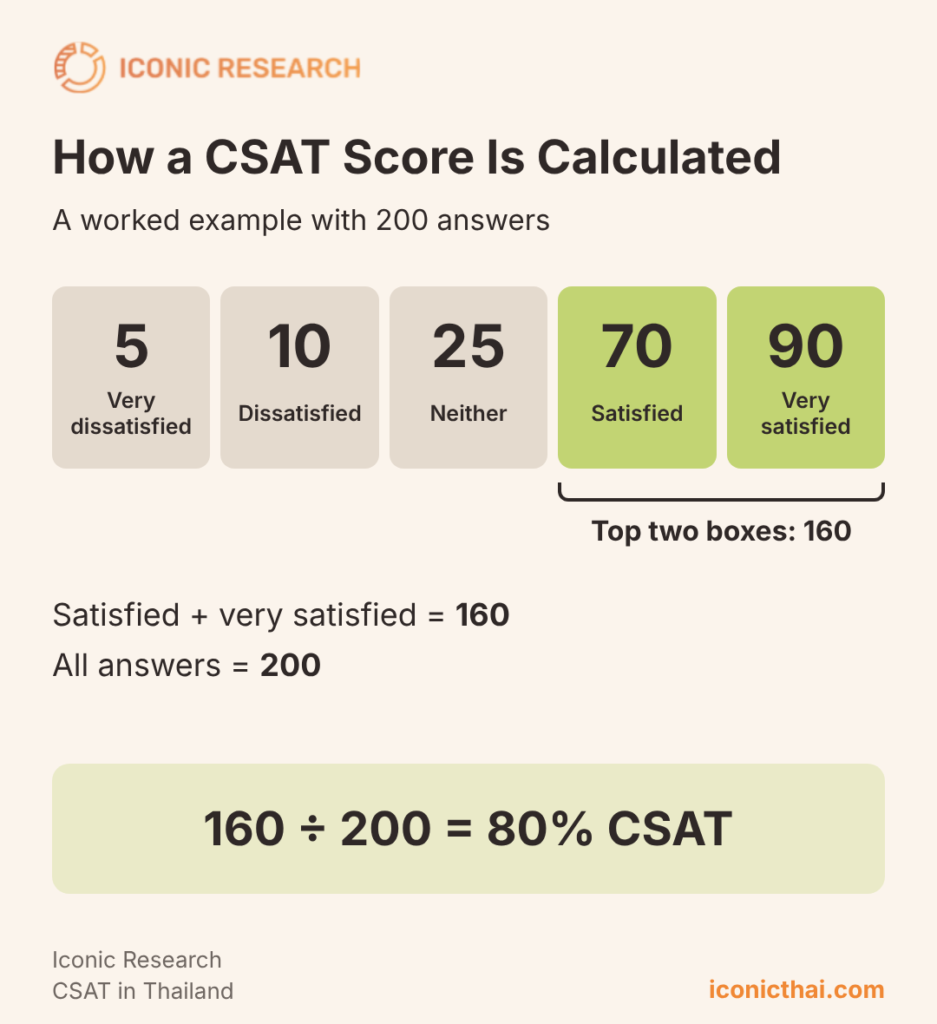
The same answers give an average of 4.15 out of 5 and a top-box score, “very satisfied” alone, of 45%. Research linking customer metrics to business results found that average satisfaction had the greatest predictive value and that top-two-box scores also predicted well [1]. In Thailand the top-box figure deserves a place in the report as well. When few customers use the bottom of the scale, most answers land on “satisfied” or “very satisfied”, and the split between those two is where differences between branches show.
CSAT vs NPS vs CES
The three customer satisfaction metrics answer three different questions.
- CSAT: “Were you satisfied?” It looks back at what just happened, and suits judging a touchpoint, a branch or a process.
- NPS: “Would you recommend us?” One question scored from 0 to 10, with detractors subtracted from promoters [2]. It describes the relationship and is the measure most often linked to customer loyalty.
- CES: “How much effort did it take?” It rests on evidence that in service contacts, reducing effort does more for loyalty than exceeding expectations [3]. It suits complaints, claims and problem-solving.
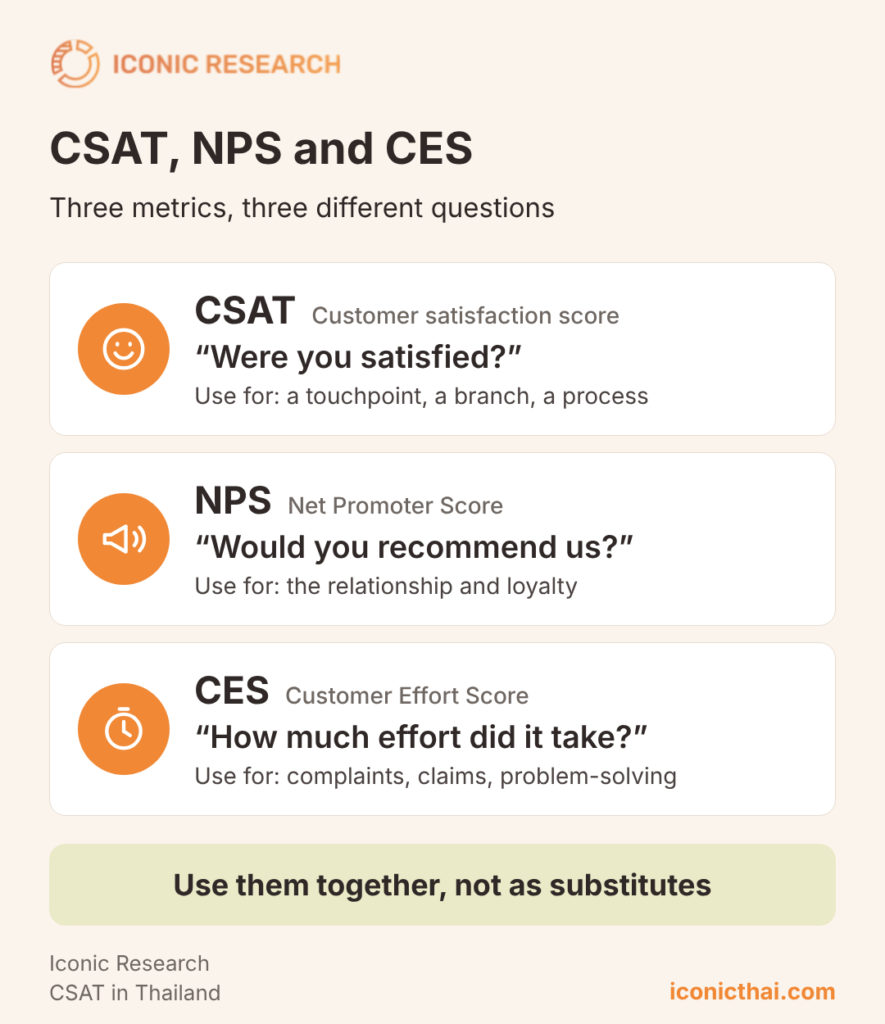
All three are affected by polite answering in Thailand. CES is affected least, because describing a process as difficult does not criticise a person, which makes it a useful check when CSAT looks too comfortable.
Reading CSAT in Thailand
A CSAT figure collected in Thailand cannot be read against one collected elsewhere. Response styles differ between countries: how readily people agree, and how far they use the ends of a scale, vary with culture, and the differences are large enough to distort comparison [4].
Polite answers inflate the score. Telling a service provider that one is dissatisfied is uncomfortable, so the bottom of the scale is used rarely and CSAT comes out high. A score should be judged by its movement and its rank among comparable units, not by its level.
Scale wording and question order matter. The Thai words chosen for each point decide how far apart “satisfied” and “very satisfied” feel. A satisfaction question asked after a series of positive statements scores higher than the same question asked first. Both have to be fixed and then left unchanged. The data collection guide covers the techniques.
Small samples should not be ranked. A provincial branch with a handful of answers can swing widely on the opinions of two or three customers. Scores from branches or provinces need a minimum sample before they are compared or put in a league table.
Benchmarks and survey design for Thailand are covered in the guide to running a CSAT survey.
Tracking CSAT Over Time
Because the level is inflated, the trend carries the information. CSAT and NPS are usually carried inside a tracking study: the same questions, asked of the same kind of sample, at regular intervals. Each wave is read against the one before, so a fall of a few points is visible as a fall.
A tracker in Thailand cuts the score by touchpoint, by segment, and by Bangkok against the provinces, where service is delivered through different branches, dealers and staff. The design has to stay constant: a change of scale, wording or channel moves the score by itself and breaks the trend. Many companies run satisfaction inside a brand health tracking programme for that reason.
What to Do When CSAT Drops
CSAT says that satisfaction fell. It does not say why, and Thai customers often will not say why either.
- Check the measurement. Confirm that the question, scale, channel and sample match the last wave.
- Locate the fall. A drop confined to one branch is a management problem. A drop across the network points to policy, price or product.
- Find the cause. Follow-up interviews run by an outside party get franker answers than a call from the company. Mystery shopping shows what staff do at the counter, which customers, out of politeness, leave unreported.
- Re-measure on the same design.
CSAT is a simple number built on several choices: which moment was asked about, who asked, which scale was used and how the score was counted. In Thailand the level matters less than the trend, the gap between branches, and the share of customers who are very satisfied.
Iconic Research runs customer satisfaction studies and tracking programmes across Thailand. To discuss measuring CSAT for your organisation, see our quantitative research service.
Frequently Asked Questions
What does CSAT stand for?
CSAT stands for customer satisfaction score. It is the percentage of customers who say they are satisfied with an interaction or with a company overall.
How is a CSAT score calculated?
Divide the number of customers who answered "satisfied" or "very satisfied" by the total number of answers, then multiply by 100. If 160 of 200 customers chose one of those two answers, the CSAT score is 80%.
What is the difference between CSAT and NPS?
CSAT measures how satisfied customers were with something that has happened. NPS measures how likely they are to recommend the company, which describes the relationship and future loyalty.
What is a good CSAT score?
There is no single number that is good everywhere. CSAT depends on the industry, the scale, the wording, the survey channel and the culture, so a good score is one that is rising against the company's own earlier waves and above comparable branches or competitors measured the same way.
How often should CSAT be measured?
Transactional CSAT is collected continuously, after each interaction. Relationship CSAT is usually measured at fixed intervals inside a tracking study, on the same design each time.
References
[1] Morgan, N. A., & Rego, L. L. (2006). The Value of Different Customer Satisfaction and Loyalty Metrics in Predicting Business Performance. Marketing Science, 25(5), 426–439. https://doi.org/10.1287/mksc.1050.0180
[2] Reichheld, F. F. (2003). The One Number You Need to Grow. Harvard Business Review. https://hbr.org/2003/12/the-one-number-you-need-to-grow
[3] Dixon, M., Freeman, K., & Toman, N. (2010). Stop Trying to Delight Your Customers. Harvard Business Review. https://hbr.org/2010/07/stop-trying-to-delight-your-customers
[4] Harzing, A.-W. (2006). Response Styles in Cross-national Survey Research: A 26-country Study. International Journal of Cross Cultural Management, 6(2), 243–266. https://doi.org/10.1177/1470595806066332
[5] Phonthanukitithaworn, C., & Sellitto, C. (2016). A Reflection on Intercept Survey Use in Thailand: Some Cultural Considerations for Transnational Studies. Electronic Journal of Business Research Methods, 14(1), 60–70. https://academic-publishing.org/index.php/ejbrm/article/view/1341
If you wish to quote any information from this article, please kindly cite the source along with the link to the original article to respect copyright. |
 |
Iconic Research Thailand Your trusted partner in market research and consulting across Thailand and Southeast Asia. Headquartered in Bangkok, we provide research-driven insights across the Philippines, Malaysia, Indonesia, Singapore, Laos, and Vietnam. We help businesses navigate Thailand's market complexities through consumer insights, market entry strategy, and trend foresight. Contact us if you have any queries! (+66)888 954 954 |
Related Resources
- Customer Satisfaction Survey: how to design and run the survey in Thailand
- Customer Experience: strategy and measurement
- Customer Loyalty: what satisfaction does and does not predict
- Touchpoint: mapping where customers meet the brand
- Data Collection: methods, and how to counter polite answering
Contact us
We always looking for new and exciting opportunities. Let’s connect.
Related posts
 Employee Engagement: What It Is and How to Measure It in Thailand
Employee engagement is the degree to which people put their energy, attention and commitment into their work. This guide explains how an employee engagement survey measures it, and why kreng jai, hierarchy and doubts about anonymity make honest answers hard to collect in a Thai workplace.
10 min read Brand Perception in Thailand: What Shapes It and How to Measure It
Brand perception is the judgment buyers form about a brand from everything they know, hear and experience of it. This guide explains what shapes brand perception in Thailand, how it is measured by segment and region, and why perception and willingness to pay must be read separately.
10 min read Usability Testing: Methods, Metrics and How It Works in Thailand
How usability testing works, which methods and metrics to use, and what changes when the users are Thai.
11 min read