

Employee Engagement: What It Is and How to Measure It in Thailand
10 min readEmployee engagement is the degree to which people put their energy, attention and commitment into their work and their organisation. It differs from job satisfaction, which describes contentment with conditions, and from employee experience, which is what the company provides. Engagement is measured with an employee engagement survey that covers outcome questions, drivers such as the manager, growth and recognition, and often eNPS. In Thailand, kreng jai, respect for hierarchy and doubts about anonymity push staff towards polite answers, so surveys work best when an independent third party runs them, in Thai, with a minimum group size for reporting.
Table of Contents
- What Is Employee Engagement?
- Employee Engagement vs Employee Experience
- Employee Engagement Survey: What It Measures
- eNPS
- Measuring Employee Engagement in Thailand
- From Survey to Action
- References
- Related Resources
Employee engagement is the degree to which people put their energy, attention and commitment into their work and their organisation. Managers usually believe they know how engaged their teams are, because nobody has told them otherwise. In a Thai workplace that silence means little. Staff rarely raise problems with a superior unprompted, and a team that looks content can be quietly looking for other jobs. Engagement therefore has to be measured, and measured in a way that lets people answer frankly.
What Is Employee Engagement?
The concept comes from Kahn, who described engaged people as those who bring themselves physically, cognitively and emotionally into their work roles. He found they do so when three conditions are met: the work feels meaningful, they feel safe to be themselves, and they have the energy available [1]. The second condition matters most for measurement, because the same sense of safety decides whether a person will answer a survey frankly.
Employee engagement is often confused with satisfaction. The research literature treats engagement as a psychological state, distinct from job quality or from what management does [2]. A satisfied employee is content with pay, hours and conditions. An engaged employee cares about the result and puts in effort nobody asked for. The two can come apart: a person can be comfortable, loyal to colleagues and satisfied with the benefits, and still do only what the job description requires.
This is why an employee satisfaction survey and an engagement survey are different instruments. The first asks whether people are content with what they receive. The second asks whether they are committed, whether they would stay, and what is helping or holding them back. In Thailand the first kind tends to return comfortable scores, since saying one is satisfied is the polite answer.
Employee Engagement vs Employee Experience
Employee experience is what the organisation provides. Employee engagement is how people respond to it.
Experience is usually mapped along the employee journey: hiring, onboarding, daily work, development, promotion and exit. At each stage the company makes choices about tools, training, managers and policies. Those choices are within its control, in the same way that a company designs the customer experience it offers buyers.
Engagement is the result, and it is not within the company’s direct control. Two people can pass through the same employee journey and end up with different levels of commitment. Measuring engagement shows which parts of the experience are working, for whom, and which are quietly losing people. In Thai companies the journey often differs sharply between head office and provincial or factory sites, so a single company-wide picture hides the stages where one group is being lost.
Employee Engagement Survey: What It Measures
Surveys remain the most direct way to measure engagement. They predict behaviour such as resignation, they give staff a channel to be heard, and the act of asking can itself change behaviour [3].
An employee engagement survey has two layers.
Outcome questions measure the level of engagement itself: pride in the organisation, intention to stay, willingness to recommend it, and readiness to put in extra effort.
Driver questions measure what explains that level. The usual set covers six areas: the manager, growth, recognition, workload, purpose and voice.
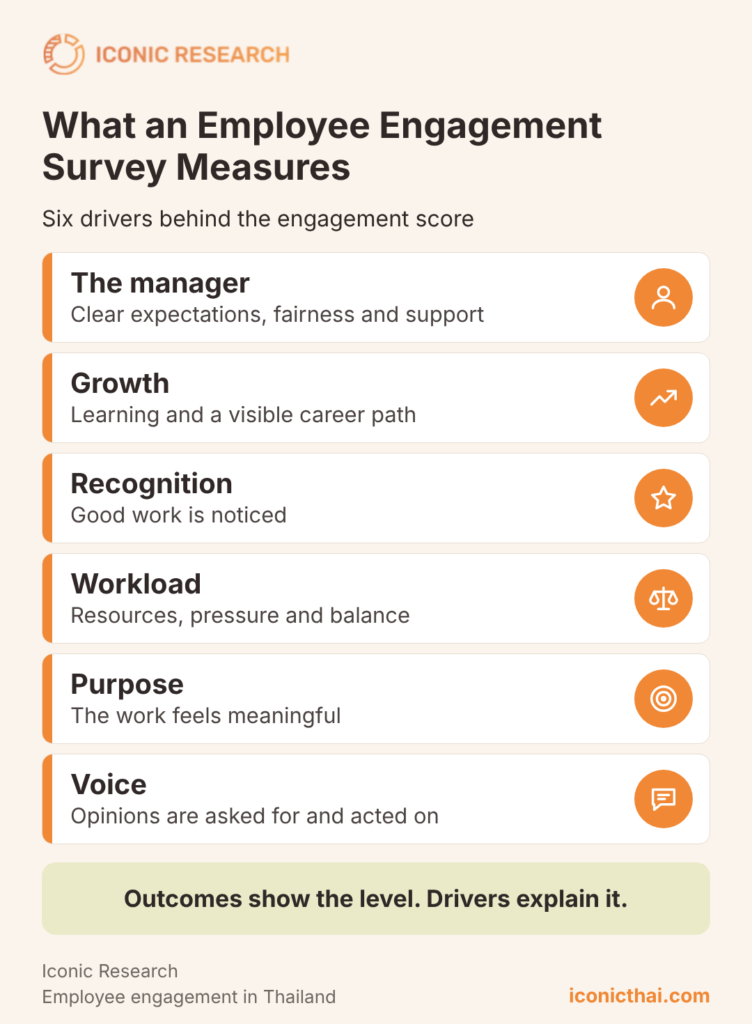
These overlap with the areas the best-known commercial instruments cover [2]. In a Thai workplace the manager questions carry the most weight and are the hardest to answer frankly, a point the section on Thailand returns to.
Frequency. An annual survey gives a full reading on a fixed design, which makes year-on-year comparison possible. Pulse surveys are short, run more often, and track a few items between the annual rounds. Most organisations use both: the annual employee survey for depth, the pulse for direction.
eNPS
The Employee Net Promoter Score adapts a customer loyalty measure to staff. Its origin is a single question about willingness to recommend, proposed as a simple predictor of growth [4]. The customer satisfaction survey guide covers the customer version.
The question. “How likely are you to recommend this organisation as a place to work?” Answers run from 0 to 10.
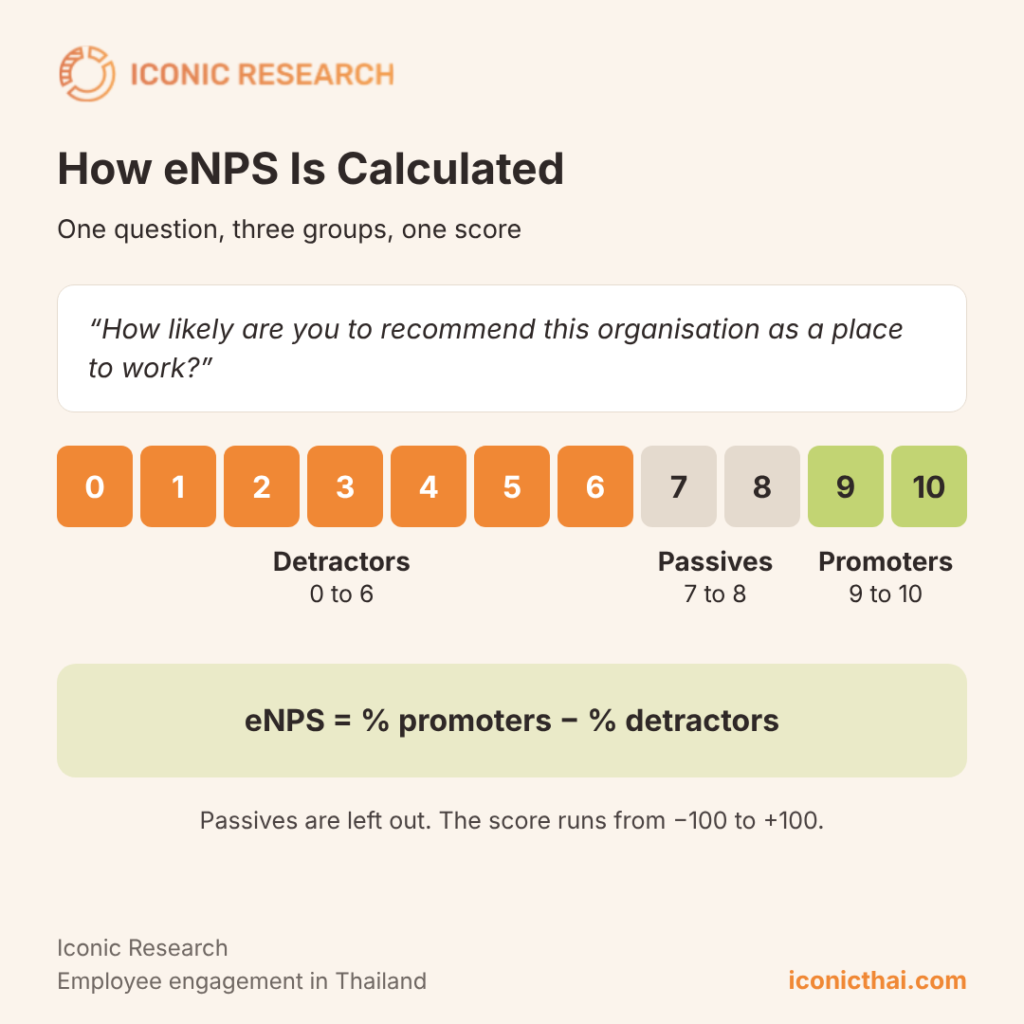
What it cannot tell you. eNPS is one number from one question. It shows direction over time, and it is easy to explain to a board. It does not say why the score is what it is, which teams are behind it, or what to change. It also travels badly between cultures. Where respondents avoid low ratings out of politeness, scores bunch in the middle and upper range, so a Thai eNPS should be compared with its own earlier waves and not with a foreign benchmark.
Measuring Employee Engagement in Thailand
A questionnaire translated from a global template will run in Thailand without visible problems and return results that look healthy. The difficulty is in how far those results can be trusted. Six points decide it.
Kreng jai and hierarchy. Kreng jai, the reluctance to cause another person discomfort, combines with respect for seniority to make staff unwilling to rate a manager critically. Research on employee voice that included Thai employees found that national culture, power distance included, shapes whether people speak up at work [5]. The guide to Thai culture and behavior explains the norm.
Polite answers inflate scores. Thai respondents are considerate of whoever is asking [6]. On agreement scales this produces acquiescence bias: agreement is over-reported and criticism softened. Question wording, scale design and the mix of positively and negatively phrased items have to be planned to counter it, as the data collection guide describes.
Anonymity. When HR runs the survey on the company’s own system, staff assume their answers can be traced, and many answer accordingly. This is the main case for an independent third party: responses are collected and held outside the company, and the employer receives only grouped results.
Minimum group size. Results for any team or department are reported only when enough people have answered that no individual can be identified. Smaller groups are merged into the level above. Staff should be told this before they answer.
Different modes for different staff. Head-office employees can answer online. Provincial, retail and factory staff often have no company email or desk, and need paper or tablet completion on site, in a setting where supervisors are not present. A market survey that mixes modes needs the same questions in the same order in each.
Thai-language questionnaire, tested first. The questionnaire should be written in Thai, not translated line by line, and tested with a small group of employees before launch. Terms such as “engagement” and “recognition” have no single Thai equivalent, and a test shows whether staff read each question as intended.
From Survey to Action
Scores show where engagement is low. They do not explain it.
- Explain the scores. Follow-up focus groups or in-depth interviews, run by an outside moderator, bring out the reasons behind a low result. In a Thai setting, one-to-one interviews usually produce franker answers than groups in which colleagues or seniors are present.
- Find the drivers. Driver analysis shows which factors move the outcome questions most, separately for each group of staff. The driver for head-office staff is often not the driver for the factory.
- Act on a short list. Two or three changes that staff can see are worth more than a long plan.
- Re-measure on the same design. The same questions, scales and groups in the next round show whether the changes worked.
Staff who are surveyed and then see nothing change answer the next survey less frankly, or not at all.
Employee engagement in Thailand can be measured as reliably as anywhere else, provided the survey is built for how Thai employees answer: independently run, in Thai, with protected anonymity and the right mode for each group of staff.
Iconic Research runs employee engagement surveys in Thailand as an independent third party, online and on site. To discuss a survey for your organisation, see our quantitative research service.
Frequently Asked Questions
What is employee engagement?
Employee engagement is the degree to which people put their energy, attention and commitment into their work and their organisation. It is different from satisfaction, which only describes contentment with pay and conditions.
What is the difference between employee engagement and employee experience?
Employee experience is what the company provides across the employee journey, from hiring to exit. Employee engagement is how people respond to that experience.
What is an employee engagement survey?
An employee engagement survey measures how committed staff are and what drives that commitment, such as the manager, growth, recognition and workload. In Thailand it works best when an independent third party runs it and anonymity is protected.
What is eNPS?
eNPS, the Employee Net Promoter Score, comes from one question: how likely staff are to recommend the organisation as a place to work, on a scale of 0 to 10. The score is the percentage of promoters minus the percentage of detractors.
How often should employee engagement be measured?
Most organisations run a full employee engagement survey once a year and shorter pulse surveys in between. The annual survey should keep the same design each time so results can be compared.
References
[1] Kahn, W. A. (1990). Psychological Conditions of Personal Engagement and Disengagement at Work. Academy of Management Journal, 33(4), 692–724. https://doi.org/10.5465/256287
[2] CIPD. Employee engagement and motivation: factsheet. https://www.cipd.org/en/knowledge/factsheets/engagement-factsheet/
[3] Judd, S., O’Rourke, E., & Grant, A. (2018). Employee Surveys Are Still One of the Best Ways to Measure Engagement. Harvard Business Review. https://hbr.org/2018/03/employee-surveys-are-still-one-of-the-best-ways-to-measure-engagement
[4] Reichheld, F. F. (2003). The One Number You Need to Grow. Harvard Business Review. https://hbr.org/2003/12/the-one-number-you-need-to-grow
[5] McKearney, A., Prouska, R., Tungtakanpoung, M., & Opute, J. (2022). The influence of national culture on employee voice in small and medium enterprises: a cross-cultural perspective. Employee Relations, 45(2), 478–494. https://openresearch.lsbu.ac.uk/item/9251v
[6] Phonthanukitithaworn, C., & Sellitto, C. (2016). A Reflection on Intercept Survey Use in Thailand: Some Cultural Considerations for Transnational Studies. Electronic Journal of Business Research Methods, 14(1), 60–70. https://academic-publishing.org/index.php/ejbrm/article/view/1341
If you wish to quote any information from this article, please kindly cite the source along with the link to the original article to respect copyright. |
 |
Iconic Research Thailand Your trusted partner in market research and consulting across Thailand and Southeast Asia. Headquartered in Bangkok, we provide research-driven insights across the Philippines, Malaysia, Indonesia, Singapore, Laos, and Vietnam. We help businesses navigate Thailand's market complexities through consumer insights, market entry strategy, and trend foresight. Contact us if you have any queries! (+66)888 954 954 |
Related Resources
- Customer Experience: strategy and measurement, the customer-side parallel
- Customer Satisfaction Survey: CSAT, NPS and CES explained
- Market Survey: survey types and modes for Thailand
- Data Collection: methods, and how to counter polite answering
- Thai Culture and Behavior: kreng jai and the norms behind it
- Focus Group Discussion: when groups work and when interviews work better
Contact us
We always looking for new and exciting opportunities. Let’s connect.
Related posts
 CSAT: What the Customer Satisfaction Score Measures and How to Read It
CSAT, the customer satisfaction score, is the share of customers who say they are satisfied with an interaction or with a company overall. This guide explains how the CSAT score is calculated, how it differs from NPS and CES, and how to read it in Thailand, where polite answers push scores up.
8 min read Brand Perception in Thailand: What Shapes It and How to Measure It
Brand perception is the judgment buyers form about a brand from everything they know, hear and experience of it. This guide explains what shapes brand perception in Thailand, how it is measured by segment and region, and why perception and willingness to pay must be read separately.
10 min read Usability Testing: Methods, Metrics and How It Works in Thailand
How usability testing works, which methods and metrics to use, and what changes when the users are Thai.
11 min read